
A Practical Guide to Commercial Gas Griddles
If you’ve ever peeked behind the pass of a busy professional kitchen, you've probably seen a commercial gas griddle in action. It's the tireless workhorse of the line, handling everything from the morning pancake rush to searing off steaks for the dinner service. This isn't just a slab of hot steel; it's a profit-generating machine that delivers consistent results, ticket after ticket.
Why the Gas Griddle Is Your Kitchen's MVP
Picture a classic diner slammed on a Sunday morning. On one end of the griddle, a cook is flipping stacks of perfectly golden pancakes. Just a few feet away, another is getting a beautiful sear on burger patties. That’s the magic of a commercial gas griddle in a nutshell—it's the adaptable, high-output heart of any serious cooking line.
This guide is going to skip the dry, textbook definitions. Instead, we’re going to get into the nitty-gritty of how this essential tool helps chefs knock out quality food at speed, making it a true cornerstone of any successful kitchen. Really understanding your griddle is the first step toward running a smoother, more profitable operation.
The Powerhouse of Professional Kitchens
There's a reason pros overwhelmingly choose gas. Gas griddles are famous for heating up fast, allowing for instant temperature changes, and bringing the raw power you need to keep up when the tickets just don't stop coming. Their dominance in the market isn't an accident; it's a testament to their value in the toughest environments.
Commercial gas griddles are the backbone of professional kitchens everywhere. The global market for these units is projected to hit around USD 576.4 million in 2025, and gas-powered models make up the lion's share at 55.2% of all sales.
This isn't just a trend. It's driven by the real-world needs of busy restaurants, hotels, and food trucks that can't afford to slow down. You can dig deeper into the commercial griddle market data on futuremarketinsights.com.
So, what does that mean for your daily grind? A commercial gas griddle gives you some serious advantages:
- Cook Almost Anything: You can have delicate eggs, hashbrowns, and thick burgers all cooking at the same time on one surface. No need to juggle a half-dozen different pans and burners.
- Instant Heat Control: Gas gives you immediate response. When you turn the knob, the temperature changes now, giving your cooks the fine-tuned control needed to avoid burning or undercooking during a hectic service.
- Built for Volume: These things are designed to take a beating. They maintain consistent heat even when you load them up with cold food, ensuring every dish comes out right, from the first order to the last.
By mastering this one piece of equipment, a kitchen can seriously ramp up its speed and consistency, which translates directly to happier customers and a healthier bottom line.
Translating Griddle Specs Into Real-World Performance
Looking at a spec sheet for a new commercial griddle can feel like trying to read another language. You’ll see terms like BTUs, plate thickness, and thermostatic controls, but what do those numbers actually mean when the tickets are flying on a busy Saturday night?
Let's cut through the jargon. Think of choosing a griddle like building the engine for your kitchen's production line. Every spec plays a vital role in how that engine performs under pressure. Get it right, and you're looking at faster cook times, consistent food quality, and a much happier line cook.
Understanding BTU: The Horsepower of Your Griddle
The British Thermal Unit (BTU) is usually the first number people look for, and for good reason. It’s a direct measure of heat output. Put simply, more BTUs mean more raw power—it's the horsepower of your griddle.
A high BTU rating means your griddle heats up fast and, more importantly, recovers its temperature quickly. Imagine dropping a dozen frozen burger patties on the flat top. A low-power griddle will instantly lose heat and struggle to get back up to searing temperature, leaving your burgers to steam instead of sizzle. A high-BTU unit, on the other hand, powers through that thermal shock and is ready for the next order in no time.
For any serious, high-volume operation, a griddle with at least 30,000 BTUs per burner is the baseline. This ensures the unit can handle a continuous rush without dropping temperature and slowing down the whole kitchen.
This power directly ties into your kitchen's overall efficiency and profitability, as you can see below.

As the diagram shows, the right specs don't just cook food faster; they make your entire operation more versatile and profitable.
Griddle Plate Thickness: Your Heat Reservoir
If BTUs are the griddle’s horsepower, then the plate thickness is its flywheel. A thicker plate acts like a thermal battery, storing up heat and distributing it evenly across every square inch of the cooking surface. This is absolutely critical for consistency.
A thin plate (around 1/2-inch) heats up fast, but it also loses that heat just as quickly. It's fine for light-duty work like warming tortillas or cooking a few eggs. But a heavy-duty, 1-inch steel plate holds a massive amount of thermal energy. It gives you incredible temperature stability, even when you're slamming it with cold product all day long.
That stability is what prevents hot and cold spots, giving you that perfect, edge-to-edge golden-brown finish on pancakes instead of a burnt-on-the-outside, raw-in-the-middle disaster.
To help you decide, here's a quick breakdown of how plate thickness impacts performance.
Griddle Plate Thickness and Best Use Cases
| Plate Thickness | Heat Retention | Recovery Time | Best For |
|---|---|---|---|
| 3/4-inch | Good | Faster | Diners, breakfast spots, and general-purpose cooking. Great for eggs, pancakes, and bacon. |
| 1-inch | Excellent | Slower | High-volume kitchens, steakhouses, and burger joints. Ideal for searing meat and cooking from frozen. |
Ultimately, a thicker plate is a professional's best friend for maintaining quality during the busiest rushes.
Control Types: Manual vs. Thermostatic
How you manage all that heat comes down to your controls. The two main options offer different levels of precision, kind of like the difference between driving a manual car and an automatic.
-
Manual Controls (Good/Better): These are your classic "low, medium, high" knobs. You're in direct control of the flame, much like a gas pedal. They are incredibly durable, simple to operate, and fantastic for hardy items like burgers and cheesesteaks where you just need raw power.
-
Thermostatic Controls (Best): This is the cruise control for your griddle. You set a precise temperature—say, 350°F—and the griddle automatically cycles the burners on and off to hold it there. This level of precision is non-negotiable for delicate foods like fish, seafood, and eggs.
Modern kitchens are definitely leaning toward more precise temperature management. In fact, around 46% of new griddle models now include thermostatic controls, showing a clear industry shift toward efficiency and consistency. You can check out more about commercial griddle market trends on businessresearchinsights.com.
Matching Griddle Size to Kitchen Volume
Finally, you have to choose the right width. Commercial gas griddles come in standard sizes from 24 inches up to 72 inches. Picking the right one is all about balancing your menu needs with the physical space you have in your kitchen.
A compact 24-inch griddle is a perfect fit for a food truck or a small café with a limited menu. But if you're a busy diner flipping hundreds of pancakes an hour, you'll need the cooking real estate of a 48-inch or even a 72-inch model to keep up. A wider griddle also lets you set up different heat zones—a screaming hot zone for searing steaks and a cooler zone for holding hash browns, all on one surface.
By looking past the numbers and understanding how these key specs translate to real-world performance, you can confidently choose a griddle that will be a true workhorse for your business.
Fueling Your Griddle and Installing It for Safety
Alright, you've picked out the griddle with the right specs for your menu. Now for the really important part: getting it hooked up and running safely. This isn't like plugging in a toaster; it's a serious step that involves choosing the right fuel and following strict safety codes.
Getting this right affects your daily costs, how your kitchen flows, and most importantly, keeps your crew safe.
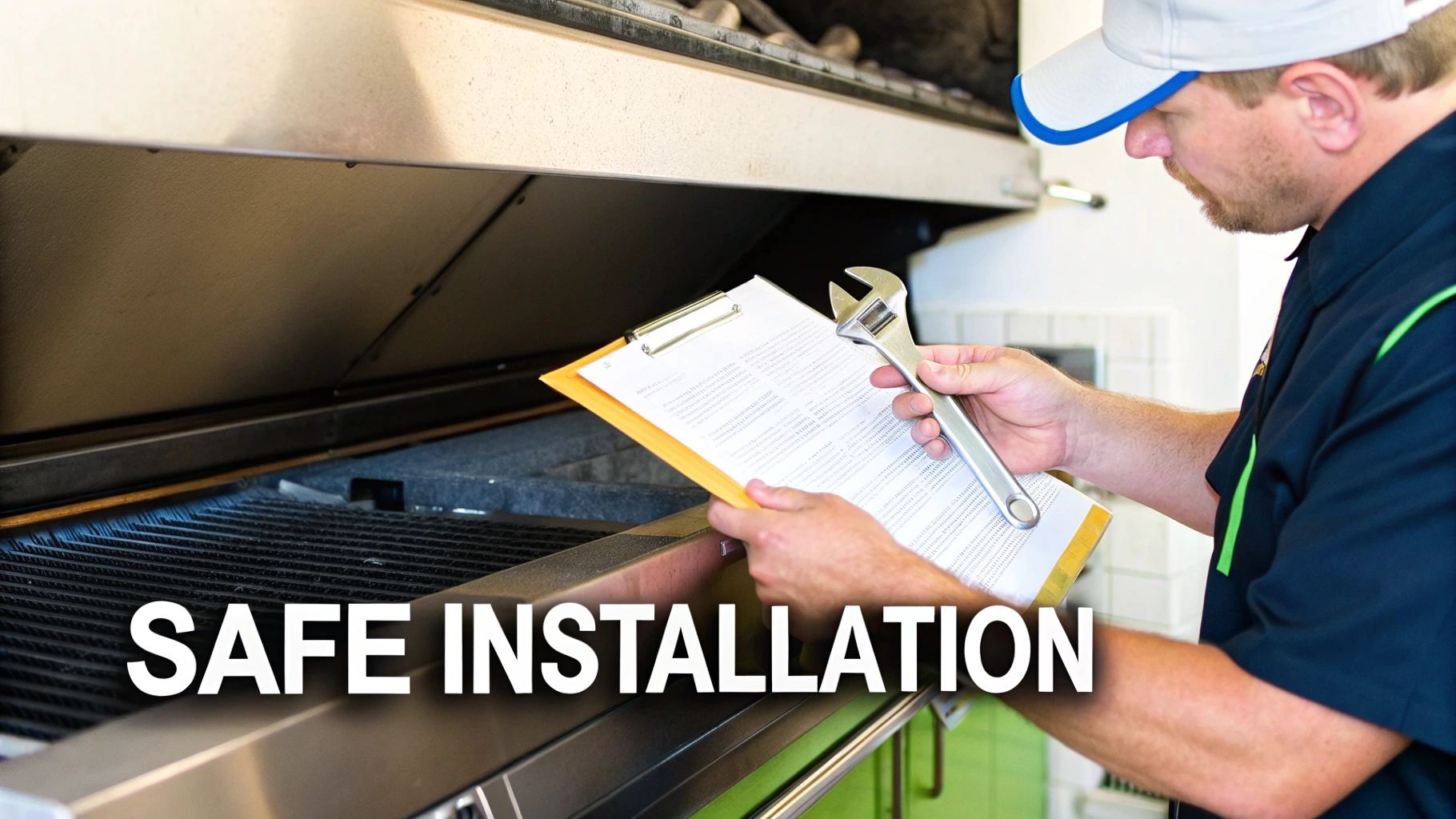
Let's walk through the fuel decision—natural gas versus propane—and why proper ventilation is something you absolutely cannot skip.
Choosing Your Fuel Source: Natural Gas vs Propane
Your first big choice is the fuel: natural gas (NG) or liquid propane (LP). Think of it this way: natural gas is like being connected to the city's power grid, while propane is like having your own powerful generator. Both work great, but how you get them and what they cost are very different.
Natural gas is the go-to for most restaurants. It comes straight from a utility line into your building, so you never have to worry about running out. It's also usually the more affordable option. If your building has a gas hookup, NG is almost always the way to go.
Liquid propane is your fuel for freedom. It’s stored in tanks you can take anywhere, making it the only real choice for food trucks, caterers, or any pop-up operation. LP might cost a bit more per unit of energy, but you can't beat the flexibility. For a deeper dive, check out our guide to natural gas vs. propane.
What’s a Gas Conversion Kit?
So you found the perfect griddle, but it's set up for natural gas and you're running a food truck on propane. No problem. That's what a gas conversion kit is for. Most modern commercial gas griddles are "field convertible," which just means a certified tech can swap the fuel type right there in your kitchen.
A conversion kit has parts like new orifices and a different regulator to handle the pressure change between gas types. Never try to run a griddle on the wrong fuel without converting it. It’s incredibly dangerous and can damage the unit, cause a fire, or worse.
The good news? Most models from Griddles.com ship with the conversion kit included, so you have options. Just make sure the conversion is done by a licensed pro—it's required for safety and to keep your warranty valid.
Ventilation Isn't Optional
I can't stress this enough: proper ventilation is a non-negotiable legal and safety requirement. A commercial griddle pumps out a ton of heat, smoke, greasy air, and nasty combustion gases like carbon monoxide. You need a commercial-grade hood system to pull all that stuff out of your kitchen.
Without it, you’re looking at:
- Serious health problems for your staff from breathing in bad air.
- A major fire risk from all the grease building up in your ducts.
- Failed health inspections that could shut you down.
Make sure your ventilation hood is bigger than your griddle, extending past the edges to catch everything. Every city has strict codes for this, so get an HVAC professional involved early in your planning.
Your Essential Installation Checklist
Don't rush the install. Taking your time here will save you from huge headaches and dangerous situations down the road. Use this as your guide.
- Check Clearances: Your griddle needs breathing room. Look at the spec sheet for the required space between the unit and walls, especially anything combustible. This prevents heat buildup and potential fires.
- Get It Level: An unlevel griddle is a mess. It won't cook evenly, and grease won't drain correctly into the catch tray. Use a level and adjust the legs until it's perfect.
- Hire a Pro for the Gas Line: This is not a DIY job. A licensed plumber or gas fitter has to make the final connection. They'll ensure it's leak-free and up to code with the right connectors and shut-off valves.
- Season It First: Before you cook a single burger, you have to season the griddle plate. This means cleaning off the protective oil from the factory, then heating it with a thin layer of cooking oil. This creates a natural non-stick surface that prevents rust and makes the griddle a dream to cook on.
Mastering Heat Management for Consistent Cooking
Anyone can crank the knobs on a griddle, but real pros know that amazing food comes from mastering the heat across every inch of that flat-top. It's about turning a simple piece of steel into a flexible, multi-tasking workhorse that can pump out order after order without breaking a sweat.
We're going to get into the nuts and bolts of how you can become the master of your commercial gas griddle. You'll learn how to set up dedicated cooking zones, hunt down and eliminate those annoying hot spots, and see firsthand how the metal itself changes the game. This is the stuff that lets you fly through a dinner rush with total confidence.
Creating Strategic Cooking Zones
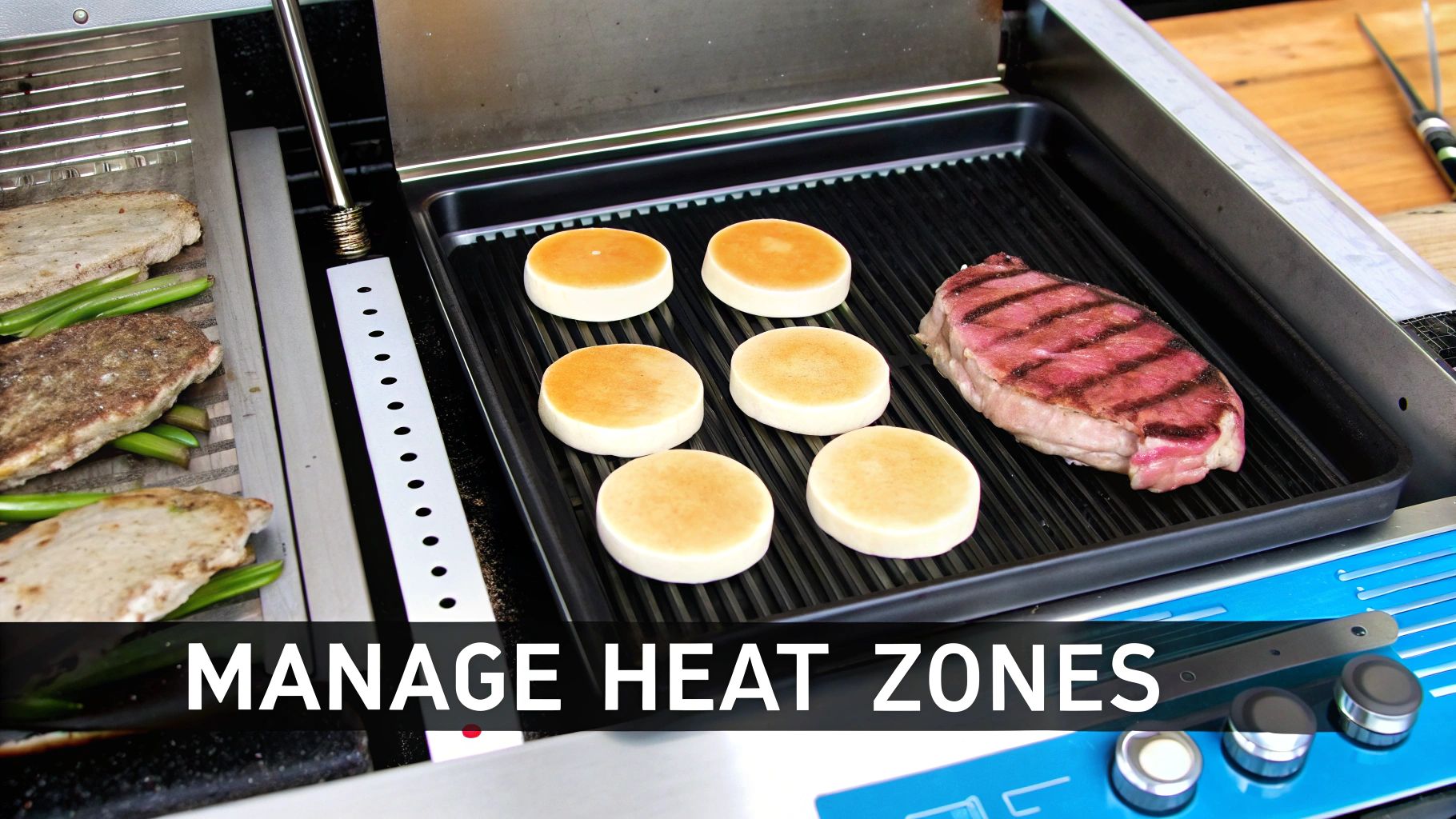
Think of your griddle surface like real estate—you want to get the most value out of every square inch. Instead of blasting the whole thing at one temperature, smart cooks create different heat zones to handle different jobs all at once. This is where a bigger griddle, like a 48-inch or 72-inch model, really starts to pay for itself.
With separate burner controls, you can set up a screaming-hot sear zone on one side, a steady cooking zone in the middle, and a gentle warming zone on the other. For instance, you could be putting a beautiful crust on a steak at 450°F, cooking burger patties all the way through at 375°F, and holding toasted buns at 200°F—all on the same surface, at the same time.
This zoning technique is an absolute game-changer for kitchen efficiency. A single cook can manage an entire plate without running back and forth, which shaves precious seconds off ticket times when you're in the weeds.
Getting your zones dialed in takes a little practice. Grab an infrared thermometer and get to know your griddle's personality. Map out the surface, find the hot spots, and learn how it behaves. The areas right over the burners are always going to be the hottest, so use that to your advantage.
Identifying and Eliminating Hot Spots
Hot spots are the sworn enemy of a consistent product. They're tiny, super-heated areas on the griddle plate that will burn one side of a pancake while leaving the other pale and doughy. This is usually caused by the burner layout or a griddle plate that's just too thin.
The number one defense against hot spots is a thick griddle plate—we're talking 3/4-inch to 1-inch thick. A beefy plate soaks up and spreads the heat from the burners much more evenly, smoothing out those temperature peaks and valleys. It acts as a buffer, giving you a far more predictable cooking surface.
Your control system also plays a huge role. Manual controls are simple and tough, but they put the burden of managing temperature on you. A thermostatic griddle, on the other hand, has built-in sensors that cycle the burners on and off automatically to hold a precise temperature. This is a massive help in fighting hot spots. You can learn more about how they deliver rock-solid temperature control in our guide on the benefits of a thermostatic griddle.
How Plate Material Impacts Heat and Cleanup
The type of metal your griddle plate is made from has a huge effect on performance and maintenance. The two main choices have very different personalities in the kitchen.
- Standard Steel Plates: This is the classic, old-school workhorse. Steel is fantastic at soaking up and holding onto heat, which is exactly what you want for high-volume searing. The trade-off? It's more reactive and needs careful seasoning to build up that non-stick layer and keep rust away. It also throws off more heat, making the cook line a bit toastier.
- Polished Chrome Plates: A chrome top is a whole different animal. The super-smooth surface transfers heat directly into the food with incredible efficiency, not into the air. That means faster cooking, quicker recovery times between orders, and a much cooler kitchen. It's also a breeze to clean and doesn't need seasoning. The catch is the higher upfront price tag.
So which one is for you? It really comes down to your menu and priorities. If you're a steakhouse that lives and dies by the sear, that thick steel plate might be your best friend. But if you're a busy breakfast joint slinging delicate eggs and pancakes, the even heat and easy cleanup of chrome could be a lifesaver.
Choosing the Right Griddle for Your Business
Picking the right commercial gas griddle isn't about grabbing the biggest, most powerful model off the shelf. It’s about making a smart match for your kitchen, your menu, and your daily grind.
Think about it: the griddle that works wonders in a high-volume diner slamming out hundreds of burgers would be complete overkill for a cozy food truck. This is where you connect the dots between your operation and the griddle’s specs. When you build a clear profile of your business, you start to see how specific features solve your real-world problems. Let’s break down how different kitchens can find their perfect griddle.
The High-Volume Diner or Restaurant Profile
For any busy restaurant, especially one that lives and dies by its breakfast rush or steak night, the griddle is the undisputed king of the cook line. The game here is all about speed, consistency, and the raw power to handle ticket after ticket without breaking a sweat.
You need a griddle built for a marathon, not a sprint.
- Size Matters: You'll want a 48-inch to 72-inch model, period. This massive surface lets your cooks create different heat zones—searing steaks on one end while gently warming veggies on the other—all on one machine.
- Thick Plate for Thermal Stability: A 1-inch thick steel plate is non-negotiable. This heavy-duty plate acts like a heat battery, soaking up energy so it doesn't flinch when you drop a dozen frozen patties on it. Every single burger gets that perfect crust.
- High BTUs for Rapid Recovery: Look for models pushing at least 30,000 BTUs per 12-inch section. This is the horsepower that gets the griddle hot fast and, more importantly, keeps it hot when you're in the weeds.
This trifecta of size, thickness, and power is what keeps a high-volume spot running smoothly through the craziest rushes.
The Mobile Kitchen and Food Truck Profile
In a food truck, space and flexibility are everything. Every square inch of counter is prime real estate, and your gear has to be tough and adaptable enough for life on the road. Your griddle choice has to match that lean, agile mindset.
Here, it all comes down to a compact footprint and the right fuel.
The go-to choice for virtually every mobile kitchen is a countertop commercial gas griddle running on liquid propane (LP). Propane delivers the high-heat muscle you need for pro-level cooking without being chained to a natural gas line. It’s total freedom.
Key features for any mobile setup include:
- Compact Footprint: A 24-inch to 36-inch countertop griddle gives you enough cooking real estate without eating up your whole prep area.
- Propane Fuel: As mentioned, LP is a must. Make sure the unit is either set up for propane from the factory or includes a simple field conversion kit.
- Durable Construction: A solid stainless steel body is critical. It has to be able to handle the bumps and vibrations that come with being on the move.
For a food truck, the griddle has to be a compact beast, delivering restaurant-grade food from a shoebox-sized kitchen.
The Specialized Cafe and Breakfast Spot Profile
Cafes and breakfast joints play a different game. The volume can still be high, but the menu often leans on more delicate items—think eggs, pancakes, and crepes. Here, a perfect, edge-to-edge golden-brown finish is way more important than a hard, ripping sear.
For these kitchens, precision temperature control is the name of the game.
- Thermostatic Controls: This is your most important feature. The ability to dial in and hold a precise temperature (say, 350°F) is what ensures delicate foods cook perfectly every time without scorching. It’s all about consistency.
- Medium-Duty Plate: A 3/4-inch plate hits the sweet spot. It holds heat well enough for a rush but is also responsive enough to temperature changes, unlike a massive 1-inch plate.
This focus on fine-tuned control is what allows a great cafe to build a reputation for beautiful, delicious food that keeps people coming back.
To make it even easier, here’s a quick-glance table to help you match your business type to the right griddle features.
Commercial Gas Griddle Feature Checklist by Business Type
| Business Type | Recommended Size | Plate Thickness | Control Type | Key Consideration |
|---|---|---|---|---|
| High-Volume Restaurant | 48" – 72" | 1" Steel | Manual or Thermostatic | Maximum output & heat retention |
| Food Truck/Mobile Kitchen | 24" – 36" | 1/2" – 3/4" Steel | Manual | Compact size & propane fuel |
| Cafe/Breakfast Spot | 24" – 48" | 3/4" Steel | Thermostatic | Precise temperature control |
| Ghost Kitchen/Commissary | 36" – 60" | 3/4" – 1" Steel | Thermostatic | Versatility for multiple menus |
Ultimately, choosing the right griddle is a foundational decision. It becomes a core part of your kitchen's workflow, which is why it's such a critical line item on any commercial kitchen equipment list. The demand for these workhorses is only growing, especially in North America where their market share consistently stays above 55%. In fact, the U.S. market for commercial gas griddles is projected to expand at a CAGR of 6.1% between 2025 and 2034. You can check out more insights on the growth of the commercial griddle market on usdanalytics.com.
Answering Your Commercial Gas Griddle Questions
Even with all the specs laid out, some of the most important questions are about what happens after the griddle is fired up in your kitchen. This is where the rubber meets the road. Let's walk through some of the most common things we hear from chefs and operators about the day-to-day reality of owning and using a commercial gas griddle.
How Often Should I Clean My Griddle?
Think of cleaning as part of the cooking process. A gunked-up griddle surface leads to nasty hot spots, uneven cooking, and can even make today's burgers taste like yesterday's onions. You really need a two-stage approach to keep it pristine.
-
After Every Service: This is non-negotiable. While the griddle is still warm (but not ripping hot), you need to scrape down all the food debris and grease. Empty that grease trap, too. A quick daily wipe-down is the single best way to prevent a major, time-consuming cleanup job down the line.
-
Once a Week: Set aside time for a deeper clean. Using a griddle stone or brick on a warm surface, you can scrub off any stubborn carbon buildup that the daily scrape didn't get. This is what keeps your griddle plate smooth, slick, and heating evenly across its entire surface.
Do I Really Need to Season a New Griddle?
Yes, you absolutely do. That shiny new griddle plate isn't ready for food straight out of the box. It’s covered in a thin, protective coating from the factory to stop it from rusting during shipping and storage. You have to get that off first.
Seasoning is the simple but crucial process of stripping that coating and then baking thin layers of cooking oil onto the heated steel. This creates a tough, non-stick surface—a process called polymerization. A well-seasoned griddle is your best friend; food won't stick, rust won't form, and your daily cleanup will be a breeze. It’s the most important first step you’ll take.
What’s the Best Griddle Plate Material?
This is a classic question, and the honest answer is: it depends entirely on your menu and your budget. There's no single "best" material, just the one that’s right for your kitchen.
-
Steel Plates: This is the workhorse of the industry. Steel is tough, holds heat like a champ for incredible searing power, and is easier on the wallet. The trade-off? You have to stay on top of seasoning and cleaning to keep it from rusting.
-
Chrome Plates: Chrome is the premium choice. The big win here is that it's ridiculously easy to clean and transfers less heat into the kitchen air, which your cooks will appreciate. It's fantastic for delicate foods like eggs and pancakes but comes with a higher price tag upfront.
We see it all the time: consistent maintenance can slash the need for griddle repairs by as much as 40%. Picking the right plate material from the start just makes that maintenance routine that much easier to stick with.
How Do I Know If My Griddle Has Hot Spots?
Your food will tell you. If your pancakes are golden brown on one edge and practically raw on the other, you've got a hot spot problem. It’s the clearest sign that your heat isn't distributing evenly.
To confirm it, grab an infrared thermometer. Let the griddle preheat fully, then start checking temperatures across the surface. If you see big swings—more than 25-50°F between different spots—you've found your culprit. This usually means the griddle isn't perfectly level or a burner isn't firing correctly.
Can I Use Water to Clean a Hot Griddle?
Be very careful with this one. Dousing a blazing hot griddle with cold water is a recipe for disaster. That sudden, extreme temperature change is called thermal shock, and it can literally cause the thick steel plate to warp or even crack.
The right way to do it is to let the griddle cool down to a manageable temperature, somewhere around 300°F. At that point, a little warm water can work wonders to steam off stubborn, stuck-on food without putting your equipment at risk. When it comes to cleaning, always put the health of your griddle ahead of saving a few seconds.
Ready to find the perfect workhorse for your kitchen? The team at Griddles.com can help you select a commercial gas griddle that matches your menu, volume, and budget, ensuring you get a reliable, high-performance unit built to last. Explore our full collection of professional griddles and accessories at https://griddles.com.