
Equipment Financing Restaurant: A Practical Guide to Commercial Griddles
When you're running a restaurant, cash is king. Financing a new commercial griddle isn't just about making a big purchase affordable; it's a strategic play to protect your working capital. Think of it as keeping your cash reserves free for the day-to-day essentials—payroll, inventory, and marketing—while still getting the high-quality griddle you need to grow. This is the secret sauce of smart equipment financing restaurant owners swear by.
Why Smart Restaurants Finance Their Commercial Griddles
Let's cut right to it. Paying cash for a big-ticket item like a commercial griddle might feel like the most responsible option, but it's often the riskiest move for a restaurant's financial health. Tying up thousands of dollars in a single griddle can leave you exposed when an unexpected repair pops up or you hit a slow season.
Financing flips that script. It transforms a huge, intimidating capital expense into a predictable, manageable monthly payment that fits right into your budget. Suddenly, that cash is free for things that actively grow your business, like launching that catering menu you've been planning or hiring another cook to get you through the weekend rush.
The real win with financing isn't just about buying a griddle you couldn't otherwise afford. It’s about agility. It gives you the power to jump on opportunities without being held back by one large purchase.
This kind of financial flexibility is mission-critical in today's industry. For instance, a smart financing plan is a non-negotiable part of a solid ghost kitchen business plan, where keeping cash flow healthy is everything.
Financing vs Cash Purchase for a Commercial Griddle
To see the difference clearly, let's break down the impact of financing versus paying cash for that new griddle you've been eyeing.
| Consideration | Financing Your Griddle | Paying Cash Upfront |
|---|---|---|
| Immediate Cash Flow | Minimal impact. Keeps thousands of dollars in your bank account for operations. | Major impact. A large, immediate drain on your working capital. |
| Budgeting | Predictable. A fixed monthly payment makes financial planning easier. | Unpredictable. Ties up funds that might be needed for unexpected expenses. |
| Griddle Quality | Higher. Allows you to afford a better, more efficient griddle right away. | Limited. You're restricted to what your current cash reserves can cover. |
| Business Flexibility | High. Preserves capital for growth opportunities, marketing, or emergencies. | Low. Less cash on hand means less ability to adapt or invest quickly. |
| Total Cost | Higher. Interest payments mean the total cost over time will be more. | Lower. You pay the sticker price and nothing more. |
While paying cash is cheaper in the long run, financing often provides the immediate operational benefits and financial security that restaurants need to thrive and grow.
Get a Better Griddle Now
One of the biggest perks of financing is getting your hands on a better, more powerful griddle than you could afford to buy outright. This isn't just about having the newest toy in the kitchen; it's a direct investment in your bottom line.
A top-tier griddle means:
- Better Food Quality: Superior griddles offer incredibly even heat distribution. That translates to perfectly cooked food, less waste, and happier customers who come back for more.
- Faster Ticket Times: High-performance griddles heat up faster and hold their temperature during a rush, which means you can turn tables quicker when you're slammed.
- Rock-Solid Reliability: A new, warrantied griddle means no more surprise repair bills or catastrophic failures during a packed dinner service.
This isn't a small trend. The whole industry is moving toward investing in better gear. According to a report from Future Market Insights, the global restaurant equipment market is projected to surge from USD 4.8 billion in 2025 to USD 10.2 billion by 2035, all driven by the relentless need for greater kitchen efficiency.
Choosing Your Path: Griddle Loans vs. Leases
So, you're ready to add a new griddle to your kitchen lineup. Now comes the big question: how are you going to pay for it? You’ve basically got two main routes to take—a griddle loan or a lease.
There's no single "best" answer here. The right choice really boils down to your restaurant's financial situation, how you plan to use the griddle, and your long-term vision. Let's break down what each path looks like.
A griddle loan is exactly what it sounds like. You borrow a chunk of cash to buy the griddle, then you pay it back, with interest, over a fixed period. After that last payment, the griddle is 100% yours. It’s the direct route to ownership.
The Case for a Griddle Loan
If you see this griddle as a long-term workhorse for your kitchen, a loan is probably your best bet. Think about it: you're buying a heavy-duty, $5,000 flat-top griddle that you know will be cranking out pancakes and burgers for the next ten years.
Going with a loan means you're building equity with every single payment. That griddle becomes a real asset on your books, which strengthens your restaurant's financial position. Plus, you can often write off the interest you pay on the loan, which is a nice little bonus come tax time. A loan is for the operator who wants to own their core griddles outright and isn't worried about having the newest model every couple of years.
A griddle loan is an investment in your restaurant's assets. You're not just paying for a tool; you're building the value of your business one payment at a time.
The Flexibility of a Lease
Now, on the other side, you've got leasing. This path is all about flexibility and keeping your upfront costs low. You can think of it like a long-term rental agreement.
Your monthly payments will almost always be lower than loan payments. Why? Because you're only covering the griddle's depreciation during the lease period, not its entire sticker price. This is a great equipment financing restaurant strategy for keeping cash flow healthy.
Leasing is also perfect for restaurants that want to stay on the leading edge of griddle technology. When the lease term ends, you can just hand the old griddle back and get a brand-new, more efficient model. No need to worry about selling used griddles. It’s a simple way to keep your kitchen modern and your expenses predictable.
You'll generally run into two common types of leases:
- Fair Market Value (FMV) Lease: This gives you the lowest monthly payment and the most options. At the end of the term, you can return the griddle, start a new lease, or buy it for whatever it's worth at that time. It's ideal if you're not sure what you'll want to do in a few years.
- $1 Buyout Lease: This is kind of a hybrid between a lease and a loan. The monthly payments are a bit higher than an FMV lease, but when the term is over, you can buy the griddle for just a buck. This is for the owner who likes the lower payments of a lease but knows for sure they want to own the griddle in the end.
Crafting an Application Lenders Will Approve
Getting a 'yes' on your equipment financing restaurant application isn't about luck—it's about preparation. Lenders are looking past your credit score to understand your restaurant's financial story. They need to see you as a reliable investment, and a well-organized application is your first chance to prove you’re a serious, professional operator.
Think of it as building a case for your restaurant's success. Your goal is to paint a clear picture of stability and growth, making the lender feel totally confident that you can handle a new monthly payment for that commercial griddle.
Gather Your Essential Financial Documents
Before you even touch an application form, get your paperwork in order. Rounding up these documents first not only makes the whole process faster but also shows you run a tight ship. It’s a small thing that makes a huge first impression.
You'll almost certainly need these three things:
- Business Bank Statements: Pull your last 3-6 months. Lenders will scan these to see your real-world cash flow, looking for consistent deposits and a healthy average daily balance.
- Profit and Loss (P&L) Statement: A recent P&L gives a quick snapshot of your restaurant's profitability. It shows them the bottom line.
- Griddle Quote: The lender needs to see an official quote or invoice from your vendor for the exact griddle you want to buy.
Having these documents ready is a key part of our commercial kitchen equipment checklist for any big purchase.
Tell the Story of Your Griddle's ROI
This is where you can really stand out. Don't just say you need a new griddle; explain why and, more importantly, how it’s going to make you more money. A simple business plan or even just a well-written paragraph can turn the griddle from an "expense" into a "revenue-generating asset" in the lender's mind.
For instance, you could write something like this: "Our current 24-inch griddle is a major bottleneck during our weekend breakfast rush. Upgrading to a 48-inch model will let us serve an estimated 50 additional breakfast plates per day, increasing our weekend revenue by approximately $750."
See the difference? That specific, data-driven projection shows you've actually thought through the investment. You're not just buying shiny new equipment; you have a clear plan to make it profitable. This is more important than ever, as a 2023 report noted that over half of restaurant operators planned to increase their equipment budgets, with 67% specifically aiming to replace existing kitchen gear. You can read more about these restaurant equipment trends and see why a strong story matters.
A strong application isn't just a collection of numbers; it's a compelling story about your restaurant's future growth, with the new griddle playing a starring role.
And don't panic if your credit score isn't perfect. A less-than-stellar score doesn't have to be a deal-breaker. If you can show strong, consistent revenue in your bank statements or offer a down payment, it can often balance out a weaker credit history and show the lender you have other strengths.
Budgeting for Your Griddle With Real-World Numbers
All this talk about financing can feel a bit abstract. Let's ground it in reality. The numbers are what really tell the story, so we’ll break down what the payments for a high-quality, $5,000 commercial griddle actually look like.
Seeing the real-world impact on your monthly budget is the only way to make a smart decision. It’s important to understand how different term lengths and financing types hit your bottom line. A shorter term means a bigger monthly payment, but you’ll pay less interest in total. A longer term is easier on your monthly cash flow but will cost you more over the life of the loan.
Sample Financing Scenarios for a $5,000 Commercial Griddle
To show you exactly what I mean, here’s a quick comparison of three common ways to finance a $5,000 griddle. Keep in mind, these are just estimates—your actual rates will hinge on your credit history and the overall financial health of your business.
Here's a sample table to illustrate the potential costs:
| Financing Option | Term Length | Estimated Monthly Payment | Estimated Total Cost |
|---|---|---|---|
| Griddle Loan | 36 Months | ~$166 | ~$5,976 |
| $1 Buyout Lease | 60 Months | ~$125 | ~$7,500 |
| FMV Lease | 48 Months | ~$115 | ~$5,520 (plus buyout cost) |
As you can see, the loan gets you ownership faster for a lower total cost, but the leases keep those monthly payments down, which can be a huge help when you're managing tight cash flow.
Calculating Your Griddle's Return on Investment
Now for the million-dollar question: how many extra burgers or pancakes do you need to sling to make this new payment worth it? This is your Return on Investment (ROI), and the math is simpler than you’d think.
Let’s stick with that 36-month loan example, which comes out to a $166 monthly payment. If your average menu item cooked on the griddle brings in a $3 profit margin, you can quickly find your break-even point.
$166 (monthly payment) ÷ $3 (profit per item) = ~55 items per month.
That’s it. You only need to sell about two extra profitable items per day to completely cover the cost of your new, more efficient griddle. Everything you sell beyond that is pure profit generated by your investment. This is the kind of back-of-the-napkin math that gives you the confidence to pull the trigger on the right griddle.
Of course, the initial cost is only part of the equation. Don't forget to factor in ongoing operational expenses. For instance, your choice of fuel can make a big difference, which you can explore by comparing natural gas vs propane griddles.
Essential Documents for Lender Approval
Want the best possible terms? You have to make it easy for the lender. That means having your financial ducks in a row and presenting a clear, professional picture of your business.
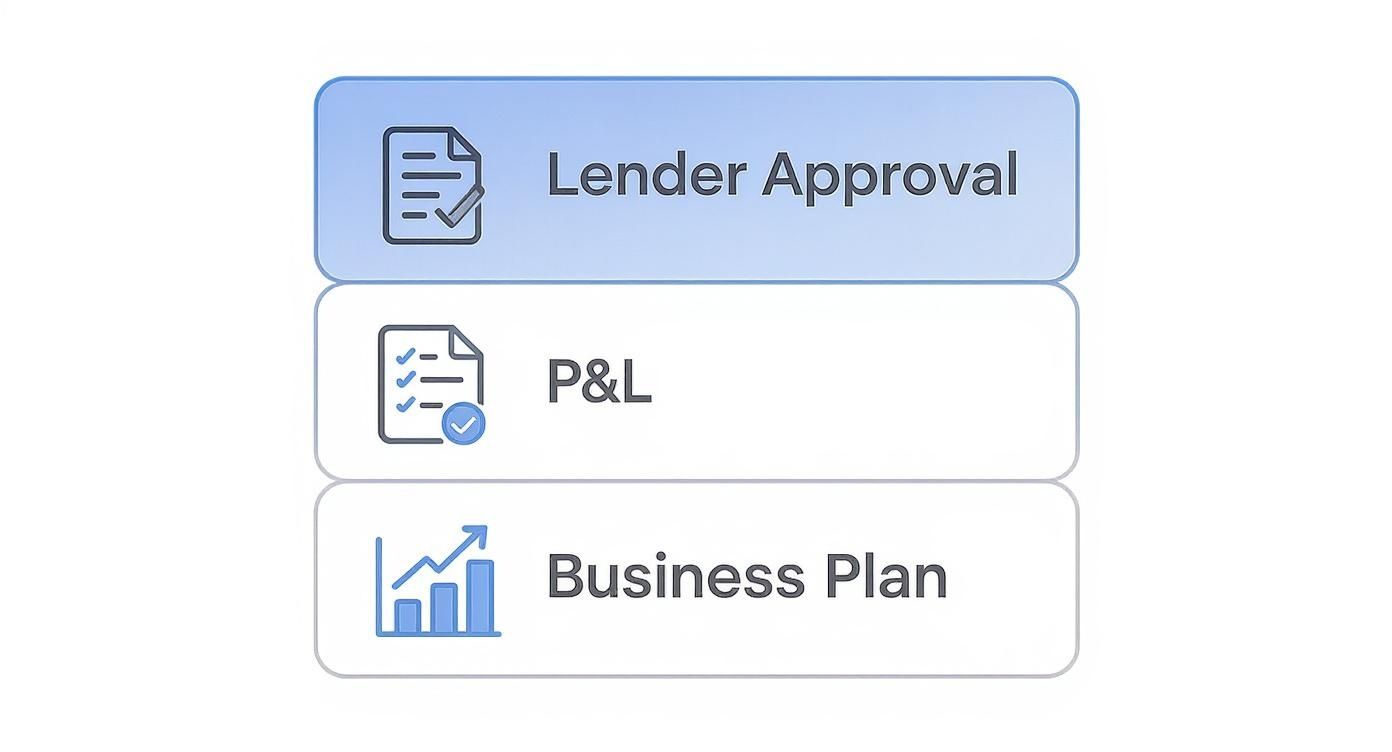
Walking in with your recent bank statements, a profit and loss statement (P&L), and a basic business plan shows you’re organized and serious. I've seen it time and again—this level of preparation can dramatically speed up the approval process and often helps you lock in a better rate.
Securing Financing Directly Through Your Griddle Vendor
Sometimes the most direct path is the best one. While many restaurant owners immediately think of going to a bank, one of the simplest and most effective ways to get equipment financing for a restaurant is to work directly with your griddle supplier. Going straight through a vendor like Griddles.com often cuts out the middleman, leading to a faster, more streamlined process from start to finish.
The biggest advantage here is expertise. The vendor's finance partners already know the griddles you're buying. They understand the real-world value and lifespan of a high-quality stainless steel griddle, which makes them far more comfortable saying "yes" to your request. That insider knowledge translates to lightning-fast decisions, sometimes in just a matter of hours.
Think about it: the vendor wants you to succeed. Your success means you'll be a happy customer, and maybe even come back for more griddles down the road. This shared goal creates a true partnership where their financing team is genuinely motivated to find a solution that works for you.
What the Vendor Application Process Looks Like
Getting started is usually incredibly simple. You’ll often find the financing option right on the product page. As you’re browsing griddles on a site like ours, you’ll see a button to "Apply for Financing" or "View Payment Options." Clicking that usually takes you to a short, secure online form.
The whole process is built for speed. You'll just need to provide the basics:
- Your restaurant’s legal name and address
- How long you've been in business and your estimated annual revenue
- Your name and contact info
Once you hit submit, the vendor’s finance partner does a quick credit review. Since they specialize in this niche, their decision-making is way faster than a traditional bank's. It's not uncommon to get an approval and see your terms on the same business day, so you can lock in your griddle purchase without missing a beat. This is a massive part of the global economy—the equipment finance sector was valued at around $1.3 trillion in 2024 and continues to grow. You can learn more about this global industry’s growth and impact if you're curious.
Tips for a Smooth Vendor Financing Experience
To make things go as smoothly as possible, view the finance team as part of your team. Be upfront about your budget and what you're trying to achieve. If the first offer you get doesn’t quite line up with your numbers, don't be afraid to ask if there's any wiggle room on the terms.
It also helps to connect the dots for them. Clearly explaining how this new griddle will boost your business can really strengthen your application. A simple line like, "This 48-inch griddle will let us double our breakfast capacity and add two new items to the menu," immediately shows them the investment's value. That kind of communication can turn a simple purchase into a powerful partnership.
Insider Tips for Better Approval Odds and Lower Rates
Once you have all your paperwork in order, there are a few extra moves you can make to look like a much stronger borrower. Think of it as stacking the deck in your favor. These steps show lenders you’re a savvy, low-risk operator, and that almost always translates into better financing terms for your new commercial griddle.
Bring Some Skin to the Game
First up: offer a down payment. Lenders love to see that you're invested. Even putting 10-20% down upfront dramatically lowers their risk on the deal. It’s a simple act of good faith, but it can unlock lower interest rates and more flexible repayment plans, saving you a ton of cash over the life of the agreement.
Do a Pre-Flight Check on Your Credit
Next, become your own financial detective. Before you even think about applying, pull your personal and business credit reports. Go through them line by line and look for errors—they happen more often than you think. Disputing inaccuracies can give your score a quick, meaningful boost and instantly improve your approval odds.
Securing the best equipment financing restaurant terms isn't just about what's on your application; it's about the strategic work you do before you even apply. A strong down payment and clean credit report put you in the driver's seat.
Tell Them How You'll Make Money
Finally, don’t just ask for money; show them the plan. Craft a sharp, one-sentence explanation of how this specific griddle will directly grow your revenue. It needs to be specific and believable.
For instance: "Upgrading to this 48-inch griddle will allow us to handle the weekend rush, increasing our breakfast sales by an estimated 30%."
A statement like that transforms the griddle from a line-item expense into a profit-generating machine in the lender's eyes. It’s a simple but powerful way to show you’ve done your homework and negotiate from a position of strength.
Common Questions About Griddle Financing
Even after you've done your homework, a few questions always pop up when it's time to talk financing. We get it. Here are the answers to the questions we hear most often from restaurant owners just like you.
Can I Get Financing for a Used Commercial Griddle?
You bet. Plenty of lenders are more than happy to finance used or refurbished griddles. They know that a well-cared-for piece of equipment is a smart buy.
Just know the process might be a little different. A lender will probably ask for a recent inspection report to confirm the griddle's condition and market value. You might also find that the repayment terms are a bit shorter or the rates a tick higher compared to buying new, simply because they're factoring in the age of the griddle.
What Credit Score Is Needed for Griddle Financing?
While having a personal credit score of 650 or higher definitely helps you land the best rates, it's not the end of the story. A lower score doesn't automatically lock you out of getting the griddle your kitchen needs.
Many modern lenders, especially those who work with restaurants all the time, care a lot more about the health of your business. They'll look at how long you've been open and, crucially, your recent cash flow. If your bank statements show strong, steady sales, that can often speak louder than a less-than-perfect credit history.
A healthy cash flow is the most powerful story you can tell a lender. It proves your restaurant is a viable, thriving business capable of handling new financial commitments, regardless of your past credit.
How Quickly Can I Get Approved?
This really depends on where you apply. If you go the traditional bank route, be prepared to wait a bit—anywhere from a few days to a couple of weeks while they do their deep dive.
On the other hand, applying for financing right through your griddle vendor is almost always the fastest path. Their financing partners are specialists who know griddles inside and out, so they can make decisions much more quickly. It's not unusual to get an approval in less than 24 hours, letting you get that new griddle on the line without missing a beat.
Ready to equip your kitchen with a high-performance griddle that can keep up with demand? At Griddles.com, we make it easy with flexible payment options and expert support. Find the perfect commercial griddle for your restaurant today.