
Restaurant Equipment Financing: Getting a Commercial Griddle
Dropping cash on a high-performance commercial griddle is a big move for any kitchen, but it doesn't have to mean emptying your bank account. Think of restaurant equipment financing as a strategic play, not a last resort. It's how you get the commercial griddle you need to grow your business without tying up all your working capital.
Why Smart Financing Is Your Kitchen's Secret Ingredient
Financing isn't about taking on debt; it's about investing in your restaurant's future. A new, high-efficiency commercial griddle can immediately boost your kitchen's output, improve food quality, and shave minutes off ticket times. By financing it, you keep your cash free for other crucial things like payroll, marketing pushes, or that unexpected walk-in cooler repair.
This isn't some niche strategy, either. It's becoming the standard way smart operators do business. In 2023, over half of all restaurant owners planned on increasing their equipment budgets, with a whopping 67 percent targeting kitchen upgrades specifically. This shows a huge shift in thinking: better tools build a better, more profitable business. You can see the full breakdown in the National Restaurant Association's State of the Industry report.
Unlocking Growth Without Draining Capital
Financing a new commercial griddle means you get the benefits of better tech right away while paying for it in manageable chunks over time. This approach is a lifesaver in a few common scenarios:
- New Restaurants: You can outfit your kitchen with a top-of-the-line commercial griddle from day one without burning through all your startup cash.
- Expanding Operations: Need another commercial griddle to handle a bigger menu or weekend rush? Financing lets you add capacity while keeping your cash flow smooth.
- Urgent Replacements: When your old griddle finally gives up the ghost, you can get a replacement in fast, avoiding the nightmare of downtime and lost revenue.
There's a common myth that financing is only for businesses that can't afford to pay cash. The reality is, savvy operators use it to stay liquid. They put their cash to work where it gets the best return—like bringing in more customers or hiring an amazing chef.
The Two Main Paths to Acquiring Your Griddle
When it comes to getting a new commercial griddle, your financing options really boil down to two main roads: loans and leases. Each has its own pros and cons depending on your goals.
An equipment loan is pretty straightforward, just like a car loan. You borrow a lump sum to buy the commercial griddle, make monthly payments, and at the end of the term, you own it free and clear. This is a great move if you see the commercial griddle as a long-term asset and want to build equity in your business.
On the other hand, a lease works more like renting an apartment. You make smaller monthly payments to use the commercial griddle for a specific period. When the lease is up, you typically have the option to buy it (often for a buyout fee), return it and walk away, or even upgrade to the latest model. Leasing is perfect for preserving cash and ensuring your kitchen always has a modern, efficient commercial griddle.
Decoding Your Commercial Griddle Financing Options
Figuring out how to pay for a new commercial griddle is a lot like deciding whether to buy or lease a new car for your business. There’s no single “best” way—it all comes down to what makes the most sense for your restaurant's cash flow, long-term goals, and immediate needs.
This decision is more important than ever. The foodservice equipment market is booming, valued at USD 46 billion in 2023 and expected to climb to USD 73 billion by 2033. Commercial griddles and other cooking gear make up the biggest slice of that pie at 31%, showing just how vital these workhorses are in any kitchen. If you're curious, you can dig into the numbers with the full foodservice equipment market report.
So, do you pay cash upfront or look into financing? This simple visual breaks down that first big choice.
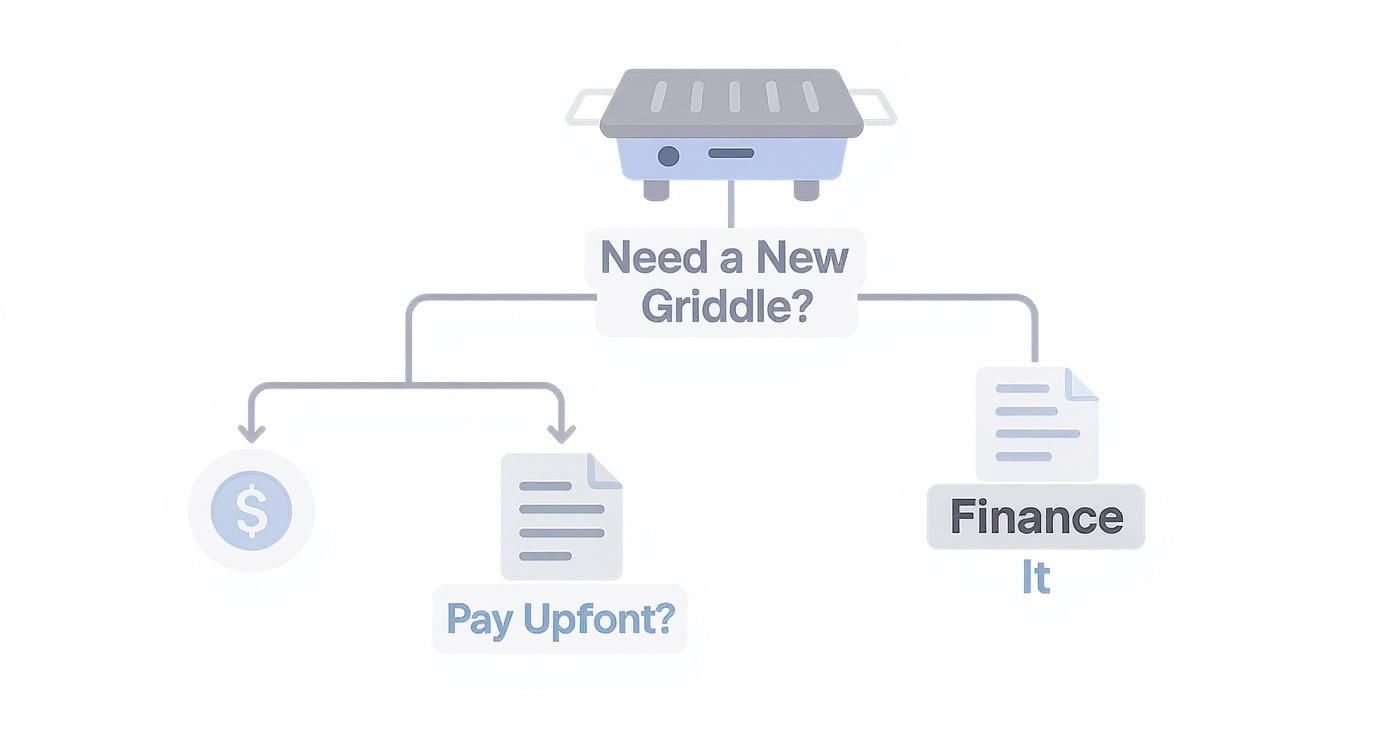
As you can see, going the financing route opens up a whole playbook of options beyond just writing a check. Let's walk through exactly what those look like.
Traditional Commercial Griddle Equipment Loans
This is the most direct path to ownership. A traditional equipment loan works just like a car loan: a bank or lender gives you the money to buy the commercial griddle, and you pay it back in fixed monthly installments, plus interest. Once you make that last payment, the commercial griddle is 100% yours.
This is a great fit for established restaurants that plan to use the commercial griddle for years to come. The perks are clear:
- You're building equity. The commercial griddle becomes a tangible asset on your books.
- Potential tax breaks. You may be able to deduct interest payments and the equipment's depreciation.
- Predictable budgeting. Those fixed monthly payments make it easy to plan your expenses.
The catch? Lenders usually want to see a down payment and a strong credit history, which can be a hurdle for newer businesses.
Flexible Commercial Griddle Equipment Leasing
Think of leasing a commercial griddle like renting an apartment. You pay a lower monthly fee to use the equipment for a set term, typically two to five years. When the lease is up, you've got choices: you can return it, sign a new lease for an updated model, or buy it at its current market value.
A lease is a powerful tool for staying technologically current. For a restaurant that prides itself on using the latest cooking technology, leasing allows you to upgrade your commercial griddle every few years without the hassle of selling old equipment.
Leasing is perfect for restaurants looking to protect their cash reserves and stay flexible. It usually requires less money down and has more forgiving credit requirements than a loan.
Government-Backed SBA Loans
For small businesses, loans from the Small Business Administration (SBA) can be a fantastic way to get restaurant equipment financing for a commercial griddle. The SBA doesn't lend the money directly; instead, it guarantees a chunk of the loan, which makes banks and credit unions more willing to lend to small operators.
That government guarantee often translates into better deals for you, like:
- Lower interest rates than you’d find with many conventional loans.
- Longer repayment terms, which means smaller, more manageable monthly payments.
- Lower down payments, with some programs requiring as little as 10% down.
The trade-off is the paperwork. The SBA application process is thorough and requires a lot of financial documentation and a solid business plan. It's a great option, but not a quick one.
Business Lines of Credit for On-Demand Funding
A business line of credit is like a credit card for your restaurant. You get approved for a specific credit limit and can draw funds from it whenever you need to. You only pay interest on the money you actually use, and as you pay it back, your available credit goes right back up.
This is the perfect tool for handling unexpected problems or jumping on opportunities. If your old commercial griddle suddenly dies mid-service, a line of credit lets you buy a replacement immediately and get back to cooking without missing a beat.
Merchant Cash Advances for Quick Capital
A Merchant Cash Advance (MCA) isn't a loan in the traditional sense. A provider gives you a lump sum of cash in exchange for a percentage of your future credit card sales. The repayment happens automatically—a small cut of each day's card transactions goes to the MCA provider until the debt is settled.
MCAs are incredibly fast, often funding within 24 to 48 hours with very little paperwork. But that speed comes at a steep price. The effective interest rates can be astronomical compared to other options, so it's best to think of this as a last-resort emergency fund.
What Lenders Look for When You Apply
Getting approved for restaurant equipment financing isn't some game of chance—it's all about being prepared. Lenders aren't just guessing; they have a specific checklist they run through to size up the risk and figure out the rates and terms you'll get. If you can see things from their perspective before you even apply, you’ll be miles ahead.
Think of your application as telling the financial story of your business. To get a "yes," you need to tell a good one, backed up with hard facts. Lenders zero in on three key areas to decide if giving you money for a new commercial griddle is a smart move.
The good news is that things have settled down in the lending world. After a bit of banking craziness in 2023, the equipment financing market is back on solid ground, with banks looking for quality applications. You can learn more about the current state of the equipment finance industry to get a feel for the trends.
The Three Pillars of Griddle Financing Approval
Lenders want to see one thing above all else: proof that you can and will pay back the loan. They measure this by digging into your credit history, how long you've been in business, and how much money you're making. Nail these three, and you're in a great spot.
1. Your Credit Score
The very first thing a lender will pull is your personal and business credit score. A score of 680 or higher is usually the magic number for getting the best rates from traditional banks. If you're below that, don't sweat it. You can still get approved, especially with alternative lenders, but be ready for higher interest rates.
2. Your Time in Business
Experience counts. A lot. A restaurant that’s been around for two or more years is a much safer bet in a lender's eyes than a startup. An established business has proven its concept and has a track record of bringing in money, giving lenders the confidence you can handle another monthly payment.
3. Your Annual Revenue
Cash flow is king. Lenders will pour over your bank statements and P&L to see how much revenue your restaurant is generating. They need to be sure you have more than enough cash coming in to cover all your current bills plus the new payment for the commercial griddle. A healthy, consistent income is a huge green flag.
Your financing application is more than just numbers on a page; it's a reflection of your operational discipline. A well-organized set of documents shows lenders you're a serious, reliable operator who manages their business effectively.
Your Essential Document Checklist
Getting your ducks in a row before you apply will save you a ton of headaches and speed everything up. Lenders need this paperwork to confirm you are who you say you are and to get a complete picture of your restaurant's financial health.
- Business Tax Returns: Be ready with the last two or three years of returns. This shows your restaurant's profitability over time.
- Recent Bank Statements: Most will ask for three to six months of business bank statements to look at your cash flow and average daily balances.
- Profit & Loss Statement (P&L) and Balance Sheet: These are the essential snapshots of your restaurant's current financial situation.
- A Solid Business Plan: This is absolutely critical for new businesses. A detailed plan shows you have a real strategy for success. It's also a must-have for anyone putting together a ghost kitchen business plan.
- Official Commercial Griddle Quote: The lender needs to know exactly what they are financing. Get a formal quote from your supplier (like us at Griddles.com) to include with your application.
By gathering these documents beforehand, you're sending a clear signal that you're organized and serious. It makes the lender's job easier, which always helps move your application to the top of the pile.
Your 5-Step Application Playbook

Alright, let's turn all this information into action. Getting the right restaurant equipment financing really comes down to having a clear plan. We've broken the entire process down into five straightforward steps.
Following this playbook will take the guesswork out of the equation and get you from application to approval with confidence.
Step 1: Pinpoint Your Exact Commercial Griddle Needs
You can't finance a commercial griddle until you know exactly which one you need. The first goal is simple: get a formal, itemized quote to show lenders.
Start by looking at what your kitchen truly demands. Is it a high-volume diner that needs a massive 48-inch thermostatic model to keep up with the rush? Or are you outfitting a food truck where a compact 24-inch countertop unit is the perfect fit? Your choice has a direct line to the loan amount you'll be asking for. If you're stuck, our commercial kitchen equipment checklist can help you sort through the options.
Once you’ve zeroed in on the perfect commercial griddle, get an official quote from the supplier. This isn't optional—it’s the document that tells a lender precisely what they’re financing and for how much.
Step 2: Assemble Your Financial Story
With your quote in hand, it’s time to pull together your paperwork. I like to think of this as building the financial story of your restaurant. Lenders need to see the numbers to feel confident in your business's health and its ability to handle another monthly payment.
Do yourself a favor and get everything organized in one place before you start applying.
- Business Tax Returns: Your last two to three years.
- Bank Statements: The most recent three to six months.
- Financial Statements: Your up-to-date Profit & Loss (P&L) and Balance Sheet.
- Business Plan: This is absolutely critical if you're a new restaurant.
Showing up with all your documents ready proves you're a serious, organized operator. Trust me, it makes a huge difference and can seriously speed things up.
Step 3: Compare Your Lending Partners
Here’s a hard truth: not all lenders are created equal. The best partner for your commercial griddle depends entirely on what you value most—is it rock-bottom rates, lightning-fast speed, or flexible terms?
- Traditional Banks: These are your go-to for the best rates, but only if you’re an established restaurant with a great credit history. Be prepared for a slower, more document-intensive process.
- Online Lenders: Perfect for newer businesses or anyone who needs cash in a hurry. They move fast and require less paperwork, but you’ll almost always pay for that convenience with higher interest rates.
- Direct Vendor Financing: Some suppliers, including Griddles.com partners, offer their own financing. This can be a fantastic one-stop-shop solution that cuts out the middleman.
A crucial piece of advice: Always get quotes from at least three different lenders. This is how you find the best deal. It also gives you some leverage to negotiate. And please, look beyond the monthly payment—compare the total cost of financing, including every single fee.
Step 4: Submit a Flawless Application
This might seem obvious, but you’d be surprised how often simple mistakes cause major headaches. A typo or an incorrect number can lead to frustrating delays or even an outright rejection.
Before you hit submit, double-check every single field. Make sure names, addresses, and financial figures match your supporting documents down to the letter.
Inconsistencies are a huge red flag for underwriters. If your tax return shows one revenue number but your P&L shows another, they're going to have questions. Be prepared to explain any discrepancies and always be upfront. Honesty builds trust.
Step 5: Scrutinize the Final Agreement
You got approved! It’s an exciting moment, but don’t rush to sign. That loan or lease agreement is a binding contract, and you need to read every single line.
Pay close attention to the fine print. You're looking for the Annual Percentage Rate (APR), the total payback amount, and any prepayment penalties if you decide to pay it off early. Make sure you understand the terms of default and what happens if you miss a payment.
This final review is your last chance to ensure you're signing a deal that helps, not hurts, your restaurant's future.
How to Secure the Best Financing Rates and Terms
Getting approved for commercial griddle financing is one thing. Getting a great deal that actually helps your bottom line? That’s the real win. Don't make the mistake of jumping on the first offer that lands in your inbox—it could cost you thousands over the long run.
Think of it this way: your financing application isn't just a request for money. It's a pitch. You're showing a lender why your business is a solid, reliable investment. The less risky you appear, the more leverage you have to negotiate a better deal. A little prep work here can lead to some serious savings.
Strengthen Your Financial Foundation
Before you even think about filling out an application, the most important work is done behind the scenes. Your mission is to make your business look as attractive as possible to a lender.
-
Boost Your Credit Score: This is easily the biggest factor. Even a small bump of 15-20 points can push you into a lower interest rate bracket. Spend a few months paying down credit card balances or clearing up any old collections before you apply.
-
Make a Larger Down Payment: Lenders feel a lot better when you have some skin in the game. Putting down 20% or more on your commercial griddle shows you’re serious and lowers their risk. They'll often reward that commitment with a better rate, which means smaller monthly payments for you.
-
Get Your Paperwork in Order: Don’t scramble at the last minute. Have your last two years of tax returns, six months of bank statements, and a current P&L statement organized and ready to share. A tidy financial package screams "professional" and makes the underwriting process go much faster.
Master the Art of Negotiation
With your financials looking sharp, it's time to talk to lenders. But don’t just be a passive applicant waiting for a decision. Be an active player in getting the deal you want.
The monthly payment is just one piece of the puzzle. You have to look at the total cost of financing. That includes all the interest, origination fees, and any documentation fees. A temptingly low payment can sometimes hide high fees that make the loan way more expensive overall.
To get the best possible terms on your restaurant equipment financing, you need to make lenders compete for your business.
-
Get Multiple Offers: Never, ever settle for the first quote. Reach out to at least three different kinds of lenders—maybe a traditional bank, an online lender, and a vendor financing partner. This will give you a real-world snapshot of what the market rate is for a business like yours.
-
Leverage Your Best Offer: Once you have a few quotes in hand, don’t be afraid to use them. Go to the lender you want to work with and show them what their competitor offered. A simple question like, "I've got an offer for 8.5% APR from another lender. Can you get any closer to that?" can make a huge difference.
A little preparation and smart negotiation can change the game. You go from being just another applicant to a client lenders want to win over, ensuring you get the best deal possible for your new commercial griddle.
How Key Factors Impact Your Griddle Financing Rate
When a lender reviews your application, they're weighing several factors to decide what interest rate to offer you. Understanding what they're looking for can help you put your best foot forward and aim for those lower rates.
| Factor | Positive Impact (Lower Rate) | Negative Impact (Higher Rate) |
|---|---|---|
| Credit Score | A strong personal and business credit score (700+) shows a history of responsible borrowing. | Lower scores (below 650) or past defaults signal higher risk to the lender. |
| Time in Business | Operating for 2+ years demonstrates stability and a proven track record. | Startups or businesses under one year old are seen as less predictable and riskier. |
| Down Payment | A substantial down payment (20% or more) reduces the loan amount and the lender's risk. | A minimal or $0 down payment means the lender takes on all the risk, resulting in a higher rate. |
| Annual Revenue | Strong, consistent annual revenue shows you have the cash flow to handle new debt payments. | Inconsistent or low revenue raises concerns about your ability to repay the loan on time. |
| Financial Documents | Clean, organized financials (tax returns, bank statements) make for a smooth underwriting process. | Messy or incomplete paperwork can cause delays and may lead to a less favorable offer. |
Ultimately, a strong application tells a story of a stable, well-managed business. The more you can do to prove your reliability, the more confident a lender will be in offering you their best terms.
Getting Your Griddle with Griddles.com
Sorting through restaurant equipment financing can feel like a headache, but the final step—actually getting your hands on the perfect commercial griddle—should be the easy part. Here at Griddles.com, we work with you to make buying that core piece of your kitchen as simple as possible. We use our experience in the industry to offer real, practical solutions that save you time and money.
Our whole goal is to get you cooking, faster. We've spent time building solid relationships with financing partners who get the restaurant business inside and out. For you, that means a cleaner application process, which can lead to faster approvals and better terms. We help you slice through the red tape so you can worry about your menu, not piles of paperwork.
More Than Just a Griddle
When you choose Griddles.com, you're not just buying a commercial griddle; you're getting a complete package designed to lower your costs right from the start. We know that financing is only half the battle—getting the commercial griddle into your kitchen quickly and affordably is just as critical.
That's why we offer free freight on every single order. No surprise shipping costs, ever. Plus, with 12 distribution centers located all over the country, your new commercial griddle shows up fast, usually within just 1–3 business days. Less time waiting means you can get that new commercial griddle fired up and making you money sooner.
Your time is your most valuable asset. Fast, free delivery doesn't just save you on shipping costs; it minimizes kitchen downtime and accelerates your return on investment.
Take the Next Step Today
Ready to find the perfect commercial griddle for your kitchen? Our team of pros is here to help you pick the right model and walk you through our straightforward payment and financing options. Whether you need a small countertop unit or a heavy-duty electric griddle to be the star of your cook line, we've got you covered.
- Call or Text Us: For instant, expert advice, reach us at (206) 419-5801.
- Email Our Team: Shoot your questions over to sales@griddles.com.
- Explore Financing: Head to our financing page to get the ball rolling.
Griddle Financing FAQs
Diving into restaurant equipment financing can feel like a lot, especially when you're just trying to get the right commercial griddle for your line. We get it. Here are some straight-to-the-point answers to the questions we hear most from chefs and owners.
Can I Finance a Used Commercial Griddle?
Yes, absolutely. But it's not quite the same as financing a new one. Lenders are a bit more cautious with used commercial griddles because they have a shorter lifespan and no manufacturer warranty—making them a higher risk in their eyes.
To make them comfortable, you'll likely need to show them a few extra things:
- A recent appraisal to prove what the commercial griddle is actually worth.
- Paperwork on its age, condition, and any maintenance records you can find.
- Expect shorter repayment terms. They'll usually want the loan paid off in two or three years, not five or ten.
While going with a used commercial griddle can definitely save cash upfront, be ready for slightly higher interest rates and a few more hoops to jump through.
What's the Real Difference Between a Loan and a Lease for a Griddle?
When you're looking at financing, the loan vs. lease debate comes down to one simple question: do you want to own this commercial griddle for the long haul, or do you want the freedom to upgrade in a few years?
Think of it like buying a house versus renting an apartment. An equipment loan is like a mortgage—you make payments every month, and when you're done, that commercial griddle is yours, free and clear. It’s an asset on your books. This is the way to go if you see that commercial griddle being a workhorse in your kitchen for the next decade.
A lease is more like renting. You pay a lower monthly fee to use the commercial griddle for a set amount of time, say, three years. Once the lease is up, you've got options: send it back and get a shiny new model, buy it out for whatever it's worth then, or just walk away. It’s a great move for keeping cash flow healthy and making sure your kitchen always has up-to-date gear.
The core difference is ownership versus access. A loan builds equity in a long-term asset, while a lease provides access to the latest equipment with lower upfront costs and predictable monthly payments.
How Quickly Can I Get Approved for Commercial Griddle Financing?
The approval timeline really depends on who you ask. Just remember, speed often comes with a higher price tag, so you have to decide what’s more important for your situation.
- Online Lenders and MCAs: These guys are the sprinters. They move fast, often giving you an answer and the money in 24 to 48 hours. They care most about your daily revenue, not a mountain of paperwork. It's perfect for when your old commercial griddle dies mid-shift, but you'll pay for that speed with the highest interest rates.
- Traditional Banks: Think of a bank as a marathon runner—slow, steady, and extremely thorough. They'll want to see everything: tax returns, a detailed business plan, your life story. The whole process can easily take 2 to 6 weeks.
- Vendor Financing Partners: This is often the sweet spot. Since they live and breathe equipment financing, their process is usually quicker than a bank but more rigorous than an online lender. You can often get an approval in just a few business days.
Ready to get the perfect commercial griddle firing on your line? The team at Griddles.com can help you find the right equipment and connect you with financing that makes sense for your restaurant. Explore our griddles and get started today.