
Choosing 4 burner griddles: Your Commercial Guide
A commercial 4-burner griddle is less of a single appliance and more like the central nervous system for a high-volume kitchen. It's the workhorse that lets a chef juggle a dozen different items at once—from pancakes and eggs to burgers and steaks—all while cutting down ticket times and keeping the line moving.
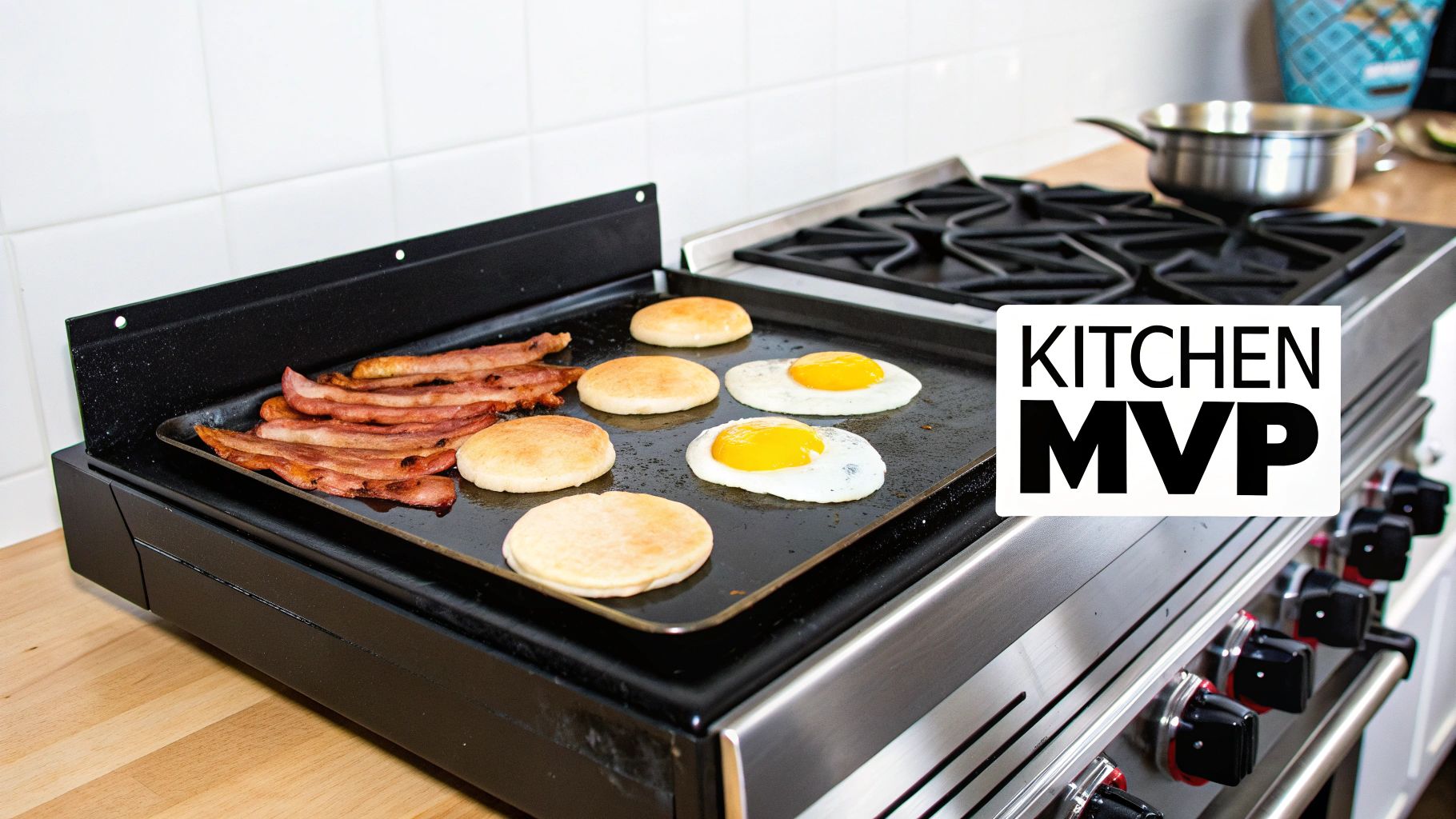
Why a 4-Burner Griddle Is Your Kitchen's MVP
Picture the morning rush. Tickets are pouring in for pancakes, bacon, sausage, and eggs over easy. Trying to manage that on a standard range means a chaotic ballet of pans, creating bottlenecks and risking inconsistent temps. It’s stressful and slow.
Now, imagine that same rush with a 4-burner griddle. It's no longer chaos; it's a finely tuned machine. You have one huge, reliable cooking surface with distinct heat zones, turning that frantic shuffle into a smooth, high-output production line.
This isn't just about making life easier for your cooks. It's about your bottom line. By simplifying how a dish gets plated, you shave precious seconds—and even minutes—off your ticket times. Faster service means happier customers and more table turns during your busiest hours. It's that simple.
Unlock Your Menu's Full Potential
The real magic of a commercial 4-burner griddle is how it lets you expand your menu without needing to expand your kitchen. That massive flat top opens up a world of possibilities that just aren't practical on regular burners.
- Dominate the Breakfast Rush: Keep dozens of pancakes, endless strips of bacon, and perfectly fried eggs moving all at once. Every plate goes out hot and fresh.
- Crush Lunch Service: Sear off rows of burger patties while toasting buns and sautéing onions on the same surface. It's a one-stop shop for speed and quality.
- Expand Your Dinner Offerings: Get a perfect sear on steaks, fish, and scallops while simultaneously wilting spinach or grilling asparagus right beside them.
This kind of flexibility is a game-changer for smaller commercial kitchens in food trucks or cafes. It gives you the power to offer a menu that can go toe-to-toe with much larger restaurants, all from a tiny footprint.
A Smart Investment in Your Growth
There’s a reason the commercial cooking equipment market is growing. Professional kitchens everywhere are looking for smarter, more efficient ways to get food out the door, and the flat top griddle is at the heart of that trend.
In fact, the market for these griddles, including powerful 4-burner models, is expected to hit $2.38 billion by 2025. And who's buying them? Commercial kitchens make up nearly 60% of all sales, because they understand the griddle's unmatched ability to handle serious volume. You can discover more market insights about flat top griddles to see the trend for yourself.
A 4-burner griddle isn't just another piece of equipment. It's an investment in your kitchen's capacity—the key piece that lets you go from serving dozens of customers an hour to serving hundreds.
If you're feeling boxed in by your current setup, a commercial 4-burner griddle is the most direct path to scaling up production, speeding up service, and boosting your profits. For any kitchen that's serious about growth, it’s the place to start.
Choosing Your Griddle: Gas vs Electric
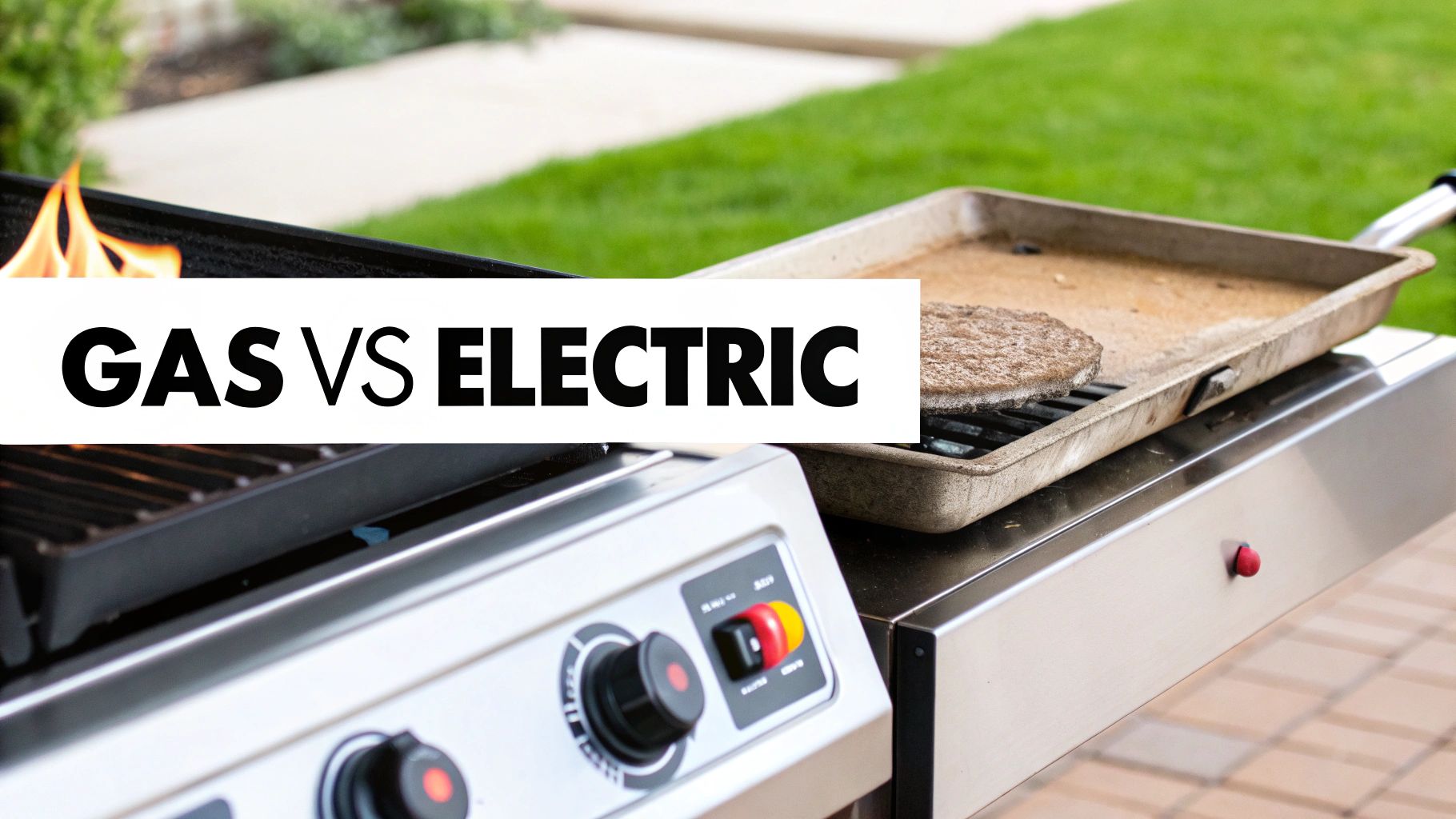
When you’re picking out a new commercial 4-burner griddle, the first big question is always the same: gas or electric? This decision goes way beyond what your utility bill will look like. It gets to the very heart of how you cook, what you can offer on your menu, and how your kitchen line flows during a busy service.
Think of it like this: a gas griddle is the raw power of a muscle car, while a commercial electric griddle is the consistent, reliable performance of a German-engineered sedan. Both are fantastic machines, but they deliver a completely different experience for the professional chef.
The gas griddle is the undisputed king of raw heat and speed. It’s for the steakhouse that needs a perfect sear, the burger joint slinging dozens of patties, or any high-volume kitchen that can’t afford to wait. When you throw a line of cold burgers on that hot steel, a gas unit roars back to life, recovering its temperature almost instantly. It’s all about power and response.
Then you have the electric griddle. This is your precision instrument. It might take a little longer to get up to temp, but once it’s there, it holds that heat with incredible consistency across every square inch. This is absolutely critical for delicate foods. If you’re known for your perfect, golden-brown pancakes or your tender crepes, an electric griddle’s steady heat is your best friend.
Heat Performance and Control
The real difference comes down to how they work. A gas griddle, whether it’s hooked up to a natural gas line or a propane tank, gives you instant feedback. Crank the dial, and the flame jumps—you get more heat right now. That responsiveness is a game-changer when you’re in the weeds and need to drop the temp from searing a steak to toasting a bun in two seconds flat.
Electric griddles take a more measured approach. The heating elements are built right into the plate, which means you get incredibly even heat distribution. No more worrying about that one hot spot that burns every third pancake. This consistency guarantees that every item you cook, from one edge of the griddle to the other, comes out looking and tasting exactly the same. If your menu demands that level of precision, checking out a quality commercial electric griddle is a no-brainer.
Did you know the global market for countertop griddles, including many 4-burner griddles, was valued around $2.6 billion in 2025? What's really interesting is that electric models grabbed 57.5% of the market revenue. This is largely because they're so energy-efficient and easier to install, especially in commercial kitchens without gas lines.
Installation and Running Costs
Sometimes, the choice is made for you by your building. A commercial gas griddle needs a professionally installed gas line and a proper ventilation hood. If you don't already have that infrastructure, it can be a significant upfront expense.
Electric models, on the other hand, just need the right high-voltage outlet. This makes them a go-to choice for food trucks, historic buildings with utility restrictions, or any spot where running a new gas line is a headache.
Looking at long-term costs gets a bit more nuanced. Natural gas is usually cheaper than electricity, so you might see a lower daily running cost with a gas griddle. However, electric units are more efficient—more of the energy they pull is transferred directly to the cooking surface instead of escaping into your kitchen as ambient heat.
To make things simple, we've put together a quick decision matrix to help you weigh the pros and cons based on your kitchen's specific needs.
Gas vs Electric 4-Burner Griddle Decision Matrix
| Feature | Gas Griddle (Propane/Natural Gas) | Electric Griddle |
|---|---|---|
| Best For | High-volume kitchens, steakhouses, burger joints. Any menu heavy on seared meats and rapid-fire cooking. | Breakfast spots, cafes, diners. Menus with delicate items like eggs, pancakes, crepes, and fish. |
| Heat Performance | Extreme Power & Fast Recovery. Heats up quickly and gets back to temp fast after adding cold food. | Unmatched Precision & Consistency. Delivers steady, even heat across the entire surface. |
| Control | Instant Response. Turn the dial, and the heat changes immediately, offering on-the-fly adjustments. | Methodical Control. Slower to respond but holds a set temperature with pinpoint accuracy. |
| Installation | Requires a dedicated gas line and professional ventilation system (hood). Can be costly if not existing. | Needs a dedicated high-voltage electrical outlet. Generally simpler and cheaper to install. |
| Kitchen Environment | Produces more ambient heat, making the kitchen warmer. Requires excellent ventilation. | More energy-efficient, producing less ambient heat for a cooler and more comfortable kitchen. |
| Typical Menu | Steaks, burgers, cheesesteaks, stir-fry, and anything needing a hard, fast sear. | Pancakes, eggs, grilled cheese, quesadillas, delicate fish, and items requiring gentle, even cooking. |
Ultimately, choosing between gas and electric isn't about which one is "better"—it's about which one is the right tool for your commercial kitchen. By matching the griddle's strengths to your menu and kitchen setup, you're setting your team up for a smoother, more successful service every single day.
What to Look for in a Commercial Griddle
Deciding between gas and electric is a big first step, but the real magic is in the details. The specific features of a commercial griddle are what separate a workhorse from a headache, directly impacting your daily workflow, how consistent your food is, and how long your crew spends scrubbing down at the end of a long night.
Think of it like this: the griddle plate is the engine, the controls are the dashboard, and the cleanup system is your maintenance plan. Getting all three right means you've got a piece of equipment that will work for you, not against you.
The Heart of the Griddle: The Plate Thickness
Without a doubt, the single most important part of any commercial griddle is its cooking plate. The thickness of this slab of steel determines how it handles heat—how it absorbs it, holds onto it, and kicks it back into your food. It’s a classic battle between speed and raw power.
- Thin Plates (Under ¾-Inch): A thinner plate heats up fast, which is great for getting the first order out quickly. The downside? It also loses heat just as fast when you slap on a bunch of cold food, leading to frustrating recovery times and spotty cooking.
- Thick Plates (¾-Inch to 1-Inch): A heavy-duty plate takes longer to get up to temp, but once it's hot, it holds onto that heat like a bulldog. A solid 1-inch thick plate can take a relentless assault of frozen burger patties and barely flinch, delivering a hard, consistent sear every single time. For any high-volume commercial kitchen, that thermal stability is everything.
Think of the griddle plate as a heat battery. A thicker plate stores way more energy, so when you need a powerful sear, the heat is right there waiting for you. This stops the griddle from getting "shocked" by cold food, which is what causes food to steam instead of sear.
Taking Command: Control Types
How your chefs interact with the griddle dictates the final product. Commercial 4-burner griddles generally come with two types of controls, and each one is built for different menus and cooking styles.
Manual Controls are the old-school, tough-as-nails option. You get simple dials—low, medium, high—that control the flame or power directly. They're incredibly durable, have fewer parts that can break, and are perfect for kitchens where you just need raw heat for things like searing steaks or smashing burgers.
Thermostatic Controls, on the other hand, give you surgical precision. You dial in an exact temperature, say 350°F, and an internal thermostat kicks the burners on and off to hold it right there. This is a must-have for delicate foods like pancakes, eggs, and fish, where just a few degrees can be the difference between golden-brown perfection and a burnt mess. If you want to get into the weeds on this, you can learn more about thermostatic vs manual griddle controls in our full guide.
Designing for Speed and a Painless Cleanup
A commercial griddle’s true value isn't just in the cooking—it’s also about how seamlessly it fits into the chaos of your kitchen. Smart design features can save your team countless hours of labor every week.
Here's what to keep an eye out for:
- Splash Guards: Tall, welded guards on the sides and back of the griddle are non-negotiable. They contain grease splatter, keeping your walls, floors, and other equipment cleaner and safer. This one feature is a massive time-saver for nightly cleanup.
- Grease Trough: A wide trough running along the front lets your cooks scrape grease and food bits away from the cooking surface in one clean motion. This keeps the flat top ready for the next order during a busy service.
- Drip Tray: A huge, easy-to-remove drip tray is a lifesaver. A tray that's too small needs to be emptied mid-rush, which kills your momentum. Look for one that can easily handle a full shift's worth of grease.
When you look past the price tag and focus on these critical features, you start to see how a 4-burner griddle will actually perform under pressure. A thick plate, the right controls, and smart, sanitation-focused design are what turn a simple flat top into the most valuable player on your line.
Matching Griddle Size to Your Kitchen's Output
When you're shopping for a commercial 4-burner griddle, it’s easy to get caught up in its physical footprint. But the real question isn't "How big is it?" It's "How much money can it make me?" That means shifting your focus from floor space to pure production power.
Think of your griddle as the engine of your kitchen's production line. A big 48-inch, 4-burner unit gives you a ton of cooking real estate, but what you can actually get out of it depends entirely on what's on your menu. This is where a little planning turns an equipment purchase into a serious investment.
Calculating Your Griddle's True Throughput
Let’s get practical. Say your diner needs to crank out 4-inch burgers during a slammed 60-minute lunch rush. A typical 48-inch wide by 24-inch deep commercial griddle gives you 1,152 square inches of cooking surface to work with.
- A 4-inch burger patty takes up about 12.5 square inches.
- On paper, you could cram 92 burgers (1,152 / 12.5) onto that surface.
But anyone who's ever worked a line knows that's not how it works. You need room to flip, move things around, and manage your hot and cool zones. Realistically, you're only using about 70% of the total space. That brings your capacity down to a more practical 64 burgers per batch.
If a batch takes 8 minutes from start to finish, you can cycle through 7.5 batches in one hour. Do the math, and you get a maximum theoretical output of 480 burgers per hour. Now you’ve connected a piece of equipment to your potential sales volume.
A griddle’s value is measured in plates per hour. By calculating your menu's throughput, you can forecast revenue potential and ensure your equipment can handle peak demand without becoming a bottleneck.
The Power Behind the Plate: BTUs and kW
Cooking surface is just one part of the equation; raw power is the other. A commercial griddle's power—measured in BTUs (British Thermal Units) for gas or kilowatts (kW) for electric—is what determines how fast it heats up. More importantly, it dictates how quickly the surface temperature recovers after you slap down a bunch of cold food.
If your menu includes anything frozen, a high BTU or kW rating isn't a luxury—it's a necessity. Ever drop a dozen frozen patties on a weak griddle? The temperature craters. Instead of a beautiful sear, the meat just steams and turns a sad shade of gray, killing your cook times and your quality.
- High-Power Gas Griddles: For a gas unit, you should be looking for at least 30,000 BTUs per burner. That means a 4-burner griddle needs 120,000 total BTUs to have the thermal muscle to keep up under pressure.
- High-Power Electric Griddles: On the electric side, a rating of 4-5 kW per foot of width is a solid benchmark for heavy commercial use.
This need for high-output equipment is what's driving the market. The commercial griddle industry, including these powerful 4-burner griddles, was valued at USD 576.4 million in 2025 and is projected to hit USD 912.4 million by 2035. That growth is coming from high-volume spots and food trucks that live and die by their griddle's output. You can explore the full commercial griddle market analysis to see the trends.
This decision tree helps visualize how to pick the right features for your kitchen.
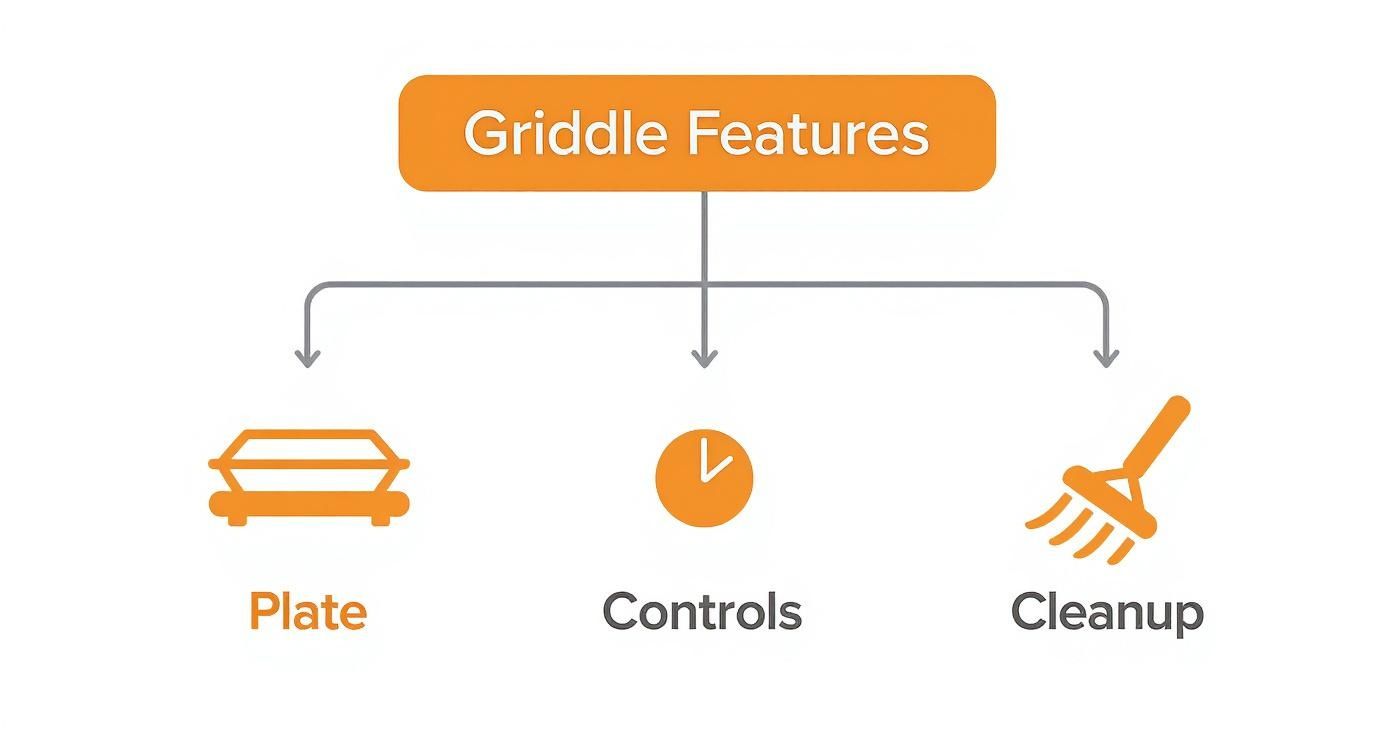
As the graphic shows, your menu is what leads the way—whether you need a thick plate for holding heat, precise controls for tricky items, or easy-to-clean features that keep the line moving.
Planning for Today and Tomorrow
Finally, think ahead. A griddle that barely keeps up with your current volume will be a boat anchor if your business grows 20% next year.
Always build in a capacity buffer. If you figure you need to produce 300 burgers an hour, don’t buy a unit that maxes out at 320. Get one that can comfortably handle 400 or more. This little bit of foresight ensures your most important piece of cooking equipment won’t be the thing that holds your business back.
Installation and Maintenance Best Practices
Dropping serious cash on a commercial 4-burner griddle is a big move for your kitchen's output. Now you have to protect that investment. Getting it set up right isn't just about flicking a switch—it's about locking in safety, performance, and keeping the health inspector happy from day one.
Think of it like a performance engine. You wouldn't just drop it in your car and hope for the best. It needs a professional install and regular tune-ups to run at its peak. Skimping on this stuff is a surefire way to get lousy performance, create safety nightmares, and kill your equipment years before its time.
Professional Installation Is Non-Negotiable
Look, I get the temptation to DIY the installation and save a few bucks. But this is one of those areas where cutting corners will come back to bite you, hard. Commercial griddles, whether gas or electric, have specific hookup needs that absolutely demand a certified pro.
For gas griddles: You need a licensed plumber or gas fitter to handle the connection to your natural gas line or propane tank. They're the ones who can guarantee the pressure is right, sniff out any potential leaks (a huge fire safety issue), and make sure the burners are firing perfectly. If you need to convert the unit from propane to natural gas (or the other way around), this is when they'll do it safely.
For electric griddles: This is a job for a licensed electrician, period. They'll make sure the griddle is wired into a circuit that can handle the correct voltage and amperage. The wrong electrical setup can fry the griddle's brain, create a fire hazard, and will instantly void your warranty.
Don't forget about breathing room. Clearance and ventilation are just as crucial as the gas or electric hookups. Your griddle needs to be installed with enough space between it and any combustible surfaces (like walls or other gear) and must sit under a commercial-grade ventilation hood. That hood is essential for pulling out all the greasy vapor, heat, and fumes.
Get into a Daily and Weekly Maintenance Rhythm
The real secret to a griddle that lasts forever and cooks like a dream? A simple, consistent maintenance routine. This isn't about a massive deep clean once a month. It’s about the small things you do every single day that prevent big, expensive problems later.
A clean, well-cared-for griddle cooks better, is easier to clean tomorrow, and stops yesterday's fish tacos from tasting like this morning's pancakes.
The Daily Shutdown Procedure
This end-of-shift routine takes 10-15 minutes, tops, but the payoff is massive.
- Scrape It Hot: While the griddle is still warm (but not blazing hot), grab your griddle scraper and push all the gunk and grease into the trough.
- Steam Clean: Pour a little warm water on the surface. That sizzle and steam is your friend—it's lifting off all the stubborn, cooked-on bits. Use a griddle pad or brick to give it a gentle scrub.
- Wipe and Dry: Use a squeegee to push all the dirty water into the grease trough. Then, wipe the whole surface down with a clean, dry cloth.
- A Light Coat of Oil: Apply a super-thin layer of high-smoke-point cooking oil across the clean, dry steel. This is your rust shield for overnight and keeps that perfect non-stick surface happy.
- Empty the Drip Tray: The final step. Carefully pull out the grease drip tray, empty it, and give it a good wash with soap and water. A clean tray won't overflow and seriously cuts down on fire risk.
Troubleshooting Common Griddle Issues
Even the best-maintained griddle can have an off day. Knowing how to spot and fix the small stuff can save you a service call, and knowing what's serious tells you when it's time to call in the cavalry.
- Uneven Heating: If you're getting hot and cold spots, first thing's first: make sure the griddle is perfectly level. If it is, take a look at the burners on a gas model. A little clog can easily disrupt the flame pattern.
- Pilot Light Won't Stay Lit (Gas): This is usually a sign of a bad thermocouple or a clog in the pilot tube. You can check for any obvious gunk, but this one is almost always a job for a service tech.
- Food Is Sticking Like Crazy: Nine times out of ten, this just means your seasoning has worn off. Give the surface a really good cleaning and then re-season it a couple of times to build that slick, protective layer back up.
Staying ahead of problems is always the best strategy. For a more detailed guide on keeping all your gear running smoothly, check out our guide to commercial kitchen equipment maintenance. Stick with these practices, and your 4-burner griddle will be the MVP of your kitchen line for years.
Got Questions About 4 Burner Griddles? We’ve Got Answers.
Picking out the right commercial griddle is a big move, even after you’ve compared all the features. To help you lock in your decision with total confidence, we put together a few of the most common questions we get from kitchen managers and chefs.
What’s the Best Griddle Plate Thickness for a 4 Burner Model?
The "perfect" thickness for a commercial griddle really comes down to your menu. For most kitchens juggling a mix of items like breakfast, lunch, and dinner, a 1/2-inch to 3/4-inch plate is the sweet spot. It's a fantastic all-rounder that heats up reasonably fast but still holds onto that heat when you're cooking different foods back-to-back.
But, if your kitchen is a high-volume machine slinging steaks or endless burgers, you need to go with a 1-inch thick plate. Think of it like a massive heat battery. It holds a consistent, blazing-hot temperature even when you slam it with cold patties or steaks, giving you that perfect crust from edge to edge, every single time.
How Do I Season a New Commercial Griddle?
Seasoning is the secret sauce. It's how you build up that slick, non-stick cooking surface on your new steel griddle. Don't skip this critical step for any commercial unit.
- First things first, give the new griddle a good scrub with soap and water to get rid of any factory oils. Rinse it well and dry it completely.
- Fire up the griddle to medium heat, somewhere in the ballpark of 300-350°F.
- Grab a high-smoke-point oil (canola or flaxseed are great choices) and apply a paper-thin layer across the whole surface with a clean, lint-free cloth.
- Let that oil cook until it starts to smoke just a little. That’s the magic happening—it’s bonding with the steel. Now, kill the heat and let it cool down.
- Wipe off any extra oil and do this whole thing 3-4 more times. You're building up that beautiful black patina that stops rust and makes food slide right off.
This isn't just a cleaning step; it's what turns a simple slab of steel into a high-performance cooking machine. A properly seasoned griddle is your best friend for non-stick cooking and lightning-fast cleanup.
Can I Run a Propane Griddle on Natural Gas?
Absolutely not—at least, not right out of the box. Propane and natural gas are totally different beasts. They run at different pressures and need specific burner orifices to work safely and correctly. Hooking up the wrong fuel is not just a recipe for bad food; it's seriously dangerous.
The good news? Many commercial 4 burner griddles are built to be "field convertible." This means they come with a conversion kit holding all the parts you need—new orifices and a new regulator—to switch from one gas to the other. Just remember, this job is for a certified gas technician only. It keeps you safe and your warranty intact.
Ready to find the perfect workhorse for your kitchen? Check out our full lineup of commercial 4 burner griddles at Griddles.com and get your line running right. https://griddles.com