

Your Guide to Buying a Commercial Range With Griddle
A commercial range with griddle is the Swiss Army knife of the professional kitchen. It’s a single, heavy-duty appliance that pulls double duty, combining the open burners you need for pots and pans with a flat-top griddle for direct-heat cooking. This setup is built to save space and pump out food at a serious pace.
Why a Commercial Range With a Griddle Is Your Kitchen's MVP
In the chaos of a professional kitchen, efficiency is everything. A commercial range with a griddle quickly becomes the heart of the cook line, a true workhorse where a chef can have pancakes flipping, steaks searing, and sauces simmering—all at the same time.
Think of it as slamming a dedicated griddle and a multi-burner stove into one seamless unit. The payoff is immediate.
- Smarter Use of Space: By merging two essential pieces of equipment, you instantly free up valuable floor and hood space for something else, like a fryer or charbroiler. For tight spots like food trucks or ghost kitchens, this isn't a luxury; it's a necessity.
- A Smoother Workflow: Your cooks can pivot from griddling burgers to sautéing onions in a single motion. That means less running around, faster ticket times, and a calmer kitchen during the dinner rush when every second is critical.
- Menu Flexibility: This combo opens up your menu options. You can knock out a full breakfast service—eggs and bacon on the griddle, oatmeal on the burners—and roll right into lunch with burgers and soups without missing a beat.
The Modern Kitchen Cornerstone
The proof is in the numbers. The demand for this kind of versatility is booming, with the global commercial griddle market expected to hit USD 3.31 billion by 2034.
This growth isn't surprising when you consider that quick-service restaurants, which make up over 58% of the market, live and die by the speed these appliances offer. You can dig deeper into the commercial griddle market and its future trends to see where the industry is headed.
At the end of the day, picking the right range with griddle is more than just buying another piece of steel. It’s a strategic move that directly impacts your kitchen's output, consistency, and bottom line.
Choosing Your Fuel Source For Peak Performance
Picking the fuel source for your commercial range with griddle is one of those foundational decisions that ripples through your entire kitchen operation. It's not just about how you turn it on; it's about what impacts your cooking speed, your precision, and even your monthly utility bills. This is about matching the heart of your appliance to the rhythm of your kitchen.
You’ve got three main players to choose from: natural gas, electric, and propane. Each comes with its own playbook of benefits and demands. Your choice will shape your workflow, whether you’re in a fixed restaurant location, a tight food truck, or a nimble catering setup.
The Power Of Natural Gas
When you think of a high-volume commercial kitchen, you're probably thinking of natural gas. It's the undisputed workhorse for a reason. Chefs love it because it delivers powerful, responsive heat—you can go from a roaring sear to a gentle simmer in seconds. Once you have a gas line installed, it’s a reliable and usually cost-effective fuel source day in and day out.
This makes it the go-to for any place that needs sustained, high-heat output for things like searing steaks or quickly turning over orders. If your building has the hookup, natural gas is a powerful, economical solution for the long haul. To see exactly how it stacks up against its portable cousin, check out our in-depth comparison of natural gas versus propane griddles.
The Precision Of Electric Griddles
Electric ranges bring a completely different strength to the table: incredible temperature precision and consistency. Instead of a live flame, electric elements distribute heat with uncanny evenness across the griddle plate. Say goodbye to those frustrating hot spots that burn one pancake while the one next to it is still pale.
An electric griddle’s stable, even heat is a game-changer for delicate items. It ensures pancakes cook to a perfect golden-brown every time and that seafood gets a beautiful sear without scorching—a level of finesse that gas can sometimes struggle to deliver.
This makes electric models the star player in kitchens focusing on breakfast service, crêpes, or delicate proteins where exact heat control is non-negotiable. They might nudge your energy bill up a bit, but for that level of control, it’s a trade-off many chefs are happy to make.
The Freedom Of Propane
For any kitchen on wheels, propane is king. It gives you the same instant, powerful heat you get from natural gas, but in a totally portable package. That freedom is the lifeblood of food trucks, event caterers, and pop-up stalls everywhere.
The main hustle with propane is just keeping an eye on your tank levels so you don't run out mid-service—a rookie mistake you only make once! But for any operator who needs serious cooking power away from a permanent kitchen, there’s really no other choice. Propane lets you take the muscle of a commercial range with griddle just about anywhere.
To help you sort through these options, we've put together a handy table that breaks down the key differences at a glance.
Commercial Griddle Fuel Source Comparison
| Fuel Type | Best For | Pros | Cons |
|---|---|---|---|
| Natural Gas | High-volume restaurants, diners, and institutions with existing gas lines. | Powerful, responsive heat. Lower long-term operating costs. Reliable and consistent supply. | Requires professional installation and a fixed gas line. Not portable. |
| Electric | Breakfast spots, crêperies, kitchens cooking delicate items, or locations without gas access. | Excellent temperature precision and even heating. No hot spots. Easy to install (plug-and-play). | Slower to heat up and recover temperature. Can have higher utility costs. |
| Propane | Food trucks, mobile catering, pop-up events, and any off-site cooking. | Highly portable. Delivers the same powerful heat as natural gas. | Must monitor and replace fuel tanks. Fuel costs can be higher and fluctuate. |
Ultimately, the best fuel source comes down to your menu, your location, and your operational style.
This decision tree can help you visualize the process based on what matters most to your business.
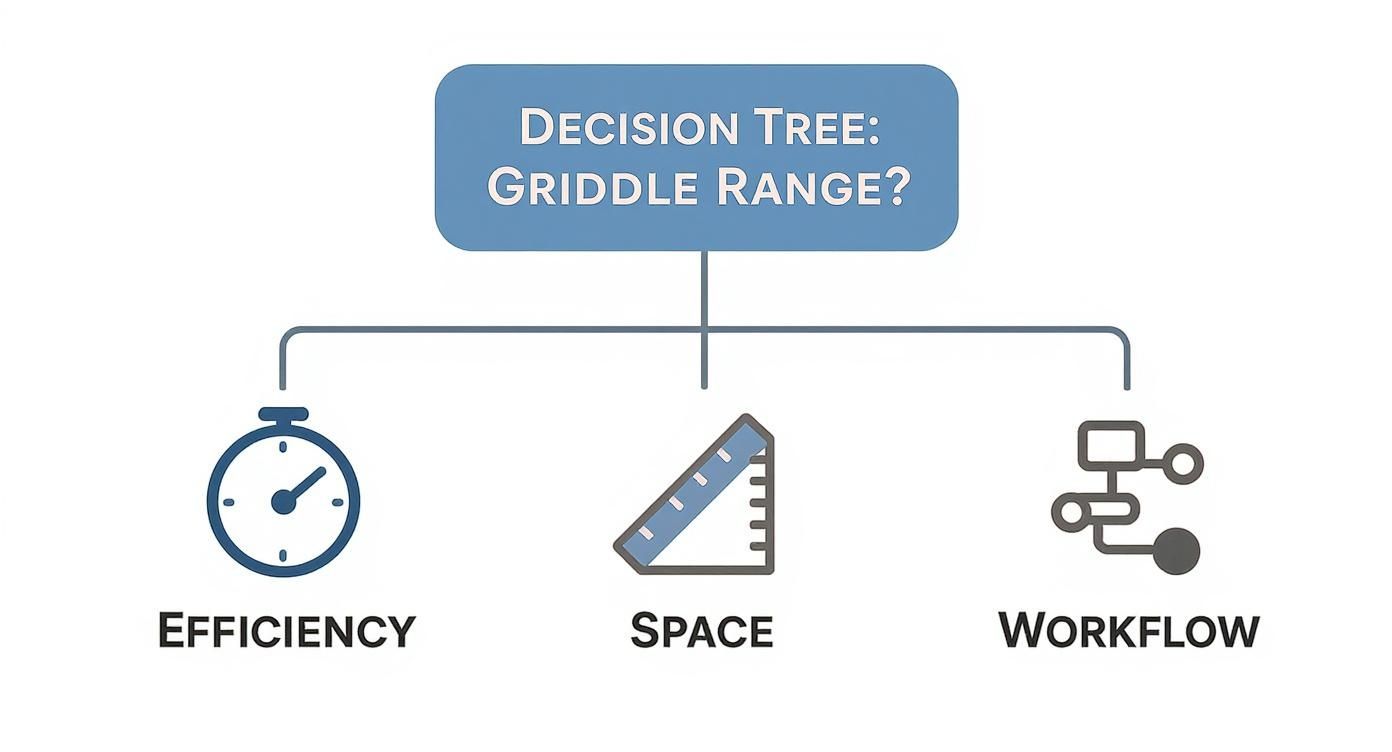
As you can see, there’s no single "best" answer. The right choice is the one that aligns perfectly with your kitchen's needs, whether that’s raw power and efficiency, pinpoint precision, or the freedom to cook anywhere.
Matching Griddle Plate Thickness to Your Menu

When you're shopping for a commercial range with griddle, it's easy to get lost in the specs. But the thickness of that steel plate? That’s one detail you can’t afford to overlook. It’s not just a slab of metal; it’s the engine that powers your cooking speed, heat retention, and your kitchen’s ability to survive a Saturday night rush.
I like to think of it as choosing an athlete for your line. A thinner plate is your sprinter—it heats up incredibly fast, getting you from a cold start to cooking in minutes. But just like a sprinter, it runs out of steam quickly. Throw a dozen frozen burger patties on it, and you'll see that heat vanish.
A thicker plate, on the other hand, is your marathon runner. It takes its sweet time getting up to temperature, but once it's hot, it holds that heat like a champ. That stability, or thermal mass, is what lets you slam it with order after order without the temperature plummeting. It's the key to consistent results, from the first ticket to the last.
Thin vs. Thick Griddle Plates
In the commercial world, griddle plates typically run anywhere from 1/2-inch to over 1-inch thick. Knowing how that thickness performs in a real kitchen will help you match the gear to your menu.
- Thin Plates (Around 1/2-Inch): Perfect for operations that need to get going fast. Think breakfast cafes serving up pancakes, eggs, and bacon. You get a quick warm-up and the plate responds instantly when you adjust the temperature.
- Thick Plates (3/4-Inch to 1-Inch and Up): This is the workhorse for any high-volume kitchen. If you run a busy diner or a burger joint, you need a thick plate that can take the constant shock of cold food hitting its surface and still maintain a blistering sear. Its ability to bounce back, known as recovery time, is what keeps your food sizzling instead of steaming.
For most restaurants with a varied menu, a 3/4-inch to 1-inch plate hits the sweet spot. It offers a great balance between a reasonable heat-up time and the thermal stability needed to handle almost anything you throw at it.
Choosing the Right Surface Material
It’s not just about how thick the plate is; the surface material matters just as much. Your two main players in the commercial space are standard steel and chrome.
The surface of your griddle directly impacts everything from food release and flavor transfer to the amount of time your staff spends cleaning at the end of a shift. Choosing correctly simplifies operations and improves food quality.
Standard polished steel is the undisputed industry standard. It needs to be seasoned properly to build up that beautiful, natural non-stick layer. Once you do, it’s unbeatable for creating that perfect Maillard reaction—the delicious, brown crust you want on a burger or steak.
Chrome-plated griddles are a different animal entirely. Their non-porous, mirror-like surface is incredibly easy to clean and radiates far less heat into the kitchen, which your cooks will definitely appreciate. Because chrome doesn't hold onto flavors, you can cook fish and then flip pancakes without any taste transfer. This makes it an amazing choice for kitchens that need to cook a huge variety of items on one surface.
Selecting the Right Size and Configuration
Picking the right commercial range with griddle is a bit like buying a new truck—it has to fit in your garage, but it also has to be powerful enough to do the job. Go too big, and you'll choke out your kitchen's workspace. Go too small, and you'll create a massive bottleneck during the dinner rush, killing ticket times and leaving your cooks scrambling. The sweet spot is that perfect balance between footprint and production power.
First thing’s first: bust out the tape measure. But don't just measure the gap you're trying to fill in the cook line. You absolutely have to account for clearance on all sides for proper ventilation and safety. That’s a non-negotiable in any commercial kitchen. Common widths like 24-inch, 36-inch, and 60-inch models give you plenty of options, but the real decision goes way beyond a simple measurement.
Matching Layout to Workflow
Once you know your physical limits, you get to the fun part—choosing a configuration. This is where you perfectly match the appliance's layout to your menu and kitchen flow. A super popular and versatile setup is a 36-inch range with a 24-inch griddle sitting next to two open burners. This lets a line cook sear burgers or flip pancakes on the griddle while simultaneously managing sauces or simmering sides on the burners.
For a high-volume spot like a classic diner or a busy steakhouse, a beast of a 60-inch or 72-inch unit might be the only way to go. These workhorses often feature a huge griddle section, six or more burners, and sometimes even a built-in convection or standard oven underneath. It’s an entire high-output cooking station in one piece of equipment, and consolidating like that is the foundation of an efficient kitchen.
The best configuration isn't about getting the most burners or the biggest griddle. It's about putting the right tools in the right place so your team can work faster and smarter. Plan your layout around what you cook most.
The market backs this up. There's a huge demand for all sorts of sizes, with some commercial units taking up over 40 square feet to serve busy restaurants and food trucks. Experts see this segment growing between 5% and 7% every year through 2033, which just goes to show that the flat-top is here to stay. You can check out more market data on the rise of flat-top griddles in professional environments on archivemarketresearch.com.
Ultimately, the best choice has everything to do with what you're putting on the plate. A small breakfast cafe has completely different needs than a sprawling hotel kitchen, and their ideal range with griddle will look worlds apart. By mapping your menu to specific configurations, you can easily browse the commercial ranges available at Griddles.com and find the one that’s a perfect match for your operation.
Mastering Installation and Maintenance
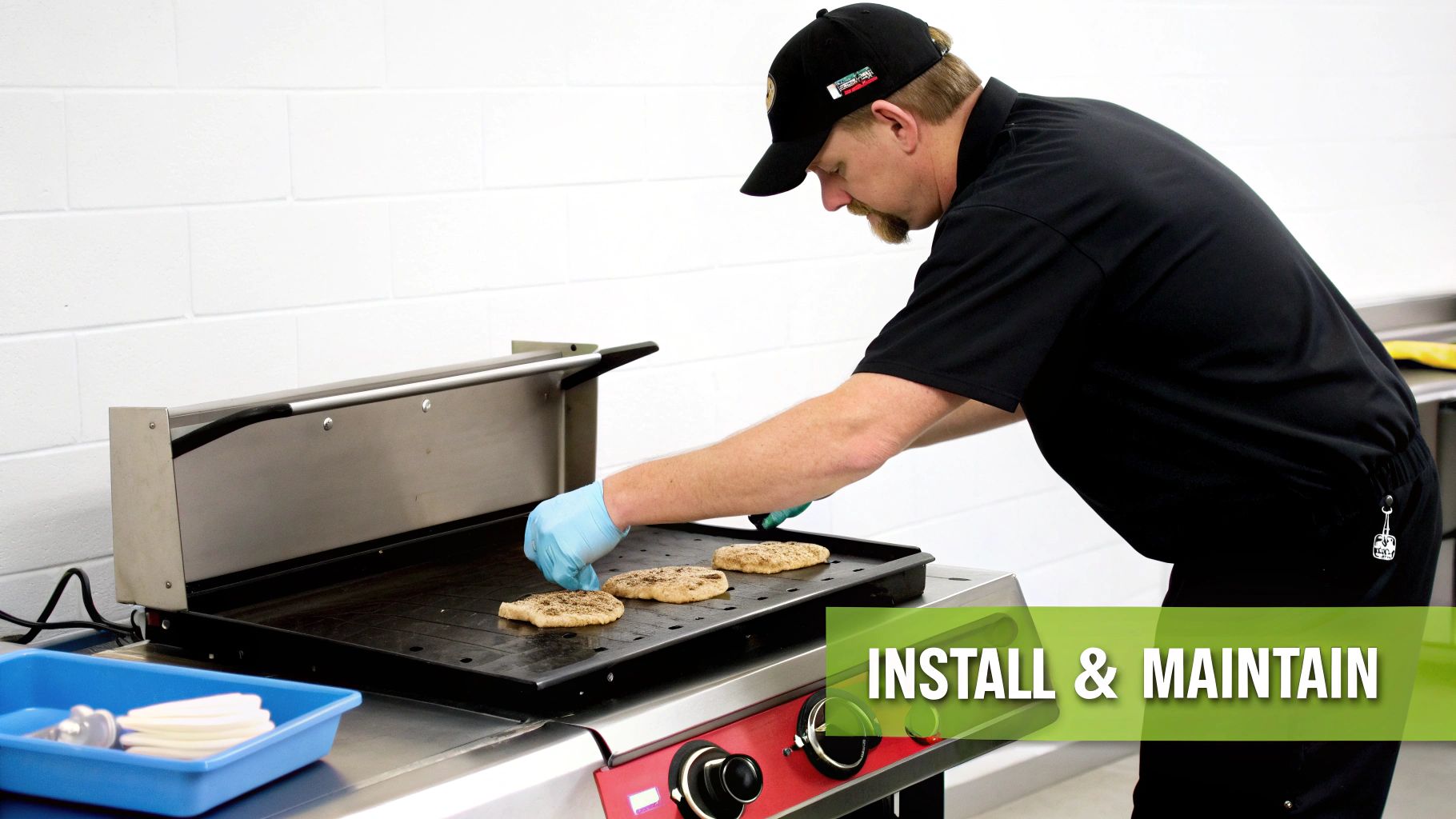
Think of your new commercial range with griddle as a long-term investment, the engine that powers your kitchen. But like any high-performance engine, its lifespan and output depend on how you treat it. This starts long before you flip your first burger—it begins with proper installation and is carried through with consistent maintenance.
Let’s be clear: this isn't a DIY weekend project. A commercial range is a serious piece of equipment with complex gas lines, ventilation requirements, and fire suppression hookups. Professional installation is non-negotiable. It's the only way to meet local safety codes and ensure your kitchen is operating legally and safely from the get-go.
Building a Bulletproof Maintenance Routine
Once your range is safely installed, keeping it reliable is up to you. A simple, proactive maintenance schedule is your best defense against the dreaded mid-service breakdown and expensive emergency repair calls. This isn't just about wiping it down; it's about preserving the heart of your operation.
A well-maintained griddle doesn't just last longer—it cooks better. Daily care prevents old flavors from ruining new dishes and stops equipment failure in its tracks. Plus, regular checks keep it running efficiently, saving you real money on repairs and energy.
The best approach is to break it down into easy, repeatable tasks for every shift, week, and month.
Daily Tasks (End of Every Shift)
- Scrape and Clean: While the griddle plate is still warm, grab a scraper and get all that leftover food and grease off. A good wipe-down stops that tough carbon crust from building up.
- Empty Grease Trap: It takes seconds, but it's crucial for sanitation and fire safety. Don't skip it.
- Light Seasoning: After it's clean, a very thin coat of cooking oil protects the steel surface. If you want to master this essential step, you can learn more about how to season a new griddle in our complete guide.
Performing Key Preventative Checks
Beyond the daily clean-up, a few quick inspections will help you spot trouble before it starts. Set a recurring reminder in your calendar for these—it'll keep your range with griddle in prime condition.
Weekly and Monthly Checks
- Inspect Connections: Take a quick look at all the gas hoses and fittings. You're searching for any signs of cracking, wear, or potential leaks.
- Calibrate Thermostats: Once a month, grab an infrared thermometer and check the surface temp against what the dial says. If they don't match, you're flying blind and risking food quality.
- Test Burner Ignition: Make sure every burner and the griddle itself fires up quickly. You want a steady, blue flame. If you see a weak or yellow flame, that's a red flag that it's time to call in a pro.
This disciplined approach turns maintenance from a chore into a smart business strategy, ensuring your range stays a reliable workhorse for years to come.
Your Commercial Griddle Questions Answered
Even after covering the essentials, you probably have a few more questions rattling around. We get it. Here are some straight answers to the most common things we hear from chefs and owners about picking out and running a commercial range with a griddle.
Key Operational Questions
How often do I need to season a new commercial griddle?
When your steel griddle is brand new, it needs a good, thorough seasoning before you cook anything on it. This is what builds that slick, non-stick surface every line cook loves. After that big initial seasoning, all it takes is a quick, light coat of oil after each cleaning to keep it in prime condition and prevent rust.
Good news if you go with chrome, though—those plates don’t require any seasoning at all.
What is the difference between thermostatic and manual controls?
Think of thermostatic controls like the thermostat in your house. You dial in an exact temperature, and the griddle holds it there. This is a lifesaver for delicate items that burn easily, like eggs or pancakes.
Manual controls are more old-school, giving you simple low, medium, and high settings. This puts experienced chefs in the driver's seat, offering raw power and instant response for cranking out burgers and steaks at full speed.
Choosing between thermostatic and manual controls directly impacts your menu's consistency. Thermostatic offers precision for delicate items, while manual provides raw power and speed for high-volume searing.
Installation and Plate Material
Can I install a commercial range in my home kitchen?
We hear this one a lot, and the answer is a hard no. It's not just a bad idea; it's often illegal. Commercial ranges are beasts—they pump out incredible heat and require heavy-duty ventilation and fire suppression systems that a residential kitchen just isn't built for. Trying to install one at home is a serious fire hazard and will almost certainly violate local building codes.
Which griddle plate material is easiest to clean?
Hands down, chrome-plated griddles win this one. Their mirror-smooth, non-porous surface means food has nowhere to stick, making cleanup a simple wipe-down. It's a night-and-day difference compared to standard steel plates, which demand constant scraping and diligent re-seasoning to stay clean and functional.
It's no surprise that powerful, multi-function cooktops are in high demand. The U.S. market for range cookers, which includes these integrated griddle models, was valued at USD 1.86 billion in 2024. That number is expected to jump to USD 3.19 billion by 2030 as more kitchens look for this kind of versatility. You can learn more about the U.S. range cooker market trends on grandviewresearch.com.
Ready to find the perfect workhorse for your kitchen? The experts at Griddles.com are here to help you select the ideal commercial range with a griddle that fits your space, menu, and budget. Explore our collection of commercial ranges and get free shipping today!