

120 vs 240 Volts: Choosing Your Commercial Griddle
When you're looking at a new commercial griddle, the 120V vs. 240V question boils down to a classic trade-off: convenience versus raw power. A 120V griddle gives you plug-and-play simplicity, which is a lifesaver for smaller professional setups. On the other hand, a 240V model is the workhorse that high-volume kitchens need for blistering heat-up and recovery times. Your choice really hinges on what your commercial operation values more—flexibility or cooking muscle.
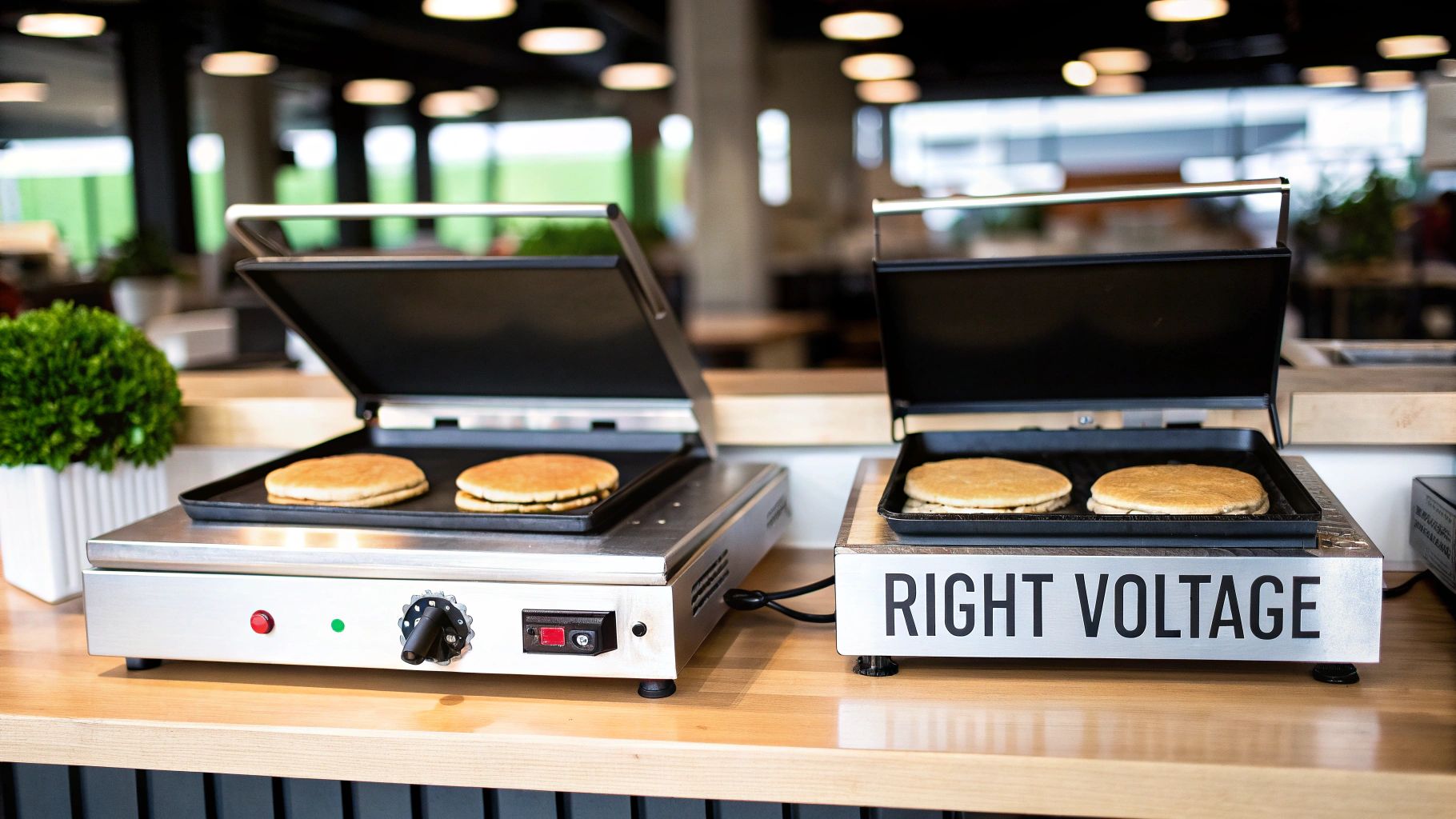
Choosing the Right Griddle Voltage for Your Kitchen
Picking the right electrical setup for your commercial griddle isn't just a technical detail—it's a decision that will hit your kitchen's efficiency, the quality of your food, and your bottom line. This isn't about which voltage is "better" overall, but which one is the right tool for your specific commercial job. Getting a handle on the core differences is the first step to making a smart investment.
A 120V commercial griddle is the definition of convenient. It plugs into any standard wall outlet, meaning zero installation headaches. This makes it a perfect match for:
- Low-volume use: Think small cafes or pop-ups where the griddle isn't running from open to close.
- Mobile kitchens: For food trucks and caterers, the ability to plug in anywhere is a game-changer.
- Startups on a budget: You get to skip the cost of hiring an electrician for a dedicated circuit, which saves real money upfront.
In sharp contrast, a 240V commercial griddle is a beast, built to handle the non-stop grind of a busy kitchen. It's designed to pull more power for one reason: to deliver superior performance when things get hectic.
Key Differences at a Glance
The biggest distinction between 120V and 240V commercial griddles is how effectively they turn electricity into heat. Higher voltage lets a griddle hit its target temperature faster and, more importantly, stay there. It's like the difference between a garden hose and a fire hose—one has way more force. This power means quicker preheating and near-instant recovery when you drop a dozen frozen burger patties on the flat top.
The Bottom Line: A 240V system delivers more power (wattage) with less current (amperage). This translates to faster heat-up times and the ability to maintain consistent temperatures during a busy rush without tripping a breaker.
| Feature | 120V Commercial Griddle | 240V Commercial Griddle |
|---|---|---|
| Primary Use Case | Low-volume, mobile, or as a secondary unit. | High-volume restaurants, diners, and ghost kitchens. |
| Installation | Simple plug-and-play into a standard outlet. | Requires a dedicated circuit and a professional electrician. |
| Heat-Up Time | Slower to reach operating temperature. | Much faster preheating. |
| Temp Recovery | Lags when cold food is added. | Recovers almost instantly, ensuring consistent results. |
Understanding Core Electrical Concepts
To get to the bottom of the 120V vs. 240V debate for your commercial griddle, you have to know a little about what's happening behind the wall outlet. It’s less complicated than it sounds. Think of your kitchen’s wiring like plumbing—the core ideas of voltage, amperage, and wattage directly control your griddle's real-world cooking power.
Let's use a simple water hose analogy. In this picture, voltage (V) is the water pressure. It’s the sheer force pushing electricity through the wires to power your equipment. A 240V circuit simply has twice the electrical "pressure" as a 120V circuit.
Amperage and Wattage Explained
Next up is amperage (A), or amps. This is the volume of water flowing through that hose. It's the amount of electrical current actually moving through the circuit to your griddle at any given moment.
Finally, there's wattage (W), which is the total power delivered. This is what really matters because it determines how much heat your commercial griddle generates. The relationship is straightforward: Watts = Volts x Amps. This simple formula is the key to why voltage makes such a big difference for a high-demand machine like a commercial griddle.
Let's put it into practice. Imagine you have two different griddles, and both need 3,600 watts of power to hit and hold the perfect cooking temperature during a busy lunch rush.
- 120V Commercial Griddle: To get to 3,600 watts, this griddle has to pull a whopping 30 amps (120V x 30A = 3600W). That's a serious electrical load for most standard circuits.
- 240V Commercial Griddle: To deliver the exact same 3,600 watts of cooking power, this one only needs to draw 15 amps (240V x 15A = 3600W).
The difference is night and day. A 240V system gives you the same power with half the current. Lower amperage means less strain on your wiring, a much lower risk of popping a breaker mid-service, and overall more efficient power delivery.
By using higher voltage, a 240V griddle gets all the power it needs without pulling an excessive amount of current. This is exactly why almost all heavy-duty kitchen appliances are designed for 240V circuits—it’s all about reliable, powerful performance.
A Quick Look at North American Voltage
Ever wonder why both 120V and 240V are available in commercial kitchens? It’s a mix of history and practicality. Back in the late 1800s, Thomas Edison's original direct-current system ran at 110 volts, largely because the first light bulbs couldn't handle anything stronger. When more efficient alternating current systems took over, they were designed to be compatible, creating a 110/220-volt standard that eventually became the 120/240-volt system we still use.
Getting a handle on these basics helps you see past the price tag and truly understand how an electric griddle will perform day in and day out. It helps you decipher the spec sheets, anticipate installation requirements, and ultimately choose the griddle that will keep up with your business.
Comparing Griddle Performance and Efficiency
When the ticket machine won't stop spitting out orders, the real difference between a 120V and 240V commercial griddle becomes painfully obvious. This isn't about numbers on a spec sheet. It's about how your griddle performs under fire, directly impacting your kitchen's speed, the quality of your food, and your bottom line. In the 120 vs 240 volts debate, your choice dictates whether your griddle is a true workhorse or a frustrating bottleneck.
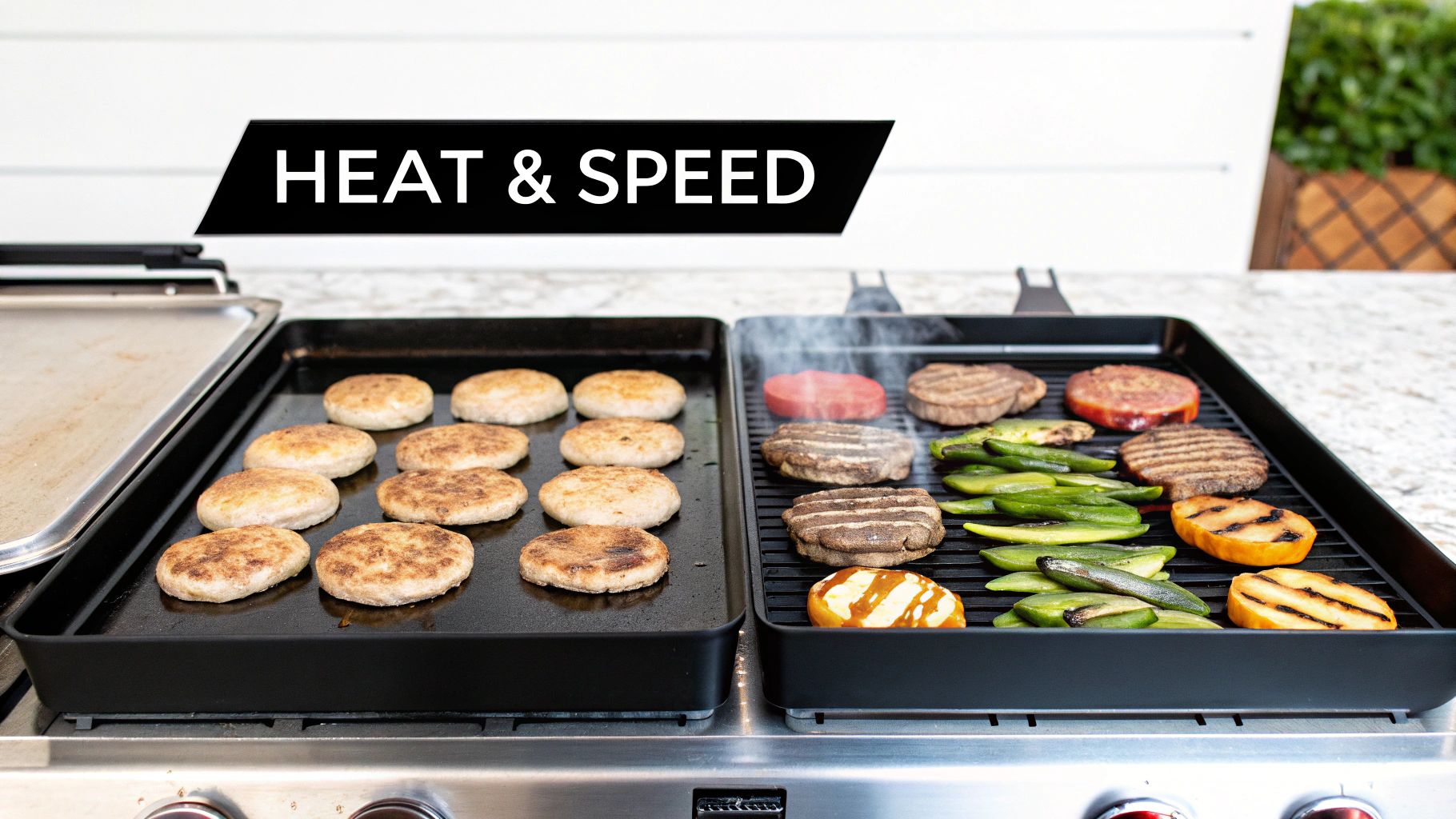
Let's dive into the metrics that actually matter in a fast-paced commercial kitchen and see how more voltage translates to more cooking power when it counts.
Heat-Up Time: The First Test of Power
Getting your commercial griddle up to temp is the first hurdle of the day, and a 240V model always wins this race. Thanks to its ability to draw more wattage efficiently, a 240V unit can be ready to go in just 5-10 minutes. A comparable 120V griddle, on the other hand, will lag behind, taking anywhere from 15-20 minutes to get hot.
This isn't just a small inconvenience. Those minutes you save add up fast, trimming labor costs and getting your kitchen ready for service sooner. That’s a huge plus during the morning prep rush.
Temperature Recovery: The True Measure of a Workhorse
Here's where the performance gap really widens. Picture your peak breakfast service: you've just slammed the griddle with two dozen cold eggs and a pound of bacon. That sudden temperature drop is the ultimate stress test for any commercial unit.
A 120V griddle will buckle under that pressure. Its limited power means a slow, sluggish recovery. Food starts to steam instead of sear, ticket times drag on, and your product quality becomes wildly inconsistent—a disaster in a high-volume kitchen.
A 240V griddle, however, has the electrical muscle to bounce back almost instantly. Its higher wattage kicks in to compensate for the heat loss, keeping the cooking surface consistently hot. That rapid recovery is what gets you a perfect sear on burgers and a golden-brown finish on pancakes, order after order. To get this level of performance, you need to find a good electric griddle that can handle your kitchen's demands.
A 240V griddle's ability to maintain a stable temperature under heavy load is its single greatest advantage. It eliminates cooking bottlenecks and ensures every dish that leaves the kitchen meets your quality standards, even during the most relentless rush.
Consistent Heat Distribution Across the Surface
Nothing ruins a chef's day faster than hot spots. While the griddle plate's material and thickness are key factors, the voltage provides the raw power needed for even heating. A 240V system pushes a more stable, robust flow of energy to the heating elements.
This stability means the entire griddle surface holds a much more uniform temperature. On a 120V commercial griddle, you'll often find the corners and edges are significantly cooler than the center, especially when it's struggling. With a 240V model, you can confidently use every single square inch of cooktop space, maximizing your output.
This table puts the performance differences side-by-side, showing the real-world impact of your voltage choice.
Commercial Griddle Performance: 120V vs 240V
| Performance Metric | 120V Griddle Reality | 240V Griddle Reality | Impact on Kitchen Operations |
|---|---|---|---|
| Heat-Up Time | Slower to reach operating temperature (15-20 min). | Significantly faster preheating (5-10 min). | Faster startup reduces prep time and labor costs. |
| Temperature Recovery | Struggles to rebound after adding cold food. | Recovers heat almost instantly under a full load. | Prevents service bottlenecks and ensures consistent food quality. |
| Heat Consistency | Prone to hot spots and cooler edges. | Maintains even heat across the entire surface. | Maximizes usable cooking area and improves product uniformity. |
| Peak Hour Performance | Becomes a bottleneck, slowing down ticket times. | Easily handles high-volume demand without performance loss. | Increases throughput and supports kitchen efficiency during rushes. |
At the end of the day, a 240V commercial griddle is simply built for the demands of a professional kitchen where speed and consistency are everything. A 120V unit might work for light-duty commercial use, but it just doesn't have the horsepower to perform under the sustained pressure of a professional environment.
Navigating Installation and Cost Requirements
Beyond pure power, the real-world logistics of installation and cost are huge factors in the 120V vs 240V debate for commercial griddles. A griddle’s price tag is just the start. The true cost of ownership depends entirely on your kitchen’s electrical setup, and understanding these expenses upfront is key to smart budgeting and avoiding nasty surprises.
A 120V commercial griddle is the path of least resistance. These machines typically come with a standard NEMA 5-15P plug—the normal three-prong plug you find on many commercial appliances. This makes setup a simple "plug-and-play" affair, letting you connect to most commercial outlets without calling in a pro. For a food truck or a small pop-up, this convenience is a game-changer, slashing initial setup costs to nearly zero.
The Demands of a 240V Installation
A 240V griddle, on the other hand, is a whole different animal. It needs its own dedicated, high-amperage circuit and a specialized outlet, like a NEMA 6-20R. This isn’t a DIY weekend project; installing a 240V circuit is a job that absolutely requires a licensed electrician.
Getting this done involves a few steps, and each one adds to the bill:
- New Circuit Breaker: An electrician will need to install a new double-pole breaker in your electrical panel to handle the griddle's higher amp draw.
- Heavy-Gauge Wiring: A dedicated, thicker-gauge wire has to be run from the panel straight to where your griddle will live.
- Specialized Receptacle: The proper NEMA outlet that matches your griddle's plug must be installed.
- Labor Costs: Professional electricians typically charge anywhere from $50 to $130 per hour, and a new circuit install can take several hours depending on how complex the wiring run is.
This is exactly why you need to get your building's electrical capacity checked before you even think about buying a 240V unit. Have an electrician inspect your panel to make sure it has the space and power to handle the extra load.
The real cost of a 240V griddle goes far beyond what you pay for the unit itself. You have to factor in the professional installation—which can easily tack on several hundred dollars or more—to make a smart financial choice.
Understanding Your Building's Electrical System
Having both 120V and 240V available is a unique feature of the power grid in North America. The system uses a split-phase design that delivers both voltages to commercial buildings. This setup lets kitchens run standard 120V circuits for everyday gear while also powering heavy-duty 240V equipment like your griddle. You can get a deeper dive into how this all works by reading about the history of North American voltage standards on NaturesGenerator.com.
Before you commit to a griddle, take a hard look at your kitchen’s existing electrical infrastructure. Powerful cooking equipment often comes with specific ventilation rules for safety and compliance, so make sure your entire setup is up to code.
In the end, while the upfront investment for a 240V griddle and its installation is higher, the superior performance often makes it a worthwhile cost for high-volume kitchens. But for businesses where budget and simplicity are the top priorities, the easy, no-fuss installation of a 120V unit is a perfectly practical and attractive choice.
Which Griddle Voltage Is Right for Your Business
Picking between a 120V and 240V commercial griddle isn't really about the technical specs—it’s about the reality of your kitchen. The right choice comes down to your menu, how slammed you get during a rush, and the electrical setup you're working with. Getting it wrong can mean a frustrating bottleneck during your busiest hours or, just as bad, paying for power you’ll never actually use.
Let's break down the ideal scenarios for each voltage to make sure your investment is a smart one.
The Case for a 120V Griddle: Flexibility and Simplicity
A 120V commercial griddle is the undisputed champ of convenience. Its biggest advantage is its simple plug-and-play nature. No special electrical work needed. This makes it the only real choice for operations where you need to be nimble and high-volume output isn't the main goal.
Here’s where a 120V model really shines:
- Food Trucks and Mobile Caterers: When your kitchen is on wheels, being able to plug into any standard outlet at an event is a must. A 120V griddle gives you the freedom that a mobile business absolutely depends on.
- Small Cafes and Concession Stands: If you're just knocking out breakfast sandwiches or quesadillas, a 120V unit has all the power you need without the upfront cost and hassle of a 240V installation.
- Low-Volume or Secondary Use: In a larger kitchen, a 120V griddle is perfect as a backup or secondary unit. Maybe you dedicate it to gluten-free items or use it for specific, low-demand dishes. It gets the job done.
For these kinds of businesses, the slightly slower heat-up and recovery times are a fair trade for the big savings on installation and the sheer ease of getting it up and running.
The Case for a 240V Griddle: Power and Reliability
When your business lives and dies by speed, volume, and consistency, a 240V commercial griddle isn't just a nice-to-have—it's a necessity. This is the workhorse built for the relentless pressure of a busy commercial kitchen. It delivers the raw power you need to keep quality high and tickets moving during the lunch rush.
A 240V griddle is the go-to tool for these high-demand spots:
- Bustling Diners and Breakfast Restaurants: An operation pumping out hundreds of pancakes, eggs, and burgers an hour can't afford to wait for a griddle to catch its breath. The almost instant heat recovery of a 240V unit is crucial for keeping ticket times down.
- High-Output Ghost Kitchens: In a delivery-only model, speed is everything. A 240V griddle ensures the kitchen can handle a constant flood of online orders without slowing down, maximizing every minute.
- Restaurants with Demanding Menus: Any kitchen where the griddle is the star of the show all day—from morning hash browns to evening seared fish—needs the rugged, reliable power that only a 240V system can deliver.
This quick flowchart sums up the basic installation choice you're facing.
It really is that simple: if your building is wired for a high-power appliance, a professional install unlocks serious performance. If not, the plug-and-play route gets you cooking immediately.
Your Final Decision Checklist
The investment in a 240V commercial griddle, including the cost of a pro install, is easily justified by the performance it brings to the table. It’s the engine that drives a high-volume kitchen. To make the final call with confidence, run through this checklist.
Commercial Griddle Decision Checklist:
- Menu Complexity: How much of your menu lives on the griddle? If it’s your primary cooking surface for an all-day menu, you should be leaning toward 240V.
- Peak Customer Traffic: How many orders are flying out during your busiest hour? For those non-stop rushes, 240V is the only way to avoid a service train wreck.
- Kitchen Space and Workflow: Is this griddle going to be a central, high-use station? A powerful 240V unit maximizes every square foot of your line.
- Electrical Infrastructure: Does your building's panel have the capacity for a dedicated 240V circuit? Get an electrician to confirm before you buy anything.
- Future Growth Plans: Do you plan on expanding your menu or expect to get busier? Choosing a 240V griddle now can save you the headache and cost of an upgrade down the road.
Answering Your Griddle Voltage Questions
Even after weighing the performance and installation factors, a few key questions always pop up when choosing between a 120V and 240V commercial griddle. Getting these details right can save you from a world of headaches and costly mistakes down the road. Let's clear up some of the most common queries we hear from kitchen operators.
We'll tackle the big ones: converting voltage, the truth about energy efficiency, and the most common electrical slip-ups that can bring your kitchen to a screeching halt.
Can I Convert a 120V Griddle to Run on 240V?
This question comes up a lot, and the answer is a hard no. Commercial griddles are built for one specific voltage, period. All the internal guts—the heating elements, wiring, thermostat, and safety controls—are specifically rated for either 120V or 240V. They aren't interchangeable.
Trying to force a 120V griddle to handle a 240V circuit isn't just a simple tweak. You'd have to gut the machine and replace nearly every electrical part with components designed for the higher voltage. The cost would be astronomical, you'd instantly void the warranty, and you’d create a massive fire risk if the job wasn't done flawlessly.
It is always safer, cheaper, and smarter to buy the griddle that matches the voltage you have. Never try to convert a griddle’s voltage yourself or let an unauthorized technician attempt it.
If you bought a 120V griddle but really need 240V power, your only real move is to sell the current unit and invest in the right tool for the job.
Is a 240V Griddle More Energy-Efficient?
This is a really common misconception. A 240V commercial griddle is way more powerful, but it doesn't magically use less electricity to do the same amount of work. When it comes to pure energy consumption, they're practically identical.
Remember the basic power formula: Watts = Volts x Amps. If a griddle needs 3,600 watts to hold its temperature, it’s going to pull 3,600 watts whether it’s plugged into a 120V or 240V outlet. The difference is how it draws that power.
- A 120V model needs to pull 30 amps to get 3,600W.
- A 240V model only needs to pull 15 amps for the same 3,600W.
Where the 240V unit gains a slight edge is in real-world operational efficiency. Because it heats up so much faster and recovers temperature instantly, it spends less time actively running its heating elements to catch up. A 120V griddle that’s constantly fighting to stay hot might end up running longer throughout the day, which could lead to a slightly higher energy bill over time. But the main advantage of 240V is its raw power and speed, not a dramatic drop in your utility costs.
What Are the Biggest Electrical Mistakes to Avoid?
A new commercial griddle is a major purchase. The last thing you want is for a simple, preventable electrical mistake to turn it into a costly disaster. Staying ahead of these common slip-ups will ensure your installation is smooth and safe.
Here are the top three electrical mistakes we see kitchen operators make:
- Not Checking the Breaker Box First: This is the big one. You can't just buy a monster 240V griddle and assume your building can handle it. You need a licensed electrician to inspect your panel to make sure there’s enough overall capacity and physical room for a new dedicated circuit. Overloading your panel isn't just an inconvenience; it's a serious fire hazard.
- Using an Extension Cord: Never, ever plug a commercial griddle into an extension cord. High-draw appliances, especially 240V models, pull a massive amount of current. A standard extension cord can’t handle that load—it will overheat, melt, and potentially start a fire. The griddle must be plugged directly into a properly rated wall outlet.
- Assuming All Outlets Are the Same: A 240V plug is not just a 240V plug. Different amperage ratings require different NEMA plug shapes and outlet configurations (like a NEMA 6-20 versus a NEMA 6-30). Double-check the griddle's spec sheet for its exact plug type and make sure your electrician installs the correct matching outlet. This avoids frustrating delays and extra costs on installation day.
By sidestepping these common blunders and working with a qualified electrician, you can get the right griddle up and running with confidence, ready to be the workhorse of your kitchen.
Ready to equip your kitchen with a griddle that delivers unmatched power and reliability? Griddles.com offers a curated selection of high-performance commercial griddles designed for the toughest kitchen environments. Explore our catalog and find the perfect model for your needs at https://griddles.com.