

How to Find a Good Commercial Electric Griddle for Your Professional Kitchen
When you’re in the market for a commercial electric griddle, you’re not just buying another piece of equipment. You’re making a serious investment in your kitchen’s speed, consistency, and ultimately, its reputation. A truly good electric griddle is a workhorse—it delivers powerful, even heat across the entire surface and bounces back fast, even when you slam it with orders during the peak rush.
What Makes a Commercial Electric Griddle Truly Good
Let's cut through the noise. Forget the flashy marketing and endless spec sheets for a minute. When you get right down to it, the quality of any commercial griddle hinges on just three things that will make or break your service.
In the heat of a dinner rush, a "good" griddle is one that just works, every single time, without you having to think about it.
It really boils down to these core pillars:
- The Cooking Surface: The material and thickness of the griddle plate are everything. This determines how well it holds heat and how food behaves on its surface.
- Heat Control & Recovery: This is all about how accurately the griddle holds its temperature and, crucially, how quickly it gets back up to temp after you drop a dozen frozen patties on it.
- Operational Size: Simply put, does it fit your space and can it handle your busiest hour?
This decision-making process is pretty straightforward once you know what to look for.
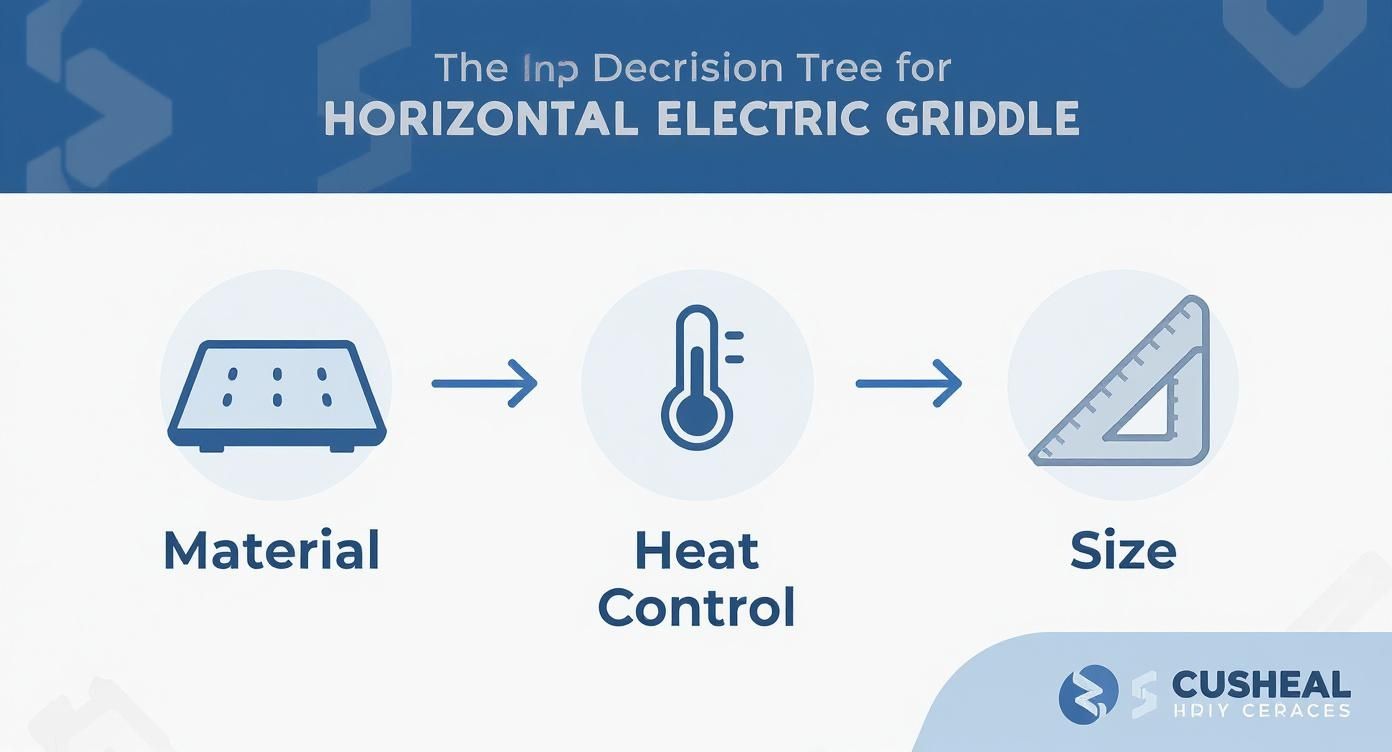
As you can see, nailing these three fundamentals—the right material, precise heat management, and the correct size—is the path to buying a griddle that becomes an asset, not a constant headache.
To help you keep these key points in mind, here's a quick reference table.
At-a-Glance Commercial Griddle Decision Guide
This table summarizes the essential factors to weigh when choosing a commercial electric griddle for your professional kitchen.
| Critical Feature | Why It's a Game-Changer | Best For This Kitchen |
|---|---|---|
| Griddle Plate Thickness | Thicker plates (¾-inch to 1-inch) hold heat better, preventing temperature drops and ensuring consistent cooking during high-volume service. | High-volume diners, fast-casual burger joints, and any operation cooking from frozen. |
| Surface Material | Steel is the all-around workhorse. Chrome prevents flavor transfer and is easier to clean, but requires more delicate handling. | Steel is great for most applications. Chrome is ideal for kitchens cooking diverse menus (e.g., pancakes then fish). |
| Thermostatic Controls | Provides precise temperature settings, giving you control over the final product. Far superior to manual controls for consistency. | Any kitchen that values consistency, from breakfast spots needing perfect golden-brown pancakes to steakhouses searing meat. |
| Heat Recovery Speed | A powerful griddle gets back to cooking temperature almost instantly, which is critical for turning tables quickly during a rush. | Every commercial kitchen, but especially those with non-stop, back-to-back orders. Slow recovery kills ticket times. |
Thinking through these points will put you miles ahead in finding the perfect griddle for your specific needs.
The Foundation of Performance
Before you even look at specific brands, you need to understand how these elements play out in the real world.
Picture a classic, bustling breakfast diner. A griddle with a thick, one-inch steel plate is non-negotiable. It holds that heat like a champ, so when the line cook drops two dozen eggs and a pile of hashbrowns, the surface temperature doesn't crash. That’s what we mean by performance.
In a professional kitchen, performance isn't just a nice-to-have feature—it’s the baseline requirement. A griddle that can’t keep up with your ticket times is a liability, plain and simple. It impacts food quality, service speed, and customer happiness.
On the other hand, if your restaurant cooks a little bit of everything, a chrome surface might be the better play. It’s fantastic for preventing flavor transfer, so the delicate crepes you made don't end up tasting like the seared salmon from the previous order. Every choice you make, from the plate material to the thermostat, should directly solve a problem presented by your menu. This guide is here to walk you through that process.
Choosing the Right Commercial Griddle Plate Material and Thickness
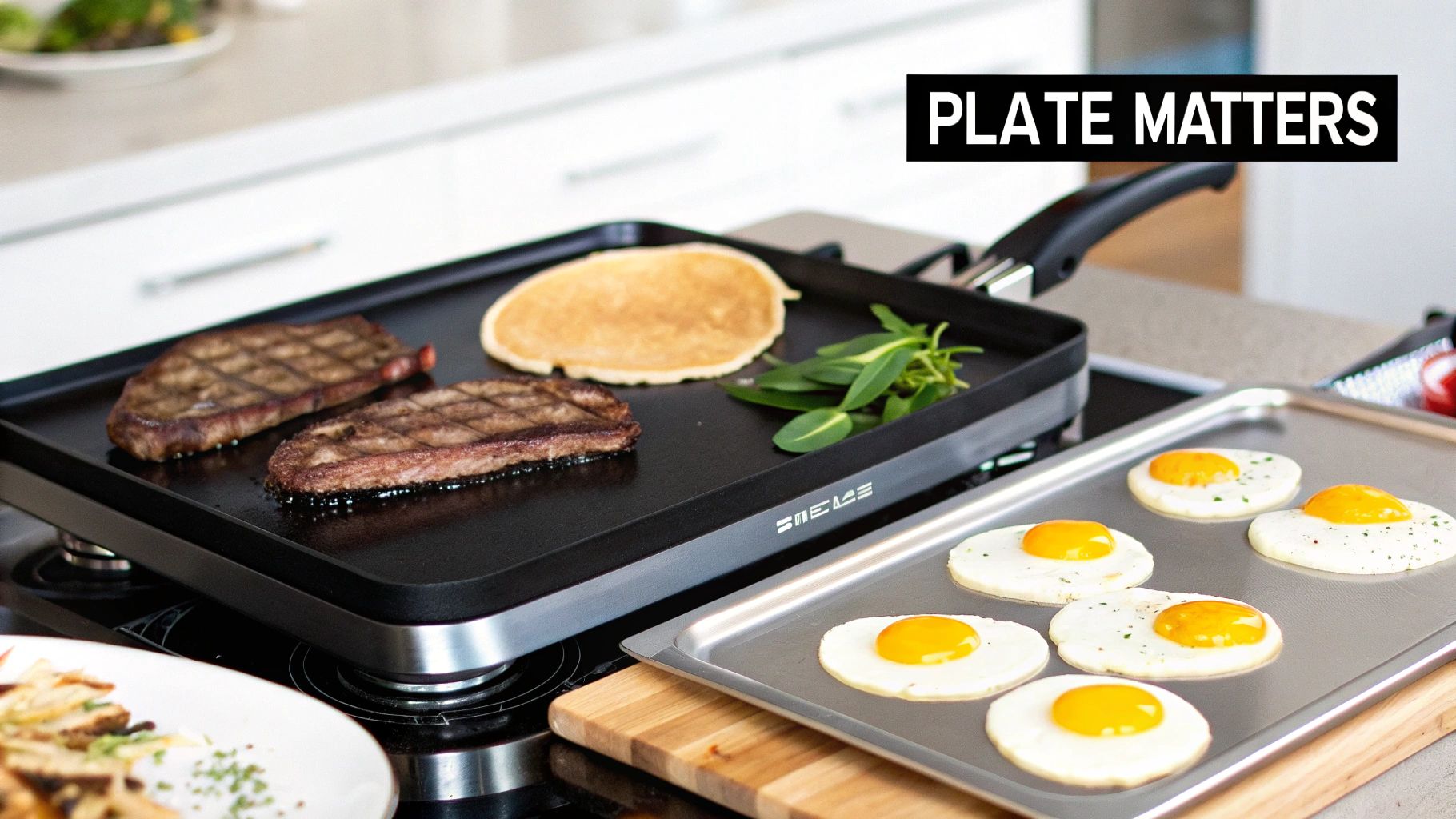
Let's be blunt: the griddle plate is the single most important part of your new commercial griddle. It’s the heart and soul of your operation. Everything else is secondary.
Think of that slab of metal as a thermal battery. Its job is simple but critical: store a massive amount of heat and dump it into the food consistently. Get this part right, and your kitchen runs smoother.
For the vast majority of professional kitchens—especially if you're slinging burgers, steaks, or anything that needs a hard sear—steel is the undisputed king. It’s a workhorse material that seasons beautifully over time, developing that coveted natural non-stick surface. It can handle the abuse of a busy service, no questions asked.
But it’s the thickness of that steel plate that truly separates a professional-grade machine from a lesser model.
Why Plate Thickness Is Non-Negotiable
A thin griddle plate (say, around ½-inch) might seem appealing because it heats up fast. But that’s a trap. It loses heat just as quickly.
Picture the lunch rush. You drop a dozen frozen burger patties on a thin plate. The surface temperature immediately crashes. Instead of that satisfying sizzle, you get a weak hiss. The meat steams, cooking slows to a crawl, and your ticket times go through the roof.
This is exactly why a thicker plate—ideally ¾-inch to 1-inch thick—is worth every penny. That extra mass of steel is your thermal insurance policy. It holds onto heat like a bulldog. When cold food hits the surface, the temperature barely flinches, giving you an instant, powerful sear and lightning-fast recovery.
- 1-Inch Thick Plate: This is the gold standard for high-volume operations. Think steakhouses and burger joints that need relentless, unwavering heat from open to close. The heat retention is second to none.
- ¾-Inch Thick Plate: A fantastic all-rounder for bustling diners and fast-casual spots. It strikes a perfect balance between heat retention and responsiveness for a mixed menu of breakfast, lunch, and dinner.
A thicker plate is your buffer against the chaos of a busy service. Your cooks can work faster and with more confidence, knowing the griddle won’t let them down, from the first ticket to the last.
When to Consider a Chrome Plate
While steel is the go-to for most kitchens, chrome has its place for very specific menus. A chrome-plated griddle has a slick, non-porous surface that offers a couple of unique advantages.
First, it’s a master at preventing flavor transfer. This is a game-changer if you’re cooking delicate items like pancakes one minute and something savory like fish the next. No lingering flavors will carry over.
Second, it radiates less ambient heat, which can make for a slightly cooler and more comfortable kitchen. The downside? Chrome needs a little more TLC. You have to be careful with metal utensils to avoid scratching the surface, and it won't build up that rugged seasoning you get with steel.
Let's put it in a real-world context:
- A breakfast cafe that lives and dies by its eggs and pancakes needs a pristine surface. Any hint of bacon flavor on a crepe is a disaster. Here, a chrome-plated griddle is the perfect solution.
- A food truck cranking out hundreds of smash burgers an hour needs pure, unadulterated searing power. For them, a 1-inch thick steel plate is the only choice that makes sense.
At the end of the day, matching the plate material and thickness to your menu is the first and most critical decision you'll make. It sets the foundation for a griddle that will be a reliable workhorse in your kitchen for years to come.
Why Temperature Control and Recovery Speed Matter in a Commercial Kitchen
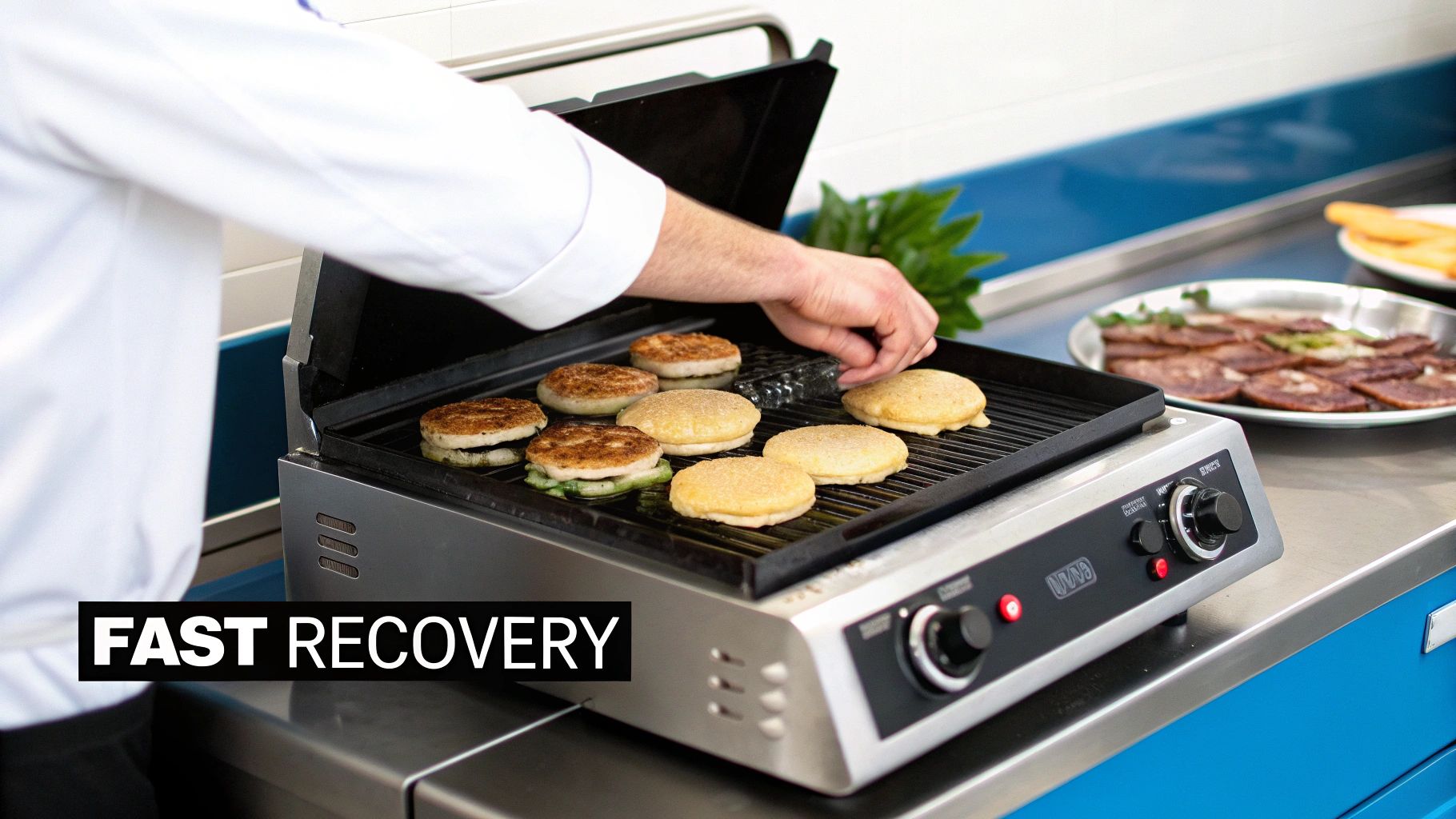
Consistency is everything in a commercial kitchen. And when it comes to your griddle, the single biggest factor affecting consistency—even more than the plate material—is how it manages heat. A good electric griddle doesn't just get hot. It gets to the right temperature and stays there, no matter what you throw at it.
Picture the weekend breakfast rush. The line cook drops a couple dozen cold eggs and a whole tray of sausage onto the hot surface. This is the moment of truth where temperature control and recovery speed make or break your service.
Recovery speed is just what it sounds like: how quickly the griddle gets back up to temp after you load it with cold food. Slow recovery is a ticket killer. Food ends up steaming instead of searing, which means greasy, sad-looking product and a bottleneck at the pass. It's the difference between perfectly golden pancakes and a soggy, uneven mess.
The Two Types of Temperature Controls
In the world of commercial griddles, you’ll really only see two kinds of control systems. They both get the job done, but they offer different levels of precision that directly translate to the quality of your food.
-
Thermostatic Controls: These are the reliable workhorses you find in most professional kitchens. You set a temperature, and an internal thermostat kicks the heating elements on and off to stay in that ballpark—usually within +/- 15°F. For things like burgers, bacon, and cheesesteaks, this is more than enough control. If you want to dive deeper into how they work, check out our guide on thermostatic griddles.
-
Solid-State Controls: When absolute precision is non-negotiable, solid-state controls are the way to go. Using more advanced sensors, they hold the set temperature with incredible accuracy, often within +/- 5°F. This tight control eliminates the temperature swings that can ruin delicate items like scallops, crepes, or eggs.
Choosing the right control type really just comes down to your menu. If you’re slinging burgers all day, a thermostatic griddle is a smart, cost-effective choice. But if you’re in a fine-dining spot searing delicate seafood, the precision of solid-state controls is an investment that pays for itself.
Change Your Workflow with Multi-Zone Cooking
One of the best features of a modern commercial electric griddle is the ability to create independent heat zones. A multi-zone griddle has separate controls for different sections of the cooktop, letting you crank up the heat on one side while keeping another at a gentle holding temp.
This completely changes your kitchen's flow. For example, you can sear burgers at a ripping hot 400°F on one zone while toasting the buns at a perfect 300°F right next to them. The efficiency you gain is a game-changer for getting plates out faster and keeping quality high.
This kind of flexibility is becoming more and more popular. As restaurants look for efficiency, you're seeing a trend toward larger, multi-zone electric models that can handle the busiest services. And with energy costs on everyone's mind, manufacturers are stepping up, with some newer models offering up to 20% greater energy savings than their older counterparts.
How to Size Your Commercial Griddle for Peak Kitchen Workflow
Picking the right size for your commercial electric griddle is about more than just finding an empty spot on the line. Get this wrong, and you’re setting yourself up for headaches. An undersized griddle creates an instant bottleneck during a rush, while an oversized one is just a power-hungry space waster.
This is a strategic choice that comes down to one thing: your peak-hour output. Picture your busiest Friday lunch rush. How many burger patties, pancakes, or steaks are flying at once? That number tells you exactly how much cooking real estate you really need.
Calculate Your Peak Production Needs
Time to look at your menu and sales data. A high-volume breakfast spot needs to know precisely how many eggs or pancakes it can drop simultaneously without them running together. Overcrowding is the enemy—it leads to steaming instead of searing, which tanks your food quality and ticket times.
Here's a simple rule of thumb I always use: leave at least one inch of space around every single item. This gives you proper heat circulation and, more importantly, room for your line cook to actually flip and handle the food without making a mess.
Let’s run the numbers. Say your standard burger patty is 4 inches wide. You really need a 5-inch-wide slot for it on the griddle. If you need to cook 20 burgers at the same time to survive your lunch rush, you need at least 100 inches of linear cooking space (5 inches x 20 burgers). That simple math instantly shows you whether a 36-inch model will cut it or if you need to step up to a 48-inch griddle.
Match Griddle Dimensions to Your Menu
Width is just one part of the equation; you also have to think about depth. A standard 24-inch depth is a solid workhorse that fits most menus and kitchen lines perfectly.
But for kitchens with a more complex menu, a deeper 30-inch model can be a total game-changer. That extra space lets you create a "production line" on a single piece of equipment.
- Front Zone: Keep this area blazing hot for getting that initial sear.
- Back Zone: Set this to a lower temp for finishing off thicker proteins or just holding food.
This kind of setup lets you wring every ounce of productivity out of one griddle. A good electric griddle with the right footprint is as crucial as any other key appliance. If you're building out your kitchen, checking a complete commercial kitchen equipment list can help put all the pieces together.
The goal is to match the griddle's footprint not just to your physical space, but to the logical flow of your cooking process. The right size minimizes unnecessary movement for your cooks, saving precious seconds on every order.
Countertop vs. Floor Model
Finally, you’ve got to decide between a countertop griddle and a full-on floor model. This decision usually comes down to your kitchen’s existing layout and infrastructure.
- Countertop Models: These are the champs of flexibility. They're perfect for smaller kitchens or for when you just need to add a bit more griddle capacity to your current line. You can pop them on a refrigerated chef base or an equipment stand to create a killer workstation.
- Floor Models: These are the heavy hitters. They’re permanent fixtures, often built with cabinet bases for extra storage. They are the go-to for high-volume operations where the griddle is the star of the show.
Think about your utility access, ventilation hood space, and what you’ll need a year from now. A countertop unit can be moved around, but a floor model provides an unshakable, high-capacity foundation for your kitchen's most profitable station.
Finding a Commercial Griddle That’s Easy to Clean and Maintain
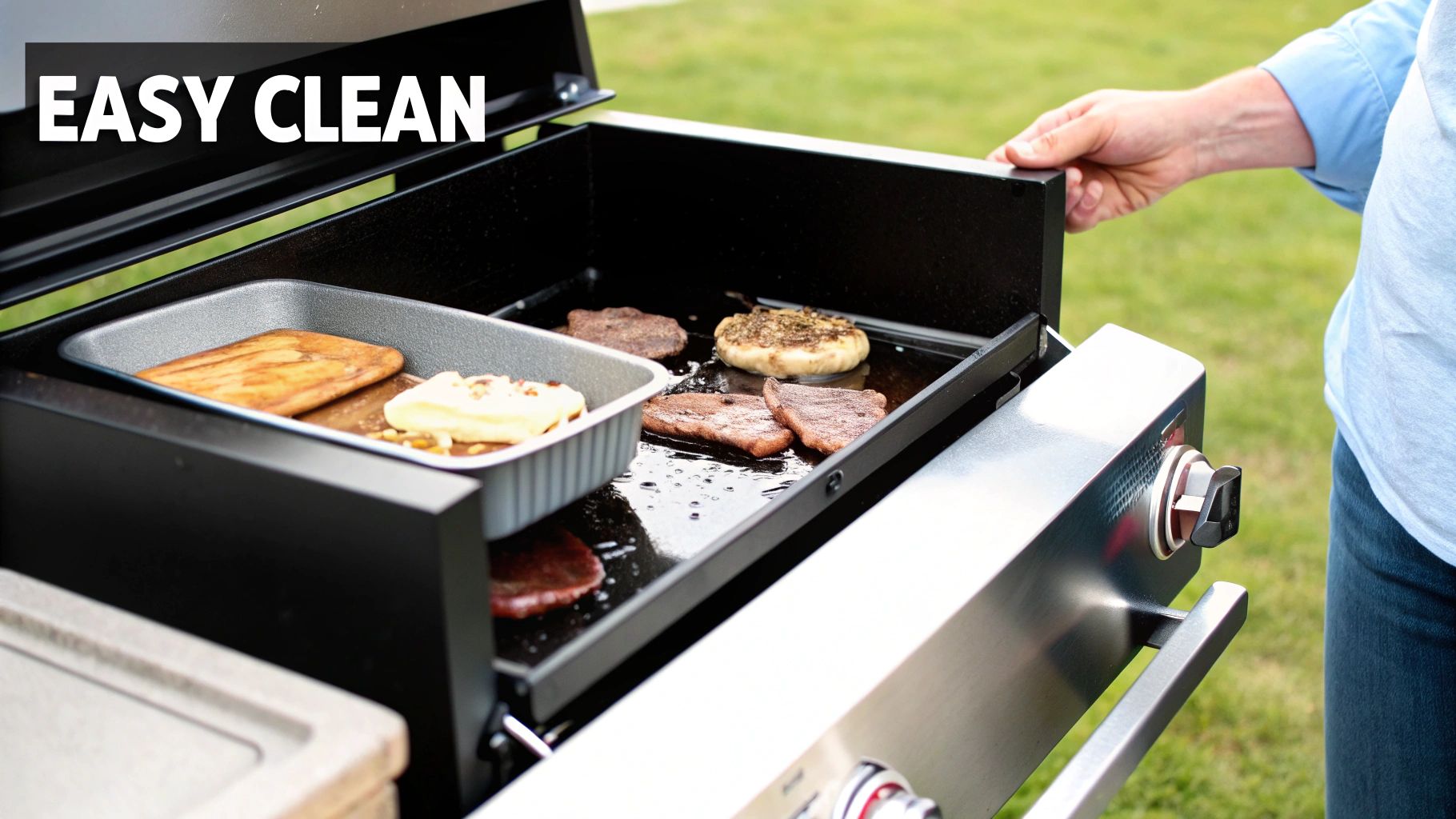
Let's be honest. After a grueling twelve-hour shift, the last thing your kitchen crew wants to face is a griddle that puts up a fight during cleanup. A unit that's a pain to clean becomes a serious drag on morale and, you guessed it, your labor costs. A good electric griddle that’s built for easy maintenance is every bit as critical as its cooking power.
The line between a quick, satisfying wipe-down and a frustrating thirty-minute scrub session often comes down to a few smart design choices. Keep an eye out for models with seamless, fully welded construction around the griddle plate and splash guards. This simple feature gets rid of all those tiny gaps where grease and grime love to hide, turning a cleaning nightmare into a simple end-of-day task.
On the flip side, griddles with bolted-on splash guards are notorious for creating grease traps that are almost impossible to get completely clean. That buildup isn't just gross; it becomes a real sanitation risk over time.
Features That Simplify Daily Cleanup
The best commercial griddles are clearly designed by people who've had to clean them. Beyond the welds, there are a couple of other non-negotiable features that will save your team time and headaches every single night.
You really want to scrutinize the grease management system. A great system isn't just one piece; it's two key components working in harmony.
- A Wide Grease Trough: It should be generously sized and sloped just right, so grease flows away from the cooking surface instead of pooling up.
- A Large Collection Drawer: Look for a drawer big enough to handle a full service without being emptied mid-rush. It also needs to slide out smoothly without catching or spilling.
A griddle with tall, wrap-around splash guards can easily save your staff 15 minutes of cleanup time every single night. That time adds up quickly, translating directly into lower labor costs and a cleaner kitchen environment.
Your Maintenance-Friendly Checklist
When you're looking at a griddle, try to see it through the eyes of the person who will be scrubbing it down at midnight. A durable stainless steel body is a given, but it’s the little details that make a huge impact on daily operations. If you want to dive deeper into the best cleaning methods, check out our guide on how to properly clean a flat top griddle.
Before pulling the trigger, run through this quick mental checklist. You'll thank yourself later. A griddle that's easy to own is just as important as one that's easy to cook on.
Thinking Beyond the Sticker Price: Power and Long-Term Costs of Commercial Griddles
When you're looking at a new commercial griddle, the price tag is just the first part of the story. A truly good electric griddle isn't just a purchase; it's an investment in your kitchen's future. What separates a smart buy from a long-term headache is thinking about the total cost of ownership right from the start.
This all begins with something surprisingly simple: your kitchen's electrical setup. Commercial griddles are serious workhorses, and they need the right kind of power to run safely and hit those consistent temperatures you rely on. Before you even think about clicking "buy," you absolutely have to know what your kitchen can handle.
Single-Phase vs. Three-Phase Power
Most professional kitchens are wired for both single-phase and three-phase power, but where you plan to put the griddle determines what you can actually use. It’s a crucial detail.
- Single-Phase Power: This is your standard for smaller, lower-wattage gear. It runs on two wires and is usually perfect for most countertop griddles that aren't expected to handle insane volume.
- Three-Phase Power: This is the heavy-hitter. Using three wires, it delivers a much more stable and powerful current for your most demanding equipment. If you're eyeing a big, high-output floor model, it's almost certainly going to require a three-phase hookup.
Don't guess on this one. Getting it wrong means a surprise visit—and a big bill—from an electrician to rewire your outlet. Always, always check the griddle's spec sheet for its voltage and phase needs, then walk over to your electrical panel and make sure they match up.
From there, you can start thinking about the long-term return. A brand-new, energy-efficient griddle with top-notch insulation might have a higher upfront cost, but it could slash your monthly utility bills. Compare that to a cheaper, older design that's constantly leaking heat and you'll see the difference pretty quickly.
This focus on efficiency is a big deal in the industry right now. The global commercial electric griddle market was valued at around $129.4 million in 2025, largely because smart foodservice operators are demanding equipment that lowers their operating costs without sacrificing quality. You can dive deeper into these trends over at Market Report Analytics. The bottom line is that an efficient model starts paying you back from day one, making it the smarter financial move in the long run.
Common Questions About Commercial Electric Griddles
When you're about to drop some serious cash on a new piece of kitchen equipment, there are always a few last-minute questions. I get it. Here are the straight-up answers to what I hear most often from chefs and managers hunting for the right electric griddle.
What Is the Single Most Important Feature on a Commercial Griddle?
Hands down, it's the griddle plate. Nothing else comes close.
The material (steel or chrome) and its thickness are the heart and soul of your griddle's performance. They dictate how well it holds heat and how fast it recovers after you slap down a dozen frozen patties. For high-volume searing—think burgers and steaks all day—a thick steel plate is your best friend. But if you’re flipping delicate eggs and pancakes, a chrome top is a better bet to keep flavors from mingling. Let your menu make the final call.
How Often Should You Deep Clean a Commercial Griddle?
The short answer? Every single day. The griddle surface needs a quick scrape-down between different foods, but a full, deep clean with a food-safe degreaser has to happen at the end of every shift. No exceptions.
For steel plates, the follow-up step is just as critical: re-seasoning. After that deep clean, you have to re-season the surface to maintain its non-stick quality and keep rust from even thinking about showing up.
Are Expensive Solid-State Controls Worth It?
This one truly comes down to what you’re cooking. Standard thermostatic controls are reliable workhorses, and for general-purpose cooking like bacon, sausage, or burgers, they do the job just fine. They're tried and true.
But if your menu features anything that demands pinpoint temperature accuracy, then solid-state controls are absolutely worth the investment. We're talking about delicate seafood, crepes, or anything that can't handle big temperature swings. Solid-state controls keep the heat incredibly steady, giving you consistent, perfect results every time.
Ready to get a reliable, high-performance griddle on your line? Explore the professional-grade selection at Griddles.com and find the perfect model to make your kitchen more efficient. Check out our commercial griddles and build out your line today.