
Finding the Best Commercial Griddle for Your Kitchen
Picking the best commercial griddle is a huge decision for any kitchen cranking out high-volume orders. This isn't about finding some one-size-fits-all "top-rated" model. It's about matching the right machine to your specific menu, your daily output, and the physical layout of your kitchen.
Get this choice right, and you'll see better food quality, a smoother workflow, and a healthier bottom line.
Finding the Right Griddle for Your Kitchen
Think of your griddle as a core profit center. It's a foundational piece of equipment that touches everything from ticket times to the consistency of your final product. Making the right call from the start means really understanding what your operation needs to thrive.
This decision is more important than ever. The market for specialty commercial cooking equipment is booming, with kitchens investing in durable, efficient equipment built for the long haul. That growth tells you one thing: kitchens are investing in gear that performs.
Three Key Factors to Nail Down
Before you even start looking at specific models, you need to get crystal clear on three things. Each one builds on the last, pointing you toward the perfect griddle for your setup.
- What’s on the Menu? Are you searing delicate fish or churning out mountains of burgers? Delicate items need precise temperature control, while high-volume breakfast service demands a large, even surface to handle pancakes, eggs, and bacon all at once.
- What’s Your Rush Hour Like? How much food are you pushing out during your busiest service? The needs of a bustling diner are worlds apart from a small cafe that only uses the griddle for a few items. Volume dictates the size and power you'll need.
- How Much Space Do You Have? Kitchen real estate is precious. You have to balance the need for a high-capacity griddle with the actual footprint you have available. For tight spaces like food trucks or small kitchens, a powerful countertop griddle can be a game-changer.
This flowchart breaks down how these three pillars guide your decision.
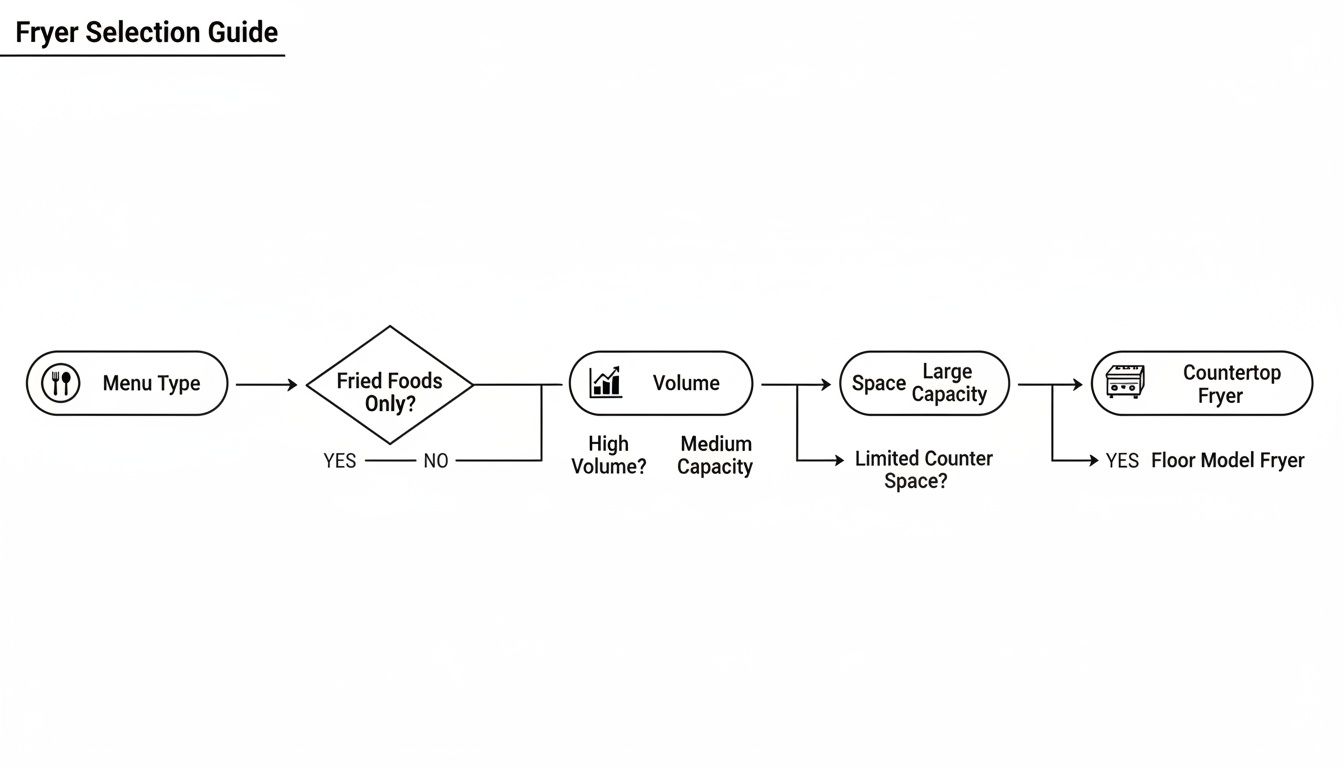
As you can see, your menu, volume, and space all work together. Answering those questions honestly is the first step to knowing whether a compact countertop unit or a larger floor model is your best bet.
Quick Guide to Selecting Your Commercial Griddle
To simplify things, here’s an at-a-glance summary to help you quickly identify the best fit for your operational needs.
| Kitchen Type | Recommended Griddle Type | Key Considerations |
|---|---|---|
| High-Volume Restaurant | Floor Model (Gas or Electric) | Focus on high BTU output for quick recovery, thick griddle plates for even heat, and multiple temperature zones for menu diversity. |
| Food Truck | Countertop or compact Floor Model | Prioritize a small footprint, propane or electric power source, and fast temperature recovery to handle rushes. Safety and ventilation are critical. |
| Ghost Kitchen / Delivery Hub | Battery of Floor or Countertop Models | Efficiency is king. Look for programmable controls for consistency, easy-to-clean surfaces, and energy-efficient models (gas or electric) to manage operating costs. |
| Small Café / Bar | Countertop Griddle | Perfect for limited griddled items. An electric model is often easier to install. Focus on simple controls and ease of cleaning for lower-volume use. |
This table should give you a solid starting point. By matching your kitchen's profile to the right griddle type, you’re already well on your way to making a smart investment.
Comparing Gas vs Electric Griddles
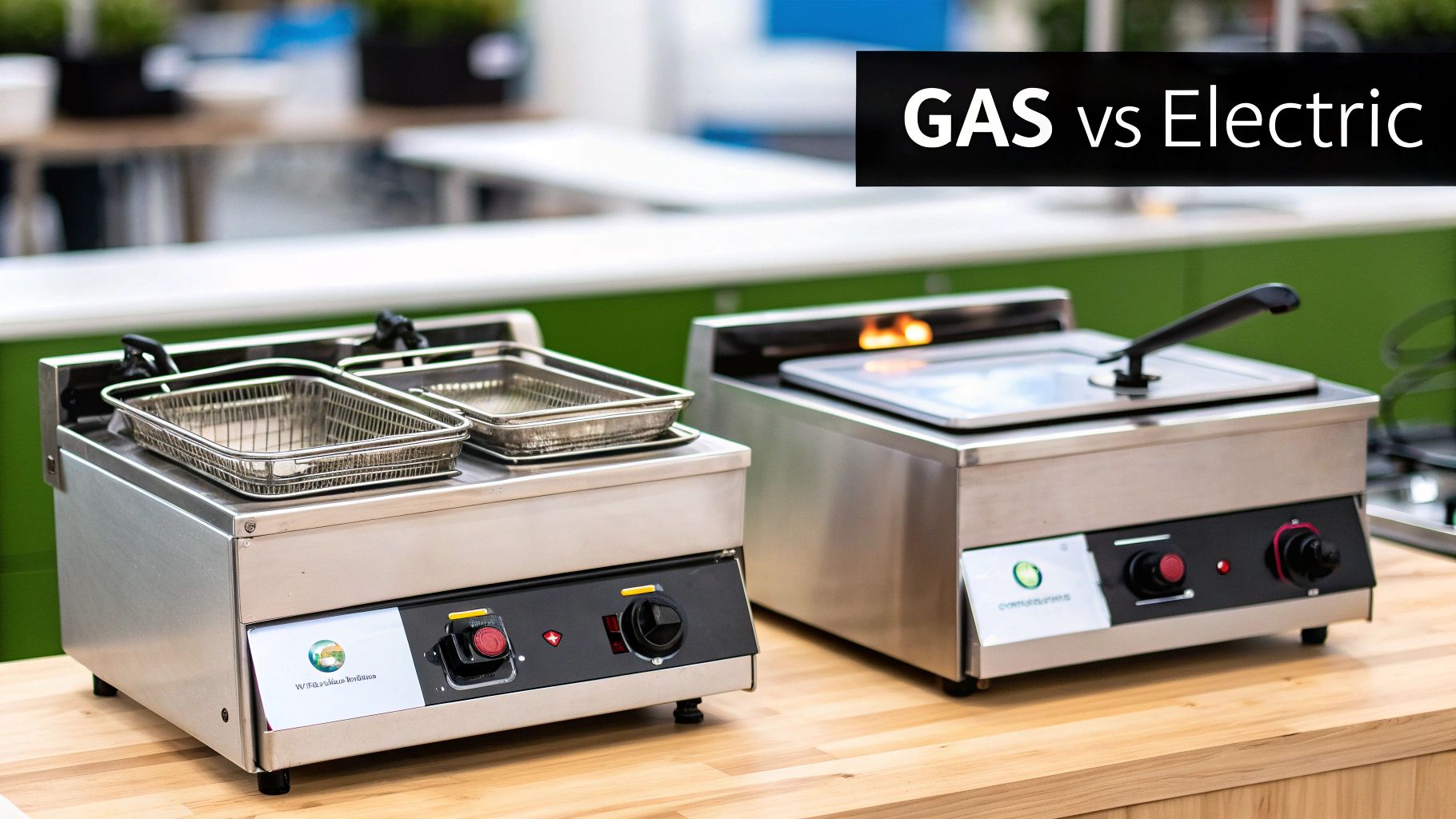
When you’re ready to buy a commercial griddle, the first question you have to answer is huge: gas or electric? This isn’t a small detail; it's the core decision that will shape your entire griddling game, from how fast you can crank out orders to how precise your temperature control is.
Think of it like choosing the engine for your restaurant's most versatile machine. The right power source has to match your menu, your volume, and how your kitchen flows. Get it right, and you’re golden.
Gas vs Electric Griddles The Power Decision
The gas versus electric debate is as old as commercial kitchens themselves, and for good reason. Each has its own personality and excels in different situations. Nailing this choice is your first big step.
A gas griddle is the undisputed king of raw power and speed. It’s the muscle car of the griddle world, using intense burners to get the flat-top screaming hot in a hurry. When the breakfast rush hits and you’re dropping back-to-back orders of pancakes and bacon, a gas unit gets back up to temperature almost instantly. That recovery time is everything.
-
Pros of Gas Griddles:
- Heats Up Fast: Gets from cold to cooking temp in a flash.
- Insane Recovery: Barely flinches when you drop on a new batch of cold food.
- Cheaper to Run: In most places, natural gas costs less than electricity, which is a nice win on your utility bills.
-
Cons of Gas Griddles:
- Tougher Install: You'll need a dedicated gas line and a pro to hook it up.
- Big Ventilation Needs: Has to live under a proper Type I hood system. No exceptions.
On the flip side, an electric griddle is all about precision and efficiency. Its heating elements are mounted directly under the plate, so nearly all the energy goes directly into heating the surface. This gives you incredibly stable and even temperatures, which is a massive advantage for delicate foods that can't handle temp swings, like eggs and seafood. For a great look at some top-tier models, you can explore a wide range of commercial electric fryers.
-
Pros of Electric Griddles:
- Super Efficient: Less wasted energy means it's better at turning electricity into heat.
- Rock-Solid Temp Control: Keeps the surface temperature right where you set it, for perfect results every time.
- Easier to Install: Much simpler to get up and running, especially the countertop models.
-
Cons of Electric Griddles:
- Slower Rebound: Takes a bit longer than gas to get back to temp after a big load of food.
- Can Cost More to Run: Depending on your local rates, electricity can be pricier than gas.
It really boils down to your kitchen's setup and what you value most. A high-volume spot that needs sheer speed and already has gas hookups will probably go with gas. A kitchen focused on consistency or one that's tight on space might find an electric model is the smarter play.
Standard Steel vs. Chrome Griddle Plates
Once you’ve picked your power source, the next choice is all about the cooking surface. This decision impacts everything from heat transfer to cleanup.
Standard steel plates are the classic workhorses. They are durable, conduct heat well, and develop a fantastic seasoning over time that creates a natural non-stick surface. They require a bit more care with cleaning and regular seasoning but are beloved for their performance.
Chrome griddle plates, on the other hand, offer a non-porous, stick-resistant surface right out of the box. They transfer heat incredibly efficiently, meaning less heat radiates into the kitchen, keeping staff cooler. Cleanup is often easier, but you must use specific, non-abrasive tools to avoid scratching the chrome finish.
Sizing Your Griddle for Maximum Throughput
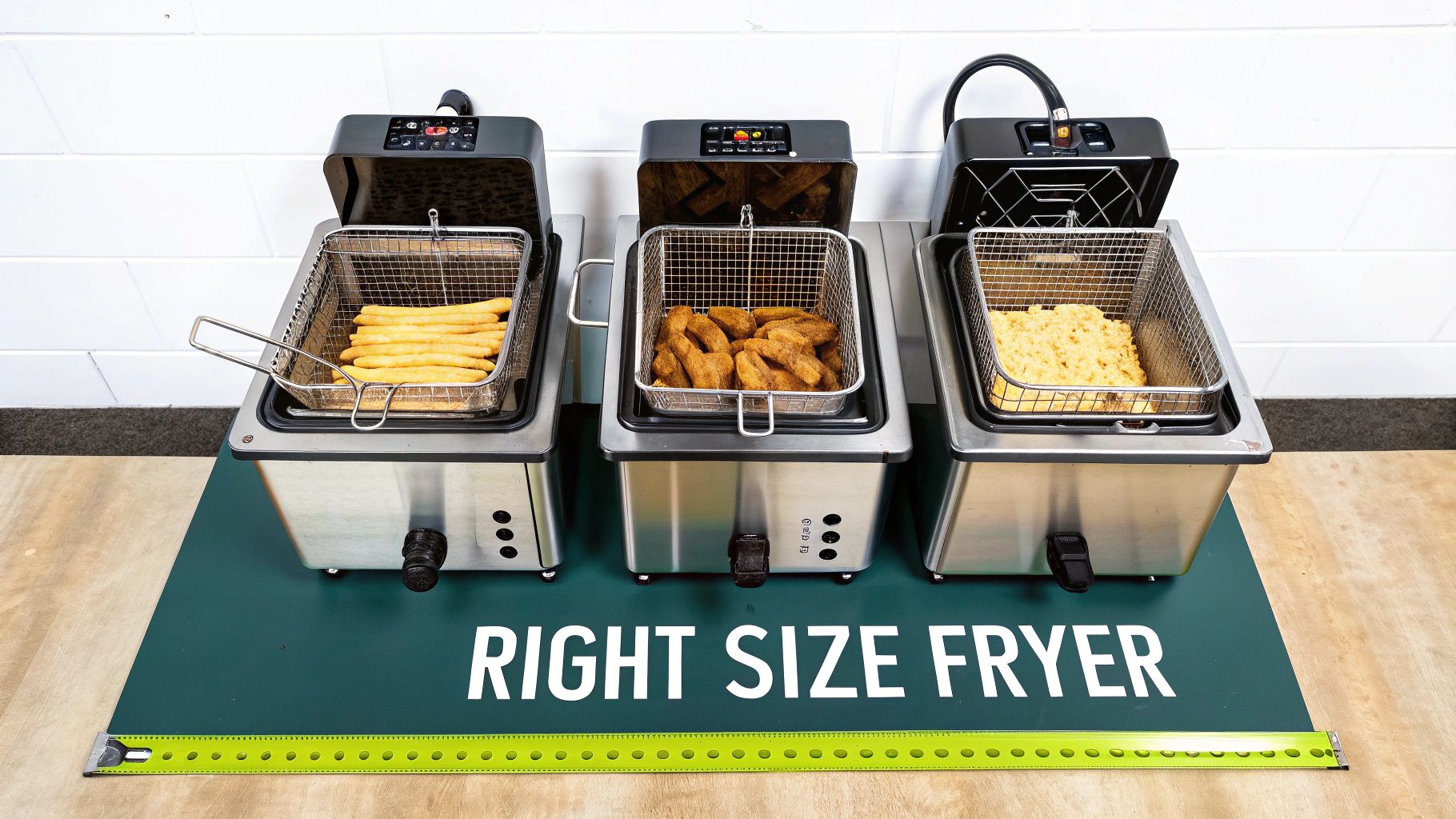
Picking the right size griddle is like choosing an engine for a race car. Go too small, and you'll stall out and create frustrating bottlenecks during the lunch rush. Go too big, and you're just burning through energy and precious kitchen real estate. The goal is to find that sweet spot that keeps service flowing smoothly.
Forget getting bogged down in spec sheets for a minute. The only thing that truly matters is matching the griddle to your kitchen's actual output. A high-volume burger joint has vastly different needs than a ghost kitchen specializing in breakfast burritos. The key is to think in terms of food cooked per hour.
The Throughput Formula
There’s a simple, battle-tested rule of thumb for this. A commercial griddle should be sized to handle your peak hour demand without cooks fighting for space. For a standard 36-inch griddle, you should be able to comfortably cook about 40-50 burgers per hour.
Why is this ratio so important? It ensures your griddle surface temperature doesn't crash when you drop on a load of cold product. This is what we call temperature recovery, and it's everything in griddling.
A properly sized commercial griddle snaps back to the target temperature almost instantly, even after you load it with cold food. This rapid recovery is the secret to getting a perfectly crispy sear and consistent cook times, item after item.
A griddle that’s too small for your volume will constantly struggle to get back up to temp. The result? Slower service, steamed food instead of seared, and unhappy customers.
Balancing Size and Space
Of course, a griddle’s cooking power is only half the equation; you also have to make sure it physically fits your kitchen layout and workflow. Commercial griddles are workhorses, and demand is surging in the foodservice sector for a reason. The growth in the commercial cooking equipment market, noted by firms like Grand View Research, underscores how critical it is to pick the right unit for your space.
- Compact Countertop Models: These are perfect for tight spaces, food trucks, or as a secondary griddle for specific menu items like appetizers or gluten-free options. They offer incredible flexibility without demanding a huge footprint.
- High-Capacity Floor Models: For kitchens where griddled food is the star of the show, a larger floor model is a must. These units provide the sheer power and surface area needed to manage a constant stream of tickets during peak hours.
The Impact of Plate Thickness
Finally, let's talk about the griddle plate itself. The thickness of the steel plate—typically ranging from 1/2 inch to 1 inch—directly impacts heat retention and recovery. Think of a thicker plate as a heat battery; it holds more energy.
A thicker plate (3/4" to 1") is ideal for high-volume scenarios where you're constantly loading it with cold or frozen product. It recovers temperature faster and maintains a more even heat across the entire surface. A thinner plate (1/2") might be cheaper and heat up faster initially, but it will struggle to keep up during a rush. For any serious commercial operation, investing in a thicker plate pays for itself in speed, consistency, and quality.
Essential Features That Boost Efficiency and Quality
Once you've settled on the basics like power source and griddle size, it's time to dig into the features that really separate the workhorses from the headaches. These are the details that directly impact your workflow, the quality of your food, and ultimately, your bottom line. Getting these right from the start pays for itself over and over again in saved time and money.
Two features stand out as absolute game-changers: high-quality temperature controls and a smart grease management system. Think of them as the brains and sanitation system for your entire griddling operation. They work in tandem to guarantee every batch comes out perfect while making cleanup faster and easier.
The Power of Precise Temperature Controls
Consistency is king on the flat top, and that all comes down to temperature. The difference between a perfect sear and a burnt mess can be just a few degrees. The real difference is how well the griddle holds its temperature, especially when you're slammed with orders.
Manual controls are the simplest option, usually with low, medium, and high settings. They are reliable and cost-effective but offer less precision. They're a solid choice for kitchens doing basic, high-heat griddling.
Thermostatic controls, on the other hand, are surgical. They let you set a specific temperature (e.g., 350°F), and the griddle works to maintain it. This gives you incredible consistency, which is vital for delicate items like eggs or for ensuring every burger is cooked to the same spec.
Programmable controls take it a step further. They use smarter technology to lock in the temperature, often holding it steady within just a degree or two. Many let you create presets for different menu items—think one button for pancakes, another for steaks. This guarantees every single order is cooked identically, no matter who's on the line.
Efficient Grease Management Systems
Anyone who's worked a line knows that grease is a constant byproduct of griddling. A good grease management system isn't a luxury; it's essential for safety and sanitation. A poorly designed system can lead to spills, fire hazards, and a nightmare cleanup at the end of the shift.
Look for a griddle with a wide, deep grease trough that effectively channels grease away from the cooking surface. The trough should lead to a large, easily removable grease drawer or pan. The larger the capacity, the less frequently your staff will have to empty it during a busy service, which minimizes workflow interruptions and the risk of spills. The insights from market reports, like those from Metastat Insight, often highlight the move towards equipment that is easier and safer to clean and maintain.
A well-designed grease trough and a large-capacity drawer aren't just features; they're an investment in a cleaner, safer, and more efficient kitchen.
The Importance of Back and Side Splashes
A smart griddle design always includes integrated back and side splashes. These are simple but brilliant features: raised steel walls around the sides and back of the cooking surface.
They serve two critical functions:
- Containment: They keep grease spatter and food debris contained on the griddle surface, preventing it from messing up your walls and adjacent equipment. This makes a huge difference in daily cleanup.
- Workflow: They act as a backstop, allowing cooks to quickly turn and move food around with a spatula without pushing it off the griddle.
Built to Last: Stainless Steel Construction
Finally, never overlook the build quality. A commercial kitchen is a battlefield for equipment. Your griddle needs to stand up to constant heat, grease, and aggressive cleaning day in and day out.
Heavy-duty stainless steel is the undisputed champion for a reason. It’s tough, it fights off rust and corrosion, and its non-porous surface is easy to clean and keep sanitized. A griddle built from quality, welded stainless steel is an investment that will reliably serve your kitchen for years to come.
Essential Maintenance and Safety Practices
Nailing the right commercial griddle is just the start. The real secret to a kitchen that hums along without a hitch? Keeping that workhorse in peak condition with solid maintenance and safety routines that your whole team lives by.
A well-maintained griddle isn’t just a piece of metal; it’s a profit engine. Think of it like a high-performance car. You wouldn't skip the oil changes and safety checks, right? Doing so just leads to breakdowns and expensive repairs down the line. The same logic applies here. This commitment keeps your food quality top-notch, makes your griddle last longer, and, most importantly, keeps your crew safe.
Daily Maintenance: The Non-Negotiables
These aren't suggestions; they are the absolute foundation for a healthy griddle. They're quick, simple, and stop grease and gunk from building up into bigger, nastier problems.
- Scrape Down Constantly: Throughout the day, use a griddle scraper to remove food debris and excess grease between orders. This prevents flavor transfer (so your pancakes don't taste like onions) and stops carbon buildup.
- Wipe Down All Surfaces: When service is over and the griddle has cooled down, give all the exterior stainless steel surfaces a thorough wipe with a food-safe degreaser. This stops that sticky, grimy film from taking over your kitchen.
- Empty and Clean Grease Trap: This is a must-do at the end of every single day. The grease drawer collects a lot of hot liquid. Letting it sit is a fire hazard and can attract pests.
Weekly and Monthly Deep Cleaning
Daily tasks keep the grime at bay, but your weekly jobs are where you really show your griddle some love. This is preventative care that ensures it’s running at 100% for years.
The big weekly job is a deep clean. This is where you use a griddle stone or screen on the cooled surface to scrub off any stubborn, baked-on carbon. After cleaning, you'll need to re-season the plate to protect it and restore its non-stick properties. For more detailed guidance, check out some simple commercial deep fryer cleaning tips that can be adapted for griddles.
Once a month, it's time for a full inspection. Get in there and check your gas lines for leaks or inspect electrical cords for any fraying or wear. It's also the perfect time to calibrate the thermostats to make sure the temperature on the dial is the actual temperature of your cooking surface.
Core Safety Protocols for Your Team
Let's be blunt: a safe kitchen is a profitable kitchen. Accidents cost time, money, and morale. Your entire team needs to be drilled on these griddle safety rules until they're second nature.
The most common griddle-related injuries are serious burns from contact with the hot surface or splashing grease. Setting up strict safety zones and enforcing proper handling procedures is the single best way to protect your staff.
Make these safety practices mandatory:
- Smart Grease Handling: Train everyone on how to safely empty and transport the hot grease from the drawer. Hammer this home: never pour water on a grease fire. Show every single person where the Class K fire extinguisher is and how to use it.
- Know the Fire Suppression System: Every cook, dishwasher, and manager needs to know exactly where the manual pull station for the kitchen's fire suppression system is. Run regular drills so that in an emergency, their reaction is automatic, not panicked.
- Keep Ventilation Clear and Clean: Your griddle must be under a properly working ventilation hood. That system is critical for pulling greasy vapor out of the air, which prevents a dangerous, flammable film from building up on your walls and ceilings. Cleaning those hood filters has to be a non-negotiable part of your regular maintenance schedule.
Calculating the Return on Your Griddle Investment
It's easy to get fixated on the sticker price when you're shopping for a new commercial griddle. But the smartest kitchen operators know that the real cost—and the real value—goes far beyond that initial number. To make a truly savvy investment, you have to look at the bigger financial picture.
This is where the concept of Total Cost of Ownership (TCO) comes in. It’s a fancy term for a simple idea: figuring out what your griddle will actually cost you over its entire life in your kitchen. This includes the purchase price, sure, but it also factors in installation, your monthly energy bill, routine maintenance, and any repairs down the line. A cheap griddle might look like a bargain today, but if it's an energy hog or needs constant service calls, it will end up costing you more in the long run.
Moving from Cost to Return on Investment
Once you've wrapped your head around the total cost, you can get to the exciting part: your Return on Investment (ROI). This isn't just about what you spend; it's about how that piece of equipment starts making you money. A high-performance griddle with a thick plate and precise temperature controls is a money-making machine.
Think of it this way. A griddle that heats perfectly evenly means no more hot spots. That translates directly to fewer burnt pancakes or undercooked burgers getting tossed in the trash, which lowers your food costs. Faster heat recovery lets your line cooks pump out more orders during a chaotic lunch rush, boosting your revenue. These are the small, daily wins that add up to a massive ROI.
The best commercial griddle isn't necessarily the cheapest one on day one; it's the one that delivers consistent, high-quality results while actively lowering your operating expenses and maximizing your kitchen's output over time.
Why a Better Griddle Pays for Itself
Let's break it down. You could grab a basic, budget-friendly griddle and save a few hundred bucks upfront. Or, you could invest in a premium, energy-efficient model that holds its heat like a champ. That second option might shave a noticeable amount off your utility bill every single month. Over a few years, those energy savings alone can completely offset the higher initial price.
Plus, a well-built griddle means less downtime. Every minute your griddle is out of commission is a minute you're not making money. When you add up the savings and the performance gains, the more advanced unit almost always shows a faster and higher return. If the upfront cost feels steep, looking into financing restaurant equipment can make a top-tier model totally manageable, letting you start seeing those financial benefits right away. At the end of the day, the right griddle isn't an expense—it's a powerful financial asset for your business.
Your Top Commercial Griddle Questions, Answered
When you're equipping a professional kitchen, questions are a good thing. They lead to smarter investments. We hear a lot of the same queries from chefs and operators trying to pick the perfect griddle, so we’ve put together some straight answers based on real-world kitchen experience.
Think of this as your cheat sheet for getting the most out of your griddle from day one.
How Often Should I Re-Season My Griddle?
There’s no magic number here—it all comes down to how hard you run your griddle and how you clean it.
For a classic diner pumping out orders for 12+ hours a day, a quick, light re-seasoning at the end of every single shift is the way to go. It’s a small step that keeps that crucial non-stick surface glassy and ready for the next rush.
If your kitchen has a more moderate pace, you might only need to do a full re-seasoning once a week. The griddle will tell you what it needs. If you see food starting to stick or the surface is looking patchy and dull, it’s time.
A solid seasoning is a griddle’s best friend. It’s not just about food not sticking; it’s a protective shield against rust and the secret to that perfectly even heat transfer that makes every dish consistent.
What's the Ideal Griddle Temperature?
The "perfect" griddle temperature is whatever is perfect for the food you’re cooking right now. There's no one-size-fits-all setting. This is exactly why griddles with thermostatic controls and multiple heat zones are worth their weight in gold.
As a starting point, here are some temperatures that work for us:
- Pancakes and Eggs: Keep it low and slow, right around 300°F to 325°F. This prevents them from burning on the outside before they're cooked through.
- Bacon and Sausage: These need a bit more heat to render the fat and get crispy. Aim for a medium heat of 325°F to 350°F.
- Burgers and Philly Cheesesteaks: For that beautiful, hard sear that locks in the flavor, you need to crank it up. We like to work between 350°F and 375°F.
Can I Cook Different Foods on the Same Griddle?
You bet. In fact, most high-volume kitchens have to. The trick is to manage your space and prevent flavor transfer, so your eggs don't taste like last night's onions.
The secret is zoning. Use your griddle's size to your advantage by setting up distinct temperature zones. You can have one end ripping hot for searing steaks while the other is at a gentle heat for holding toasted buns.
Just as important is cleaning on the fly. A good, sharp griddle scraper is your most valuable tool here. Scraping down the residue and oil after a batch of bacon before you drop a single egg is non-negotiable. It's the only way to keep flavors clean and customers coming back.
Ready to find the workhorse griddle your kitchen deserves? At Griddles.com, we live and breathe this stuff. We connect professional kitchens with top-tier, reliable equipment built to handle the daily grind. Explore our curated selection of commercial griddles and let our experts help you find the perfect match for your menu.