
Your Essential Commercial Gas Griddle Guide
Simply put, a commercial gas griddle is a flat-top cooking machine that runs on either natural gas or propane. Built for the grind of a high-volume kitchen, its huge, evenly heated surface lets you sling everything from pancakes and burgers to cheesesteaks all at once. It's the undisputed champion in restaurants, classic diners, and bustling food trucks.
Why a Gas Griddle Is Your Kitchen's Workhorse
Ever peeked into a busy kitchen during the lunch rush? It's a blur of motion, a symphony of sizzles and orders being called out. Right in the middle of it all, you'll almost always find a gas griddle. It's more than just a piece of steel; it's the engine that powers the entire service, from breakfast through dinner, with raw speed and consistency.
Think of it as the most reliable person on your line. It fires up in an instant, takes on a relentless wave of tickets without breaking a sweat, and churns out perfectly seared food, order after order. A commercial gas griddle is built for the brutal reality of a professional kitchen. It's all about pure power and immediate heat response.
The Griddle's One Simple, Crucial Job
At its core, a gas griddle does one thing incredibly well: it provides a massive, consistently hot surface for cooking a ton of food fast. This single capability is what allows chefs to juggle multiple orders at the same time, giving them the edge they need in any fast-paced environment.
And the numbers back this up. Gas models are the go-to choice for pros, grabbing a significant portion of the total market revenue. The entire commercial griddle market was valued at about USD 576.4 million in 2025 and is only expected to keep growing, proving just how essential these machines are. You can dig into more data on the commercial griddle market to see where things are headed.
Key Factors That Define Performance
But let's be clear—not all gas griddles are created equal. The difference between a basic unit and a high-performance beast comes down to just a few critical specs you absolutely need to know before you buy.
- BTU Power: This is your griddle's horsepower. More BTUs mean the griddle heats up faster and, more importantly, recovers its temperature instantly when you slap down cold food.
- Plate Material and Thickness: The cooking surface itself is a huge deal. Thicker steel plates hold heat like a champ, giving you that consistent, powerful sear. The material also affects how tough the griddle is and how you'll care for it.
- Control Types: You'll see two main options: manual or thermostatic. Manual controls are simple high-medium-low dials, while thermostatic controls let you dial in an exact temperature, just like your oven at home.
A commercial gas griddle isn't just a flat top—it's a productivity multiplier. The ability to cook morning eggs, lunchtime burgers, and evening steaks all on the same surface is what makes it a cornerstone of any profitable kitchen.
Getting these basics down is your first step. Once you understand how power, plate design, and controls all work together, you can start looking at models with confidence and choose a real asset that will serve your kitchen for years to come.
Decoding Griddle Specs That Actually Matter
When you start shopping for a commercial gas griddle, you’re hit with a wall of technical specs. Terms like BTU, plate thickness, and thermostatic controls get thrown around, but what do they really mean for your kitchen’s daily grind?
Think of these specs as the griddle's DNA. They determine how fast it heats up, how well it holds its temperature during a relentless Saturday night rush, and how much control your chefs have. Nailing this choice means less frustration on the line and more perfectly cooked food going out to customers.
The Power Behind The Sear: BTU Explained
The first number you’ll probably see on any commercial gas griddle spec sheet is the BTU rating. BTU stands for British Thermal Unit, and it's basically a measure of raw heat output. The easiest way to think about it is like horsepower for your griddle’s engine.
A higher BTU rating gives you more power. That translates into two huge benefits: faster preheating and quicker temperature recovery. A 90,000 BTU griddle will hit its cooking temp way faster than a 60,000 BTU unit, saving you precious time. More importantly, when you drop a dozen frozen burger patties on the surface, that high-BTU griddle bounces back almost instantly, giving you a consistent sear instead of steaming the meat.
- High BTU (30,000+ per burner): This is non-negotiable for high-volume spots cranking out burgers, steaks, and cheesesteaks, especially from frozen.
- Standard BTU (20,000-25,000 per burner): This is plenty of muscle for breakfast joints, cafes, and kitchens cooking things like eggs, pancakes, and bacon that don't shock the griddle with cold.
The Foundation of Cooking: Griddle Plate Thickness
The griddle plate is where all the magic happens, and its thickness has a massive impact on performance. It’s the difference between a flimsy pan that scorches everything and a heavy cast-iron skillet that lays down a perfect, even crust every single time.
When it comes to griddle plates, there's a simple rule: thickness equals heat retention. This table breaks down what that means for your menu.
Griddle Plate Thickness Comparison
| Plate Thickness | Best For | Heat Retention | Heat-Up Time | Ideal Use Case |
|---|---|---|---|---|
| 1/2-Inch | Responsiveness | Lower | Faster | Delicate items like eggs, crepes, and fish that need quick temperature changes. |
| 3/4-Inch | Versatility | Good | Moderate | The all-around workhorse. Great for diners and restaurants with varied menus. |
| 1-Inch | Searing Power | Excellent | Slower | High-volume burger joints, steakhouses, and kitchens that need maximum, steady heat. |
A thick 3/4-inch to 1-inch plate acts like a heat battery. It soaks up and stores a ton of thermal energy, spreading it evenly across the surface. This stored energy is what gives you that powerful, consistent sear. The only trade-off is that it takes a bit longer to heat up and cool down.
On the flip side, a thinner 1/2-inch plate is much more responsive. It heats up fast and reacts quickly when you adjust the dial, which is great for delicate foods. The catch? It loses heat faster when you load it up with cold product, making it less ideal for high-volume searing.
Precision vs. Power: Thermostatic and Manual Controls
The final big decision is how you want to control all that heat. You’ve got two main choices here: thermostatic and manual controls.
Thermostatic controls are like the oven in your home. You set a precise temperature—say, 350°F—and the griddle automatically turns the burners on and off to hold that temp. It's like cruise control for your griddle, making it perfect for:
- Cooking delicate items like pancakes that need an exact temperature.
- Kitchens with newer cooks, since it helps prevent burning.
- Holding food at a consistent temperature for long periods.
Manual controls are much simpler, usually with just low, medium, and high settings. They put the chef in the driver's seat, giving them direct, hands-on control over the flame. Old-school line cooks often swear by this setup for its raw power and instant response, letting them create different heat zones on the fly.
We're seeing a big shift toward precision, though. Many new commercial griddle models come with advanced thermostat or infrared controls to boost accuracy and save on gas. If you're stuck on this decision, our guide on thermostatic vs. manual griddles breaks it down even further.
To help you put it all together, here's a quick way to think about your choice:
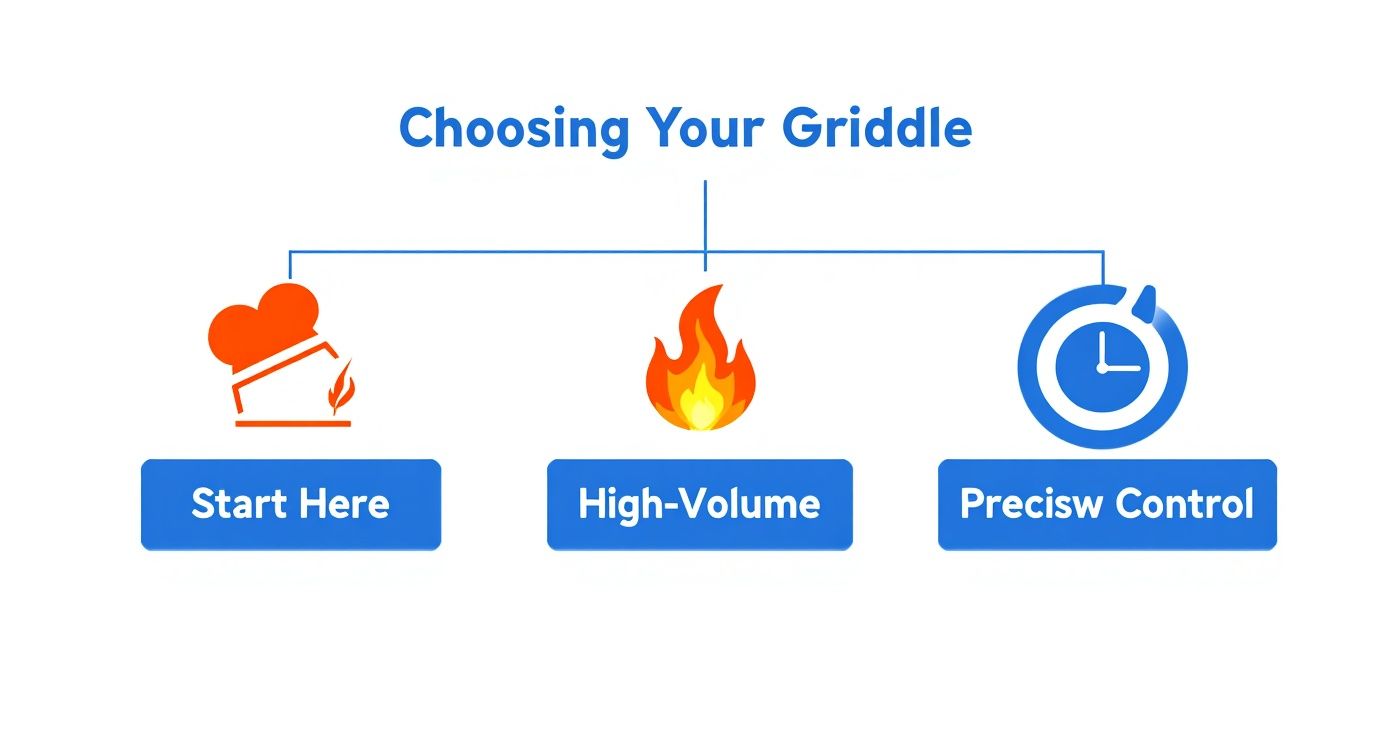
The bottom line is simple: if you’re a high-volume operation, you need to prioritize high BTUs and a thick plate. If your menu is all about finesse and delicate items, precise thermostatic controls will be your best friend.
Fuel and Installation From a Pro's Perspective
Once you've nailed down the perfect griddle specs for your kitchen, it's time to think about how you'll power it up. Getting the fuel and installation right is just as important as the griddle itself. This isn't just about hooking up a hose; it's about making smart decisions that affect your daily workflow, safety, and long-term costs.
Let’s be clear: a professional installation isn’t optional. It’s the only way to ensure your griddle performs as expected and your kitchen operates safely and legally.
Natural Gas vs. Propane: The Fuel Decision
Your first big call is choosing between Natural Gas (NG) and Liquid Propane (LP). Think of it like this: NG is like being hooked up to the city's power grid, while LP is like having your own powerful, portable generator.
-
Natural Gas (NG): This is the workhorse for most brick-and-mortar spots. It's piped directly into your building, so you get a steady, endless supply. You'll never have to worry about running out of gas mid-rush, and it’s usually cheaper in the long run.
-
Liquid Propane (LP): If you're running a food truck or setting up shop somewhere without a gas line, LP is your answer. It’s stored in tanks you’ll need to swap out or refill. LP actually burns a bit hotter than NG, but you have to stay on top of your fuel levels to avoid getting caught empty.
The choice has real impacts on your costs and operations. For a full breakdown, check out our guide on natural gas vs propane for commercial kitchens.
The Flexibility of Field-Convertible Kits
What if your business moves? Or your food truck lands a permanent spot with a gas line? That's where field-convertible kits are a game-changer.
Many of our griddles come with these kits. They include everything you need—new orifices and regulators—to switch your unit from NG to LP, or the other way around. This little feature gives you incredible flexibility, protecting your investment if your situation changes. It can literally save you from having to buy a whole new griddle.
Professional Installation Is Non-Negotiable: Hooking up a commercial gas line is a serious job governed by strict safety codes. We're talking about precise pipe sizing, mandatory shut-off valves, correct ventilation, and specific connectors.
Trying to DIY this is a recipe for disaster. It can lead to gas leaks, fires, or carbon monoxide poisoning. It will also instantly void your warranty and could get your insurance claim denied. Always, always hire a licensed and certified technician. They’ll ensure your griddle is installed to code, keeping your staff and your business safe. This isn't just advice—it's a requirement for any professional kitchen.
Keeping Your Griddle in Fighting Shape
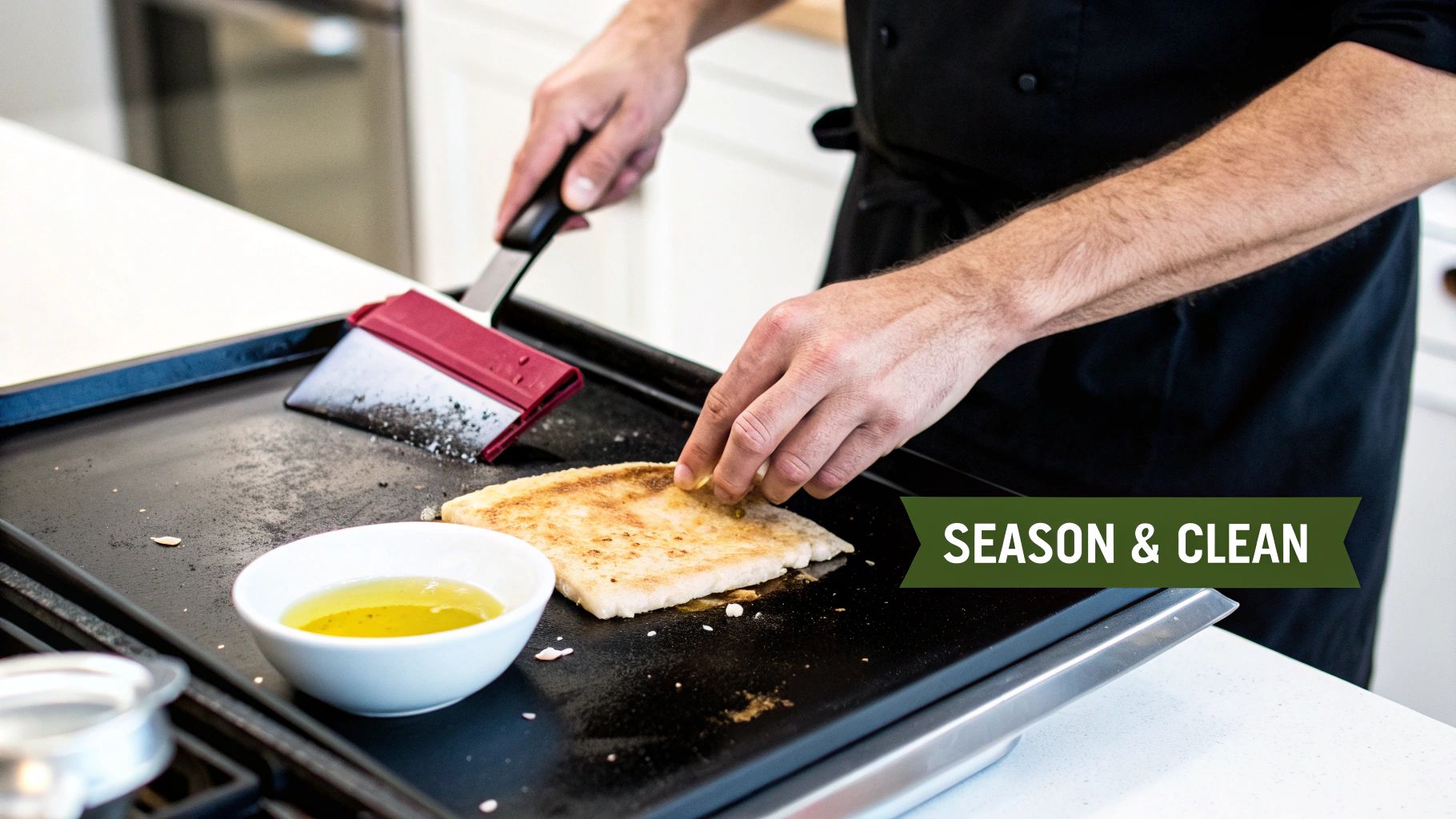
Think of your commercial gas griddle as the engine of your kitchen's production line. Just like any engine, its performance, reliability, and lifespan all come down to one thing: a solid maintenance routine. A clean, well-seasoned griddle is the secret to getting that perfect sear, preventing food from sticking, and making sure every dish tastes exactly as it should.
Let things slide, and you’ll run into problems. A thick layer of grease creates hot spots and uneven cooking, while burnt-on bits can transfer nasty, off-flavors to your fresh ingredients. The good news is, a simple, repeatable cleaning process is all it takes to keep this workhorse in peak condition for years to come.
The Daily Cleaning Playbook
The absolute best time to clean your griddle is right after service, while it’s still warm but not blazing hot. In that window, grease and food particles are soft and easy to scrape away before they have a chance to harden into a real mess.
Make this a non-negotiable part of your end-of-day shutdown:
- Scrape It Down: While the griddle is still warm (think 300-350°F), grab your griddle scraper and push all the food debris and grease into the catch tray.
- Add a Little Sizzle: Carefully pour a small amount of warm water or club soda onto the surface. The steam it generates is fantastic for lifting off any stubborn, stuck-on gunk.
- Give It a Scrub: Use a non-abrasive griddle pad or grill screen and scrub in a circular motion. This gets rid of that last layer of grime without scratching up your steel.
- Final Pass: Scrape the dirty water into the grease trap, then wipe the whole surface down with a clean, dry towel.
- Empty the Grease Trap: This one is crucial—do it every single day. An overflowing grease trap isn't just messy; it's a serious fire hazard.
For a deeper dive, check out our full guide on how to clean a flat top griddle for extra tips on tackling tough spots.
The Magic of Seasoning
Cleaning is only half the story. Seasoning is what elevates your griddle from a slab of steel to a naturally non-stick powerhouse. It's simply the process of baking thin layers of oil onto the cooktop, which creates a hard, slick coating called a patina.
This protective layer does way more than just stop food from sticking. It shields the raw steel from moisture, prevents rust, and builds up a beautifully uniform cooking surface that actually gets better the more you use it.
Maintaining this surface is easy. After cleaning your commercial gas griddle each day, just apply a very thin coat of a high-smoke-point oil (canola or vegetable oil work great) with a clean cloth while the griddle is still warm. Spread it evenly, then wipe off any excess. This quick re-seasoning reinforces that protective layer and gets it primed for the next service, so you're always ready to go. You only need to do a full, from-scratch seasoning on a brand-new griddle or if the old layer has been accidentally stripped away.
How Different Kitchens Get the Most Out of Their Griddles
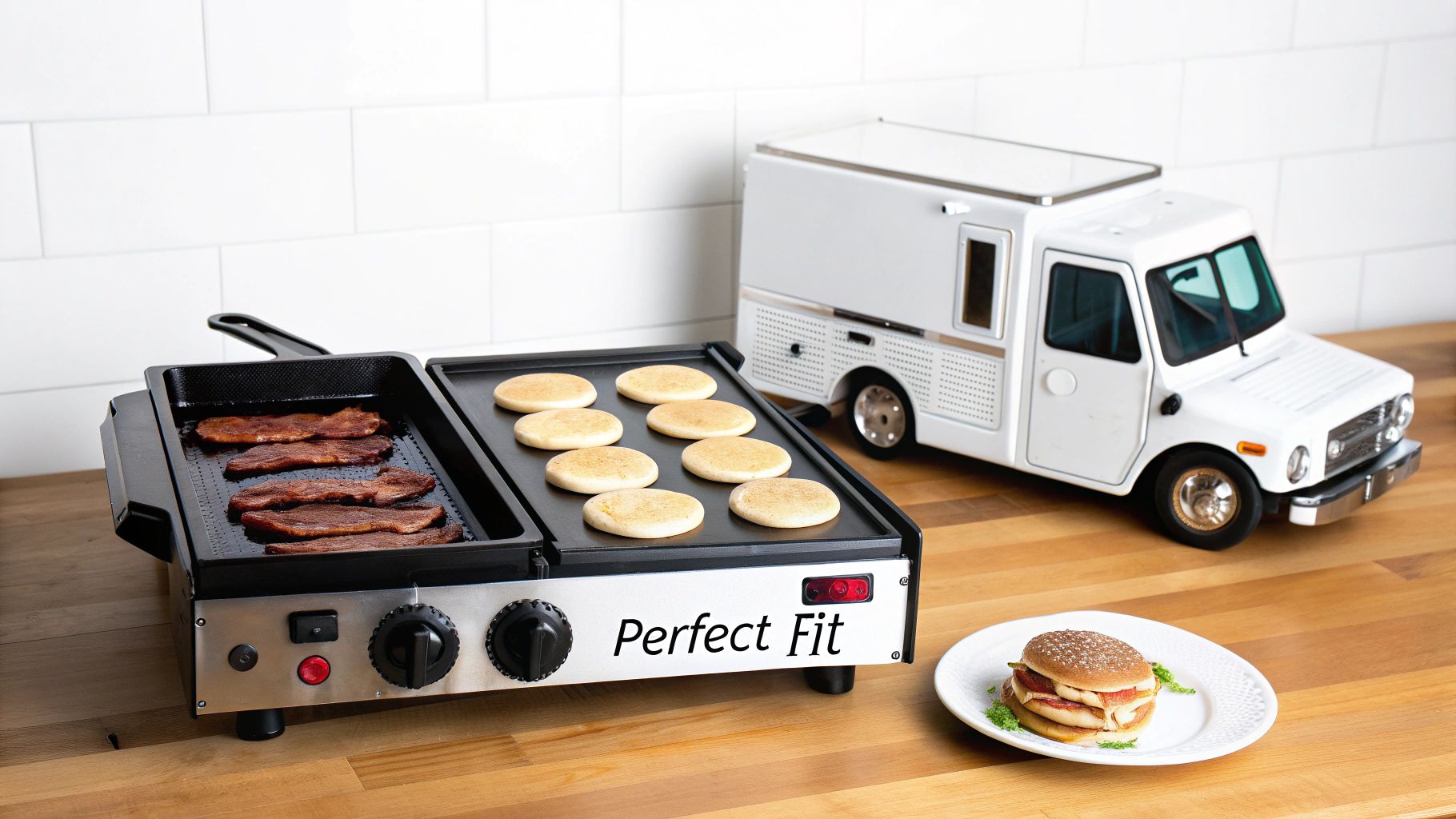
A griddle isn't just a hunk of steel; it's the heart of the line in countless kitchens. The magic is in how each operation—from a packed diner to a nimble food truck—tailors its griddle setup to match its unique rhythm.
Whether you're slinging pancakes or searing burgers, the right griddle configuration is all about maximizing speed, consistency, and volume. It’s no surprise the global commercial griddle market hit USD 1.4 billion in 2025 and is on track to reach USD 2.4 billion by 2034. According to USDA Analytics, that 6.1% CAGR is all thanks to the rugged durability and precise temperature control these workhorses bring to the table.
Let’s break down how different kitchens put them to work:
- Classic diners go big on surface area and raw heat to churn out breakfast plates.
- Food trucks prioritize a compact design and the go-anywhere flexibility of propane.
- Ghost kitchens rely on zoned thermostatic controls to juggle a wide mix of orders.
Each setup is a masterclass in aligning equipment with workflow.
The Classic Diner Setup
Picture a classic diner during the morning rush. You need a massive, powerful cooktop that can handle a relentless flood of tickets without breaking a sweat.
That's why most diners go for a 48-inch griddle with a thick, 1-inch steel plate, fired up by at least 90,000 BTUs. This beast heats up fast and, more importantly, stays hot, ensuring every egg, pancake, and strip of bacon comes out perfect, order after order.
Think of that thick steel plate as a thermal battery. It stores a tremendous amount of heat, so when you drop a dozen cold eggs on it, the temperature doesn't crash.
A typical diner setup includes:
- A 48-inch width for maximum real estate.
- A 1-inch steel plate for unbeatable heat retention.
- Thermostatic controls for setting and holding specific cook zones.
- Tall splash guards and a big drip tray to manage the mess.
Food Truck Adaptations
In a food truck, space is everything. Every square inch of counter has a job, so efficiency is the name of the game.
Here, a 24-inch countertop griddle is the perfect fit. It offers enough cooking surface to handle the rush without hogging precious real estate. Since you can’t always count on a natural gas line, propane hookups are a must, and a field-convertible kit is your best friend. It means a dead propane tank won't shut you down for the day.
“Our truck depends on propane flexibility and a tight footprint, so we never miss a beat during events,” says Chef Maria Rodriguez.
Getting your setup streamlined means you can pivot from a breakfast rush to a lunch service in minutes. Regular checks are also key to avoiding downtime when you're on the move.
- Always check your propane regulators before a shift.
- Use a leak detector on all cylinder connections.
- Give the griddle surface a good scrape midday to prevent buildup.
- Look for models with quick-release brackets for easy breakdown and cleaning.
Ghost Kitchen Efficiencies
Ghost kitchens live and die by precision. With no front-of-house to lean on, the entire operation is about getting diverse, high-quality orders out the door fast.
This is where zoned thermostatic controls become a game-changer. They effectively turn a single griddle into multiple, independent cooking stations. One zone can be set for searing steaks, another for gently toasting buns, and a third for sautéing vegetables, all at the same time. This workflow minimizes cross-contamination and dramatically speeds up throughput.
In a ghost kitchen, your griddle isn't just a flat-top; it's a multi-lane highway for getting tickets out the door.
- Assign specific zones to different menu categories, like sandwiches vs. wings.
- Pre-program temperatures for your most popular items.
- Schedule a quick calibration check midday to ensure accuracy.
- Use digital timers to keep every order on track.
Griddle Configuration by Kitchen Type
To make it even clearer, here's a quick cheat sheet on how these different kitchens typically spec out their griddles.
| Kitchen Type | Recommended Size | Key Feature 1 | Key Feature 2 |
|---|---|---|---|
| Classic Diner | 48-inch | 90,000 BTU output | 1-inch steel plate |
| Food Truck | 24-inch | Propane or NG field convert | Portable countertop design |
| Ghost Kitchen | 36-inch | Zoned thermostatic controls | Flexible cooking zones |
This table shows just how critical it is to match the griddle's features to your kitchen's specific needs. Getting the footprint and controls right is the key to fulfilling orders efficiently.
The right commercial gas griddle can turn kitchen chaos into a smooth, seamless operation. Remember, the sticker price is just the beginning; fuel costs and maintenance play a huge role in your long-term return on investment.
Before you buy, take some time to:
- Audit your peak ticket volume to determine the right BTU output.
- Match the plate thickness to what you're actually cooking.
- Factor in your space and gas hookups for a pain-free installation.
- Train your team on how to manage heat zones to get the most out of the unit.
The experts at Griddles.com can walk you through selecting and installing the perfect griddle for your diner, truck, or cloud kitchen. Visit Griddles.com for detailed specs, exclusive field conversion kits, and free freight on all our commercial gas griddles.
Calculating the Real Cost and ROI of Your Griddle
A commercial gas griddle isn't just another piece of equipment; it's an engine for your kitchen's profitability. To make a smart buy, you have to look past the sticker price and understand the Total Cost of Ownership (TCO). This gives you the full story of what you’ll actually spend over the life of the unit.
The initial price is just the first step. The real value is found in the balance between that upfront cost and the griddle’s long-term performance. A cheap unit might feel like a win today, but it can quickly turn into a liability, costing you thousands in repairs and lost sales when it inevitably breaks down during a dinner rush. A solid machine from a trusted brand, backed by a real warranty, isn't an expense—it’s an asset that pays for itself.
Looking Beyond the Sticker Price
To get a true sense of the cost, you need to add up all the ongoing expenses. Think of it like buying a delivery truck; the price you pay at the dealership is only part of what it costs to keep it on the road.
Here are the key operational costs to budget for:
- Daily Fuel Consumption: The griddle's BTU rating tells you how much power it has, but that power comes from gas. Higher BTU models cook faster but will also use more fuel, so knowing your local natural gas or propane costs is key to forecasting your monthly bills.
- Cleaning Supplies: The cost of griddle bricks, scrapers, degreasers, and polish can add up. It’s a small thing, but it’s a constant operational expense.
- Potential Repairs: Even the best equipment needs a fix eventually. While a good warranty is your safety net, it's smart to plan for potential out-of-pocket repairs, especially for parts that aren't covered or after the warranty expires.
Measuring Your Return on Investment
Now for the fun part: figuring out your Return on Investment (ROI). This is where you see how your griddle stops being a cost and starts making you money. It's not just sitting on the line; it’s a revenue-generating machine.
A high-performance griddle can completely change your kitchen's output. By increasing your cooking capacity and shaving minutes off ticket times, you can serve more customers during your busiest hours. That directly translates to more money in the register.
To see the ROI in action, start tracking a few key numbers once your new griddle is fired up:
- Increased Order Capacity: How many more burgers, pancakes, or cheesesteaks can you push out per hour? Moving from a 24-inch to a 48-inch griddle can literally double your throughput.
- Faster Ticket Times: With better heat recovery and more cooking real estate, orders fly out of the kitchen. This means faster table turnover and happier, repeat customers.
- Expanded Menu Offerings: Does this new griddle finally give you the space to add those high-profit items you've been wanting to try? This opens up entirely new streams of revenue.
When you track these metrics, you put a real dollar value on your investment. A quality griddle doesn't just cost money—it makes money and drives your business forward.
Common Commercial Griddle Questions Answered
When you're running a busy kitchen, you don't have time for guesswork. A commercial gas griddle is the heart of many operations, and knowing the ins and outs can make a huge difference in your workflow, food quality, and even safety. Let's tackle some of the most common questions we hear from chefs and restaurant owners.
Think of this as a quick-reference guide to reinforce what we've covered and give you clear, practical answers for those everyday griddle challenges.
What Is the Ideal Griddle Plate Thickness for My Restaurant?
The right answer comes down to what you're cooking. If your claim to fame is smash burgers or thick-cut steaks, you need a thicker plate—think 3/4-inch to 1-inch. That extra steel is like a heat battery; it holds a massive amount of energy, giving you a powerful and consistent sear even when you slap down cold patties one after another.
On the flip side, if your menu features delicate items like pancakes, eggs, or flaky fish, a thinner 1/2-inch plate is your best friend. It’s more nimble, heating up and cooling down quickly so your line cooks can make those fine-tune temperature adjustments on the fly. For most kitchens that do a little bit of everything, a 3/4-inch plate hits that sweet spot, offering a great mix of heat retention and responsiveness.
How Often Do I Need to Season My Gas Griddle?
Seasoning isn't a "set it and forget it" task—it's an ongoing relationship with your griddle. Your brand-new steel griddle needs a solid initial seasoning before you cook a single thing on it. This builds up that beautiful, black, non-stick surface called a patina.
After that, it's all about daily maintenance. A quick, light re-seasoning should be part of your nightly cleanup routine. Just wipe on a very thin layer of high-smoke-point oil after it's been cleaned. You only need to strip it down and do a full, from-scratch seasoning if the surface gets damaged by acidic foods (like a lot of tomato sauce), gets scrubbed too hard, or starts showing any signs of rust.
We strongly advise against any DIY installation of a commercial gas griddle. Safety and compliance should always be your top priorities. A professional installation is not just a recommendation; it's a requirement to protect your staff, your customers, and your business.
Can I Install a Commercial Gas Griddle Myself?
This is one area where you absolutely cannot cut corners. The answer is a hard no—this job is strictly for the pros. Always hire a licensed and certified technician to install any commercial gas appliance.
There are strict local and national codes that dictate everything from the type of gas lines you can use to ventilation requirements and how far the unit must be from flammable surfaces. Trying to do it yourself is a massive risk that can lead to gas leaks, fires, or carbon monoxide poisoning. On top of that, a DIY job will instantly void your equipment warranty and could get any related insurance claims denied.
Which Is Better: Thermostatic or Manual Griddle Controls?
For the vast majority of modern kitchens, thermostatic controls are the way to go. They work just like your oven at home: you set a precise temperature (say, 350°F), and the griddle automatically cycles its burners on and off to hold that exact temp. This is a game-changer for consistency, especially with delicate foods or when you have cooks with different experience levels.
Manual controls are the classic low-medium-high knobs. They're simple and durable, and some old-school chefs love the direct control they offer. However, they require a skilled hand and constant attention to keep the temperature from swinging too high or low.
Ready to find the perfect workhorse for your kitchen? The experts at Griddles.com can help you select a commercial gas griddle that matches your menu, volume, and budget. Explore our full range of durable, high-performance models with free freight on every order.