
Commercial Griddles: Find the Right Size for Your Kitchen
Picking the right commercial griddle isn't just about filling a gap in your kitchen line—it’s a decision that can make or break your workflow, especially during a busy service. The perfect unit strikes a delicate balance between fitting into your physical space and having enough cooking surface for your entire menu. Get it right, and you've just built a powerhouse of efficiency.
Choosing The Right Commercial Griddle For Your Kitchen
Think of a commercial griddle as more than just a hot surface. It's the strategic heart of your operation that can supercharge the speed and efficiency of your entire cook line. The "right size" goes way beyond a tape measure; it's about how the unit supports your crew during the chaos of a service rush.
Ultimately, you're trying to nail the sweet spot between three critical factors:
- External Dimensions: Does it physically fit on your cook line? More importantly, does it fit with enough clearance for safety and proper ventilation?
- Cooking Surface Area: Forget total width for a second. Think in real-world terms. How many pancakes, burger patties, or portions of hashbrowns can it handle at once?
- Workflow Integration: The griddle needs to feel like the natural center of your kitchen, keeping mission-critical cooking space perfectly heated and always ready for the next ticket.
Why Sizing Matters for Profitability
In the tight quarters of most commercial kitchens, every inch of counter space is prime real estate. That's exactly why correctly sized commercial griddles have become so essential. The market for this equipment is massive, driven by the relentless demand for powerful, efficient cooking solutions.
It's no surprise that models between 24 and 48 inches are the most popular, making up a huge portion of the market's revenue share. They're the workhorses for high-volume kitchens where efficiency is everything. For a deeper dive into market trends, check out the analysis on various foodservice equipment reports.
A perfectly sized commercial griddle doesn't just cook food—it streamlines your entire operation. It cuts down on wasted steps, speeds up cook time, and helps reduce ticket times. When your line cooks have the right amount of space to work, they cook faster and more consistently. That translates directly to quicker service and healthier profits. For a broader look at kitchen planning, a good appliance sizing guide can be a huge help.
The goal is to create a powerful workstation where your chef can turn, grab, and cook without being limited by surface area. This is where a well-chosen commercial griddle proves its value.
This guide will walk you through the key sizing factors so you can confidently browse https://griddles.com/ and find the perfect fit for your kitchen's unique needs.
Matching Griddle Dimensions and Capacity to Your Menu
Picking the right commercial griddle isn't about staring at spec sheets—it's about picturing your workflow in the middle of a chaotic dinner rush. Forget abstract numbers for a second. Think of that unit as the high-performance engine of your cook line. The real win is matching its size and heat zones directly to the menu items you’re cooking every few seconds.
You’ll see standard widths everywhere: 24-inch, 36-inch, 48-inch, and 60-inch models are the bread and butter of the industry. But the magic happens when you translate that into what it means for your line. A typical 48-inch, four-burner griddle isn't just a number. It's the ability to sear 20-24 burgers at once, keeping all your orders moving and an arm's length away.
From Square Inches to Menu Items
Thinking in menu items instead of square inches is a total game-changer for kitchen planning. It completely shifts your focus from raw size to pure workflow efficiency. A chef flipping burgers doesn’t care about the total width; they need to know if their griddle can handle a 12-top's order of burgers, another of cheesesteaks, and another of grilled chicken—all without a frantic search for space.
The best way to nail down the right griddle size is to map out your station’s needs. List your best-selling dishes, break them down into their cooking space requirements, and figure out how many you cook during peak hours. That simple exercise gives you a real-world capacity to take shopping.
This hands-on approach guarantees the size of commercial griddle you buy actually helps your menu and kills bottlenecks before they start. If you're juggling a lot of different items, understanding the benefits of a durable stainless steel commercial refrigerator to support your griddle station can also offer key insights into keeping everything fresh and organized.
Gas vs. Electric: What Works Best?
How you power your griddle—with gas or electricity—has a huge impact on your kitchen's performance and utility costs. Each setup has its own strengths, and the best choice really comes down to how your team operates and what your kitchen is equipped for.
- Gas Griddles (24"-72"): These are perfect for high-power, rapid-response cooking. They heat up quickly and allow for precise temperature adjustments on the fly, making them great for searing steaks or quickly cooking breakfast items.
- Electric Griddles (12"-48"): The go-to for consistent, even heating. They are often more energy-efficient and can be a great choice for kitchens where gas lines aren't available, such as in food trucks or certain building types.
- Thermostatic vs. Manual Controls: Thermostatic controls maintain a precise temperature, ideal for delicate items like eggs. Manual controls offer more direct power, perfect for high-heat searing.
For smaller operations like cafes or mobile setups, the 24-36 inch griddle is king, making up a significant portion of the market. These units, available in both gas and electric, strike that perfect balance between cooking capacity and counter space. While gas models have traditionally dominated, electric griddles are seeing a surge in modern and mobile kitchens. It’s a clear trend: kitchens are moving toward setups that are efficient and versatile. The right choice is all about what makes your line move smoothest.
How to Measure Your Space for a Perfect Fit
There's no worse feeling than unboxing a brand-new commercial griddle, only to find it's a hair too wide for the opening on your line. It's a costly mistake that brings your kitchen workflow to a screeching halt and can even create safety issues. To avoid this kitchen nightmare, you need to measure your space with precision, thinking beyond just the raw dimensions of the opening.
Think of your griddle's heat output as its engine. If you jam it into a space with no room to breathe, you create a fire hazard and an uncomfortable work environment. That hard-working unit will make the area dangerously hot, and eventually, it could damage surrounding equipment. This is why measuring for proper clearance is just as critical as measuring the opening itself.
The Foolproof Measuring Method
Grab a tape measure and let's get this right the first time. The key is to measure everything twice—once near the front of the opening and once near the back. Floors aren't always level and counters aren't always perfectly square, so this little trick accounts for any sneaky inconsistencies.
- Measure the Width: Start by measuring the horizontal space from one side of the equipment stand or counter opening to the other. Do this near the front edge, then repeat the measurement closer to the back wall.
- Measure the Height: Next, measure the vertical space from the equipment stand up to any overhead shelving or hoods. Just like before, take one measurement at the front and another at the back.
- Measure the Depth: Finally, measure from the front edge of the counter straight back to the wall. As you do this, keep an eye out for any gas lines or electrical outlets that could get in the way.
Once you have your numbers, always, always use the smallest measurement for each dimension—width, height, and depth. This simple rule is your insurance policy, guaranteeing the griddle will slide in without a fight.
This whole process is about more than just a physical fit. You're balancing the unit's dimensions with its cooking capacity and how your team will actually access it during a busy service.
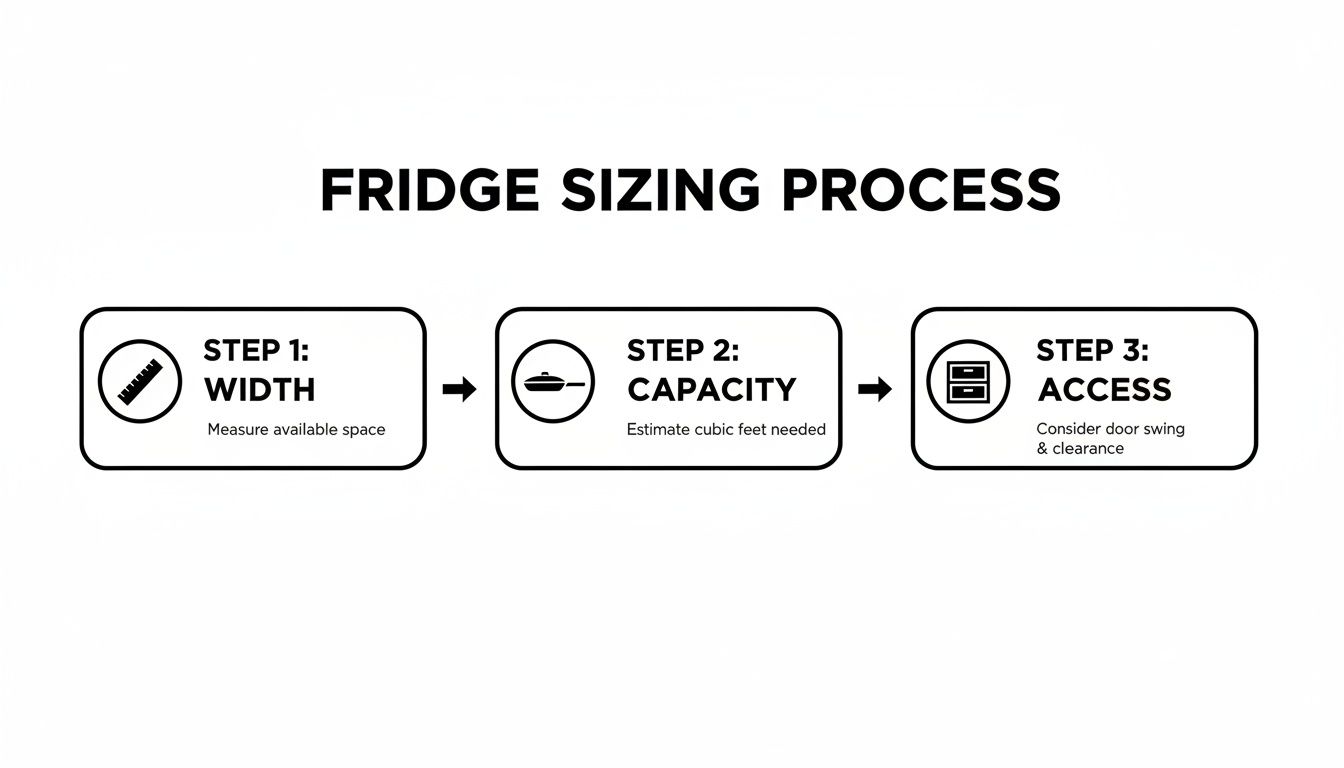
As you can see, getting the size right is a three-part puzzle that ensures your new equipment works for you, not against you.
Accounting for Critical Safety Clearances
Okay, you've got the dimensions of your opening. Now for the most overlooked step: factoring in clearance. Without enough room for air to circulate and heat to dissipate, your griddle will create an unsafe working environment and could violate health codes.
While you should always check the manufacturer's specific recommendations, a solid rule of thumb for clearance is:
- 6-12 inches of space at the back from any combustible surfaces
- 6 inches of space on each side from other equipment
- Sufficient overhead space for your ventilation hood to work effectively
Subtract these numbers from your opening's measurements. The result is the maximum size of commercial griddle your space can truly handle. To see how these numbers translate to real-world models, you can explore specific undercounter refrigerator dimensions and find the perfect match for your kitchen line. A little planning now ensures your investment runs safely and efficiently for years to come, keeping food perfectly cooked and ready for service.
Understanding Countertop vs. Drop-In Griddles
When you're outfitting a kitchen, "countertop" and "drop-in" might seem like minor details, but for a commercial griddle, they’re everything. This isn't just about looks; it's about how the unit is installed and how it integrates into your workflow. Get it wrong, and you’re looking at an inefficient cook line and a cleaning nightmare.
Think of a drop-in model as a custom-tailored suit for your cook line. It’s engineered to be installed completely flush within your countertop, creating that seamless, professional kitchen look. It’s the secret behind a clean, integrated aesthetic, letting you create a flat, easy-to-clean surface.
The Power of Integrated Design
Drop-in units are the undisputed champions of kitchen aesthetics and sanitation. They are specifically made to be enclosed, turning a simple appliance into a cohesive and incredibly functional workstation. If you're aiming for that fully integrated kitchen, digging into a guide on built-in cabinets can give you some great ideas for achieving that custom look.
A countertop griddle, on the other hand, is more of a jack-of-all-trades. These units are self-contained and sit on top of an equipment stand or countertop. They offer flexibility in placement and are easier to install or move, but they can create gaps where grease and debris can collect.
The choice between drop-in and countertop directly dictates the size of commercial griddle setup you can have. A drop-in unit lets you create a tighter, more integrated station, while a countertop model offers flexibility, which can be useful for mobile or changing kitchen layouts.
Installation and Performance Differences
It all comes down to how the griddle fits into your line. A drop-in unit is a permanent installation. It requires a custom cutout in your counter, but the result is a smooth surface that's easy to wipe down. This design is fantastic for sanitation and a modern look.
Countertop units are different. They are portable and can be placed on any suitable, non-combustible surface. This makes them ideal for kitchens that might need to reconfigure their layout, or for adding a griddle to an existing line without major renovations. However, cleaning around and under them can be more challenging.
Here's a quick breakdown to make the choice clearer:
| Feature | Drop-In Griddle | Countertop Griddle |
|---|---|---|
| Ventilation | Vents as specified by manufacturer for built-in use | Self-contained, requires side/back clearance |
| Installation | Requires custom countertop cutout | Sits on an equipment stand or counter |
| Best Use Case | Permanent, high-end show kitchens | Flexible layouts, food trucks, existing lines |
| Aesthetics | Seamless, integrated appearance | Standalone, utilitarian look |
At the end of the day, if you’re setting up a dedicated cook station where sanitation and a clean look are priorities, a drop-in model is almost always the right call. It’s designed for the intensity of a commercial line and supports a smarter workflow.
Sizing Your Griddle for Real-World Kitchen Scenarios
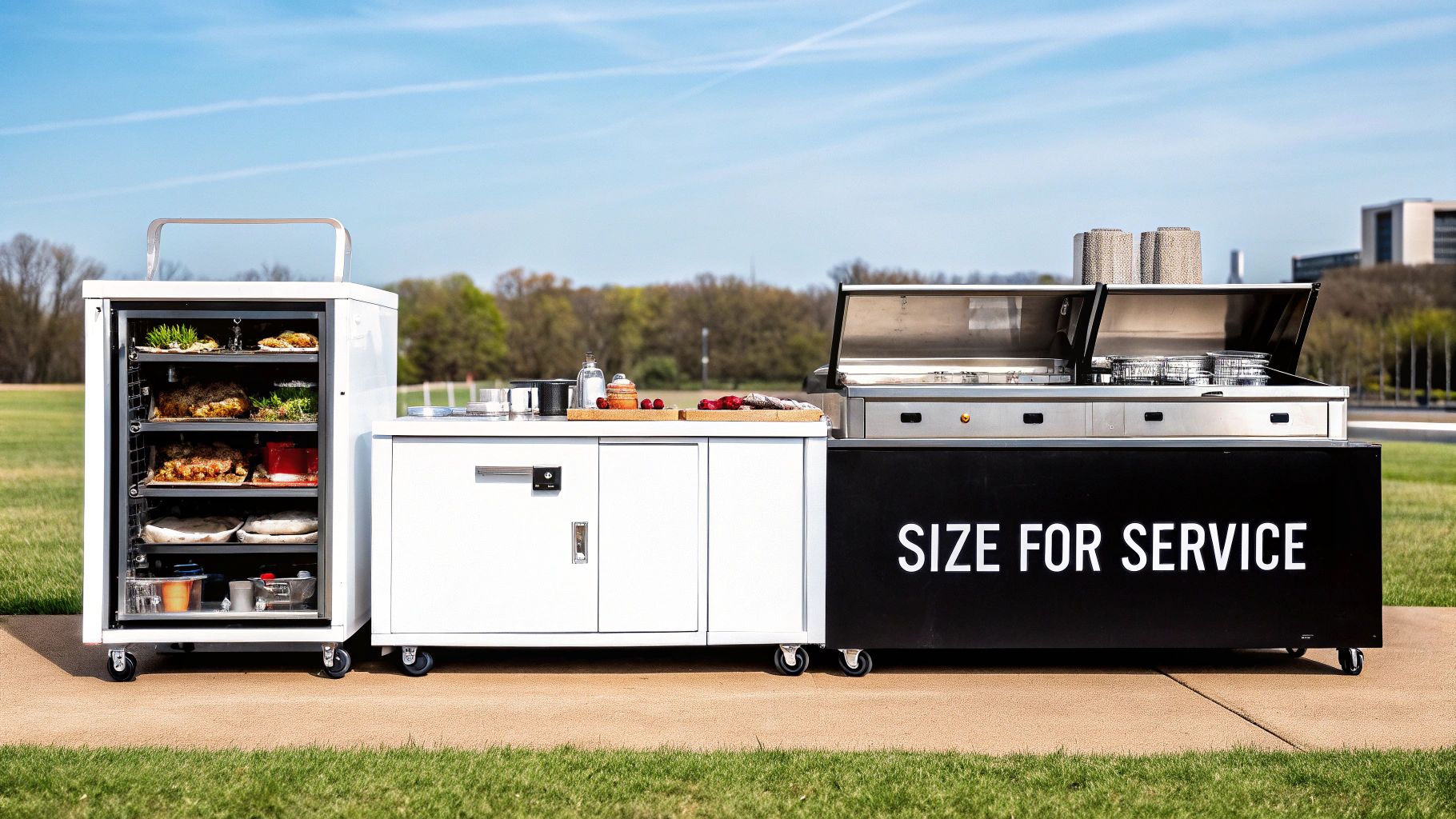
All the measurements in the world are just theory until you see how the right size of commercial griddle can absolutely transform a kitchen's workflow. Let's step away from the spec sheets and walk onto the floor of three very different commercial kitchens.
Each one has a unique challenge, and in each case, the right griddle isn't just a piece of equipment—it's the solution that turns a chaotic bottleneck into a smooth, efficient powerhouse. You'll see how the menu, the space, and the daily grind all point to the perfect fit.
The High-Volume Diner
Picture a classic diner slammed with the Sunday morning breakfast rush. The griddle is sizzling non-stop with pancakes, bacon, and omelets flying off the line. The cook can't afford to run out of cooking space. Every second wasted is a ticket time that gets longer and a customer that gets hungrier.
The answer here is a 72-inch, six-burner gas griddle. This massive surface area creates multiple cooking zones. The cook can have pancakes going on one end at a lower temp, bacon and sausage in the middle, and eggs searing on the other end. It’s a single, fluid workspace that keeps the line moving and the food coming out hot.
The Compact Food Truck
Now, let's squeeze into a food truck that cranks out gourmet burgers. In this world, space is gold. Every single inch has a job to do. A big, clunky griddle would be a disaster, generating too much heat and taking up valuable prep space.
For a tight mobile kitchen like this, a slim 24-inch countertop griddle is the perfect teammate. It tucks right onto the equipment line, providing just enough surface to handle a rush of burger patties. Its tiny footprint keeps the line clear for movement while providing the essential cooking power needed to crush a lunch service.
The Modern Ghost Kitchen
Finally, imagine a ghost kitchen—one line, but it's firing off orders for three different online brands. One's a burger joint, the next is a quesadilla concept, and the third slings Philly cheesesteaks. Having distinct temperature zones is critical for cooking different items correctly and getting orders right.
This operation needs a 60-inch griddle with thermostatic controls. This setup allows the chef to create precise, independent heat zones. One section can be held at 350°F for burgers, another at 375°F for cheesesteaks, and a cooler zone for toasting buns. It’s an airtight system that makes it simple for cooks to manage multiple menus from one unit.
This kind of setup is exploding in delivery-first kitchens. In fact, versatile griddles have seen a 30% jump in ghost kitchens because they offer quick, flexible cooking, reportedly slashing cook times by 22%. For more on this trend, you can check out market insights from Credence Research.
Common Questions About Commercial Griddle Sizes
You've done the homework, you've measured the space, and you're narrowing down the options. This is when the last few critical questions always pop up—the details that can make or break an installation.
Think of this section as your final walkthrough. We're covering the most common sticking points we hear from chefs and owners to make sure you nail the decision and avoid any expensive surprises.
How Much Clearance Does a Commercial Griddle Need?
Forgetting about proper clearance is the fastest way to create a fire hazard. For most standard commercial griddles, you absolutely need to leave 6 inches of breathing room on the sides and back from any combustible walls or surfaces. That gap is crucial for letting the unit dissipate heat safely.
But here’s the exception: some models are rated for zero clearance against non-combustible surfaces. This means they can be placed right next to other stainless steel equipment.
When in doubt, always, always check the manufacturer's spec sheet. It's the single source of truth for your model. Ignoring it is asking for a failed inspection and a dangerous kitchen.
Can I Put a Griddle Directly on Top of a Refrigerator?
Absolutely not—unless you want a melted refrigerator and a major safety hazard. A standard refrigerator just isn't built to handle the searing heat and sheer weight of a commercial griddle. The top will warp, the cooling system will fail, and you'll have a mess on your hands.
For that kind of setup, you need a specific piece of gear called a refrigerated chef base or equipment stand. These beasts are built for the job, with a heavy-duty, heat-resistant top that can safely support hot cooking equipment like a griddle. This is how you create that perfect, compact workstation with cold ingredients right below your cooktop.
Is Griddle Plate Thickness More Important Than Width?
In a working kitchen? They're both critical, but for different reasons. Width determines your capacity—how many burgers you can cook at once. Plate thickness determines your heat retention and recovery time.
A thicker plate (3/4" to 1") holds heat better, so when you throw on a batch of cold burgers, the surface temperature doesn't drop as much. It’s the real-world metric that tells you how consistent your cooking will be during a dinner rush. A chef needs both capacity (width) and performance (thickness) to get through a busy service.
Are Thermostatic Controls Better Than Manual for Energy Efficiency?
In a busy kitchen, thermostatic controls usually win this fight. A manual griddle is either on or off, often leading to it being left on high heat even during slow periods. A thermostatic griddle cycles on and off to maintain a specific temperature.
This pays off in two big ways:
- Lower Energy Bills: The griddle only uses energy when it needs to heat up to the set temperature, saving significant costs over time.
- Smarter Cooking: You get precise, consistent temperatures, which is better for delicate foods and ensures consistent product quality. Less burnt food means less waste.
Over time, that combo of precise control and less wasted energy means thermostatic griddles can save you money and produce a better, more consistent product.
For a complete selection of commercial griddles, chef bases, and other essential line equipment designed for high-performance kitchens, trust the experts at Griddles.com. Find the perfect fit for your operation at https://griddles.com and benefit from free freight and fast delivery.