
What Is a Commercial Griddle and Why Is It Essential for Your Kitchen?
In the fast-paced world of a commercial kitchen, the griddle is the undisputed workhorse. It's not just a piece of equipment; it's the heart of the cooking line. This high-powered, flat-top cooking surface provides consistent, even heat, making it perfect for everything from searing burgers to cooking pancakes.
The Ultimate Cooking Tool for Your Restaurant Station
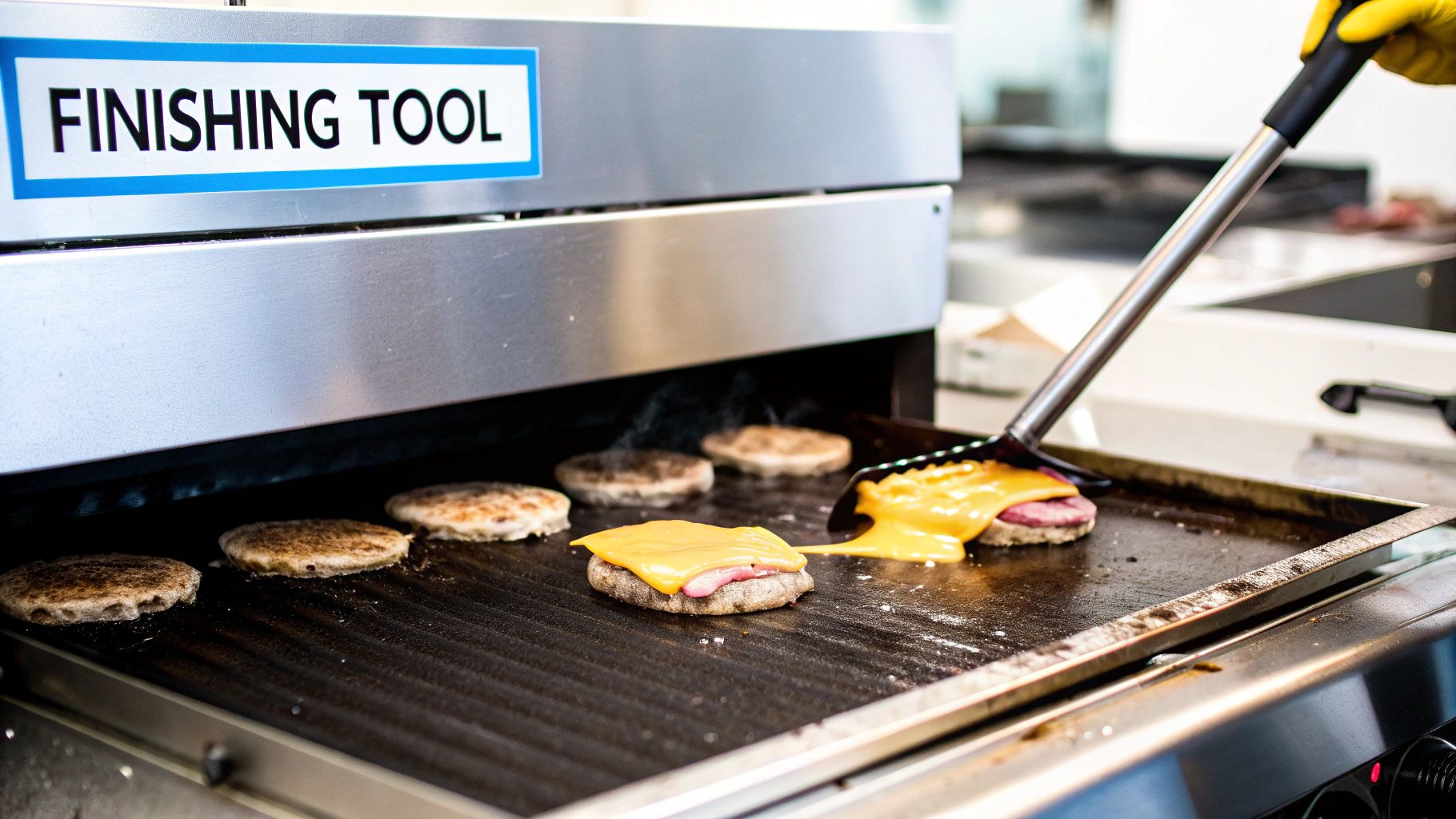
While other appliances handle specialized tasks, your commercial griddle does the heavy lifting—cooking the bulk of your menu with speed and reliability. It’s the difference between a good service and a great one.
So, what is a commercial griddle in cooking terms? It’s a large, flat cooking surface, typically made of steel, that is heated from below by either gas burners or electric elements. Its design allows for direct, even heat transfer, making it ideal for cooking a wide variety of foods simultaneously. The concept of flat-top cooking has been around for centuries, but modern commercial griddles are now essential gear for any high-volume operation, from classic diners to bustling food trucks and ghost kitchens. For a deeper dive into how this gear fits into a professional setup, you can explore this general restaurant equipment overview.
This powerful tool is purpose-built for jobs that demand both precision and speed.
A commercial griddle isn’t just for pancakes. It’s for achieving the perfect sear, consistent temperature, and high-volume output that defines a professional kitchen.
Just think about how a commercial griddle can master these classic menu items:
- Patty Melts: It achieves a perfect sear on the burger patty while simultaneously toasting the bread in its own juices for maximum flavor.
- Breakfast Sausages: A griddle provides the space and even heat to cook dozens of sausage links or patties to a beautiful, uniform brown.
- Gourmet Burgers: You can sear multiple patties, toast buns, and sauté onions all on the same surface, streamlining the entire cooking process.
Commercial Griddle at a Glance Key Functions and Benefits
To put it simply, a commercial griddle takes on core cooking tasks with unmatched efficiency. Here’s a quick breakdown of its core functions and the direct benefits they bring to your kitchen workflow.
| Core Function | Kitchen Benefit |
|---|---|
| Searing and Browning | Creates a perfect Maillard reaction crust on meats. |
| High-Volume Cooking | Cooks large quantities of food simultaneously and evenly. |
| Toasting Buns | Quickly toasts bread for texture without drying it out. |
| Zone Cooking | Allows for different temperature zones on a single surface. |
| High-Speed Cooking | Drastically reduces cooking times for faster service. |
Essentially, having a commercial griddle on your line means better-tasting food, faster ticket times, and more consistent results—all things that make a huge difference during a busy service.
How a Commercial Griddle Delivers Its Consistent Heat
The magic of a commercial griddle lies in how it generates and distributes heat across its large, flat surface. Once you understand the technology, you’ll see why it’s a cornerstone of any professional kitchen. The two main types are electric and gas, and each brings something different to the table.
Think of a gas griddle like the powerhouse of the kitchen. Fueled by natural gas or propane, its burners heat the steel plate from below. This approach provides rapid heating and quick temperature adjustments, making it perfect for high-volume restaurants that need to switch from searing steaks to gently cooking eggs in a hurry.
The Power of Thermostatic Controls
Electric griddles, on the other hand, are all about precision. They use heating elements embedded beneath the griddle plate, often governed by thermostatic controls. This setup offers incredibly accurate and consistent temperatures across the entire surface. It's an ideal choice for delicate items like pancakes or seafood where precise heat control is critical.
For example, a chef can set an electric griddle to a precise temperature and cook perfect crepes batch after batch without worrying about hot spots. Of course, maintaining the right heat is just one part of the equation; it’s always critical to follow the guidelines for safe cooking temperatures for meat to make sure every plate is both delicious and safe.
The real difference comes down to power and precision. Gas griddles offer raw power and fast response times. Electric griddles provide unparalleled temperature accuracy and consistency.
That precision is why electric griddles with thermostatic controls are gaining popularity. A thermostatic unit allows you to set a specific temperature, and the griddle will cycle its heating elements on and off to maintain it. This is a huge advantage for consistency and can lead to energy savings—a huge plus for any business looking to keep operating costs down.
It’s a game-changer for mobile setups, too. Imagine a food truck pairing an electric griddle with their power system. During a breakfast rush, pancakes can be cooked to golden perfection every time. On top of that, the best models are incredibly efficient.
Griddle vs. Standard Range Top: What's the Real Difference?
Most commercial ranges come with standard burners, so you might be wondering, "Why bother with a whole separate griddle?" It really boils down to surface area and heat distribution. Think of a standard range top as a collection of individual heat sources—great for pots and pans. A griddle, on the other hand, is a single, continuous cooking surface designed for direct-contact cooking at scale.
The biggest separator is volume and efficiency. Your standard burners are inefficient for cooking dozens of burgers or a mountain of hashbrowns. A dedicated commercial griddle, especially a modern thermostatic model, delivers consistent heat across its entire surface, allowing you to cook large batches of food evenly and simultaneously. That makes it an absolute powerhouse for a busy line.
Feature Showdown: Commercial Griddle vs. Standard Range Top
While both use heat, how they perform in a real commercial kitchen couldn't be more different. Your standard range might be fine for sautéing vegetables in a pan. But a griddle is engineered to cook hundreds of breakfast orders during a chaotic morning rush without ever skipping a beat. When ticket times are everything, that efficiency is gold.
To really see the difference, let's break down the key features head-to-head.
| Feature | Commercial Griddle | Standard Range Top |
|---|---|---|
| Cooking Surface | Large, continuous flat top | Individual burners for pots/pans |
| Heat Distribution | Even and consistent across the surface | Concentrated heat under each pot |
| Volume Capacity | Very high; cooks many items at once | Low; limited by pan size and number of burners |
| Workflow | Seamless; cook multiple components of a dish | Requires multiple pans and coordination |
| Cleaning | Simple scrape-down of a single surface | Requires cleaning multiple burners and grates |
| Best For | High-volume breakfast, burgers, cheesesteaks | Sautéing, boiling, simmering in pans |
As you can see, the griddle is built from the ground up for the speed and repetition demanded by a professional kitchen, while the range top is more of a versatile, all-purpose station.
Designed for a Professional Workflow
Another critical factor is how the equipment fits into your kitchen's flow. A range top requires a cook to manage multiple pots and pans, which can be awkward and slow.
In contrast, a commercial griddle is a single, unified station.
This strategic design allows a cook to manage an entire dish with simple, fluid motions—flipping pancakes, searing bacon, and frying eggs all on one surface. You're shaving critical seconds off every single order.
This setup isn't just faster; it's also far more ergonomic and efficient. It creates a smooth, unbroken line for high-volume production. This is the same kind of thinking that goes into choosing other specialized equipment—you can learn more about what is a charbroiler and its place in the kitchen line in our detailed guide. In a high-volume restaurant, those small efficiencies add up to a massive boost in both output and consistency.
The diagram below shows the two main technologies that give these units their power.
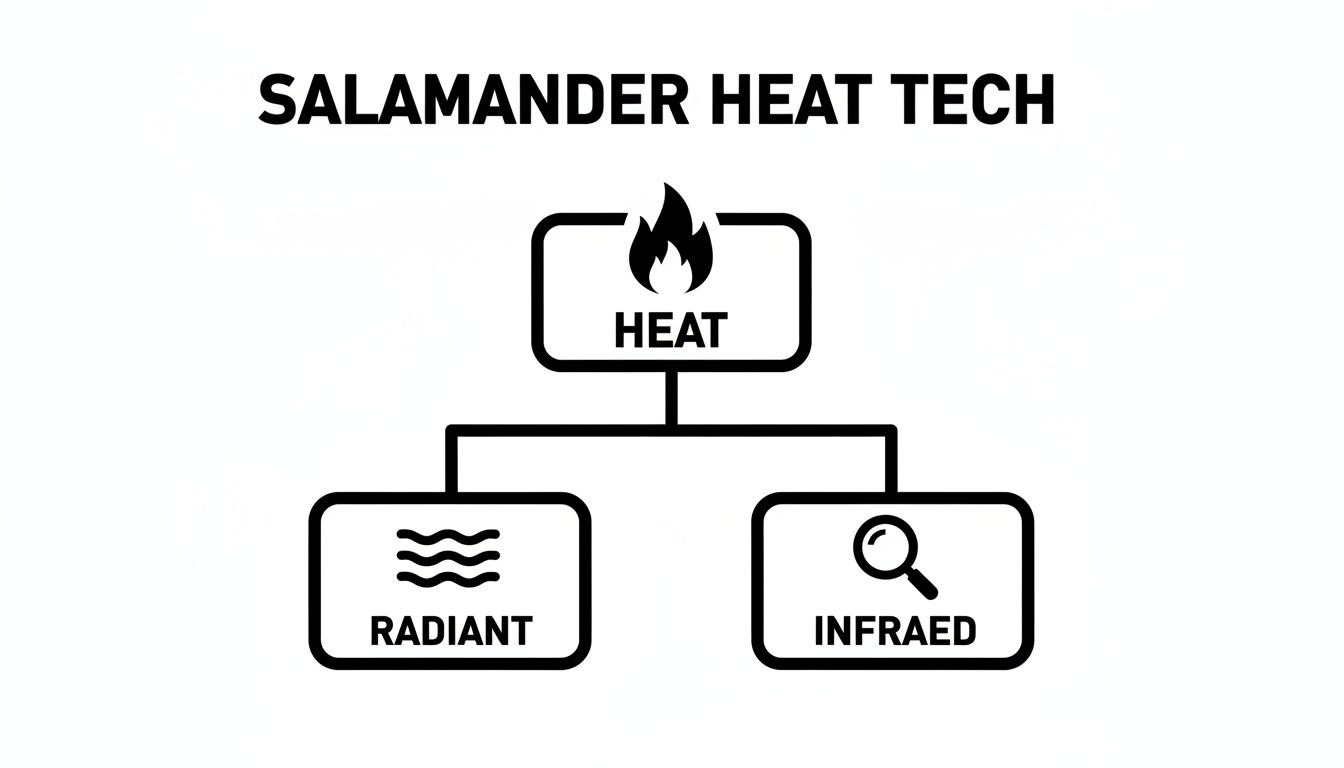
As you can see, both gas and electric systems deliver powerful heat to the griddle plate, giving chefs the consistent cooking surface they need for different types of dishes.
How a Commercial Griddle Supercharges Your Menu
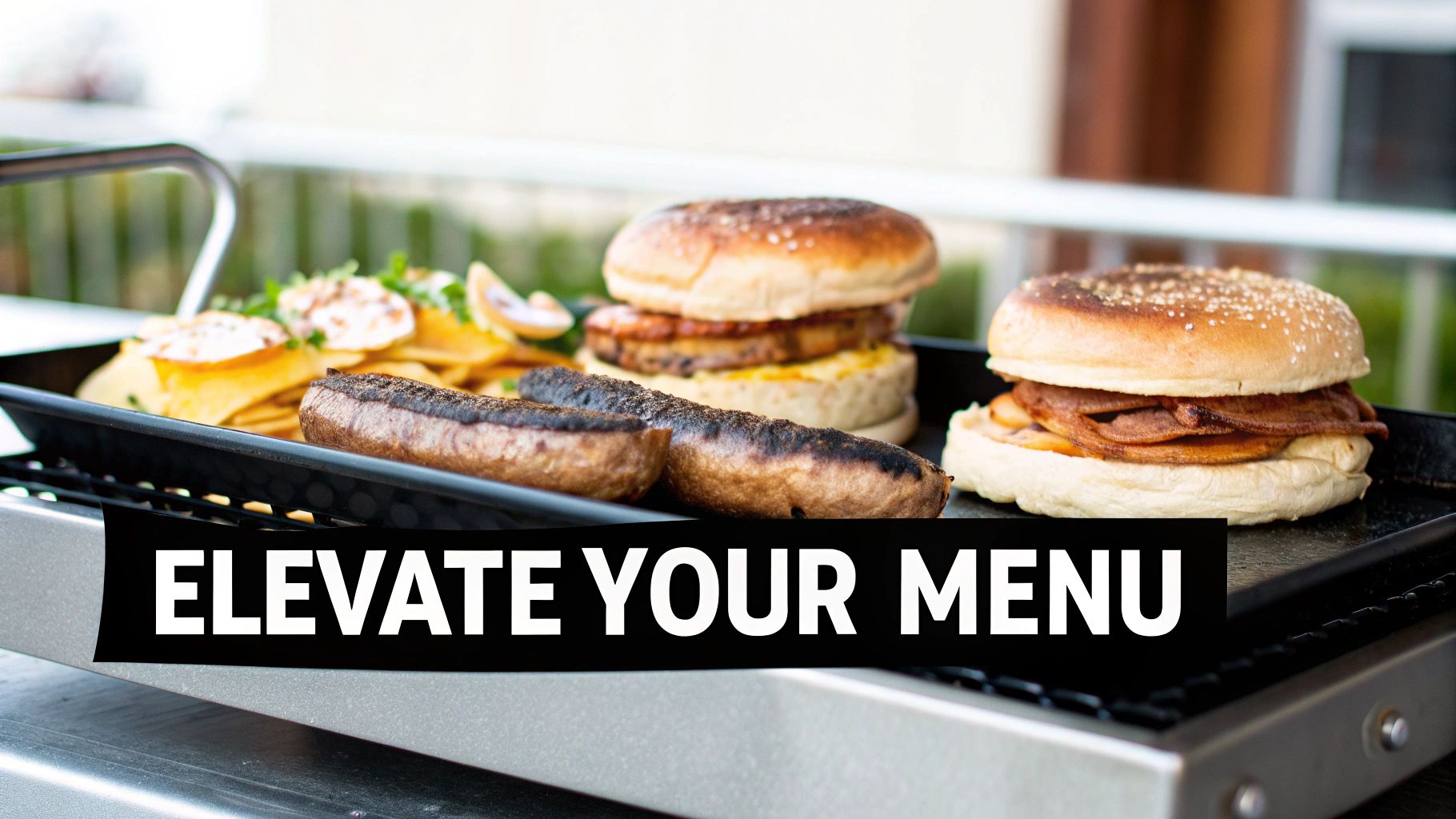
Let's get past the specs and talk about what really matters: how a commercial griddle can be the foundation for your entire menu. This is where the magic happens on a busy line, transforming a simple flat top into a serious profit center. Its power goes way beyond just breakfast; we're talking about a versatile platform for creating textures, colors, and layers of flavor for every meal service.
Think about searing a perfectly crusted steak, caramelizing onions, and toasting the bun for a steak sandwich—all on the same surface. Or imagine cooking delicate salmon fillets to achieve that crispy skin everyone loves, right next to your asparagus. These are the workhorse capabilities that allow you to build an extensive and profitable menu.
Unlocking New Menu Possibilities
A commercial griddle opens up a world of possibilities for breakfast, lunch, and dinner. Just look at how it can master some classic dishes:
- Ultimate Patty Melts: Get that iconic sear on the patty and a perfect golden-brown crust on the rye bread.
- Gourmet Toasted Sandwiches: Create an incredible club sandwich by toasting the bread directly on the seasoned griddle surface.
- Caramelized Pork Chops: Achieve a perfect, even sear across the entire surface of the chop for maximum flavor and moisture retention.
- Golden-Brown Brioche Buns: Toasting burger buns on the griddle gives them a light, crisp interior that adds a fantastic texture contrast.
Thermostatic griddles, which offer precise temperature control, are incredibly versatile. They can hold a low temperature for delicate items or crank up the heat to sear burgers in under 5 minutes. This is huge, especially since plant-based menu items have jumped a staggering 300% in U.S. restaurants since 2019, and many require careful temperature management. For more on adapting to trends, you can read about how salamanders help kitchens adapt to food trends on hatcocorp.com.
A commercial griddle is the tool that closes the gap between slow, small-batch cooking and professional, high-volume service. It’s all about consistency and speed at scale.
This speed is a game-changer during the morning rush. You can really expand your offerings by checking out some popular breakfast restaurant menu ideas that a griddle helps you pull off flawlessly.
Choosing the Right Commercial Griddle for Your Kitchen
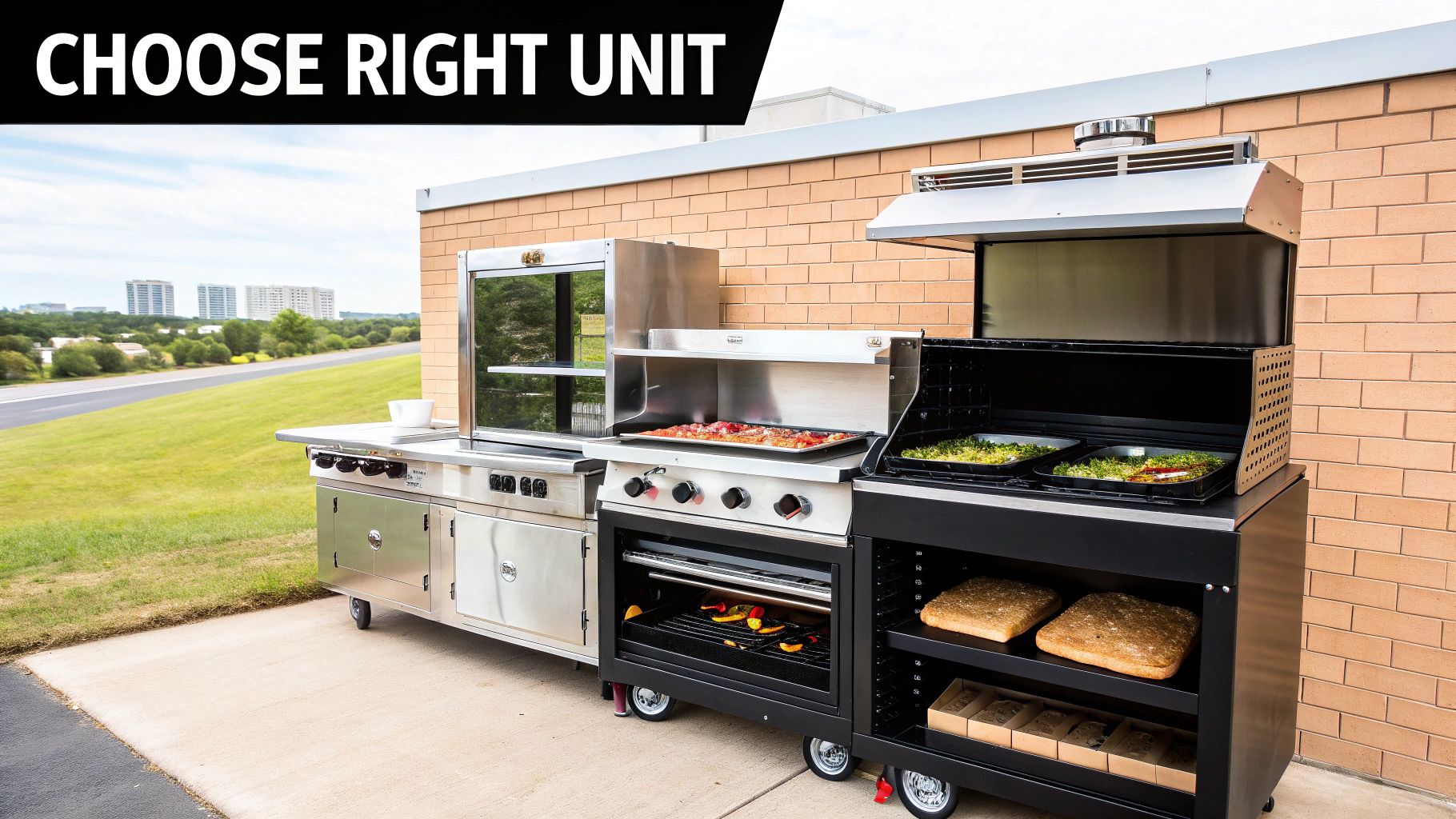
Picking out the perfect commercial griddle for your kitchen isn't as simple as just grabbing the first one you see. The right choice really comes down to what's on your menu, how busy you are, and the physical layout of your cook line. Get this right, and your new workhorse will power your kitchen instead of creating a frustrating bottleneck.
Your first big fork in the road is the power source. Gas griddles are the heavy-hitters, pumping out raw, consistent power that's perfect for high-volume searing. On the flip side, electric griddles give you much finer temperature control, which is a lifesaver for more delicate work like eggs and pancakes. They're also the go-to for spots where gas isn't an option, like many food trucks.
After that, you'll want to think about the plate thickness and material. A thicker steel plate holds heat better and provides more even cooking, while specialty surfaces like chrome can be great for presentation cooking as they are less prone to food sticking.
Matching the Griddle to Your Space
Finally, you have to consider the size of the unit and how it fits into your kitchen's flow. In a tight space, the right countertop model can be a game-changer. Whenever you're shopping for new gear, whether it's a griddle or another workhorse, a good essential kitchen appliance buying guide can help you think through all the critical details.
The goal is to choose a griddle that supports your menu, enhances your output, and fits your operational reality. A busy diner with a huge breakfast menu needs a powerful, 72-inch gas unit, while a compact food truck will benefit more from a space-saving electric model.
Here are the most common types:
- Countertop Griddles: These models sit on a refrigerated base or work table, offering flexibility in kitchen design. They come in a wide range of sizes.
- Drop-In Griddles: Built directly into a countertop for a seamless, clean look. This is a great custom option for front-of-house or exhibition kitchens.
- Teppanyaki Griddles: Designed for Japanese-style cooking where chefs cook in front of guests. They provide a large, social cooking surface.
Don't forget that any griddle requires proper ventilation, which is a huge deal for kitchen safety and air quality. We get into the weeds on that in our guide to commercial kitchen ventilation systems.
Your Top Questions About Commercial Griddles
If you're wondering whether a commercial griddle is the right move for your kitchen, you're not alone. A few common questions always pop up. Getting straight answers is the best way to figure out how this essential piece of gear will affect your workflow, your menu, and your profits.
Can a Griddle Just Replace My Stove?
Not entirely. While they are incredibly versatile, a griddle is designed for flat-top cooking, not for holding pots and pans. You'll still need burners for stocks, sauces, and boiling. A commercial griddle excels at cooking food directly on its surface at high volumes. It's meant to work alongside your range, not replace it, handling the bulk of your direct-heat cooking with incredible efficiency.
What's the Difference Between a Manual and a Thermostatic Griddle?
The real difference comes down to temperature control. A manual griddle has simple High/Medium/Low settings. It's a durable, no-frills option great for kitchens that cook a limited menu and don't require precise temperatures.
A thermostatic griddle, on the other hand, allows you to set a specific temperature (e.g., 350°F), and it will automatically maintain that heat. This precision is perfect for delicate foods like eggs and seafood and ensures incredible consistency from one order to the next.
How Do I Keep a Commercial Griddle Clean?
A little regular maintenance goes a long way in keeping your griddle seasoned and running like new. A simple daily routine is all it takes to protect your investment.
- Daily: After service, use a griddle scraper to remove all food debris. While the surface is still warm, pour on some water and use a griddle brick or pad to scrub the surface clean.
- After Cleaning: Wipe the surface completely dry to prevent rust.
- Seasoning: Apply a thin layer of cooking oil to the clean, dry surface to protect it and build up a non-stick patina over time.
Pro tip: Always—and I mean always—follow the manufacturer's cleaning instructions. Avoid using harsh chemicals or ice on a hot griddle, as this can cause the metal to warp (thermal shock).
Gas or Electric Griddle for a Food Truck?
This one is all about your truck's existing setup. Electric griddles are often smaller, easier to slot into place, and can offer really precise temperature control. If you have a beast of a generator or a solid battery bank, electric is a fantastic choice.
Gas griddles (usually propane) are known for their raw, consistent power and don't tax your electrical system. If your truck is already set up with a robust propane system for the fryers, sticking with gas makes a lot of sense. It really just comes down to the power sources you already have on board.
Ready to make your kitchen more efficient with the perfect flat-top cooking surface? The team at Griddles.com can walk you through finding the right commercial griddle for your kitchen and your budget. Check out our lineup of high-performance commercial kitchen equipment today.