

Optimize Your Kitchen with a Commercial Griddle: Cut Costs & Boost Quality
Let's get straight to the point—if you're not optimizing your commercial griddle operations, you're throwing money away with every order. This isn't just about keeping things clean; it's a fundamental strategy for financial health and quality control in any serious kitchen. Think of it as an investment that pays for itself, shift after shift.
The Real Cost Of a Poorly Maintained Griddle
Skipping the daily cleaning routine is one of the most common—and costly—mistakes I see in commercial kitchens. It's a seemingly small oversight that directly hits your bottom line by jacking up energy costs, creating inconsistent food, and even introducing safety risks.
Degradation And Higher Energy Consumption
Without regular cleaning, all those tiny bits of food—crumbs, grease, stray seasonings—are left to carbonize on the hot surface. Throughout service, they just keep cooking, burning, and creating a layer of buildup. This is what turns your griddle surface dark, creates hot and cold spots, and transfers nasty "off" flavors that seep into everything you cook.
The immediate result? Your griddle has to work way harder to transfer heat, increasing energy consumption. It's been shown that a solid cleaning schedule can improve the efficiency of your commercial griddle by up to 50%. That's a massive reduction in your annual utility bills, turning a simple daily task into a genuine profit-booster.
The Impact On Food Quality And Customer Satisfaction
Your griddled food is only ever as good as the surface it's cooked on. Period. Once that surface starts to degrade, you can forget about getting that perfect sear your customers crave. Instead, food comes out unevenly cooked, greasy, and tasting slightly burnt or bitter.
The simple truth is that proper maintenance is a quality control checkpoint. It ensures that the last batch of pancakes served at closing is just as delicious as the first one served at breakfast.
This kind of inconsistency is a killer for customer satisfaction and your restaurant's reputation. Using proper cleaning techniques for your commercial griddle is non-negotiable for delivering the high-quality, consistent product that keeps people coming back. To see how different systems can help, you can learn more about deep fryer filtration systems in our detailed guide.
At the end of the day, cleaning isn't a chore or a luxury; it's an operational necessity for any kitchen that's serious about its food and its finances.
Choosing the Right Commercial Griddle
Picking the right commercial griddle isn't just about ticking a box; it’s a critical decision that ripples through your kitchen's workflow, your bottom line, and the quality of every dish you serve. What's perfect for a high-volume diner would be total overkill for a small cafe, and vice versa.
The secret is to match the griddle type to how you actually operate. You need to think about your daily customer count, what you're cooking (burgers vs. delicate crepes makes a huge difference), your staffing situation, and what you can afford upfront. Let's dig into the main options to figure out which one fits your kitchen best.
Standard Steel Griddles
For the small cafe, the startup food truck, or any spot where griddled food isn't the main event, the standard steel griddle is the classic starting point. We're talking about a simple, durable steel plate. The process is straightforward: you season it, heat it, and cook directly on the surface.
It’s by far the cheapest way to get started. However, it's also the most demanding on your staff for cleaning and maintenance to prevent sticking and rust. It's a completely hands-on job that takes time out of a busy service, which can be a real drawback.
Chrome Griddles
Taking a big leap forward in ease of use and efficiency, we have the chrome griddle. Think of this as a premium surface—a fantastic middle ground for a ton of kitchens. A busy gastropub that cranks out burgers or an independent restaurant with a popular breakfast menu will see the benefits almost immediately.
The chrome surface provides excellent heat distribution and is far less porous than steel, meaning less flavor transfer and easier cleanup. This is worlds better for cooking delicate items and requires less oil. It cuts down on the back-breaking scraping and the very real risk of food quality decline.
This is all about finding the sweet spot. A chrome griddle gives you a massive upgrade in performance and ease of maintenance over standard steel without the hefty price tag of more specialized equipment.
Grooved Griddles
When you get to the big leagues—steakhouses, high-end burger joints, or any kitchen where grill marks are part of the presentation—grooved griddles are the undisputed champions. These griddles are designed to mimic the look of a charbroiler, providing beautiful sear marks while cooking on a solid, easy-to-clean surface.
The grooves also help channel away excess fat, making for a healthier final product. This setup maximizes presentation, guarantees consistent cooking, and provides a unique aesthetic that customers love.
Commercial griddles are the heart of these businesses, and new technology is making them smarter than ever. For example, modern griddles with advanced thermostatic controls can slash energy waste by 50%. That can push your griddle's efficiency from a standard 20-30% all the way to 50-60%, which adds up to huge savings on utility bills. There’s a good reason a recent report on the commercial deep fryer market highlighted these advancements.
To help you visualize the trade-offs, here’s a quick comparison of the griddles we've covered.
Commercial Griddle Comparison
| Griddle Type | Best For | Initial Cost | Labor Intensity | Heat Retention |
|---|---|---|---|---|
| Standard Steel | Low-volume, tight budgets | $ | High | Medium |
| Chrome | Mid- to high-volume | $$ | Medium | High |
| Grooved | High-volume, steakhouses | $$$ | Low | High |
Ultimately, while the upfront cost for a chrome or grooved griddle is the highest, the return on investment is a no-brainer for demanding kitchens. The savings on labor, the reduction in energy costs, and the boost in food quality are simply unmatched. For operations like these, getting the right model is everything. If that sounds like you, you might want to check out our guide on choosing the best commercial deep fryer.
Mastering the Daily Griddle Cleaning Process
In any busy kitchen, consistency is king. That doesn’t come from guesswork; it comes from having disciplined, repeatable processes. Once you’ve picked out your commercial griddle, the next step is building a daily playbook around it. A rock-solid standard operating procedure (SOP) is what protects your crew, your equipment, and ultimately, the taste of your food.
This isn’t just about a quick scrape at the end of the night. It's a series of small but critical steps that often get skipped when the dinner rush hits. From using the right tools to cleaning a hot surface without incident, every single detail counts. A daily cleaning routine done right is the cornerstone of good griddle management.
This graphic gives you a quick visual on how the different griddle types stack up, from the most basic manual setups to the fully automated ones. It’s a good way to see where your current operation fits in.
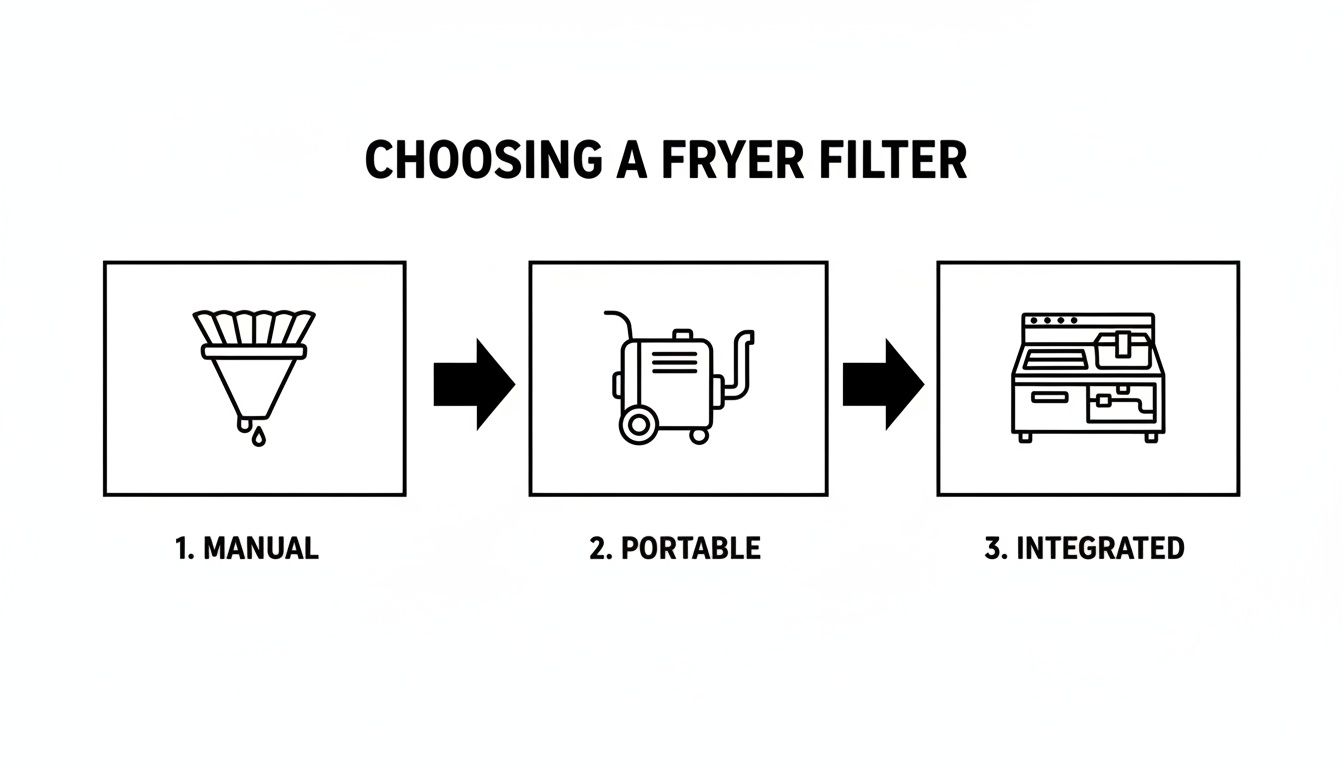
As you can see, the solutions scale right alongside your kitchen's complexity, starting with simple steel plates and moving all the way up to advanced grooved units.
The Pre-Cleaning Checklist
Before you even think about applying cleaner, a few prep steps can make a world of difference in how well your cleaning actually works. I’ve seen countless kitchens rush this part, and it almost always leaves behind the gunk they were trying to get rid of in the first place.
First things first: adjust the heat. Let the griddle cool down a bit to a safer handling temperature, somewhere around 300-350°F. At this temp, the surface is perfect for loosening grease without causing cleaning solutions to instantly evaporate. Trying to clean a cold, greasy griddle is a waste of time and can put a serious strain on your staff.
Next is the step everyone seems to forget: grab a high-heat scraper or griddle brick and give the entire surface a good scrub. Get the walls, corners, and especially the cooking zones. All that caked-on carbon and old food isn't going anywhere if you just pour cleaner on it. You have to knock it loose so it can get scraped away.
Executing The Cleaning Safely
Let’s be clear: safety is non-negotiable when you’re dealing with a surface that’s hundreds of degrees. Make sure anyone involved in the process is geared up with the right PPE. No exceptions.
- Heat-Resistant Gloves: Get the long ones that cover the forearms.
- Safety Goggles or Face Shield: Splashes happen, and eyes are irreplaceable.
- Non-Slip, Closed-Toe Shoes: This should be standard kitchen attire, but it’s extra important here.
Once everyone is properly protected, just follow the manufacturer's guide for your specific griddle and cleaning solution. You'll typically apply the cleaner, let it sit, scrub with a griddle pad, and carefully squeegee the residue into the grease trap.
Here's a pro tip for any setup: empty the grease trap completely. Even a little bit left in the bottom is a fire hazard and can instantly make your clean griddle area unsanitary.
Post-Cleaning Best Practices
After the griddle surface is clean and dry, you're not quite finished. Take the time to properly season the surface if it's a steel griddle, clean the surrounding area, and wipe up any drips on the floor. Keeping the whole area clean and sanitary is just as important as the cleaning itself.
This daily habit is especially vital for kitchens running on gas griddles, which power an estimated 60-70% of commercial griddle stations around the world. The right cleaning routine can slash energy consumption by 15-20% and cut down on maintenance calls by a whopping 35%. For an average business, that’s a savings of over $1,000 a year for each griddle.
Finally, while daily cleaning is your bread and butter, don't skip the weekly deep clean. This is the heavy-duty effort that gets rid of the stubborn, sticky, polymerized grease that daily cleaning can't touch. A weekly deep clean basically resets your griddle, helping your surface stay cleaner, longer. If you're looking to learn more about the equipment itself, our guide on the modern commercial deep fryer is a great place to start.
How to Build a Consistent Cleaning Schedule
Okay, so we've covered the different types of griddles. Now let's talk about the real game-changer: timing. This is where you see the savings and quality improvements really start to add up.
A random, "we'll get to it when it's slow" approach just won't cut it. If you want to squeeze every last bit of performance out of your griddle and serve consistently great food, you need a cleaning schedule that actually fits your kitchen's unique pace.
Think of it like any other piece of critical equipment. You wouldn't skip preventative maintenance on your walk-in, right? A consistent cleaning schedule for your griddle is just as vital. But here's the thing: there's no magic one-size-fits-all answer. How often you need to clean comes down to what you're cooking, and how much of it you're pushing out the door.
Tailoring Your Schedule to Your Menu
The single biggest factor dictating your cleaning frequency is your menu. A kitchen pumping out greasy bacon and sugary pancake batter is going to need a much more aggressive schedule than a spot that mostly just sears vegetables.
All that fat and sugar sheds a ton of debris, and those little bits burn fast, absolutely wrecking your griddle surface. If that sounds like your menu, you should be cleaning at least once per shift. No exceptions. On the other hand, a lower-volume operation cooking cleaner items might get by just fine with one solid cleaning session every 24 hours.
Key Takeaway: Your menu dictates the schedule. More grease and sugar means more frequent cleaning. Don't treat a burger griddle the same as a vegetable-only griddle.
Sample Cleaning Schedules
To give you a better idea of what this looks like in the real world, let's break down a few common scenarios. See where your operation fits.
- High-Volume QSR: Think of a busy fast-food joint that's constantly cooking burgers. They're likely cleaning their griddle two to three times a day. This is non-negotiable for handling the insane grease buildup and keeping the food quality high during the lunch and dinner rush.
- Busy Diner: A classic American diner with a mixed menu will probably clean its main workhorse griddles at the end of every shift. If they have a dedicated griddle just for eggs, they might be able to get away with cleaning that one just once a day.
- Small Cafe or Pub: For a place where griddled food is on the menu but isn't the main event, a single, thorough cleaning at the close of business each day is usually plenty.
Knowing When to Resurface the Griddle
Even with the best cleaning schedule, your commercial griddle surface has a finite lifespan. You've got to know when it's time to call it and have it professionally resurfaced. While you could wait for major issues, it's better to be proactive.
Your eyes are your first line of defense. If the surface is getting pitted, warped, or if it starts to have significant hot and cold spots that don't go away, you've got a problem. If food consistently sticks no matter how well you clean it, that surface is done.
For a more objective approach that takes out the guesswork, use an infrared thermometer. Test various spots on the surface. If you see significant temperature variations, it’s a clear sign that heat transfer is compromised and it’s time to consider resurfacing or replacement.
Solving Common Commercial Griddle Problems
Even with the best equipment and a rock-solid schedule, things can go sideways during a busy service. Knowing how to quickly diagnose a griddle problem is what separates a minor hiccup from a full-blown kitchen meltdown.
Most of the issues that seem like a huge deal often have a surprisingly simple fix once you know where to look. We’ve all been there. From food that looks unevenly cooked to a surface that just refuses to stay clean, let's walk through the common culprits and get you back in business.
Dealing With Uneven Cooking
You just cooked a batch of burgers, and some are perfectly seared while others are pale. Nine times out of ten, this is a classic case of uneven heat distribution. Poor heat is public enemy number one for a commercial griddle—it breaks consistency and kills the perfect sear you're looking for.
This usually happens when carbon buildup creates hot and cold spots or when heating elements begin to fail.
- The Fix: Make sure your team is giving the griddle a thorough scraping and cleaning before every service to remove any buildup.
- Best Practice: Regularly check your heating elements or gas burners to ensure they are functioning correctly across the entire griddle surface.
Fixing a Sticky Surface
Is your griddle clinging to food, tearing delicate items like pancakes or fish? The most common reason is an improperly seasoned surface (on steel griddles) or using the wrong utensils. Metal spatulas on a chrome griddle can cause scratches that lead to sticking.
The other likely suspect is leftover food residue. If the surface wasn't cleaned properly, tiny bits of carbonized food create a rough, sticky texture.
A sticky surface isn't just an annoyance; it's a warning sign. Pushing through service can lead to ruined food and costly delays. Always address the root cause immediately.
A quick inspection and proper cleaning before you start service will save you this headache.
Preventing Warped Surfaces
There's nothing more soul-crushing than seeing your once-flat griddle develop a bow or warp. All your liquids pool to one side, and cooking becomes a nightmare. It’s a common frustration, especially with lower-quality steel griddles.
Warping almost always happens because of "thermal shock"—hitting a very hot griddle with a large amount of cold liquid.
- Solution: Never dump ice or large quantities of cold water on a hot griddle to clean it.
- Pro Tip: Allow the griddle to cool down to the recommended temperature before starting your cleaning process.
This gentle approach lets the metal cool evenly without warping. This kind of attention to detail is vital for all kitchen equipment. For kitchens running a mix of gear, integrating air fryer filters is also key for trapping airborne grease, which helps with health codes and can extend equipment life by 20-30%. In fact, kitchens using filtered air frying systems often see 40% less downtime for cleaning—a huge win in a high-volume spot. To learn more, you can discover more insights about the commercial air fryer market.
Your Commercial Griddle Questions, Answered
When you're dialing in your kitchen's griddling program, a lot of questions pop up. We get it. We've heard them all from chefs and operators trying to get the most out of their equipment. Here are the straight-up answers to the most common questions we hear about commercial griddles.
How Often Should I Season My Griddle?
For most kitchens with standard steel griddles, the best practice is to re-season the griddle daily. It’s the simplest way to guarantee you’re starting every service with a non-stick, protected surface.
But let your usage be your real guide. If you’re running a high-volume diner and constantly scraping the surface, you may need to apply a thin coat of oil more frequently throughout the shift. Chrome griddles do not require seasoning.
Your griddle will tell you when it’s time. If you notice food starting to stick or see patches of dull, unprotected metal, it's time for a new coat of seasoning. No debate.
Is It Better to Clean a Griddle Hot or Cold?
Warm. Always, always clean your griddle while it's still warm. The sweet spot is between 300-350°F (150-175°C).
Why? At that temperature, grease and food particles are loosened and easy to remove. This allows you to scrape and wipe the surface clean with minimal effort.
Trying to clean a cold griddle is a fool's errand. The grease solidifies and carbon sticks like glue. Even worse, you're putting a massive amount of strain on your staff and tools, which is a fast track to damaged equipment and frustration you can't afford.
What Is the True ROI on a Commercial Griddle?
The return on a good commercial griddle is one of the easiest things to prove in a commercial kitchen. The savings and benefits hit your P&L from several angles, making it a no-brainer investment.
First, the obvious one: you’ll increase your menu versatility. By properly maintaining your griddle, you can cook a wider range of items consistently, which can boost your sales by up to 50%. Then there's the food quality. A clean, even surface makes for a better-tasting, better-looking final product. That means happy customers who come back again and again.
The ROI isn't just about cooking more food. It’s about protecting your food quality, reducing labor costs associated with harsh cleaning, and extending the life of your expensive cooking equipment.
Finally, think about your equipment. A clean griddle heats more efficiently, saving on energy costs. That translates to less time your crew has to spend scrubbing and can even extend the life of your griddle’s heating elements.
What Is the Difference Between Scraping and Cleaning?
These two jobs go hand-in-hand, but they are not the same thing.
Scraping is what you do during service. It’s the quick, simple act of using a scraper to remove the big, loose bits of food and grease from the surface between orders. Think of it as battlefield maintenance during the dinner rush.
Cleaning, on the other hand, is the deep clean. This is where you use a griddle brick, screen, or chemical cleaner to remove all the tough, carbonized buildup that a scraper could never hope to catch. Scraping keeps the surface clear during a shift; cleaning actually extends the life of that griddle for years.
Ready to equip your kitchen with the best? Griddles.com offers a full line of commercial cooking equipment, including high-performance deep fryers and the commercial griddles to support them. Explore our selection and get free shipping on every order at https://griddles.com.