

Upgrade Your Kitchen: Pairing Commercial Griddles with the Right Stainless Steel Work Table
In any serious commercial kitchen, the stainless steel work table is the unsung hero supporting your most valuable equipment. It's the silent workhorse, the foundational platform where all the magic happens—from fine-tuned prep work to holding up heavy commercial griddles. Getting this choice right is absolutely critical for your kitchen's efficiency, safety, and bottom line.
The Unsung Hero Supporting Every Commercial Griddle
Look inside any high-performing kitchen—a bustling restaurant, a tight-fit food truck, or a streamlined ghost kitchen—and you'll find it’s all built around the stainless steel work table. This isn't just a piece of furniture; it's the central hub of your entire workflow, especially for your griddle station. It’s where raw ingredients start their journey to becoming the finished dishes on your menu.
Think of it as the stage for your griddle's daily performance. It has to be tough enough to handle heavy equipment like a commercial griddle, durable enough to take a beating from constant chopping and cleaning, and sanitary enough to fly through health inspections. A cheap or poorly chosen table creates bottlenecks, risks cross-contamination, and will cost you more in the long run when it needs replacing. The right one, however, feels like a seamless extension of your team.
This essential role is why the market for them is booming. The global stainless steel tableware and kitchenware market, which is dominated by these workhorses, hit a massive USD 23.5 billion in 2023. Projections show it climbing towards USD 35.7 billion by 2032 as the hospitality industry keeps expanding. And for good reason—data shows kitchens using proper stainless steel tables often see up to 25% faster sanitation times. For a busy operation, that's a game-changer. You can dig deeper into these numbers with this market analysis report.
Why It Is the Industry Standard for Griddle Stations
There's a simple reason stainless steel reigns supreme in professional kitchens: it's built for the job. Its non-porous surface is naturally resistant to bacteria, rust, and corrosion, which is non-negotiable for food safety. Unlike wood, which can trap germs in every nick and groove, or plastic that stains and degrades, stainless steel gives you a bulletproof surface that health inspectors love to see. This need for tough, hygienic surfaces goes beyond the main cook line, showing up in critical areas like Kroger's quality lab for salad dressing, where there's zero room for error.
In essence, a stainless steel table is an investment in consistency. It ensures that every prep station, especially your commercial griddle setup, operates on a surface that is reliable, safe, and built for the rigors of professional cooking.
This guide will break down everything you need to know to pick the perfect table for your commercial griddle. We’ll cut through the jargon about steel grades, help you match the right table size to your griddles, and cover what you need to do to meet health codes. The goal is to make sure your investment pays off in durability, hygiene, and kitchen efficiency from day one.
Decoding Stainless Steel Grades and Gauges for Your Griddle
Picking the right stainless steel for your kitchen work table might seem like you're trying to crack a secret code, but it's really pretty straightforward. You just need to focus on two things: the grade and the gauge. The grade tells you what the steel is made of and how well it fights off rust, while the gauge tells you how thick it is.
Think of the gauge like armor for your kitchen—the lower the number, the thicker and tougher the steel.
Getting this right from the start means your table will be a workhorse, easily holding a heavy commercial griddle or standing up to the daily abuse of prep work. This isn't just about looks; it's an investment in a surface that won't warp, dent, or rust when the pressure is on.
The Two Most Common Grades: T-304 and T-430
In any commercial kitchen, you're going to run into two main types of stainless steel: Type 304 (T-304) and Type 430 (T-430). Each has its place, and knowing the difference will save you headaches down the road.
-
T-304 Stainless Steel: This is the undisputed champ for corrosion resistance. Thanks to a higher nickel content, T-304 laughs off rust and pitting, even when it's constantly exposed to acidic foods, harsh cleaning chemicals, or moisture. It's the go-to for any "wet" work—think prep tables for marinades, washing produce, or filleting fish.
-
T-430 Stainless Steel: While it has less nickel, T-430 is still plenty durable and a bit easier on the wallet. It’s magnetic, which is a neat party trick, but more practically, it makes it a solid choice for equipment stands. It’s more than strong enough to hold heavy gear like commercial griddles, just keep it away from areas with constant water.
The proof is in the performance. A good quality Type 304 or 430 table can easily last over 20 years of daily use without pitting from food acids, a massive improvement over the 3-5 years you'd get from painted steel. We've seen a 15% jump in commercial kitchens investing in better steel since 2020 as operators get serious about durability. In fact, 72% of new diner setups now feature stainless steel tables, which has led to an 18% drop in maintenance costs. You can dive deeper into these numbers by checking out the full market report.
To make it even simpler, here’s a quick comparison to help you match the right steel to the right job.
Stainless Steel Type and Gauge At a Glance
| Specification | Type 304 Stainless Steel | Type 430 Stainless Steel | Best Use Case |
|---|---|---|---|
| Corrosion Resistance | Excellent: High nickel content resists rust, acids, and moisture. | Good: Solid for dry environments but can rust with prolonged water exposure. | T-304 for prep stations and wet areas. T-430 for equipment stands holding commercial griddles. |
| Durability | High durability, resists dents and pitting. | Good durability, but slightly softer and more prone to dents. | T-304 for heavy-impact zones. T-430 for general use away from the main action. |
| Cost | More expensive due to higher nickel content. | More budget-friendly. | T-430 helps control costs for non-critical surfaces. |
| Common Gauge | Typically 14 or 16-gauge for heavy-duty tops. | Often used in 16 or 18-gauge for legs and undershelves. | Match the gauge to the load, regardless of type. |
Ultimately, choosing between 304 and 430 comes down to balancing your budget with how you'll be using the table every day.
Understanding Steel Thickness: The Gauge System
The gauge of a work table tells you everything you need to know about its strength and how much weight it can handle. The system is a little backward: the lower the gauge number, the thicker and stronger the steel.
A lower gauge means a thicker, more robust table—one that won't buckle or bow when you place a 300-pound commercial griddle on top. It's the difference between a flimsy surface and a rock-solid foundation for your cooking line.
Here’s how the common gauges stack up in a real kitchen:
-
14-Gauge: This is the heavyweight champion. It's incredibly thick and built for the most brutal tasks, like supporting multiple heavy appliances or taking a pounding from heavy-handed prep cooks.
-
16-Gauge: You'll find this everywhere. It’s the industry standard for most commercial kitchens because it hits the sweet spot between durability and cost. It’s the perfect all-rounder for countertop griddles, mixers, and everyday prep.
-
18-Gauge: As the most economical choice, 18-gauge steel is thinner and better for lighter work. Think storage shelves, light assembly, or holding smaller equipment that doesn’t get used constantly.
This decision tree gives you a visual guide for piecing it all together—your space, your workflow, and your compliance needs—to land on the right table for your commercial griddle.
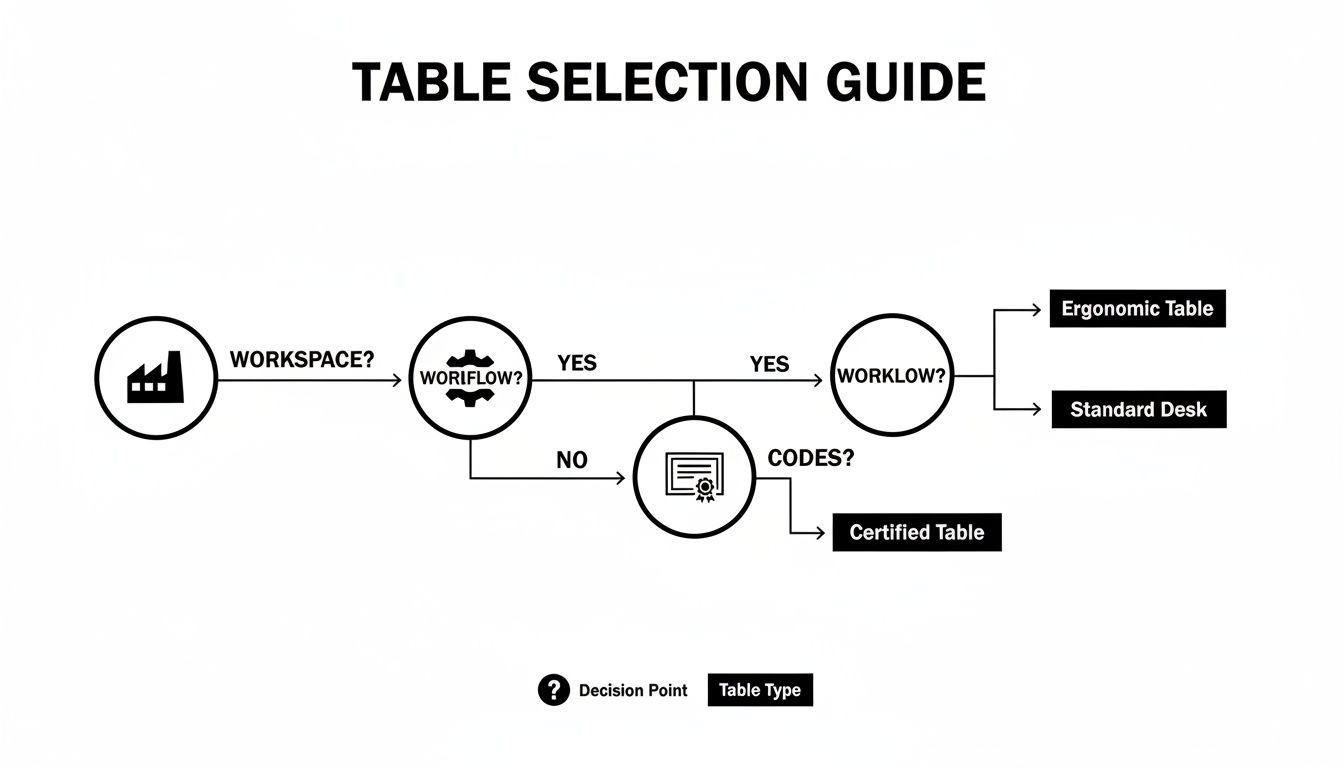
As the flowchart shows, the first step to building an efficient, compliant kitchen is simply matching the table's specs to its job. Get that right, and you're already ahead of the game.
Choosing the Right Size and Style for Your Commercial Griddle
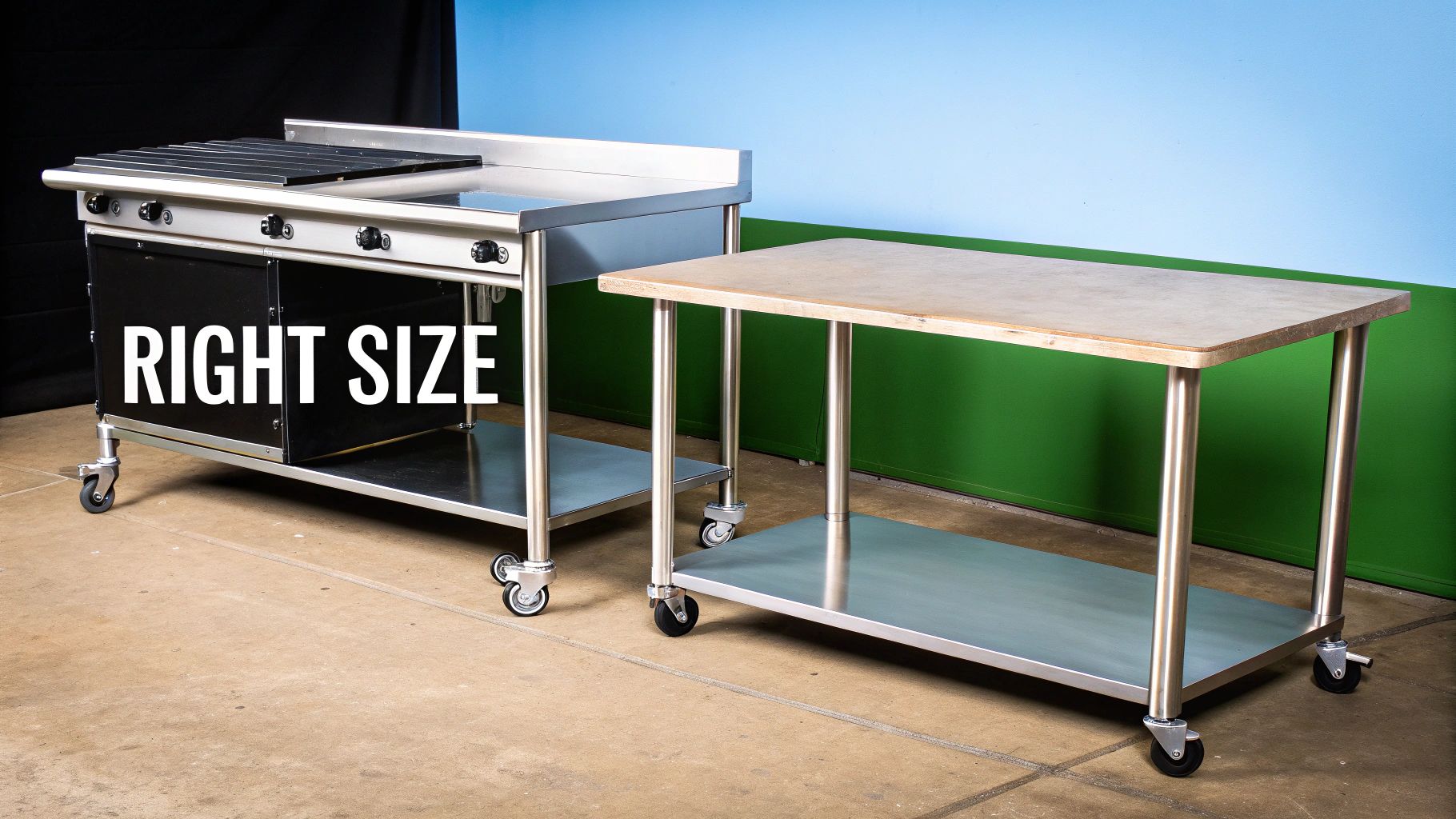
Once you've nailed down the right material and gauge, it's time to make sure your table actually fits your kitchen and your team's rhythm. A perfectly sized table isn't just a place to set your griddle; it's a tool that can seriously speed up your kitchen's output. Go too small, and you create clutter and bottlenecks. Go too big, and you're just wasting floor space and making your staff take extra steps.
Think of each table as the home base for a specific task. Is this where a single countertop griddle will live, or is it a massive prep station for your whole team? The goal is to match the table's footprint and features to the job at hand. This is what separates a kitchen that just works from one that truly hums.
Matching Table Size to Your Commercial Griddle
Commercial work tables are available in a huge variety of standard sizes, so you can find something for just about any space, whether you're running a massive restaurant kitchen or a tiny food truck.
-
Width: You can find tables anywhere from a compact 24 inches to a sprawling 96 inches or even 120 inches wide. A 24-inch or 30-inch table is perfect for holding a small commercial griddle. Step up to a 60-inch or 72-inch table, and you’ll have plenty of space for two cooks to work elbow-to-elbow during a hectic dinner rush.
-
Depth: The most common depths are 24 inches and 30 inches. A 24-inch depth is a lifesaver in tight galleys and for jobs that don't need a lot of surface area. But if you’re doing complex prep work or plating next to your griddle, that extra room on a 30-inch deep table is a game-changer.
Before you click "buy," get out the masking tape. Seriously. Tape the table's dimensions on the floor where you plan to put it. This little trick helps you see exactly how it will affect traffic flow and ensures you have enough clearance for staff to walk by and for oven doors to open without hitting anything.
Essential Features That Drive Efficiency
Beyond the raw dimensions, a table's style is all about its features. Every add-on is designed to solve a real-world kitchen problem, from storage headaches to sanitation nightmares.
Undershelves for Smart Storage An undershelf is one of the most practical features you can add, instantly doubling your storage without eating up more floor space. It’s the perfect place to stash extra pans, ingredient bins for your griddle, or small appliances, keeping them organized and right where you need them.
A table with an undershelf turns dead vertical space into a prime storage area. This simple feature gets clutter off your main work surface, which directly translates to faster prep times at your griddle station.
Casters for Ultimate Mobility Putting casters (wheels) on your work table transforms it from a stationary object into a mobile workstation. This flexibility is a huge win in busy kitchens, especially when you need to rearrange your commercial griddle for deep cleaning or to adapt to a new menu.
The need for mobile setups is blowing up. We’ve seen a 54.27% jump in searches for wheeled prep tables, largely driven by operators like food trucks. For them, mobility is everything. It’s no wonder that 68% of food trucks that switched to stainless steel tables in 2024 said they cut their daily setup time by an average of 40%.
Backsplashes to Protect Your Walls If your table is going against a wall, a backsplash is a must-have, especially if it's behind cooking equipment like a commercial griddle. This raised edge stops grease, water, and food from splattering all over the wall, making cleanup a breeze and keeping things hygienic. A standard 4- to 6-inch backsplash can catch up to 95% of splatters from high-heat cooking.
Making your workspace efficient is a universal principle. While focused on a different field, this guide to lab workstations and tables has some great insights on planning and setup that apply just as well to a high-performance commercial kitchen.
Meeting Health Codes and Sanitation Requirements for Griddle Stations
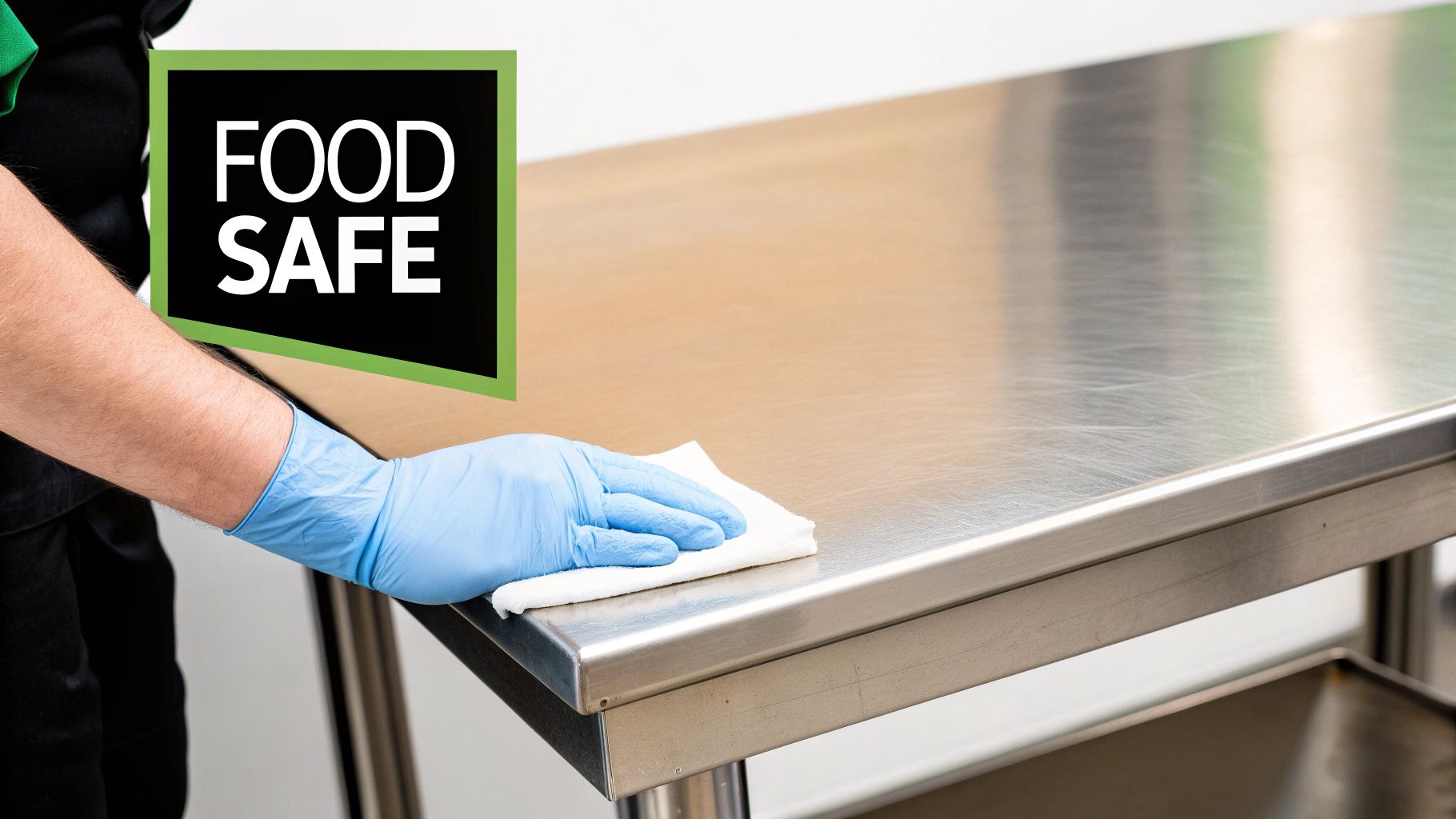
Let's talk about the one thing that keeps every operator up at night: the health inspection. Passing isn't just about a good cleaning schedule; it starts with the bones of your kitchen—the equipment you choose. Your kitchen work table stainless steel is your first line of defense, but believe me, not all tables are created equal in the eyes of an inspector.
Seeing a certification from an organization like the NSF (National Sanitation Foundation) is more than just a sticker on a table leg. It's a guarantee. It tells you that the table was built from the ground up to meet tough public health standards, making food safety its core purpose, especially when used with commercial griddles.
What Health Inspectors Look for in a Work Table
When an inspector walks through your doors, they’re trained to spot risks you might overlook. An NSF-certified table immediately tells them you're serious about safety.
They zoom in on specific design details that make or break your sanitation efforts.
- Non-Porous Surfaces: This is stainless steel's superpower. Unlike wood that can soak up juices and become a breeding ground for germs, steel is a solid, impenetrable barrier that's a breeze to sanitize.
- Coved Corners and Welded Seams: Sharp 90-degree corners and tiny gaps are where bacteria love to hide. NSF tables often have rounded, "coved" corners and perfectly smooth welds, leaving no nooks or crannies for gunk to get trapped in.
- No Exposed Fasteners: Any screw or bolt head on a work surface is a magnet for grime. Certified tables are designed with minimal exposed hardware, giving you a seamless, easy-to-wipe-down top.
These aren't just nice-to-have features. They are non-negotiable for making your daily cleaning effective and keeping you on the right side of the health code.
The Role of Stainless Steel in Your HACCP Plan
Your HACCP (Hazard Analysis and Critical Control Points) plan is the playbook for your entire food safety program. A well-chosen kitchen work table stainless steel is a star player in that system, especially at critical points where you're handling raw foods for your commercial griddle.
A certified stainless steel table is a foundational tool for your HACCP plan. It provides a controllable, verifiable surface that helps you mitigate the risk of cross-contamination, one of the most common sources of foodborne illness.
Because the surface is completely inert, it won’t hold onto flavors or react with acidic foods like tomatoes or citrus. This allows you to create clearly defined prep zones—raw chicken on this table, fresh veggies on that one—which drastically cuts down the risk of dangerous pathogens jumping from one ingredient to another. The ability to sanitize a surface completely between tasks is the bedrock of any solid HACCP plan.
For a closer look at what inspectors are trained to hunt for, this restaurant health inspection checklist is a great resource. Picking the right table isn't about dodging a fine; it's about building a culture of safety that protects your customers and your reputation.
Essential Maintenance and Cleaning Best Practices
Your kitchen work table stainless steel is a serious investment in your kitchen’s daily grind, and keeping it in top shape is easier than you might think. Good maintenance goes way beyond just looking clean—it’s about protecting the steel itself, keeping food safe, and making sure that table lasts for decades. The secret? A simple, consistent cleaning routine, especially around your commercial griddle.
Think of the protective chromium oxide layer on your stainless steel like the perfect seasoning on a cast iron griddle. It's an invisible shield. But harsh chemicals, especially anything with chlorides like bleach, can strip that shield right off, leaving the steel exposed and vulnerable to rust. Sticking to the right cleaning methods keeps that barrier strong.
Establishing Your Cleaning Routine
A structured cleaning plan makes a world of difference. When you break down the tasks into daily, weekly, and as-needed deep cleans, you stop grime from building up and catch small issues before they turn into big headaches. This little bit of planning saves a ton of elbow grease down the road.
-
Daily Wipe-Down: After every shift, give the entire surface a good wipe-down. Use a soft cloth with warm water and a mild detergent. Here's a key tip: always wipe in the direction of the steel's grain to avoid tiny scratches. Rinse it off with clean water and dry it completely with a microfiber cloth to prevent water spots from forming.
-
Weekly Polish: Once a week, after the daily clean, apply a food-safe stainless steel polish or even just a little mineral oil. This quick step buffs out fingerprints, brings back the shine, and adds another layer of protection that makes daily cleanups even easier.
-
As-Needed Deep Clean: For that stubborn, stuck-on gunk or grease from your griddle, make a simple paste with baking soda and water. Gently scrub the spot with a non-abrasive sponge, again, moving with the grain. It's surprisingly effective at lifting grime without scratching the surface.
The single worst thing you can do is grab steel wool or a wire brush. They will permanently scratch your stainless steel work table, creating tiny grooves where bacteria can multiply. Suddenly, your easy-to-clean surface becomes a sanitation nightmare.
Common Cleaning Mistakes to Avoid
Knowing what not to do is just as critical as knowing what to do. A few common cleaning habits can cause permanent damage, forcing you into costly repairs or an early replacement. Avoiding these simple mistakes is the key to getting the most out of your table.
For a closer look at cleaners designed for the toughest jobs, check out our guide on choosing the right commercial stainless steel cleaner for your kitchen.
To make things even easier, here’s a simple schedule you can follow to keep your stainless steel tables looking brand new.
Your Stainless Steel Cleaning Schedule
| Frequency | Task | Recommended Cleaner | Pro Tip |
|---|---|---|---|
| Daily | General surface cleaning and sanitizing. | Mild soap and warm water. | Dry thoroughly with a microfiber cloth immediately after rinsing to prevent water spots. |
| Weekly | Polishing and removing fingerprints. | Food-grade stainless steel polish or mineral oil. | A weekly polish not only shines the surface but also makes daily wipe-downs faster. |
| Monthly | Removing tough stains or light rust spots. | Baking soda and water paste. | Apply the paste and let it sit for 15-20 minutes before gently scrubbing. |
Sticking to this simple routine ensures your stainless steel tables will remain a sanitary, reliable, and professional-looking centerpiece of your kitchen for years to come.
Pairing Your Table with Commercial Griddles and Cooking Equipment
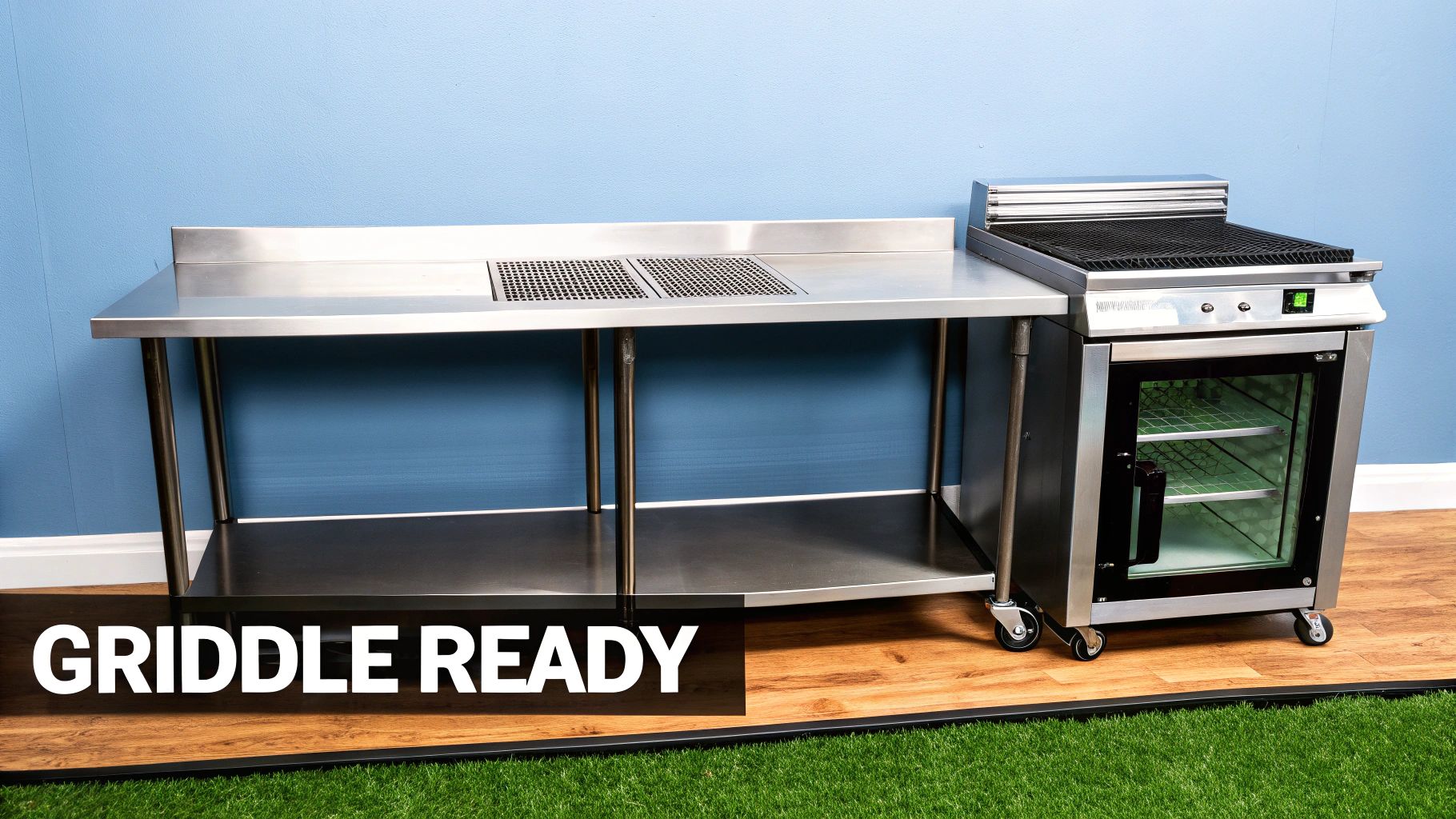
The right kitchen work table stainless steel is more than just a place to set your griddle—it’s the backbone of your cook line. A well-matched table can turn a good station into a great one, streamlining the whole process from prep to plating. It's what separates a chaotic, clumsy workspace from a high-performance engine.
Think of it like a pilot's cockpit. Everything is exactly where it needs to be to minimize wasted motion and maximize efficiency. That's the goal for your griddle station. You want to build a cohesive unit where the table, commercial griddle, and surrounding gear work in harmony, making every service faster and smoother.
Creating the Ultimate Commercial Griddle Station
Before you even think about firing up the griddle, you need to make sure your table is the right foundation. Start with the basics.
First, grab the spec sheet for your commercial griddle and check its exact weight and dimensions. Your table needs to handle that weight and then some. A good rule of thumb is to choose a table with a capacity at least 25% higher than the griddle's weight. This gives you a safe margin for tools, ingredients, and the wear and tear of a busy service.
Next up is surface area. You need elbow room. For a standard 36-inch commercial griddle, you’ll want at least 12-18 inches of clear "landing space" on one side for plating and another 6-12 inches on the other for staging raw ingredients and your tools.
An undersized table is an instant bottleneck. That landing space isn't a luxury—it's non-negotiable for a high-volume line. It's what lets a cook juggle multiple orders without creating a mess or risking cross-contamination.
This simple layout is key to preventing pile-ups during the dinner rush. If you're looking for more ways to optimize your kitchen's flow, our guide on restaurant kitchen layout design has some great, practical tips.
Integrating Your Table with Other Line Equipment
A truly efficient station doesn't stop with just the commercial griddle. The best setups put everything a cook needs within arm's reach, and that's where thoughtful table selection and placement make all the difference.
-
Undercounter Refrigeration: Stick an undercounter fridge or a chef base right below or next to your griddle station. This keeps your high-turnover items—eggs, cheese, burger patties—chilled and ready to go. It completely eliminates those time-wasting trips to the walk-in.
-
Prep and Plating Zones: Use the table's surface to create dedicated zones. One side is for your squeeze bottles and spatulas; the other is a clear landing zone for assembling dishes. This kind of organization feels intuitive and keeps the workflow clean.
-
Mobile Fryer Carts: If you’re slinging fries with your burgers, a mobile fryer on casters is a game-changer. You can roll it into position for service and then move it out of the way for deep cleaning, all without disrupting the main line.
When you see your kitchen work table stainless steel as the central hub for a complete system, you can build a station that doesn't just support your commercial griddle—it makes your whole kitchen more productive.
FAQ About Kitchen Work Table Stainless Steel for Commercial Griddles
When you're outfitting a commercial kitchen, a few questions always pop up about stainless steel work tables. Let's clear the air so you can get the right surface for your operation, especially when it's going to be the home base for a heavy-hitter like your commercial griddle.
What Is the Best Gauge for a Commercial Kitchen Work Table?
For the vast majority of kitchens, 16-gauge stainless steel is the workhorse you need. It's the perfect balance of toughness and affordability, easily holding up heavy countertop gear (including most commercial griddles) and shrugging off the daily abuse of prep work without getting all dinged up.
Now, if you're mounting extremely heavy equipment or your workflow involves a lot of high-impact action, stepping up to a brawnier 14-gauge table is a smart move for maximum strength. On the flip side, an 18-gauge table is a great, budget-friendly option for lighter duties like a plating station or holding smaller appliances.
How Do I Remove Rust Spots from My Stainless Steel Table?
It’s true—stainless steel is incredibly rust-resistant, but it's not totally rust-proof. You might see tiny spots pop up, usually from contact with other metals (like a cheap can opener left on the surface) or harsh cleaning chemicals. The fix is simple: mix up a paste of baking soda and water.
Using a soft cloth, gently rub the spot in the same direction as the steel's grain. This is key to avoiding scratches. If you've got a stubborn spot, a dedicated non-chloride stainless steel cleaner will knock it out. Just remember to rinse the area well with clean water and dry it completely afterward to let that protective chromium layer reform.
Is a Backsplash Necessary on a Kitchen Prep Table?
If the table is going against a wall, a backsplash isn't just nice to have—it's practically essential. This is especially true on a hot cook line with a commercial griddle.
A backsplash acts as a critical barrier, preventing grease, food particles, and liquids from splattering onto the wall. This not only simplifies your daily cleanup but also significantly improves overall kitchen sanitation and helps you stay compliant with health codes.
For tables out in the open, like an island prep station, you'll want a model with smooth, rounded "bullnose" edges on all sides. It's just a safer and more practical setup for a central workstation.
Can I Put Hot Pans Directly on a Stainless Steel Table?
Go right ahead. One of the best things about stainless steel is its incredible heat resistance. You can slide a hot pot or sheet pan straight from the oven onto the table without a second thought. It won't scorch, melt, or suffer any damage. The metal will get hot, of course, but it's built to take the heat day in and day out.
Ready to build the ultimate, high-efficiency workstation for your commercial griddle? Explore the durable and reliable kitchen work table stainless steel options at Griddles.com. Find the perfect foundation for your cook line by visiting https://griddles.com today.