
A Practical Guide: Commercial Griddle Dimensions for Your Kitchen
When you're outfitting a commercial kitchen, every inch counts. That’s why most commercial griddles are built to specific dimensions, usually 24, 36, or 48 inches wide, and about 30 to 34 inches deep. These aren't random numbers; they’re designed to sit perfectly on a standard chef base or equipment stand, fitting in neatly with the rest of your cook line.
Decoding Standard Commercial Griddle Dimensions
Picking the right commercial griddle is like finding the perfect puzzle piece for your cook line. Those dimensions on the spec sheet—width, depth, and height—are more than just numbers. They’re the key to a smooth installation and a functional kitchen. Get them right, and the unit fits in perfectly. Get them wrong, and you've got a frustrating and expensive headache.
Manufacturers figured this out a long time ago. They standardized these sizes to solve a huge problem for chefs and restaurant owners: how do you add high-volume cooking capacity right where you need it without ripping out the entire kitchen? This consistency means you can plan your layout with confidence, knowing a new griddle will line up with your fryers or prep tables.
The Three Core Measurements
Every commercial griddle lives and dies by three numbers. Nail these, and you're golden.
Commercial kitchen design has settled on a few key dimensions that just plain work. Widths typically land on 24, 36, 48, 60, or 72 inches, which is the sweet spot for matching production needs to available space. For depth, you’ll almost always see a standard of around 30 to 34 inches, designed to fit on standard equipment stands and chef bases.
Finally, height is generally consistent to ensure a comfortable working surface for cooks, usually aligning with the standard 36-inch countertop height when placed on its stand. This is critical because it allows the griddle to sit flush with your other equipment, giving you that clean, professional look without anything jutting out into the walkway.
Common Commercial Griddle Dimensions
This quick reference guide breaks down the industry-standard dimensions for width, depth, and height, helping you instantly see what will fit your kitchen layout.
| Dimension | Common Range or Size | Key Benefit for Kitchens |
|---|---|---|
| Width | 24, 36, 48, 60, 72 inches | Offers flexibility for small spaces or high-volume production. |
| Depth | 30 to 34 inches | Fits perfectly on standard equipment stands and chef bases. |
| Height | ~15 inches (unit only) | Sits at a standard ergonomic working height on a stand. |
Having these common sizes makes swapping out old equipment or adding new units a breeze. You're not locked into a single brand just because of a weirdly sized opening.
Why Standardization Simplifies Kitchen Design
This commitment to standard sizes is a lifesaver for anyone designing a kitchen, whether it’s in a restaurant or a food truck. It completely removes the guesswork.
Key Takeaway: Standardized dimensions mean you can plan your kitchen with confidence, knowing that different pieces of equipment from various manufacturers will align properly. This creates a more ergonomic and efficient workflow for your team.
This predictability is also what lets you squeeze every bit of utility out of your floor plan. Knowing the standard griddle width and how it relates to other appliances helps you build a cohesive, functional space right from the start. You end up with a professional, streamlined kitchen without having to make expensive, on-the-fly adjustments.
How to Measure Your Space for a Perfect Fit
Picking out a commercial griddle with the right specs is one thing, but making sure it actually slides into place without a fight is where good planning really shines. A common—and costly—mistake is taking just one quick measurement for width, depth, and height. The reality is that no space is perfect. Floors aren't always level and adjacent equipment is rarely perfectly square, especially in a busy commercial kitchen that's seen some action.
That’s why the old carpenter’s wisdom, “measure twice, cut once,” is so critical here. Think of it like double-checking a recipe before service; you need to measure your opening from a few different angles to catch any little imperfections. A few extra seconds with the tape measure can save you the massive headache of discovering your brand-new griddle is a quarter-inch too wide to fit.
This flowchart breaks down the basic order of operations for getting your dimensions right.
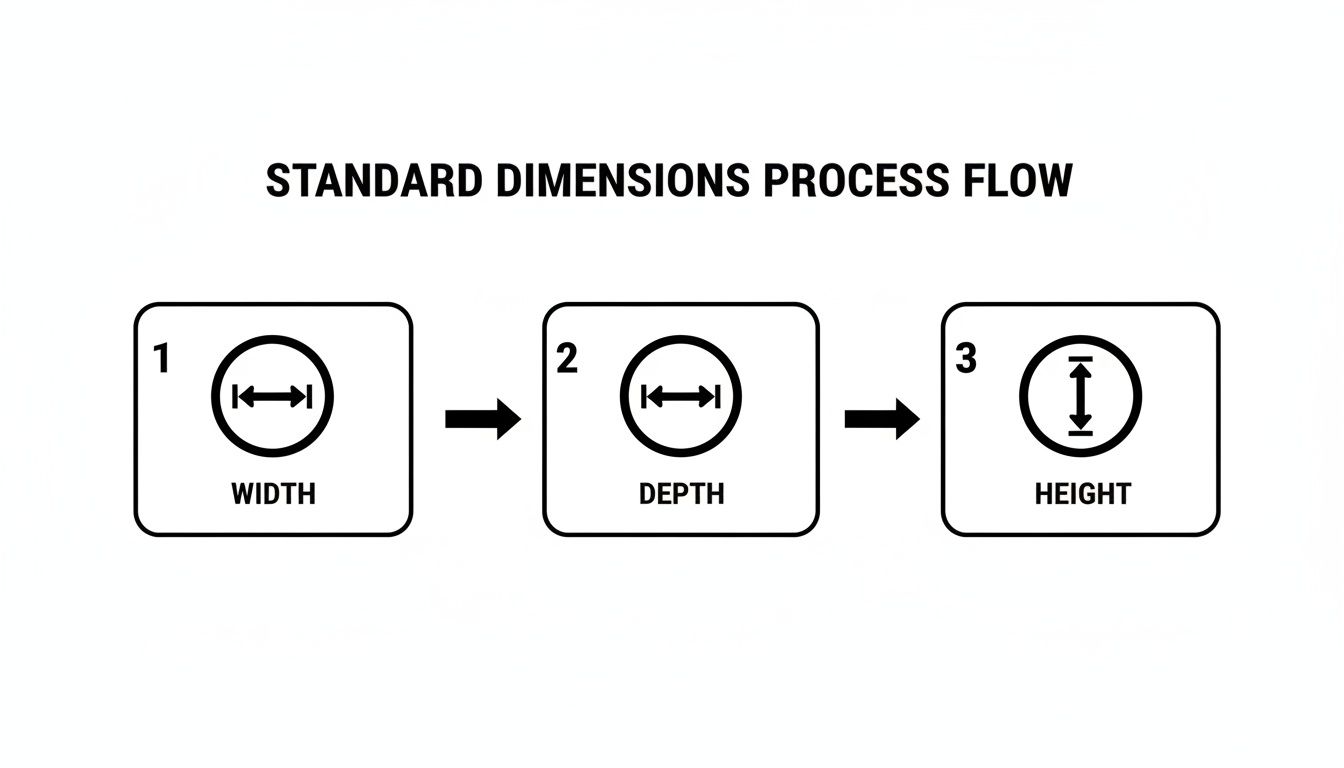
The key takeaway is that you have to check each dimension at multiple points to guarantee your new griddle will slide in smoothly.
The Three-Point Measurement Technique
To get a true picture of the space you're working with, use this simple pro-level technique. It's the best way to avoid any nasty surprises on installation day.
- Width: Measure the horizontal distance across the opening at the front, middle, and back.
- Height: Measure the vertical clearance from the stand to any upper shelves on the far left, in the center, and on the far right.
- Depth: Measure from the back wall to the front edge of the cook line on both the left and right sides.
Once you have all your numbers, here's the most important step: always use the smallest measurement for each dimension. That smallest number is your real, usable space. If the front of the opening is 36 inches wide but the back is 35.5 inches, your working width is 35.5 inches. Period.
Don't Forget Ventilation Clearance
A griddle isn’t just a static box—it's a hard-working machine that creates heat and needs to breathe. Forgetting to leave room for ventilation is one of the fastest ways to create a fire hazard. When a griddle is choked for air, its burners can't operate efficiently, and grease-laden vapors can build up, creating unsafe conditions.
Crucial Tip: As a rule of thumb, plan for 6-12 inches of open space on the sides and back of the unit from any combustible surfaces. This pocket of air is essential for heat to dissipate safely. Always, always check the manufacturer’s spec sheet for the exact clearance requirements for your specific model and local fire codes.
Carefully planning your layout, from the griddle's fit to how it lines up with your ventilation hood, is the secret to a smooth-running kitchen. To get a better handle on your space and play with different setups, some of the modern kitchen design software tools can be a huge help. And for a deeper dive into laying out your entire cook line for maximum efficiency, check out our guide on smart restaurant kitchen layout design.
Countertop vs. Freestanding Griddles Explained
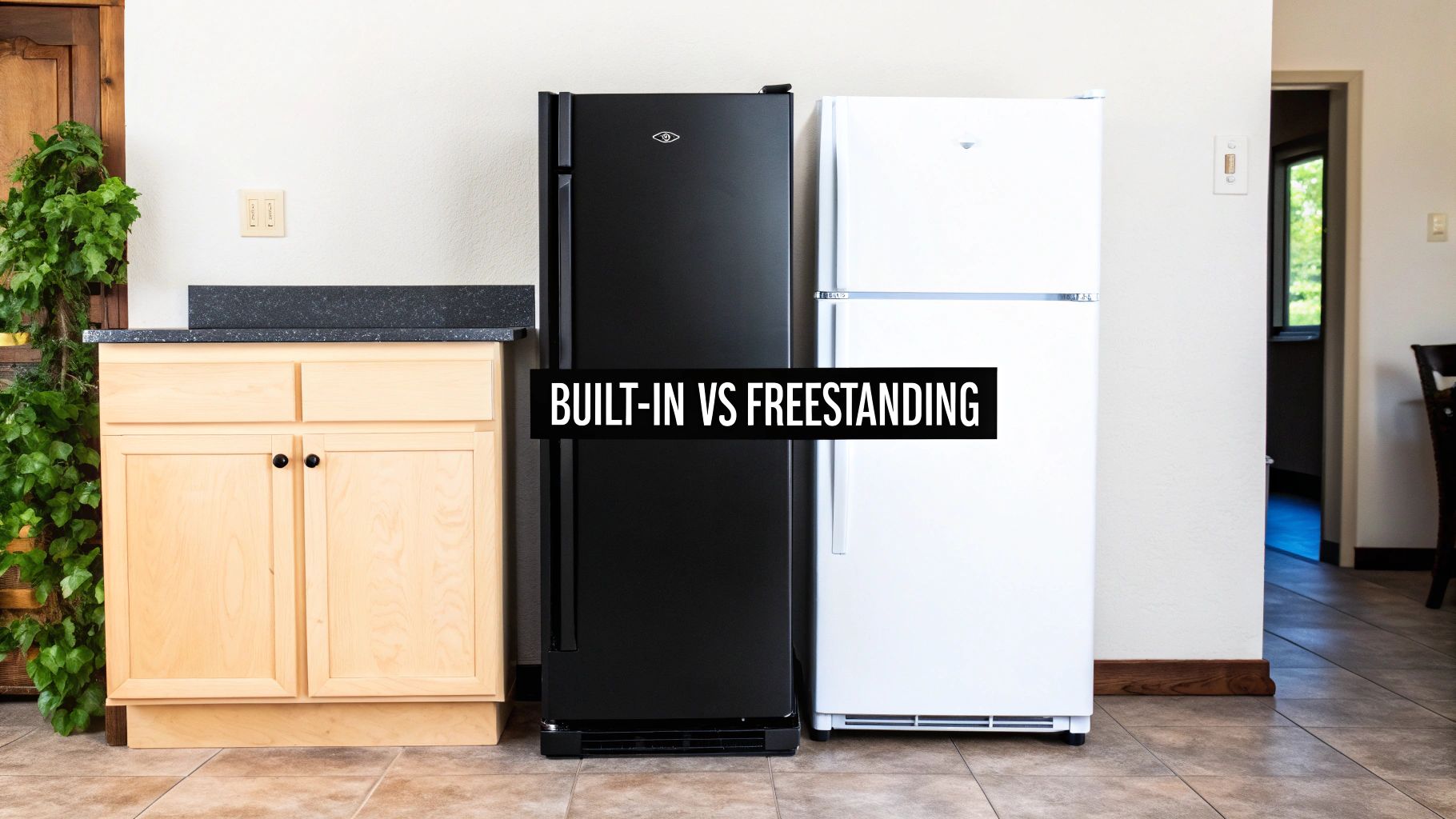
Picking between a countertop and a freestanding commercial griddle is about more than just aesthetics. It’s a make-or-break decision for your kitchen's workflow, your equipment's stability, and the overall flow of your cook line. The right call depends entirely on your existing setup and production needs.
You can think of a countertop unit like a portable induction burner. It's compact, versatile, and you can place it on any suitable equipment stand or refrigerated chef base. These griddles offer flexibility, allowing you to build a custom cook line by mixing and matching equipment.
A freestanding model, on the other hand, is an all-in-one unit with its own integrated cabinet or oven base. It’s designed to be a complete, self-contained station, creating a sturdy and permanent fixture in your kitchen. It sits perfectly flush with other floor-model gear, like a commercial griddle, giving your line a tight, organized feel.
The Critical Role of the Base
Here's the most important difference: what's underneath. This one detail dictates where you can install them, and it’s something you absolutely cannot ignore, whether you're designing a new kitchen or outfitting a food truck.
A countertop griddle needs a sturdy, heat-resistant surface to sit on, like a stainless steel equipment stand or a refrigerated chef base. Placing it on an improper surface is a major safety hazard. All that intense heat requires a non-combustible foundation.
Freestanding units were engineered to solve this exact problem. They come with their own base, which could be a simple cabinet for storage or a fully functional convection oven, providing extra utility in the same footprint.
Key Takeaway: The base is the secret sauce of a griddle setup. It’s not just a nice feature—it's the core component that ensures stability, safety, and proper working height for your cooks.
Matching the Unit to Your Setup
So, how do you know which one you need? It all comes down to your kitchen's layout and workflow.
-
Countertop Griddles Are Ideal For:
- Kitchens with existing equipment stands or refrigerated bases.
- Situations where you might need to reconfigure the cook line.
- Creating a custom, modular cook station.
-
Freestanding Griddles Are Necessary For:
- Installations where a dedicated, all-in-one station is preferred.
- Maximizing footprint with an oven or cabinet base.
- High-volume kitchens that need a permanent, heavy-duty setup.
For just about any commercial kitchen trying to build an efficient, clean-looking line, a countertop griddle on a proper stand or chef base is the most flexible way to go. It’s specifically designed to respect the proper commercial griddle dimensions and ventilation needs, making sure your investment keeps running strong for years to come.
Matching Griddle Size to Your Kitchen Workflow
Sure, the exterior commercial griddle dimensions tell you if a unit will physically fit in your space. But for a busy kitchen, there's a far more important number to consider: its cooking surface area. Measured in square inches, this is the real-world capacity that dictates how efficiently your line cooks can fly through a service.
Get this right, and you'll see fewer bottlenecks, faster ticket times, and a much smoother rhythm on the line—especially when that griddle is the heart of your breakfast or lunch rush.
Think of it like a mechanic picking a toolbox. For a few simple fixes, a small bag with a handful of tools is perfect. But a master mechanic building an engine needs a massive rolling chest to keep every socket and wrench right where they need it. It's the same in the kitchen. A quiet café might get by with a slim 24-inch griddle for a few sandwiches, but a slammed diner needs a much bigger 72-inch model to hold all the bacon, eggs, pancakes, and burgers for the rush.
From Dimensions to Daily Output
The real goal here is to match the griddle's cooking power to the demands of your menu. When you nail the size and BTUs, you cut down on wasted time, make life easier for your cooks, and get food out of the window when things get chaotic.
A high-volume burger joint, for example, is a perfect home for a wider, 48-inch or 60-inch griddle. This gives cooks distinct temperature zones for searing patties, toasting buns, and holding product, which makes building and plating orders so much faster. For a station like this, a unit with 6 to 8 burners can be a total game-changer.
One of the most common mistakes we see is chefs choosing a griddle based only on the available hood space. They completely forget to think about how much product that station will burn through during a peak service. An undersized griddle quickly becomes a massive bottleneck, forcing cooks to constantly wait for space to open up and slowing down the whole line.
Finding the Sweet Spot for Your Kitchen
So, how much space do you actually need? To help narrow it down, here’s a quick look at how different sizes fit into various kitchen operations.
Choosing the Right Griddle Size for Your Kitchen
| Unit Width | Typical Burners | Ideal Kitchen Application | Example Use Case |
|---|---|---|---|
| 24 inches | 2 | Low-volume stations, tight spaces | Small café (sandwiches), appetizer station |
| 36 inches | 3 | Medium-volume cook lines | Standard breakfast/diner setup, food truck primary cooktop |
| 48 inches | 4 | High-volume production, main line workhorse | Burger-focused restaurant, high-volume brunch service |
| 60+ inches | 5+ | Very high-volume, centralized production areas | Large institutional kitchens, dedicated breakfast station in a hotel, high-output diners |
Looking at the market, it's clear where the sweet spot is for most kitchens. Units in the 36-inch to 48-inch range account for the majority of all sales, making them the go-to choice for most independent restaurants and food trucks. This size range strikes the perfect balance between production capacity and footprint.
This popular capacity allows for multiple temperature zones. From there, you can fine-tune your workflow by choosing between different plate thicknesses. A thicker plate provides more even heat and better recovery, but a tough stainless steel commercial refrigerator chef base underneath will always give you better workflow and cold storage in a hot kitchen.
At the end of the day, making sure your unit's size and features match your menu and pace of service is what turns your griddle from just another box that "fits" into a tool that actually speeds up your entire kitchen.
Essential Installation Factors Beyond Physical Size
Nailing the right dimensions for your commercial griddle is a great start, but it's only half the job. To get a reliable, long-lasting unit, you have to look past the tape measure and think about the technical side of the installation. I’ve seen it time and time again—operators skip these details and end up with performance headaches or a failed inspection that could have been easily avoided.
A commercial griddle is a workhorse, just like your fryer or range. It needs the right utility hookups to do its job day in and day out. Getting the setup right isn't just about making it fit; it’s about giving the machine the fuel and stability it needs to survive the grind. A little planning now ensures your investment is ready for action from day one.
Fueling Your Unit Correctly
Here’s the single most important rule for fueling your griddle: use a properly sized gas line. This is absolutely non-negotiable in a commercial kitchen.
If you connect it to an undersized line that's shared with other gas-guzzling equipment, you’re asking for trouble. Every time that other appliance kicks on, it creates a pressure drop that starves your griddle's burners for fuel. This leads to weak flames, slow preheating, and poor recovery times.
Expert Tip: Always connect your commercial griddle to a dedicated, properly sized gas line with its own shut-off valve. This simple step prevents underperformance during a busy service, protects the components from damage, and ensures consistent, powerful heat.
Think of it as the best and cheapest insurance policy you can buy for your cooking equipment.
Managing Grease and Ventilation
Most commercial griddles are equipped with a grease trough and catch tray. This handy feature captures runoff, meaning you don't have to worry about grease spilling onto the floor. It’s a huge safety feature, but you have to make sure to empty the tray regularly. An overflowing tray is a serious fire hazard.
For any griddle, proper placement under a commercial ventilation hood is crucial for removing smoke, heat, and grease-laden vapors from the air, preventing fire hazards and ensuring a safe, comfortable kitchen.
The Importance of a Level Foundation
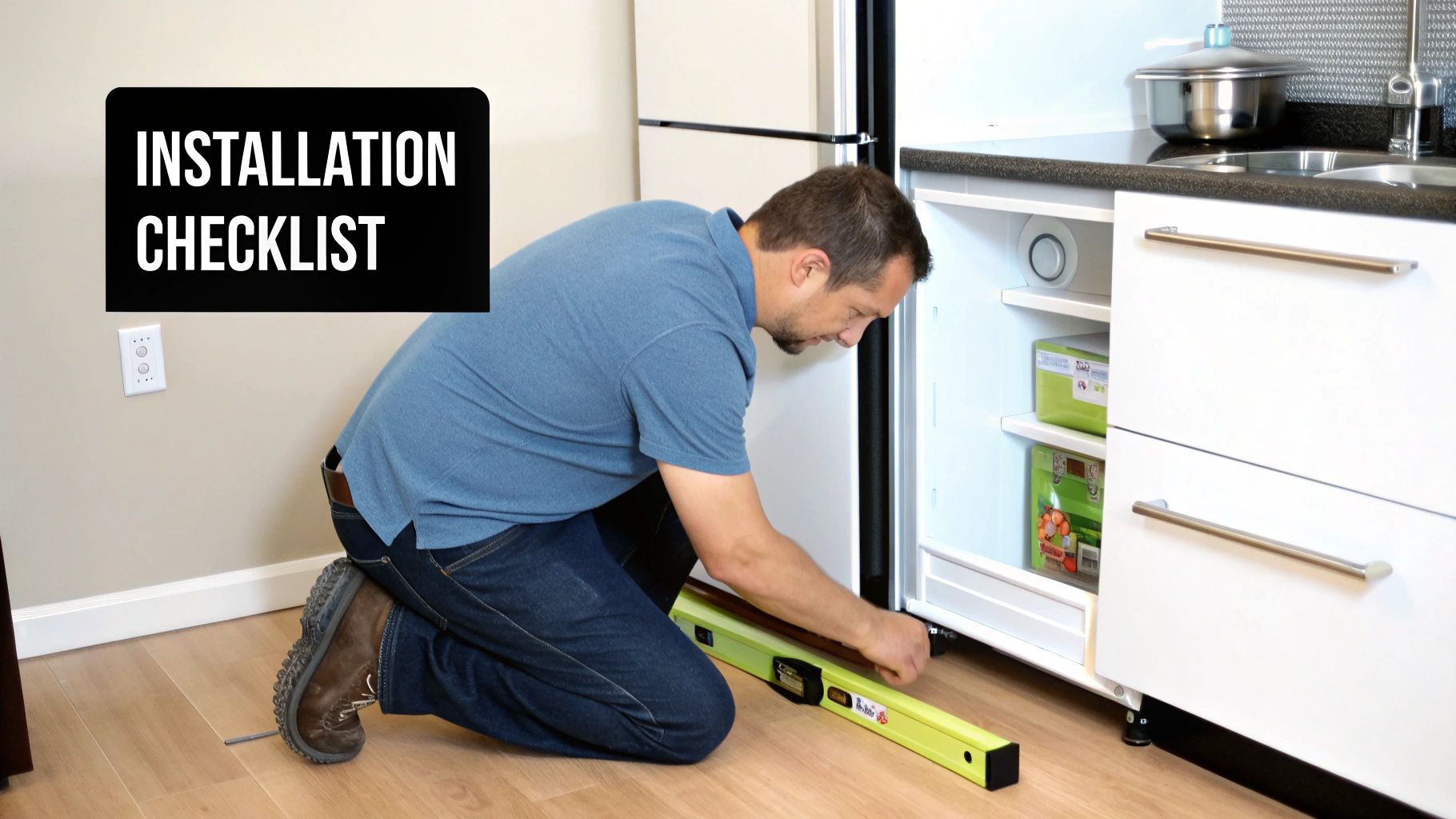
Finally, don't ever blow off leveling the unit. It seems like a small thing, but an unlevel griddle creates two big problems.
First, grease won't drain properly into the trough. This causes it to pool on the cooking surface, leading to inconsistent cooking and potential flare-ups. You'll see it when burgers on one side are swimming in grease while the other side is dry. Second, an unlevel surface puts uneven stress on the unit's frame and welds.
Taking a minute with a simple level to adjust the unit's legs is a critical final touch. It ensures the machine runs safely and lasts as long as it should.
And if you’re exploring other compact cooking options for your line, you might find our guide to countertop refrigeration helpful.
Why Getting the Right Griddle Size Matters
Look, picking the right commercial griddle dimensions is about way more than just making sure a box fits in a hole. It's a critical decision that hits your bottom line, hard. In a kitchen that moves at the speed of service, every inch of space and every second your cooks spend waiting for cook-space is money. Get this wrong, and you'll feel the pain in your workflow, your ticket times, and even your food quality.
An oversized griddle is a silent killer of profits. It just sits there, burning more gas or electricity than it needs to, bloating your utility bills. Worse, it’s a space hog, eating up precious real estate under the hood that you could be using for something else. In a tight kitchen, that wasted footprint is a bottleneck you'll bump into all day long.
The Cost of an Undersized Unit
Going too small, on the other hand, creates a different kind of chaos. When your line cooks are constantly running out of space on the flat-top, they're forced to work in batches. That's not just annoying; it grinds service to a halt and opens the door for food quality to suffer during a hectic rush.
A poorly sized griddle introduces friction into your workflow. It forces your team to take extra steps, slows down ticket times, and ultimately limits your kitchen's maximum output and profitability.
There's a reason the commercial griddle market is booming. It's a cornerstone of high-volume foodservice because operators are realizing how vital these units are. This growth isn't just a trend; it's a direct response to the need for maximizing every square foot of cooking space for peak efficiency. You can see the full story on why this equipment is so crucial in this in-depth market analysis.
At the end of the day, the right-sized griddle is an investment in a smoother operation. It gives your team the firepower they need, protects your ticket times by allowing for continuous production, and lets your cooks do what they do best. When you match the unit's dimensions to what your menu actually needs, you’re setting your kitchen up to be faster, more consistent, and a whole lot more profitable.
Frequently Asked Questions
When you're trying to fit a new commercial griddle into your line, a few questions always pop up. Getting the answers right from the start means your unit will fit in perfectly and run like a champ, even during the busiest dinner rush. Here’s what you really need to know about commercial griddle dimensions.
Are Electric and Gas Griddle Dimensions the Same?
For the most part, yes. A 36-inch gas griddle will have the same footprint as a 36-inch electric model. The primary difference isn't the exterior size but the utility requirements and performance characteristics.
Gas griddles heat up faster and offer more responsive temperature control, while electric models provide more even, consistent heat across the entire surface. The decision comes down to your kitchen's utility hookups and your chef's preference.
Key Difference: The external dimensions are standardized, but the power source dictates performance and installation needs. Gas requires a proper gas line, while electric needs a high-voltage electrical circuit.
How Much Clearance Does a Commercial Griddle Need?
This all comes down to safety codes. You must provide adequate clearance from any combustible surfaces. If your griddle is next to a wall, it needs to be a non-combustible material.
As a general rule, plan for at least 6 inches of clearance on the sides and back from any combustible materials like drywall. For high-output models, this could be more. Always, always check the manufacturer’s spec sheet and your local fire codes first.
Can I Put a Commercial Griddle on Top of an Undercounter Refrigerator?
Never. Absolutely do not put a hot griddle directly on top of a standard undercounter refrigerator. The constant, intense heat will destroy the cooling system, spoil your food, and create a massive fire hazard. It's a recipe for disaster.
For that kind of setup, you need a special piece of equipment called a chef base or a worktop refrigerator. These beasts are built for the job, with a heavy-duty, heat-resistant top and serious insulation. They're specifically designed to support fiery hot griddles and other cooking equipment while keeping your ingredients perfectly chilled just inches below.
Ready to build out your perfect cook line with equipment designed for performance and reliability? At Griddles.com, we offer a curated selection of commercial griddles, chef bases, and other equipment to optimize your kitchen's workflow. Explore our full range of commercial kitchen equipment today.