

The Ultimate Commercial Griddle Health Inspection Checklist: 8 Areas to Master
A health inspector's visit can feel like a high-stakes exam for any restaurant, diner, or food truck operator. A surprise audit can disrupt service, stress your team, and put your hard-earned reputation on the line. But what if you could transform that anxiety into the confidence of knowing your commercial griddle is always prepared? This guide is designed to do exactly that, providing an actionable and exhaustive restaurant health inspection checklist focused entirely on your high-volume commercial griddle.
We'll move beyond generic advice and dive into the specific daily, weekly, and monthly tasks that matter most for griddle compliance. Recognizing the central role of this specialized equipment, we’ve created a special focus on maintaining and sanitizing your commercial griddle, a common area for critical violations. This is not just a list; it is a complete operational system for building a rock-solid food safety culture around your most important cooking surface.
From mastering precise temperature logs and implementing foolproof sanitation protocols for your griddle to managing allergen cross-contact and verifying cooking temperatures, this griddle-centric checklist is your roadmap. You will find detailed procedures and practical examples to help you not just pass, but excel during your next inspection. Let's get started on building a system that health inspectors and, most importantly, your customers will notice and appreciate.
1. Griddle and Cooking Surface Sanitation
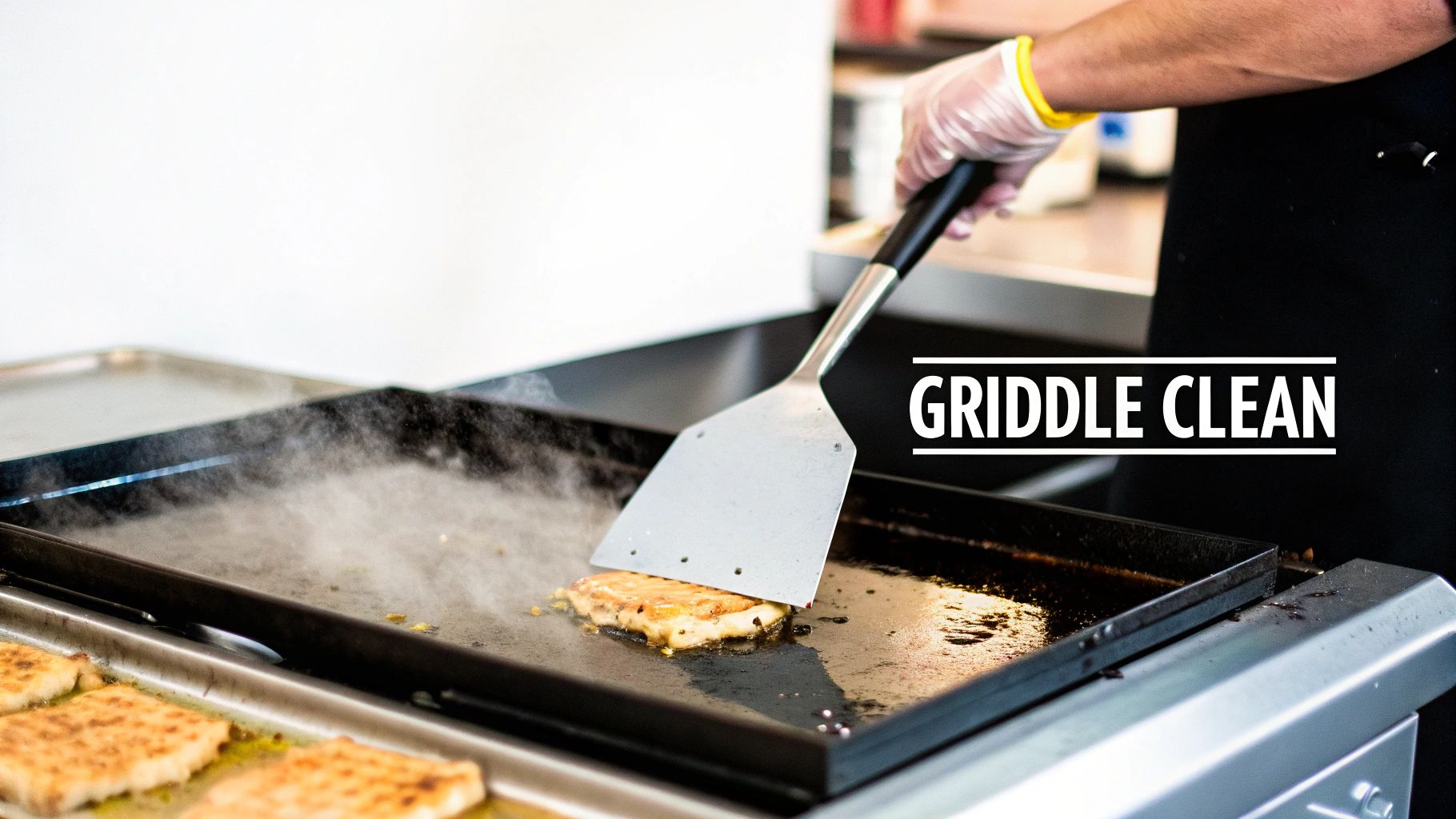
A spotless, well-maintained griddle isn't just for show; it's a non-negotiable component of any restaurant health inspection checklist. Health inspectors meticulously examine high-contact cooking surfaces like commercial griddles for signs of carbon buildup, grease residue, and improper sanitation practices. These surfaces are prime areas for bacterial growth and cross-contamination if not managed correctly, making them a top priority for food safety compliance.
Inspectors verify that your griddle is cleaned between cooking different types of foods (e.g., raw meats and vegetables) and that a thorough sanitization process is followed at the end of each service. They will look for clean grease traps, properly maintained temperature zones, and evidence of a consistent cleaning schedule. Forgetting this critical step can lead to an immediate violation.
Why It's a Top Priority
Griddle sanitation directly impacts food quality and safety. A dirty griddle can transfer burnt, off-flavors to fresh food and harbor harmful bacteria like Salmonella and E. coli. Consistent cleaning prevents the accumulation of carbonized grease, which can flake off into food, and ensures even heat distribution for predictable cooking results. Documenting your cleaning protocols shows an inspector your commitment to proactive food safety.
How to Implement and Prepare
To stay ahead of health inspections, integrate a multi-layered cleaning approach for all your commercial griddles. This system ensures your equipment is always ready for scrutiny.
- Frequent Scraping: During service, staff should use a stainless-steel scraper to remove food debris and excess grease between orders, especially when switching between proteins. This light cleaning should happen every 30-60 minutes in high-volume settings.
- End-of-Shift Deep Clean: At the close of each shift, perform a full deep clean. This involves scraping the surface, applying a commercial-grade griddle cleaner while the surface is still warm (per product instructions), and finishing with a food-safe sanitizer.
- Documentation: Maintain a daily cleaning log next to the griddle station. This log should include checkboxes for each cleaning task, the time it was completed, and the initials of the staff member responsible. This tangible proof is invaluable during an inspection. For a detailed, step-by-step guide, you can learn more about the correct process for cleaning a commercial griddle.
- Staff Training: Ensure all griddle station staff are trained on the proper dilution ratios and required dwell times for your sanitizers, as mandated by local health codes. Make cleaning supplies, including scrapers, scouring pads, and designated cleaning cloths, easily accessible near the griddle.
2. Food Storage Temperature Control and Monitoring for Griddle Stations
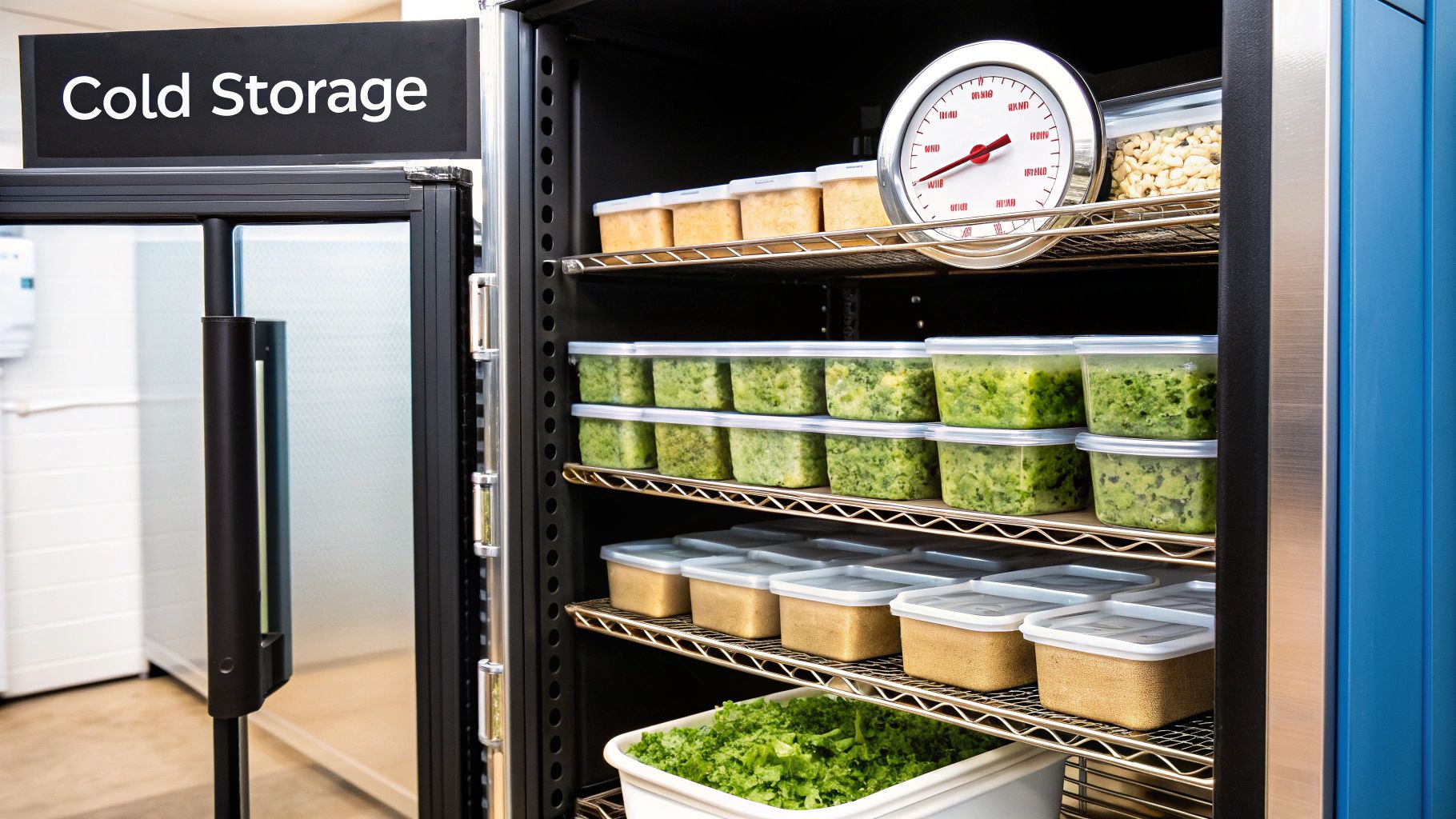
Maintaining precise temperature control for all ingredients destined for the griddle is a cornerstone of food safety. Health inspectors will meticulously check that refrigeration units near the griddle station consistently hold food outside the "temperature danger zone" (41°F to 135°F), where bacteria multiply rapidly. This scrutiny extends from under-counter refrigerators to larger walk-in coolers where griddle ingredients are stored, making documented temperature monitoring an essential part of your restaurant health inspection checklist.
Inspectors will look for calibrated thermometers inside each unit and review your daily temperature logs for consistency. They verify that cold-holding units, especially those holding raw eggs, meats, and cheese for the griddle, stay at or below 40°F. A failure to demonstrate control over these critical points can result in significant violations.
Why It's a Top Priority
Proper temperature control for griddle ingredients is non-negotiable for preventing the growth of pathogens like Listeria and Salmonella. Beyond safety, it protects the quality, texture, and flavor of your ingredients, reducing waste. Consistent monitoring and logging, as outlined in the FDA Food Code, provide inspectors with concrete proof of your commitment to food safety standards at the griddle station. This documentation demonstrates a proactive approach to managing critical control points.
How to Implement and Prepare
To ensure your griddle station is always inspection-ready, implement a systematic and verifiable process for temperature control for all relevant ingredients and storage units.
- Systematic Logging: Create laminated temperature check sheets for every refrigeration unit holding griddle ingredients. Staff should be required to log the temperature at least twice per shift, noting the time and their initials. For an in-depth look at equipment management, you can learn more about optimizing your walk-in cooler.
- Regular Calibration: Calibrate all food thermometers used for checking storage and cooking temperatures quarterly. Use the ice-point method (placing the thermometer in an ice water slurry until it reads 32°F). Document these calibrations in a dedicated log.
- Corrective Action Plan: Establish a clear protocol for what to do when a unit holding griddle ingredients falls out of the safe temperature range. This plan should include steps for notifying a manager, moving food, and documenting the failure.
- Staff Training: Train every griddle cook to correctly read thermometers, fill out logs, and understand the importance of the temperature danger zone for the specific ingredients they handle.
3. Personal Hygiene and Employee Health Practices at the Griddle
Proper personal hygiene and robust employee health policies are foundational pillars of a safe griddle operation. Inspectors rigorously evaluate how well a restaurant prevents the transmission of pathogens from staff to food, with a special focus on high-volume stations like the griddle. They will check for conveniently located and fully stocked handwashing stations, observe employee practices, and review your policies for handling sick workers.
Inspectors will verify that handwashing sinks are dedicated solely to that purpose and are easily accessible to the griddle cook. They look for clean uniforms, proper use of hair restraints, and a clear understanding among staff of when and how to wash their hands—especially after handling raw ingredients like eggs or bacon. An effective employee health policy is also a critical point of review.

Why It's a Top Priority
Griddle cooks are a primary vehicle for cross-contamination. According to the CDC, proper handwashing can prevent a significant percentage of foodborne illnesses. A sick employee handling food, or a cook touching their face before flipping pancakes on a griddle, can easily transfer germs like Norovirus or Staphylococcus aureus. Having clear, enforceable policies protects your customers, your staff, and your restaurant's reputation. Documented training shows an inspector you are serious about proactive food safety at this critical station.
How to Implement and Prepare
Build a culture of health and cleanliness at the griddle station that is visible, documented, and consistently reinforced. This ensures your team is always inspection-ready.
- Accessible Handwashing Stations: Install a dedicated handwashing sink within easy reach of the griddle station. Equip it with hot and cold running water, soap, and a sanitary drying method. Motion-sensor faucets can reduce cross-contamination and improve compliance for busy cooks.
- Implement a Strict Health Policy: Create a written policy that requires employees to report specific symptoms (vomiting, diarrhea, jaundice) and stay home when sick. Have every new griddle cook read and sign this policy as part of their onboarding.
- Continuous Training and Reinforcement: Conduct mandatory hygiene training for griddle staff during onboarding and hold annual refreshers. Use clear signage as constant reminders.
- Documentation and Monitoring: Keep detailed records of employee health policy agreements. Designate a shift leader to oversee practices at the griddle station during service, ensuring protocols are followed.
4. Cross-Contamination Prevention and Separation on the Griddle
Preventing cross-contamination on a commercial griddle is a cornerstone of any successful health inspection. Inspectors are trained to look for robust systems that separate raw animal products from ready-to-eat foods at every stage, from storage to the griddle surface itself. This includes evaluating the use of separate spatulas, turners, and distinct cooking zones on the griddle. A single lapse, like using the same tongs for raw chicken and cooked vegetables, can lead to a critical violation.
An inspector will trace the flow of food to your griddle, looking for potential points of contact between raw and cooked items. They will check prep stations for color-coded equipment and observe staff handwashing practices between tasks. For establishments using large griddles, they will verify if one zone is dedicated to raw proteins while another handles vegetables or cooked items, ensuring a clear separation of duties to maintain a high score on your restaurant health inspection checklist.
Why It's a Top Priority
Cross-contamination is one of the leading causes of foodborne illness. Implementing and enforcing strict separation protocols on and around your griddle directly protects your customers from getting sick and safeguards your restaurant's reputation. Beyond the immediate health risks, strong cross-contamination controls demonstrate to an inspector that your operation prioritizes a culture of food safety. This proactive approach prevents costly violations and preserves the trust of your patrons.
How to Implement and Prepare
To ensure your griddle operation is inspection-ready, embed cross-contamination prevention into your daily workflow. A systematic and visual approach is key to staff compliance.
- Color-Coded System: Implement a universal color-coded system for spatulas, tongs, and other griddle utensils. A common standard is red for raw meat, yellow for raw poultry, and green for vegetables. Post a chart in the griddle area to reinforce the system.
- Designated Griddle Zones: Physically separate areas on the griddle for handling raw and cooked foods. Breakfast diners can use one side for raw bacon and sausage and the other for pancakes and finished omelets.
- Strategic Storage: Organize your low-boy refrigerators at the griddle station with a top-to-bottom hierarchy. Store ready-to-eat items like cheese on top shelves, with raw eggs, bacon, and ground meat stored on progressively lower shelves.
- Staff Training and Audits: Conduct regular training sessions with visual aids showing proper and improper food handling on the griddle. Document these trainings. Perform random daily audits by observing the griddle cook's workflow to ensure compliance is consistent. For more on this, explore our guide on how to prevent cross-contamination in your business.
5. Pest Control and Environmental Sanitation Around the Griddle
An effective pest control program is a fundamental pillar of any restaurant health inspection checklist, and the griddle area is a primary focus. Health inspectors are trained to spot even the smallest signs of pest activity attracted by grease and food debris. They will rigorously check for vulnerabilities like unsealed entry points behind the griddle, improper grease trap management, and conditions that attract and harbor pests, making this a critical area of focus.
Inspectors will verify that you have a proactive Integrated Pest Management (IPM) program in place. They will look for clean floor drains near the griddle, sealed cracks in walls and floors, and evidence of professional pest control services. The grease trough and trap of a commercial griddle are magnets for pests if not cleaned daily, and any sign of an infestation here can lead to an immediate critical violation.
Why It's a Top Priority
Pests like rodents and cockroaches are notorious vectors for dangerous pathogens, including Salmonella and E. coli, posing a direct threat to public health. The warmth and food particles around a griddle make it an ideal environment for them. Their presence can contaminate the cooking surface and nearby utensils. Documenting your pest control efforts and maintaining a pristine griddle station demonstrates to an inspector that you are actively protecting your customers.
How to Implement and Prepare
To ensure your griddle area is always inspection-ready, implement a comprehensive pest management strategy that combines professional services with daily staff diligence.
- Professional Partnership: Contract with a state-licensed pest control operator for, at a minimum, quarterly service visits, with a focus on the cook line. Request detailed service reports that document findings, treatments used, and any recommended structural improvements.
- Daily Environmental Audits: Train staff to conduct daily checks in and around the griddle. This includes inspecting behind and under the unit and ensuring floor drains are clean. Griddle grease traps must be emptied and cleaned daily to prevent them from becoming breeding grounds for flies.
- Structural Integrity: Seal all potential entry points near the griddle. Use caulk to fill cracks in walls and floors behind the unit and ensure utility line penetrations are sealed. All griddle-related food and supplies must be stored on shelves at least six inches off the floor.
- Waste Management: All indoor trash receptacles near the griddle must have tight-fitting lids and be emptied regularly to avoid attracting pests to the cook line.
6. Griddle Cleaning Protocols and Equipment Maintenance Sanitation
Documented cleaning protocols are the backbone of a successful restaurant health inspection checklist, especially for a commercial griddle. Inspectors are trained to look beyond a seemingly clean surface and verify that a systematic, verifiable sanitation process is in place. A lack of written procedures for griddle care, inconsistent schedules, and improperly used chemicals are major red flags that signal a breakdown in food safety.
Inspectors will ask to see your cleaning logs for the griddle, verify that sanitizers are at the correct concentration using their own test strips, and observe staff practices. They need to see that your team not only has a plan but actively follows it. From ensuring biofilm and carbon don't accumulate on the griddle plate to preventing cross-contamination, these documented protocols are your proof of due diligence.
Why It's a Top Priority
Standardized cleaning protocols for your griddle eliminate guesswork and ensure every team member follows the same food-safe procedures. This consistency is crucial for preventing foodborne illnesses. Documenting these activities creates accountability and provides tangible evidence to a health inspector that your commitment to safety is an active, daily priority. A well-maintained griddle also functions more efficiently and lasts longer, ensuring even heat distribution.
How to Implement and Prepare
To impress an inspector and build a robust sanitation system, embed clear, accessible procedures into your griddle station's operations. This structured approach ensures nothing is overlooked.
- Create Equipment-Specific Guides: Develop and post a laminated, easy-to-read cleaning card right at the griddle station. This card should use simple language and pictures to detail the daily and weekly cleaning steps, required chemicals, and sanitizer concentrations.
- Establish Detailed Cleaning Logs: Maintain a specific sanitation log for the commercial griddle. This log should have columns for the task (e.g., "mid-shift scrape," "end-of-day deep clean"), date, time, and the initials of the employee who completed it. A shift manager should sign off on the log at closing.
- Train and Test Consistently: Purchase commercial-grade sanitizer test strips and train all griddle staff on how to use them correctly. Conduct regular, unannounced checks to ensure sanitizer buckets at the griddle station are mixed to the proper concentration.
- Schedule Deep Cleans: Beyond daily wipe-downs, your protocols must include a schedule for deep cleaning. For a commercial griddle, this involves a weekly deep clean where the griddle plate is carefully treated to remove all carbon buildup. For more details on this, explore a guide to commercial kitchen equipment maintenance.
- Organize Chemical Storage: Store all griddle cleaning chemicals in a designated cabinet away from any food storage or the griddle surface itself to prevent chemical contamination.
7. Griddle Time/Temperature Control and Cooking Temperature Verification
Maintaining precise time and temperature control on the griddle is the cornerstone of any effective restaurant health inspection checklist. Health inspectors rigorously check that potentially hazardous foods are cooked to their required internal temperatures. This involves verifying the use of calibrated food thermometers, reviewing temperature logs, and ensuring proper cooking protocols are followed for every item prepared on the commercial griddle.
Inspectors will ask to see your process for verifying cooking temperatures for everything from ground beef patties to scrambled eggs cooked on the griddle. They will check that thermometers are accessible at the griddle station, properly calibrated, and used consistently. Failure to control and document these critical control points is a significant violation that can directly lead to foodborne illness outbreaks.
Why It's a Top Priority
Proper temperature control is one of the most fundamental and effective ways to prevent foodborne illness. Cooking foods like chicken, ground meats, and eggs to the correct internal temperature on the griddle kills dangerous pathogens like Salmonella, E. coli, and Listeria. Accurate temperature verification ensures food safety, protects your customers, and safeguards your restaurant's reputation. Documenting these checks provides concrete proof of your due diligence to a health inspector.
How to Implement and Prepare
To ensure compliance and food safety, build a robust temperature verification system into your griddle station's daily workflow. This system should be easy for staff to follow and simple for inspectors to review.
- Invest in Quality Tools: Equip the griddle station with its own calibrated digital probe thermometer. Having a dedicated thermometer ensures one is always available. Keep a laminated temperature reference chart nearby showing the FDA-required minimum internal temperatures for different foods cooked on the griddle.
- Daily Calibration and Logging: Start each day by calibrating the griddle station's thermometer using the ice water method (the thermometer should read 32°F in a properly made ice bath). Document this in a daily log that includes the thermometer's ID, date, time, and the staff member's initials.
- Implement a 'Verify Before Service' Policy: Train all griddle cooks to take and record the internal temperature of food items before they are plated. For example, a breakfast house must verify that scrambled eggs reach 160°F on the griddle. This non-negotiable step is critical for a strong food safety culture.
- Staff Training: Regularly train all griddle cooks on correct thermometer usage, calibration techniques, and the importance of temperature logging. For a broader understanding of kitchen safety, review these effective ways to prevent foodborne illness to reinforce your training. Make sure your team knows what corrective actions to take if an item on the griddle doesn't reach its target temperature.
8. Griddle Allergen Management and Labeling Compliance
Proper allergen management on a shared cooking surface like a commercial griddle is a non-negotiable part of any modern restaurant health inspection checklist. Inspectors are increasingly focused on how kitchens prevent cross-contact. For high-contact surfaces like commercial griddles, they will want to see proof of a strict cleaning protocol between cooking allergen-containing items (like pancakes with wheat flour) and allergen-free orders (like gluten-free items).
Health inspectors will scrutinize your entire griddle workflow, from how ingredients are staged to how the final dish is plated. They look for evidence of dedicated utensils, like separate color-coded spatulas, and clear communication from servers to the griddle cook. A failure in this area not only risks a major violation but can also lead to severe health consequences for customers.
Why It's a Top Priority
Effective allergen management is a critical public health responsibility that directly prevents severe allergic reactions. On a shared surface like a griddle, the risk of cross-contact is high. Robust allergen protocols protect your business from liability and build crucial customer trust. Documenting your procedures, from utensil segregation to staff training logs, demonstrates to an inspector that you have a proactive and systematic approach to food safety at the griddle.
How to Implement and Prepare
To ensure your griddle station is prepared for inspection and can safely serve all guests, implement a comprehensive allergen management system. This system should be visible, understood by all staff, and consistently enforced.
- Create an Allergen Matrix: Develop a master document that lists every griddle menu item and identifies which of the major allergens it contains. This "allergen matrix" should be easily accessible to the griddle cook to answer inquiries accurately.
- Establish Segregation and Cleaning Protocols: Implement clear rules for preventing cross-contact on the griddle. This includes using color-coded utensils for common allergens. Your policy must require a full scrape, clean, and sanitization cycle before preparing an allergen-free order on any part of the griddle surface.
- Implement Staff Training: Conduct regular, mandatory training sessions for all griddle staff covering the major food allergens, the dangers of cross-contact on a shared surface, and your restaurant's specific communication protocols. Document these training sessions.
- Clear Labeling and Communication: Train servers to ask guests about allergies and to communicate any special requests clearly to the griddle cook using a standardized system, such as a special ticket color or a designated manager-led process. This is a key component of a successful restaurant health inspection checklist.
8-Point Commercial Griddle Health Inspection Comparison
| Item | Implementation Complexity 🔄 | Resources & Frequency ⚡ | Expected Outcomes 📊 | Ideal Use Cases 💡 | Key Advantages ⭐ |
|---|---|---|---|---|---|
| Griddle and Cooking Surface Sanitation | Medium–High — frequent in-service cleaning and periodic deep cleans | Labor-intensive; scrapers, sanitizers, PPE; daily & end-of-shift routines | Reduced cross-contamination, lower bacterial load, longer equipment life | QSR breakfast lines, food trucks, high-volume griddle stations | Prevents surface-borne illness; improves inspector compliance |
| Food Storage Temperature Control for Griddle Stations | Medium — requires monitoring systems and calibration | Low-boy refrigeration, thermometers, logs; continuous monitoring | Prevents spoilage of griddle ingredients; audit trail for inspections | Restaurants, ghost kitchens, caterers with dedicated griddle lines | Preserves food safety and reduces waste; regulatory compliance |
| Personal Hygiene at the Griddle | Low–Medium — policy + ongoing behavior enforcement | Handwashing stations, soap/towels, training; continuous | Fewer contamination events at the griddle; improved staff health | Any food prep operation, small diners, food trucks, QSRs | Most cost‑effective prevention; visible safety commitment |
| Cross-Contamination Prevention on the Griddle | Medium — workflow redesign and sustained staff compliance | Dedicated griddle zones, color-coded tools, separate storage; ongoing | Eliminates primary cross-contact pathways on the cooking surface | Griddles with diverse menus, high-risk protein prep, caterers | Strong mitigation of pathogenic transfer; simplifies training |
| Pest Control Around the Griddle | Medium — facility improvements + daily cleaning | Sealing, grease trap management, professional services; periodic inspections | Fewer infestations; reduced disease vectors; protected reputation | All kitchens with commercial griddles, especially older facilities | Prevents closures; protects brand and health safety |
| Griddle Cleaning Protocols & Maintenance | Medium–High — SOPs, logging, chemical controls | SOPs, sanitizer test strips, cleaning tools; scheduled tasks | Consistent sanitation, reduced carbon, compliance documentation | All commercial kitchens, particularly multi-station griddle ops | Systematic compliance proof; extends equipment lifespan |
| Griddle Cooking Temperature Verification | Low–Medium — discipline plus calibrated tools | Probe thermometers, logs, calibration routines; frequent checks | Properly cooked foods; reduced pathogen survival | Cook-to-order kitchens, food trucks, batch cooking operations | Directly prevents undercooking outbreaks; traceable records |
| Griddle Allergen Management | Medium–High — training, segregation, cleaning protocols | Allergen matrices, separate utensils/zones, staff training; documentation | Reduced cross-contact allergic risk on the griddle surface | Establishments with complex menus or known allergen demand | Prevents severe reactions; builds customer trust and reduces liability |
Your Next Steps to an Inspection-Ready Griddle
Navigating the complexities of a health inspection can feel like a high-stakes exam, but as this guide has demonstrated, acing your griddle inspection isn't about last-minute cramming. It's the direct result of building a resilient, proactive food safety culture around your most vital piece of cooking equipment. The comprehensive restaurant health inspection checklist we’ve explored is a blueprint for operational excellence that protects your customers, your reputation, and your bottom line.
By moving from a reactive "clean-up for the inspector" mindset to a proactive "always inspection-ready" approach for your griddle, you transform a source of anxiety into a point of pride. The key is to integrate these checks and balances into the very fabric of your daily workflow, making them second nature for every team member who operates the griddle.
From Checklist to Culture: Making Griddle Safety Second Nature
The true power of this griddle-focused checklist lies in its consistent application. Let’s distill the core principles from our eight key areas into actionable, forward-thinking strategies that will solidify your griddle's defenses and streamline your operations.
-
Systematize Your Griddle Sanitation: Don't leave cleaning to chance. Your griddle and cooking surface sanitation protocols, equipment maintenance schedules, and pest control efforts must be documented and consistently executed. A scheduled, logged task is a task that gets done correctly every time.
-
Embrace Precision with Temperature Control: Vague temperature checks are a leading cause of violations. As we covered, diligent monitoring of your ingredient storage and precise verification of cooking temperatures on your commercial griddle are non-negotiable. Implementing meticulous records provides irrefutable proof of your due diligence.
-
Empower Your People: Your griddle cook is your first and best line of defense. The sections on personal hygiene, employee health, and cross-contamination prevention are not just rules to follow; they are habits to build. Invest in continuous training specific to the griddle station.
Turning Knowledge into Actionable Improvement
Reading a checklist is one thing; implementing it is another. Your immediate next step is to perform a rigorous self-audit of your commercial griddle station. Go through each of the eight sections with a critical eye, just as an inspector would. Where are your processes weakest? Is it your allergen management on the griddle, or perhaps the consistency of your cleaning between shifts?
Key Takeaway: A health inspection is not a single event; it's a snapshot of your everyday habits. The goal is to ensure that any snapshot of your griddle operation, taken on any day, reflects your commitment to the highest standards of food safety.
Once you identify these gaps, create a targeted action plan. This might involve:
- Scheduling a Team Training Session: Focus specifically on your weakest areas, like allergen management on a shared surface or proper griddle cleaning techniques.
- Updating Your Documentation: Implement the daily and weekly griddle log templates mentioned earlier. Get them in use immediately at the station.
- Evaluating Your Equipment: Assess if your current commercial griddle is hindering your food safety efforts. An old griddle with pitted surfaces or hard-to-clean corners can be a constant source of sanitation challenges. Upgrading can often pay for itself in labor savings and reduced risk.
By methodically addressing each point on this griddle-specific restaurant health inspection checklist, you are not just preparing for a visit; you are investing in the long-term health and success of your business. You are building a kitchen where excellence is the standard, ensuring every plate from your griddle is not only delicious but demonstrably safe.
Is your commercial griddle making it harder to stay inspection-ready? The right equipment, designed for easy cleaning and precise temperature control, is a cornerstone of a safe kitchen. Explore the latest models at Griddles.com to find a unit that simplifies sanitation and enhances your operational efficiency.