
Your Guide to Commercial Griddles for Food Truck Kitchens
When you start digging into equipment for food truck kitchens, there’s one piece that really defines your operation. It’s not just an appliance; your commercial griddle is the absolute heartbeat of your mobile kitchen, setting the pace for your menu, your speed, and ultimately, how much money you make.
The Griddle: Your Food Truck's Most Valuable Player
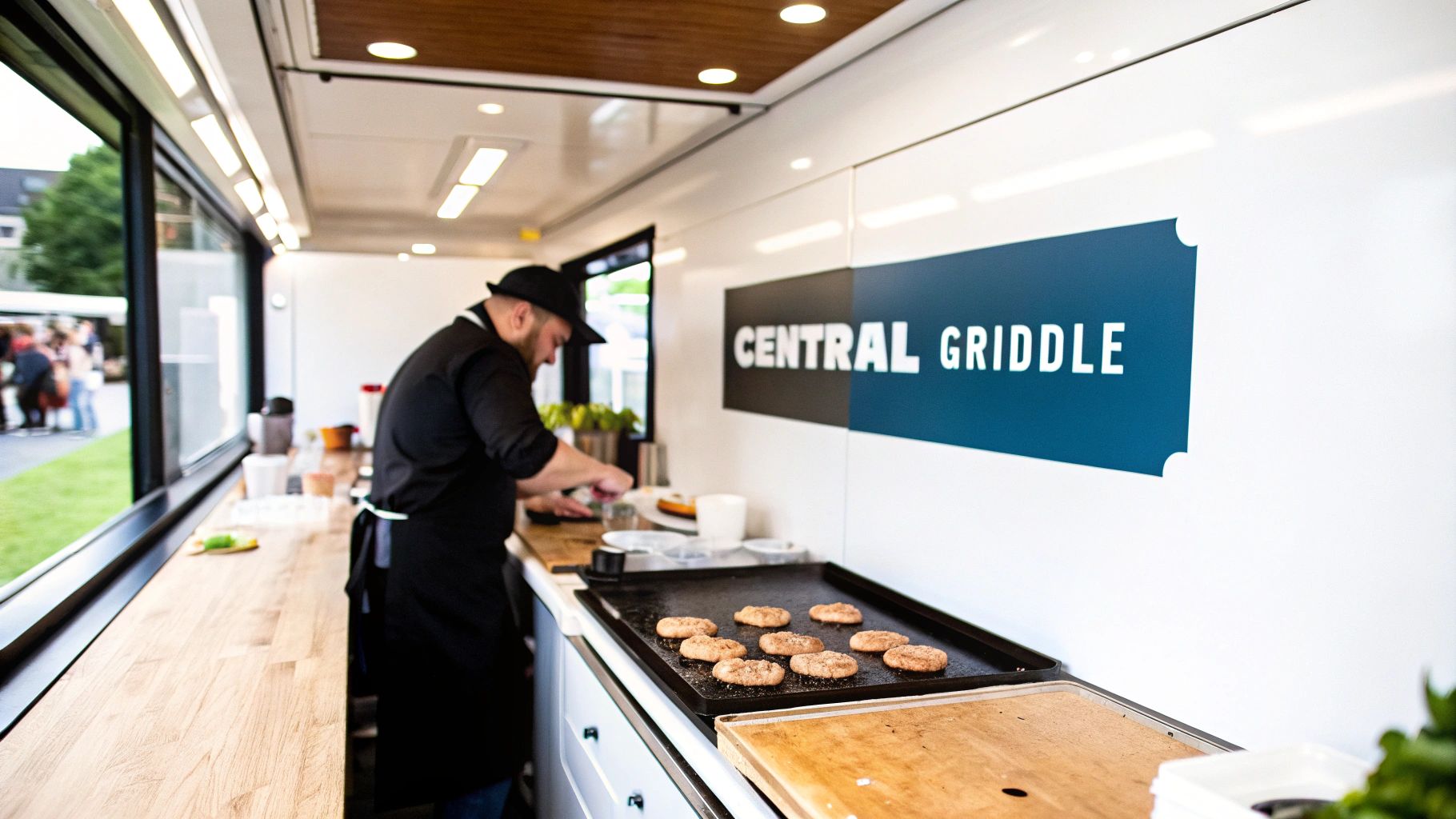
Picture your food truck layout like a tiny solar system. Right at the center, holding everything together, is your commercial griddle. It's the engine that powers you through breakfast rushes and keeps the burgers flying during late-night service. A typical food truck kitchen is tight—we're talking 120 to 200 square feet—so every single equipment choice is a big deal. The griddle is where that decision matters most.
This single appliance is a true workhorse. From searing smash burgers and caramelizing onions to flipping pancakes and toasting buns, its big, flat surface is the most versatile cooking station you can possibly own. In a space where single-use gadgets are a luxury you just can't afford, that multi-functionality is everything.
Maximizing Space and Speed with the Right Griddle
The right commercial griddle can turn your biggest limitation—space—into a strength. By handling multiple cooking jobs on one surface, it frees up precious counter space for prepping, plating, and other must-have gear. This is the key to creating a smart workflow where your team isn't tripping over each other, which means orders get out the window faster.
A well-chosen griddle directly impacts your service speed. The ability to cook multiple orders simultaneously on a large, evenly heated surface is what separates a profitable truck from one struggling to keep up with the lunch rush.
The Strategic Importance of Your Griddle
Choosing your griddle isn't just an equipment decision; it's a core business decision that shapes your entire operation from the ground up.
- Menu Development: The size and power of your griddle basically dictate how complex your menu can be and how many people you can serve.
- Operational Efficiency: A high-quality griddle with consistent, reliable heat means faster cook times and less wasted food, which goes straight to your bottom line.
- Customer Attraction: Great food cooked perfectly on your griddle is your best marketing tool. But first, you have to get people to your window. Pairing top-notch kitchen gear with effective food truck signage is the one-two punch for attracting a crowd.
Ultimately, picking your commercial griddle is the first real step in building a high-output culinary machine on wheels. It's the strategic centerpiece that everything else in your kitchen will revolve around.
Choosing Your Griddle's Fuel Source
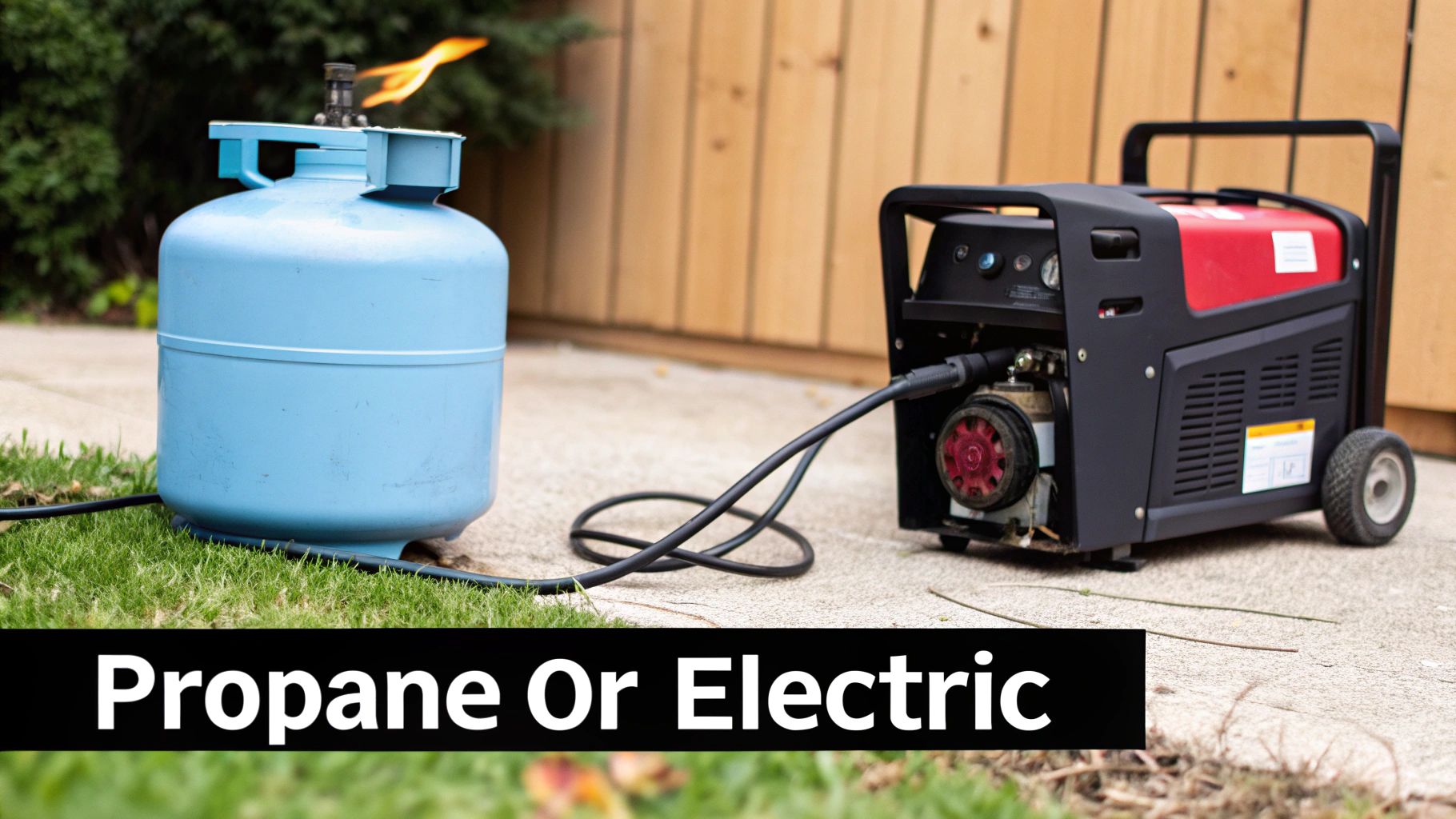
Picking a power source for your commercial griddle is one of the first big decisions you'll make, and it shapes just about everything else—from your mobility and running costs to how your food actually cooks. It’s like choosing the engine for a race car; the choice defines your power, your efficiency, and the entire setup you need to support it. This isn't just a small detail; it’s a critical piece of the puzzle when selecting equipment for food truck kitchens.
The two main contenders for griddles on the road are propane and electric. Each has its own personality, with real pros and cons that can make or break your day. The right one for you comes down to your menu, your business plan, and where you dream of parking your truck.
Propane Griddles: The Mobile Standard
When it comes to freedom, propane is the undisputed champ for food truck griddles. It delivers raw, powerful heat and lets you cut the cord completely, so you can set up on any street corner, at a remote festival, or anywhere the crowds are. This fuel is all about power and independence.
If you’re running a high-volume operation slinging burgers, cheesesteaks, or anything that needs a serious sear, the intense, roaring heat from a propane griddle is your best friend. It just can't be beat for speed. But with great power comes great responsibility. You’ll need to be diligent about safely hauling and securing tanks, and always—always—have a backup ready. Running out of fuel mid-lunch rush is a nightmare you don't want to live. If you want to dive deeper into gas options, check out our guide on natural gas versus propane griddles.
Electric Griddles: Precision and Simplicity
On the flip side, electric griddles are the masters of precision and consistency. For more delicate items like pancakes, crepes, or eggs, being able to dial in a specific temperature and trust it to stay there is a game-changer. Plus, with no open flame, many operators feel they're a safer bet in the tight confines of a truck.
The catch? Electric griddles are power hogs. They need a beefy, reliable generator or a hookup to shore power to run. This can tether you to specific locations and adds the constant hum (and maintenance) of a generator to your workday. They're a perfect fit for trucks that have guaranteed access to power or for chefs who value absolute temperature control over raw heat.
Your griddle's fuel source isn't just a technical detail—it's a strategic decision that dictates your operational freedom. Propane offers go-anywhere power, while electric provides plug-in precision.
This decision is especially important for different types of mobile kitchens. Take food trailers, for instance. They’re the quiet workhorses of the industry, holding a massive 43.27% market share in 2024. Their popularity comes from lower startup costs and simpler upkeep, making them a great starting point. These trailers often lean on versatile, field-convertible gas griddles that pack a punch and fit into the compact layouts needed to meet city permits.
Making The Right Choice: A Side-By-Side Look
To really nail this decision, it helps to see how propane and electric griddles stack up on the factors that matter most to an operator. I've put together a quick comparison to help you match the right fuel source to your business needs.
Griddle Fuel Type Comparison for Food Trucks
| Fuel Type | Best For | Portability | Heat Control | Upfront Cost | Utility Needs |
|---|---|---|---|---|---|
| Propane | High-volume cooking, searing, and maximum mobility at outdoor events or street corners. | Excellent. Completely independent of electrical grids, requiring only propane tank swaps. | Good. Manual controls offer quick adjustments but lack the fine-tuned precision of thermostats. | Moderate. Griddles are comparably priced, but you must factor in tanks and gas lines. | Propane tanks. Requires safe storage and regular refills or exchanges. |
| Electric | Precise temperature-sensitive cooking (e.g., crepes, eggs) and indoor or stationary locations. | Limited. Requires a powerful generator or a direct electrical hookup (shore power). | Excellent. Thermostatic controls provide precise, consistent, and repeatable temperatures. | Moderate to High. The unit cost is similar, but a high-output generator adds significant expense. | High-wattage electricity. Demands a robust generator or reliable shore power access. |
Ultimately, whether you choose the untethered power of propane or the controlled precision of electric for your griddle, the goal is the same: to have a reliable setup that lets you cook amazing food, day in and day out.
How to Match Griddle Size to Your Menu and Space
Inside a food truck, every single inch is prime real estate. Choosing the right griddle size isn't just about buying a piece of equipment—it’s a strategic move that defines your entire kitchen's flow. Go too big, and you'll choke out your prep area. Go too small, and you'll create a bottleneck during the lunch rush, leaving money on the table.
This single decision is the cornerstone of designing effective equipment for food truck kitchens. The right commercial griddle is the heart of your operation, the command post where your menu comes to life. It lets you pump out orders quickly and keep the line moving. Let's dig into how to match your menu, your volume, and your physical space to the perfect griddle.
Calculating Your Peak-Hour Cooking Surface
First, you need to think like a line cook slammed with tickets. Your griddle has to handle the absolute maximum number of items you'll be cooking at once. Don't just guess—do the math.
Grab your menu and a notepad. You need to answer a few key questions:
- What are your biggest griddle sellers? Zero in on the griddle-cooked items that will actually make you money.
- How many can you realistically sell in your busiest hour? Be ambitious but honest. If your goal is 60 burgers an hour, your griddle better be able to keep up.
- How many items physically fit on the griddle at one time? A standard 4-inch burger patty, for example, eats up about 16 square inches of space.
This quick exercise takes you from wishful thinking to hard numbers. Knowing you need to have 12 burgers sizzling or eight orders of pancakes cooking simultaneously gives you a tangible surface area to aim for. It turns a wild guess into a calculated investment in your griddle.
Translating Menu Needs into Griddle Dimensions
Once you know your capacity, you can start matching it to standard commercial griddle sizes. The width is the key measurement here; it determines your side-to-side working space.
Your griddle isn't just taking up space; it's creating production capacity. The goal is to find that sweet spot where the griddle is big enough for the rush without swallowing your entire cook line.
Let's look at how this plays out with different griddle sizes:
- The Compact Taco Truck (24-inch griddle): A 24-inch griddle is the perfect fit for a tight menu of tacos, quesadillas, and fajita veggies. It gives you plenty of room to sear meats and warm tortillas without overwhelming a small kitchen.
- The All-Day Breakfast Truck (36-inch griddle): When you're juggling pancakes, eggs, bacon, and hash browns, a 36-inch griddle is your workhorse. It gives you enough distinct heat zones to cook everything at once without the bacon grease invading your pancakes.
- The High-Volume Cheesesteak Truck (48-inch griddle): If your whole concept is built on slinging hundreds of cheesesteaks, you need maximum real estate. A massive 48-inch griddle lets you grill mountains of steak and onions while toasting rows of buns so you never fall behind.
These examples show a clear line connecting menu complexity, sales volume, and the physical size of your griddle. For a complete rundown of everything you might need for your truck, check out our detailed food truck equipment list.
Measuring and Optimizing Your Truck's Layout
Finally, get out the tape measure. A 48-inch griddle is completely useless if you only have 40 inches of space on the line. Measure the depth and width where your cook line will go, and don't forget to account for mandatory safety clearances between the griddle and other surfaces or walls.
This is exactly why custom builds are taking over the food truck world. Customization now holds a commanding 35% market share as of 2025, according to Future Market Insights. It's not about fancy paint jobs; it's about the nitty-gritty need for a kitchen built to maximize every inch for a specific menu and its core griddle. You can learn more about the rise of customized food trucks on FutureMarketInsights.com.
When you carefully map your menu to your peak demand and your physical constraints, your commercial griddle stops being just another appliance. It becomes the perfectly tuned engine driving your mobile kitchen's success.
What Makes a Food Truck Griddle a True Workhorse?
Okay, so you’ve picked your griddle’s size and decided between gas and electric. Now for the fun part. We’re getting into the details that separate a basic hot plate from a high-performance machine that can handle the chaos of a lunch rush. These are the features that really define the best equipment for food truck kitchens.
Getting these griddle details right means less time scrubbing, more consistent food, and a piece of equipment that won't fall apart after a few months on the road. Let’s look at the must-haves.
The Foundation: It’s All About a Thick Griddle Plate
Think of the griddle plate as the heart of your operation. If it's weak, everything else falls apart. In a food truck, you absolutely want a griddle plate made from thick steel—aim for something between 3/4-inch and 1-inch thick. That thickness isn't for looks; it's your secret weapon against temperature swings when you’re slammed.
A thick plate holds onto heat like a champ. When you throw down a dozen cold burger patties, a flimsy, thin plate will lose heat fast, and you’ll end up steaming the meat instead of searing it. Not good. But a heavy, thick plate keeps that temperature steady, giving you a perfect, crusty sear every single time. This is how you eliminate hot spots and guarantee every burger is as good as the last.
Precision Cooking: Manual vs. Thermostatic Controls
Next up is how you control all that heat on your griddle. You've got two main choices here, and what’s best for you really depends on your menu.
- Manual Controls: These are your classic high-medium-low knobs. They’re tough as nails, straightforward, and give you direct control over the flame. If you're slinging burgers or searing steaks and cook by feel, these are perfect.
- Thermostatic Controls: These let you dial in a precise temperature—say, 350°F—and the griddle holds it there by cycling the burners on and off. This is a lifesaver for anything delicate like pancakes, eggs, or crepes that need perfectly consistent heat to avoid burning.
Here’s a simple way to think about it: Manual controls are for the grill artist who works with instinct and raw heat. Thermostatic controls are for the culinary scientist who needs repeatable, exact results.
Small Griddle Details That Make a Huge Difference
Beyond the cooking surface and knobs, a few other design features on your griddle will make your life on the truck so much easier. These might seem like minor points, but they add up to massive time savings and a much cleaner, safer kitchen.
- Tall Splash Guards: You need welded splash guards around the back and sides of your griddle. Period. They contain grease splatter, which keeps your workspace from becoming a skating rink, cuts down on fire risk, and saves you a ton of cleaning at the end of a shift.
- Solid Stainless Steel Body: Your food truck is a kitchen on wheels, and it bounces around. A griddle with a fully welded, heavy-duty stainless steel frame is built to handle the constant vibrations of travel. Don't cheap out here.
- A Big, Easy-to-Remove Grease Tray: You'll be amazed at how much grease you generate. A large-capacity drip tray that you can easily pull out is a non-negotiable on a commercial griddle. It needs to slide out smoothly so you can empty it quickly without making a mess.
These are the kinds of high-performance features driving the commercial kitchen market, which is expected to grow by a massive USD 41.81 billion between 2024 and 2029. For the 30% of trucks serving fast food, a top-tier griddle is mission-critical, helping them slash labor costs by up to 20% with even cooking and smart, easy-to-clean designs. You can find more on these commercial kitchen equipment trends from Technavio.
Integrating Your Griddle for Safety and Workflow
Getting your commercial griddle installed is about way more than just hooking up the gas or plugging it in. It's about building a smart, safe, and efficient cooking station that actually works for you during the dinner rush. How you place this workhorse directly impacts your speed, your safety, and ultimately, your bottom line. This is a critical step when you're pulling together all the equipment for food truck kitchens.
Think of your griddle less like a standalone appliance and more like the heart of an integrated system. This whole setup needs to satisfy the health inspector while making your crew's life easier and faster when the tickets start flying.
Mastering Safety Clearances and Ventilation for Your Griddle
In the cramped confines of a food truck, you can't mess around with fire safety. Every commercial griddle has manufacturer-specified safety clearances—that’s the mandatory minimum distance between the unit and any flammable surface, like a wall or even other equipment. Ignoring these isn't just a bad idea; it's a guaranteed way to fail your health and fire inspections.
Just as crucial is the relationship between your griddle and your ventilation hood. That hood is your kitchen’s lungs, pulling all the hot, greasy air out. For it to work right, the hood needs to extend at least six inches beyond every edge of your griddle. This overhang creates a "capture zone" that ensures smoke and grease go up the vent instead of coating every single surface inside your truck.
To take safety a step further, many operators install gas and water leak detection systems to get an immediate alert on any potential hazards before they become big problems.
Designing a Seamless Kitchen Workflow Around the Griddle
Once you've got the safety sorted, it's all about speed. A killer workflow can shave precious seconds off every order, and over a busy lunch service, that adds up to real money. The secret is simple: minimize the steps your cooks have to take.
Imagine the path an order takes from the ticket printer to the customer's hand. The smartest layouts create a natural, assembly-line flow. One of the most effective setups we see time and again is placing the griddle directly beside a refrigerated prep table.
A "cook-and-plate" system, where the griddle and prep station are side-by-side, is the gold standard for food truck efficiency. It allows a cook to grab ingredients, cook them, and plate the final dish without ever taking more than a single step.
This simple adjacency creates a powerful, self-contained workstation. Your cook can pivot, grab burger patties from the cold drawer, throw them on the flat top, and assemble the finished product on the prep surface right next to it—all without running around.
This is where the design of the griddle itself plays a huge role in making that smooth workflow possible.
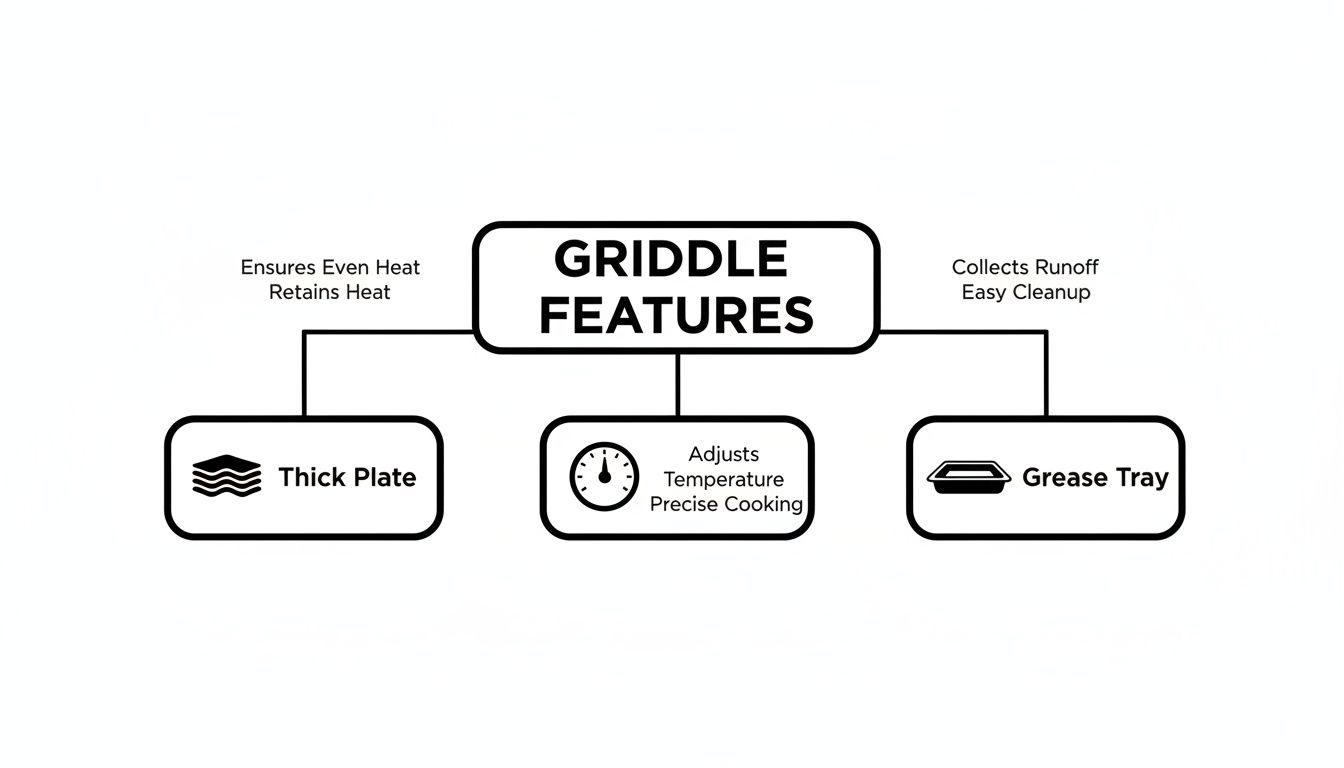
As you can see, features like a thick plate that holds heat, precise temperature controls, and a big grease trap for quick clean-up are what allow your team to operate at peak speed.
Placement Best Practices for Your Griddle
So, to tie it all together, here are the non-negotiable rules for placing your griddle when you're designing your truck's layout.
- Centralize Your Heat Line: Keep your griddle and any other high-heat equipment all grouped together under one properly sized exhaust hood. This contains the heat and grease in one zone.
- Isolate from Cold Storage: Don't put your hot griddle right next to your main fridge. The heat will force the refrigerator's compressor to work overtime, shortening its life and spiking your energy bill.
- Prioritize Accessibility: Make sure you can easily reach the griddle’s controls, gas hookups, and especially the grease trap. If it's a pain to clean, it won't get done right.
- Consider the Service Window: Position your griddle for a smooth handoff to the expo or window person. You want to avoid creating a traffic jam right where the food goes out.
By thinking through your griddle's placement with both safety and workflow in mind, you turn it from a big piece of steel into the high-powered engine that drives your whole business.
Daily Maintenance to Protect Your Griddle Investment

Think of your commercial griddle less like just another piece of steel and more like the heart of your food truck's profitability. A well-cared-for griddle is a reliable workhorse that will serve you faithfully for years. But if you neglect it, that same workhorse quickly becomes a constant headache, leading to unevenly cooked food and nightmare cleanups.
The best insurance for your investment is a simple, consistent daily cleaning routine. This isn't just a suggestion—it's a non-negotiable for running a pro-level mobile kitchen. Taking care of your equipment for food truck kitchens with these small steps prevents massive problems, like the carbon buildup that kills a griddle's non-stick surface and gives your food a nasty burnt flavor.
The End-of-Shift Griddle Shutdown Routine
This is how you tuck your griddle in for the night. Make this quick five-step process second nature for your closing crew, and you'll guarantee your griddle is clean, safe, and ready to fire up for the next service.
-
Scrape While It's Warm: The moment service ends, while the griddle is still warm (but not blazing hot), grab your scraper. Push all the leftover bits and grease straight into the grease trap. A warm surface lets go of gunk way easier than a cold one.
-
Deglaze with Water: Carefully pour a little warm water or club soda on the cooktop. That sizzle and steam is your friend—it's lifting off all the stubborn, cooked-on residue. Scrape that grime away into the trap.
-
Empty and Clean the Grease Trap: This is a huge fire safety step, so don't skip it. Pull the grease trap out, get rid of the contents according to your local health codes, and give it a good wash with soap and water.
-
Wipe and Season: After the griddle surface is clean and totally dry, wipe a very thin layer of cooking oil across it with a clean towel. This micro-seasoning protects the steel from rust overnight and keeps that slick surface perfect.
-
Clean the Exterior: Last thing, give the griddle's stainless steel front, sides, and knobs a wipe-down with a damp cloth and a mild cleaner to get rid of the day's splashes and splatters.
Want to see these techniques in more detail? Our guide on how to clean a commercial griddle breaks it all down step-by-step.
The Importance of Seasoning Your Griddle
So, what is "seasoning?" It's not about salt and pepper. It's the layer of baked-on, polymerized oil that creates that beautiful, naturally non-stick surface on your griddle. It's the secret to getting a perfect sear on a smash burger and flawlessly flipping pancakes.
A well-seasoned griddle surface is your best friend in the kitchen. It’s a living surface that gets better with every use, as long as you treat it right. Neglecting it is like trying to cook in a pan without oil—everything sticks, and nothing cooks evenly.
When your griddle is brand new, you have to build this surface from scratch by applying several thin coats of oil and heating it up. Over time, that daily wipe-down of oil is all you need to maintain it. If you ever notice food starting to stick, it's just a sign that it's time to re-season the plate and bring it back to life.
Got Questions? We’ve Got Griddle Answers
Even after you've picked the perfect commercial griddle, you'll have questions once you hit the road. That's just part of the food truck life—knowing your equipment for food truck kitchens inside and out means you can troubleshoot on the fly and keep the line moving.
Here are some quick-fire answers to the questions we hear all the time from operators about their griddles.
How Do I Stop My Food from Sticking to the Griddle?
Nine times out of ten, sticking is a seasoning problem. A perfectly seasoned griddle builds up a slick, non-stick surface from layers of baked-on oil. If food starts grabbing, that layer has been damaged or stripped away.
The fix? A deep clean and a fresh seasoning. You'll need to apply a super-thin layer of a high-smoke-point oil (canola or grapeseed oil work great) and heat the griddle until the oil stops smoking. Do this 3-4 times to build a solid base. To keep it that way, just wipe it down with a light coat of oil after you clean up each day.
A well-seasoned griddle plate is everything. It's not some factory coating; it's a surface you create and maintain yourself. That slick, black top is what makes pro cooks look like they're performing magic.
What’s the Best Griddle Temperature for Burgers?
You want that sizzle and that perfect brown crust on your burgers, right? That comes from hitting the sweet spot on temperature. Aim for somewhere between 350°F and 375°F on your griddle.
This range is hot enough to kick off the Maillard reaction—that's the science-y term for the process that creates all the amazing flavor and color on seared meat. It's also just cool enough that you won't scorch the outside before the inside is perfectly cooked. Grab an infrared thermometer to zap the surface and know your temp for sure.
Can I Cook Different Things on the Griddle at Once?
You bet. In fact, you should! This is where those bigger 36-inch or 48-inch griddles really prove their worth. They don't heat perfectly evenly, and that's actually a huge advantage. You get built-in temperature zones on your griddle.
- The Hot Zone: Right over the burners. This is where you sear your burgers, steaks, and anything else that needs a hard, fast cook.
- The Medium Zone: In between the burners. This spot is perfect for things that need a gentler cook, like bacon, onions, or veggies.
- The Warm Zone: Along the edges. Use this space to toast your buns without burning them or to hold finished items for a minute before they go out the window.
Ready to find the perfect workhorse for your mobile kitchen? At Griddles.com, we specialize in high-performance commercial griddles designed for the demands of food truck life. Explore our collection and get free shipping on every order!