

What Is the Best Stainless Steel Cleaner for Your Commercial Griddle?
When you're running a commercial kitchen, the "best" stainless steel cleaner for your griddle isn't what you'd grab from a grocery store shelf. You need a food-grade, high-alkaline degreaser that is NSF-certified. This kind of heavy-duty formula is built to slice through the toughest, cooked-on grease splattered on a griddle's exterior, all without harming your equipment or putting food safety at risk.
What Makes a Griddle Cleaner the Best Choice for Commercial Kitchens
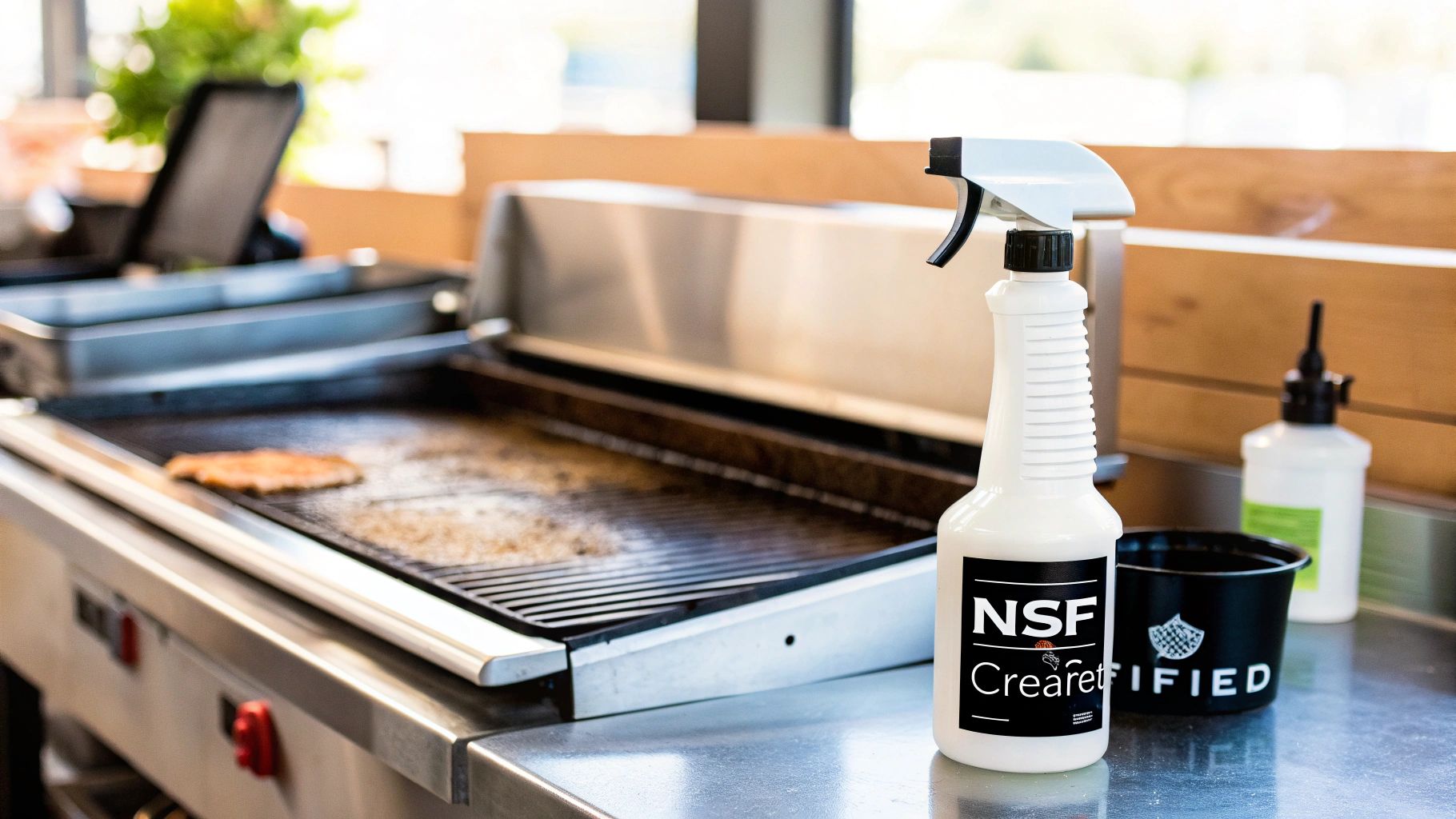
In a busy restaurant, "best" isn't just about making things shiny. It’s a delicate dance between raw cleaning power, absolute safety, and kitchen efficiency. A standard household cleaner just can't keep up with the demands of a commercial griddle.
The grime splattered on your griddle's stainless steel body is a whole different beast. After hours of high-heat cooking, that grease polymerizes, turning into a stubborn, almost plastic-like film that bonds to the metal.
Think of it like trying to remove hardened tree sap with soap and water. A regular cleaner might get the fresh stuff off, but it won't touch that baked-on layer. You need a commercial-grade formula engineered to chemically shatter that bond, letting you wipe it away without a fight. This is where the pros turn to specialized products to keep their griddles looking sharp and meeting health codes.
To help you cut through the noise, here’s a quick look at what truly matters when choosing a cleaner for your commercial griddle's stainless steel exterior.
Key Attributes of an Ideal Commercial Griddle Cleaner
| Attribute | Why It Matters for Your Griddle | Look For This on the Label |
|---|---|---|
| High Alkalinity (High pH) | Effectively dissolves and saponifies (turns to soap) the tough, polymerized fats and oils unique to commercial cooking. | "Degreaser," "Heavy-Duty," "Commercial Grade," pH level of 11+ |
| NSF Certification | Confirms the product is non-toxic and safe for use on surfaces that may have incidental food contact, a must for health inspections. | "NSF Certified," NSF logo, specific registration number (e.g., A1, A4, A8) |
| Food-Grade/Food-Safe | Ensures no harmful chemical residues are left behind that could contaminate food, protecting your customers and your reputation. | "Food-Grade," "Food-Safe," "For Food-Contact Surfaces" |
| Non-Abrasive Formula | Cleans without scratching or dulling the griddle's stainless steel finish, preserving the protective passive layer that prevents rust. | "Non-Abrasive," "Scratch-Free," "Safe for Stainless Steel" |
| Fast-Acting | Reduces downtime and labor costs by breaking down grease quickly, which is critical during or after a busy service. | "Fast-Acting," "High-Temp Formula," "Cuts Through Grease" |
Ultimately, picking the right cleaner is about finding a product that works hard so your team doesn't have to, all while keeping your kitchen safe and compliant.
The Power of Specialized Formulas
The demand for high-performance stainless steel cleaners is booming, especially in the food service world. In fact, the market for food-grade cleaners is expected to jump from $754.7 million to $1,076 million by 2032. Kitchens that make the switch to these targeted formulas for their griddles often see cleanup times drop by up to 30%, freeing up staff to focus on what matters most: the food.
That efficiency boost comes down to smart chemistry. These cleaners are built for a single purpose:
- Destroy Polymerized Grease: They use powerful agents that chemically dismantle the structure of baked-on fats on your griddle's exterior.
- Protect Your Gear: The formulas are non-corrosive, so they won't eat away at the passive layer of your stainless steel that keeps rust at bay. Keeping up with this is a core part of our guide to commercial kitchen equipment maintenance.
- Guarantee Food Safety: With NSF certification, you know they're safe for food prep areas, eliminating the risk of chemical contamination.
Balancing Cleaning with Protection
At the end of the day, you're trying to protect a major investment. Using a dedicated stainless steel cleaner and polish on your griddle is a smart move because it cleans effectively while leaving a protective barrier. This dual-action approach not only gets the grime off but also creates a micro-thin shield that makes the next cleanup much faster.
The goal is simple: get that griddle looking brand new without leaving behind scratches or chemical damage. The best cleaner does this fast, keeping your kitchen humming and looking as professional as the food you serve.
Your Toolkit for Stainless Steel Griddle Care
Not all stainless steel cleaners are created equal. In a commercial kitchen, picking the right one is like a mechanic grabbing the exact wrench needed for a specific repair—it just works better. Think of your cleaning supplies as a toolkit; you need the right product for the right job to keep your griddle in prime condition. Using the wrong solution is like trying to tighten a bolt with a hammer. It might sort of work, but you're going to cause damage.
The two most essential tools in your kit for cleaning the griddle's exterior are a powerful degreaser and a protective polish. Each one plays a distinct, equally important role in keeping your equipment hygienic and looking sharp.
The Heavy-Duty Wrench: Degreasers
For the daily grime and grease that builds up during a busy service, a high-alkaline degreaser is your heavy-duty wrench. This is the product you’ll reach for most often to break down the tough, cooked-on gunk that splatters onto the griddle's stainless steel exterior.
Alkaline cleaners work through a chemical reaction called saponification. In simple terms, this process transforms stubborn, water-insoluble fats and oils into a soap-like substance that you can easily wipe away. For any kitchen that's serious about high-volume cooking, a good degreaser is non-negotiable for griddle maintenance. If you're dealing with really stubborn, caked-on residue on the griddle plate itself, you might need a little extra muscle. For more on that, check out our guide on choosing the right flat-top grill scraper to add to your routine.
The Protective Shield: Polishes
After the heavy lifting is done, a stainless steel polish is the final touch that protects your investment. If the degreaser is the wrench, think of the polish as the protective wax coating you apply to a car after a thorough wash.
A quality polish does more than just add shine to your griddle. It creates a thin, invisible barrier on the steel's surface, which helps repel future grease splatters and makes the next cleanup significantly easier.
This protective layer also helps prevent water spots and fingerprints, keeping your entire griddle line looking professional and impeccably clean for both customers and health inspectors. It’s a proactive step that will save your team a ton of time and effort down the road.
Beyond the chemicals, even the water you use can affect the final result. For example, industries that rely heavily on stainless steel equipment, like breweries, understand the importance of pure water in brewery cleaning processes. Hard water can leave behind mineral residue, dulling the finish you just worked so hard to achieve.
By understanding the specific roles of degreasers and polishes, you're equipping your team to tackle any cleaning task efficiently. This two-step approach ensures your stainless steel griddle not only meets hygiene standards but also maintains its value and professional appearance for years to come.
A Step-by-Step Guide to Cleaning Your Griddle Exterior
Having the best stainless steel cleaner on hand is half the battle. Knowing how to use it is what gets you that perfect, streak-free shine that makes your kitchen pop. The right technique cuts through grease and grime faster, saving you elbow grease and product. This guide is built for the chaos of a busy kitchen, focusing specifically on the griddle’s exterior—not the cooking surface itself.
First thing's first: safety. Make sure the griddle is completely cool before you even think about spraying it down. Hitting a hot surface with cleaner is a recipe for funky fumes and a sticky residue that’s even harder to get off. And always, always wear your PPE. Gloves and safety glasses are non-negotiable.
The Griddle Exterior Cleaning Process
Ready to get that griddle looking brand new? Here’s a simple routine to nail every time you shut down for the night.
- Clear the Debris: Grab a soft cloth and wipe down the stainless steel surfaces to get rid of any loose food bits or hardened grease splatters. This quick pre-clean stops you from just smearing the gunk around.
- Apply the Cleaner: Spray your food-grade stainless steel cleaner liberally on the exterior. Don't be shy, especially on the backsplash and sides where the buildup is worst.
- Let It Work: Give the cleaner about 3-5 minutes to sit. This is the magic step. That "dwell time" lets the active ingredients get in there and dissolve all that tough, cooked-on grease, so you don't have to scrub like a maniac.
- Wipe with the Grain: Take a clean microfiber cloth and wipe in the same direction as the metal's grain. You'll see little lines in the steel—follow them. This little trick is the secret to avoiding streaks and pulling grime out of the metal's tiny grooves.
- Rinse (If Needed): Some heavy-duty degreasers need a quick rinse with a damp cloth to get rid of any leftover chemicals. Just check the product label to be sure you're keeping things food-safe.
- Dry and Polish: With a separate, dry microfiber cloth, buff the surface until it’s completely dry. This gets rid of any leftover moisture, prevents those annoying water spots, and really brings out the shine. For an extra layer of protection, you can finish it off with a dedicated stainless steel polish.
Integrating Cleaning Into Your Workflow
Making this a daily habit is key. For a busy diner that’s constantly fighting grease splatter, the right cleaner isn't just a preference—it's a necessity. In fact, top-tier cleaners can slash surface bacteria by 99.9%, based on EPA-aligned testing, which is a massive win for cutting down on foodborne illness risks. Cognitive Market Research has more on the benefits if you want to dig deeper.
This two-step process—degrease then polish—is really the core of great griddle care.
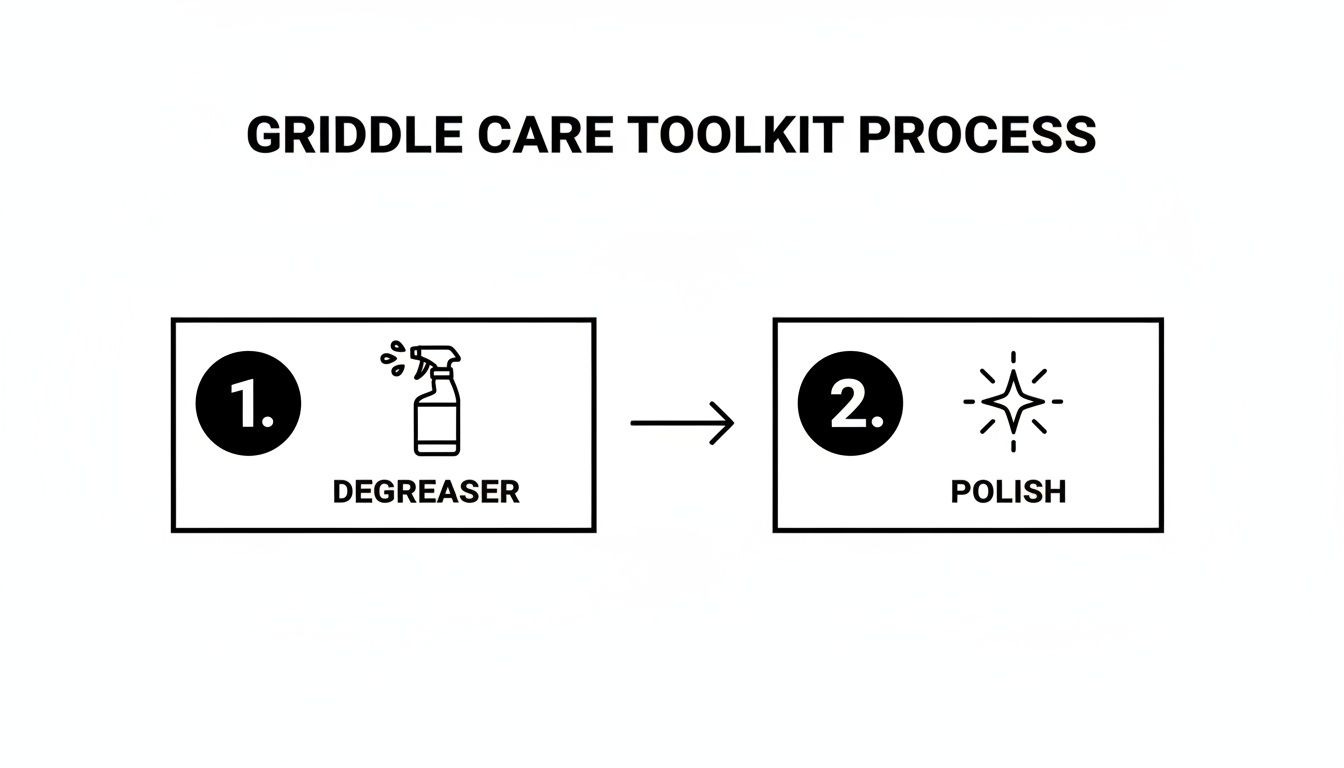
Think of it like this: cleaning gets rid of the mess you made today, and polishing protects the surface so it's easier to clean tomorrow.
Just a heads up: this whole process is only for the stainless steel body. The griddle plate itself is a different beast and needs special high-heat cleaners. For the full rundown on that, check out our guide where you can learn more about how to clean a commercial griddle.
Choosing the Right Cleaner for Your Commercial Griddle
The best stainless steel cleaner for a high-volume diner slinging hundreds of burgers a day is worlds apart from what a nimble food truck needs for its griddle. Your choice boils down to your operation's scale, your budget, and how your team works. Picking the right product isn’t just about finding something that works; it's about finding what works for you.
This guide will walk you through picking the perfect product for your unique kitchen. We'll break down the different cleaner formats and shine a light on the non-negotiable safety certifications you need to look for.
Cleaner Formats: Sprays, Concentrates, and Wipes
When you're stocking the chemical closet, your first big decision is the format. Each has its place, and choosing the right one for your griddle can save you time, money, and headaches.
Here’s a quick comparison to help you match the cleaner format to your kitchen's workflow.
| Cleaner Format | Best For | Pros | Cons |
|---|---|---|---|
| Ready-to-Use (RTU) Sprays | Food trucks, smaller cafes, quick mid-service cleanups on the griddle line | Ultimate convenience, no mixing required, easy for staff to use correctly | Higher cost per ounce, more packaging waste |
| Concentrates | Large restaurants, ghost kitchens, high-volume diners with extensive griddle use | Most economical option, reduces packaging, buys in bulk | Requires precise mixing and staff training, potential for waste if mixed incorrectly |
| Wipes | Front-of-house touch-ups on countertop griddles, sanitizing small surfaces | Extremely fast and portable, no extra supplies needed, controlled application | Highest cost per use, not practical for large areas, generates more waste |
For fast-paced spots where every second counts, ready-to-use (RTU) sprays are clutch. Staff can just grab, spray, and wipe the griddle exterior, making them perfect for quick cleanups during a busy service or in tight spaces like a food truck. The tradeoff? A higher cost per ounce.
On the other hand, for larger kitchens, diners, and ghost kitchens, concentrates are the undisputed king of value. You buy the potent formula in bulk and dilute it with water on-site. This slashes your cost per use and cuts down on plastic waste, but it absolutely requires proper training to make sure your team is mixing the correct, safe dilution ratios every time.
Think of it like this: An RTU spray is like grabbing a ready-to-drink coffee—perfect when you're on the go. A concentrate is like buying a big bag of beans. It’s way cheaper in the long run and gives you more control, but you have to know how to brew it right.
How to Read the Safety Labels
Beyond the format, safety is everything when cleaning your griddle. There are two acronyms you absolutely have to know: NSF and SDS. Ignoring them isn't just a simple mistake; it can lead to serious health code violations and put your customers and staff at risk.
An NSF Certification is your proof that a cleaner is safe for food environments. The National Sanitation Foundation (NSF) is an independent organization that puts products through rigorous testing. If you see that little blue NSF logo on the label, you know it's gotten the green light from the people health inspectors trust.
An SDS (Safety Data Sheet) is a mandatory document that spells out a chemical's potential hazards, how to handle it safely, and what to do in an emergency. By law, you must have an SDS on hand for every single chemical in your kitchen. Always review the SDS before you buy to understand what you're dealing with—its ingredients, required PPE, and proper disposal.
Once you get a handle on these key factors, you can confidently choose the best stainless steel cleaner for your specific griddle. Whether you need the grab-and-go ease of a spray for a food truck or the powerhouse economics of a concentrate for a bustling restaurant, the right choice will always be one that’s effective, fits the budget, and—above all—is safe.
Common Mistakes That Can Ruin Your Griddle's Stainless Steel
Even the best stainless steel cleaner in the world can't save a commercial griddle from damage caused by a few simple, everyday mistakes. It turns out, knowing what not to do is just as important as knowing the right way to clean. Protecting your investment starts with sidestepping the common pitfalls that can scratch, corrode, and permanently wreck your griddle's professional finish.
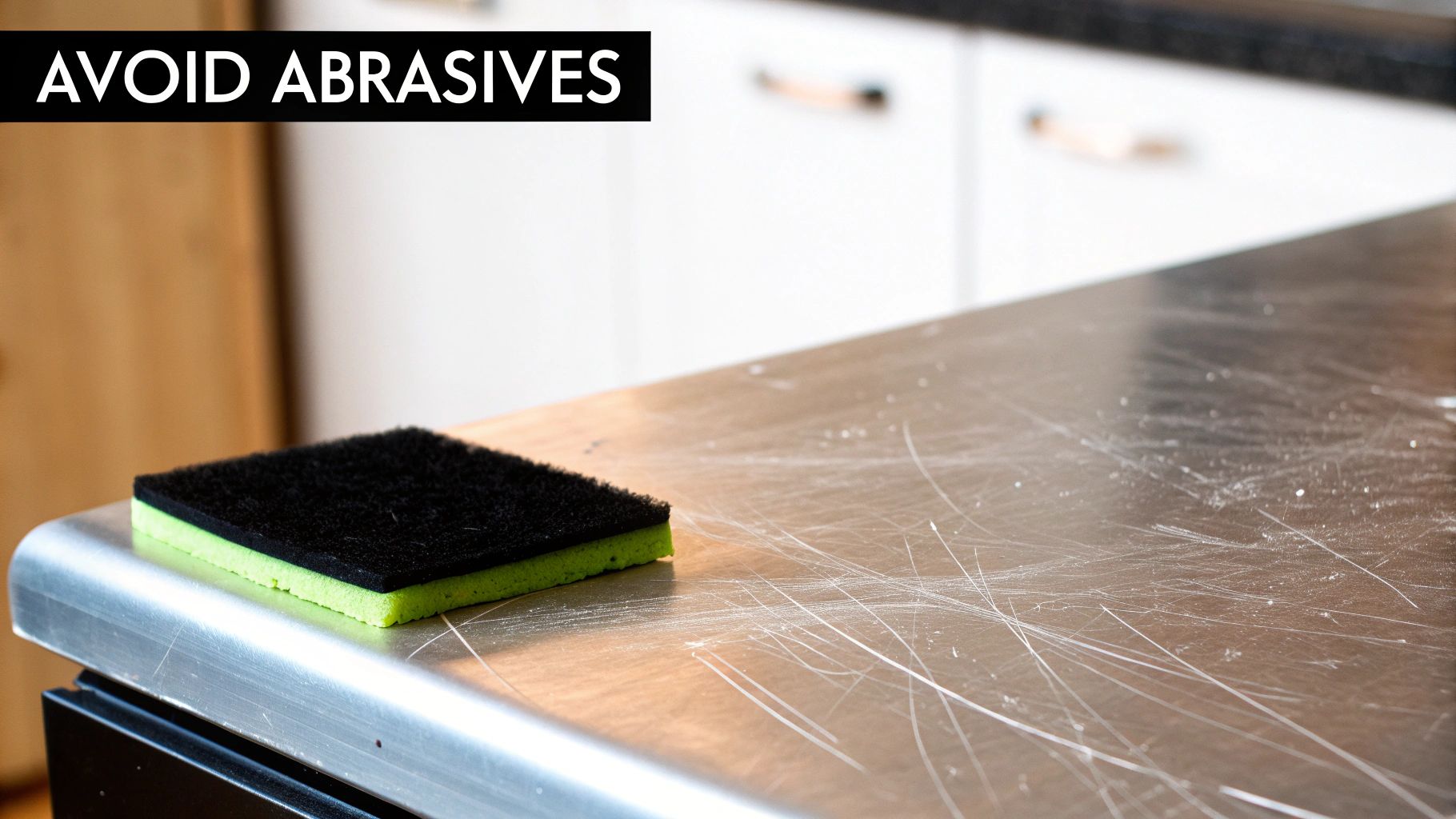
Most of these blunders happen when staff are in a hurry and grab the wrong tool or chemical, not thinking about the long-term consequences for the griddle.
The Wrong Tools for the Job
The absolute fastest way to ruin a griddle’s exterior is with abrasive materials. Sure, they might seem like they’re working because they rip right through the grime, but they’re also ripping through the steel's protective layer.
Here are the top offenders you need to ban from your griddle cleaning kit right now:
- Steel Wool and Scouring Pads: These are basically tiny knives that gouge the metal. They leave deep scratches that become perfect hiding spots for bacteria and rust.
- Wire Brushes: While they have their place in the kitchen, they are far too aggressive for stainless steel finishes. You’ll just end up with a web of ugly scratches on your griddle.
- Putty Knives or Metal Scrapers: Never, ever use sharp metal tools on the body of your griddle. It’s too easy for them to slip and cause deep, permanent gashes in the surface.
Using the right tools isn't just about looks; it's about efficiency and NSF compliance. Kitchens that pair food-grade cleaners with the right non-abrasive pads report using 50% less effort to get the job done. That’s a direct saving on labor costs. You can discover more insights about the scrubber market here.
The Wrong Chemicals for the Kitchen
Just as bad as using the wrong tool is grabbing the wrong chemical for your griddle. Some cleaners contain ingredients that literally attack stainless steel on a chemical level, leading to pitting, weird discoloration, and corrosion.
Think of stainless steel's surface as having a shield—a passive layer of chromium oxide that protects it from rust. The wrong chemicals can shatter that shield, leaving the metal vulnerable.
Steer clear of these chemicals when cleaning your griddle's exterior at all costs:
- Bleach (Chlorine): Chlorine is public enemy number one for stainless steel. It aggressively attacks that chromium oxide layer, causing ugly brown spots and rust-like pitting.
- Oven Cleaners: These are built for the baked-on carbon you find inside an oven. They are way too caustic for a griddle’s exterior and will often leave permanent discoloration.
- Ammonia-Based Glass Cleaners: Great for windows, not so much for stainless steel. Ammonia can leave streaks and sometimes reacts badly with certain finishes.
Frequently Asked Questions About Griddle Cleaners
Even with the best gear and a solid cleaning plan, questions always pop up on the line. Getting the small details right about which stainless steel cleaner to use on your griddle—and when—can save you a ton of time, prevent costly damage, and just make service run smoother. Let’s tackle some of the most common questions we hear from kitchen managers about keeping their griddle exteriors looking sharp.
Here are the straight-up answers to the practical problems you face every day.
Can I Use the Same Cleaner on the Cooking Surface and the Stainless Steel Body?
Absolutely not. This is probably the single most important mistake to avoid with a commercial griddle. The cooking plate and the stainless steel body are two completely different beasts and need to be treated that way.
Your griddle plate needs a heavy-duty, high-heat cleaner made to demolish burnt-on carbon and grease. Those formulas are incredibly powerful and do a fantastic job on the cooking surface.
But if that same aggressive cleaner touches the softer stainless steel exterior? You're asking for trouble. It can strip away the protective finish, cause ugly discoloration, and even lead to rust. Think of it like washing a car: you wouldn’t use harsh wheel acid on the paint job. Always grab a dedicated, food-grade stainless steel cleaner for the griddle's body.
How Often Should I Deep Clean My Griddle's Exterior?
The real secret here is consistency. A little work every day prevents the kind of baked-on grease that takes an hour of scrubbing to fix. Your griddle cleaning schedule should have two parts: a daily wipe-down and a weekly deep clean.
- Daily Wipe-Downs: After every single shift, the whole stainless steel exterior needs a quick wipe with a food-safe degreaser. This gets rid of fresh splatters before they have a chance to cook on and harden overnight.
- Weekly Deep Cleans: Once a week, commit to a more detailed cleaning. This is when you pull off the control knobs, get into the vents, and attack all the nooks and crannies where grease loves to hide. Following this up with a good polish is a pro move—it restores that protective barrier and makes your daily wipe-downs way easier.
Are DIY Cleaners Like Vinegar Safe for a Commercial Griddle?
While vinegar and baking soda might work wonders in a home kitchen, they have no place in a commercial setting for cleaning griddles. There are two big reasons why.
First off, they just aren’t strong enough. They don’t have the chemical muscle to cut through the thick, polymerized grease you find on a commercial griddle. Your crew will waste time and elbow grease for a result that’s mediocre at best, and that labor costs you money.
The bigger issue? DIY cleaners are not NSF-certified. Using a non-certified product in a food prep area is a fast track to a health code violation. To stay compliant and keep your griddle and food safe, you have to stick with commercially formulated, food-grade stainless steel cleaners. It's the only way to know you’re meeting professional standards.
Ready to equip your kitchen with a griddle built to last? At Griddles.com, we offer a robust selection of commercial griddles designed for durability and easy maintenance. Find the perfect model for your operation and keep it looking pristine with the right care.