

Choosing a Top Rated Electric Griddle for Your Commercial Kitchen
For any professional kitchen, finding the top rated electric griddle is about more than just buying a new appliance. It's an investment in a machine that delivers relentless consistency and efficiency, shift after shift. The best commercial models are built for the grind of high-volume service, offering a level of temperature control and raw durability that is essential for professional use. They are the true workhorses behind every successful service.
Why a Commercial Electric Griddle Is Your Kitchen's MVP
Picture a single piece of equipment that can sail through a morning breakfast rush, put a perfect sear on steaks for the dinner crowd, and deliver the same great results every single time. That’s what a commercial electric griddle brings to the table. This isn’t just a flat-top cooker; it’s a strategic piece of gear for any serious restaurant or food service business.
Commercial units are forged for the chaos of a professional kitchen. They’re built from heavy-duty stainless steel and feature thick, beefy cooking plates that hold onto heat like nothing else. This means when your line cook slaps a dozen frozen burger patties on the surface, the temperature barely dips, giving you a consistent, predictable cook every single time.
The Foundation of Efficiency and Versatility
The real magic of a top-tier commercial griddle is how it simplifies your kitchen's workflow while opening up your menu. Think of it as the command center of your cooking line.
- Serious Menu Versatility: From eggs and bacon in the morning to Philly cheesesteaks for lunch and seared fish at dinner, a griddle gives you a massive, evenly heated canvas to cook just about anything.
- Boosted Kitchen Efficiency: With a huge cooking area, your chefs can fire off multiple orders at once. This absolutely crushes ticket times during your busiest hours—something a collection of smaller pans and appliances just can't do.
- Unwavering Consistency: Forget about hot and cold spots. Advanced thermostatic controls keep the temperature precise across the entire cooktop. This ensures the 100th pancake of the day is just as perfect as the first.
A commercial griddle is more than just equipment—it's an investment in your restaurant's quality control. By giving your chefs a stable and completely reliable cooking platform, it allows them to produce high-quality, predictable food that keeps your customers happy and coming back for more.
At the end of the day, picking the right griddle is the bedrock of both quality and speed in your kitchen. In this guide, we'll dig into what really separates a professional-grade unit from the rest, helping you make a much smarter buying decision.
Understanding Commercial Griddle Specifications
Trying to make sense of a spec sheet for a top-rated electric griddle can feel like you're reading a foreign language. But those numbers and technical terms aren't just abstract details—they translate directly into how that griddle will perform on the line during a busy service. My goal here is to decode that jargon so you can see exactly how these specs impact everything from your ticket times to the consistency of your food.
The Griddle Plate: Thickness and Materials
Think of the griddle plate as a thermal battery. Its job is to store heat and deliver it consistently to the food. The plate's thickness is what determines how much energy it can hold.
For many kitchens, a standard 1/2-inch plate does the job just fine. But if you're running a high-volume operation, a heavy-duty 1-inch steel plate is an absolute game-changer. That extra mass holds onto heat like a champ, so when you throw a dozen frozen burger patties on it during the lunch rush, the surface temperature doesn't crash. This stability means faster recovery, faster cooking, and ultimately, shorter ticket times.
The material of the cooking surface is just as important. It dictates everything from how easily food releases to how you'll be spending your evenings cleaning it.
To help you decide, here's a quick comparison of the most common materials you'll encounter. Each one comes with its own set of pros and cons, making them better suited for different types of cooking and kitchen workflows.
Commercial Griddle Plate Material Comparison
| Material Type | Heat Retention | Stick Resistance | Best For | Maintenance |
|---|---|---|---|---|
| Steel | Excellent | Good (improves with seasoning) | All-purpose cooking: burgers, steaks, breakfast | Requires regular seasoning to build and maintain patina. |
| Chrome | Good | Excellent | Delicate items: eggs, pancakes, fish | Use non-metal utensils. Prone to scratching. |
| Composite | Varies | Varies | Specialized applications like high-speed searing | Varies by manufacturer; often requires specific care. |
As you can see, there's no single "best" material—it's all about matching the griddle's surface to your menu and your team's workflow.
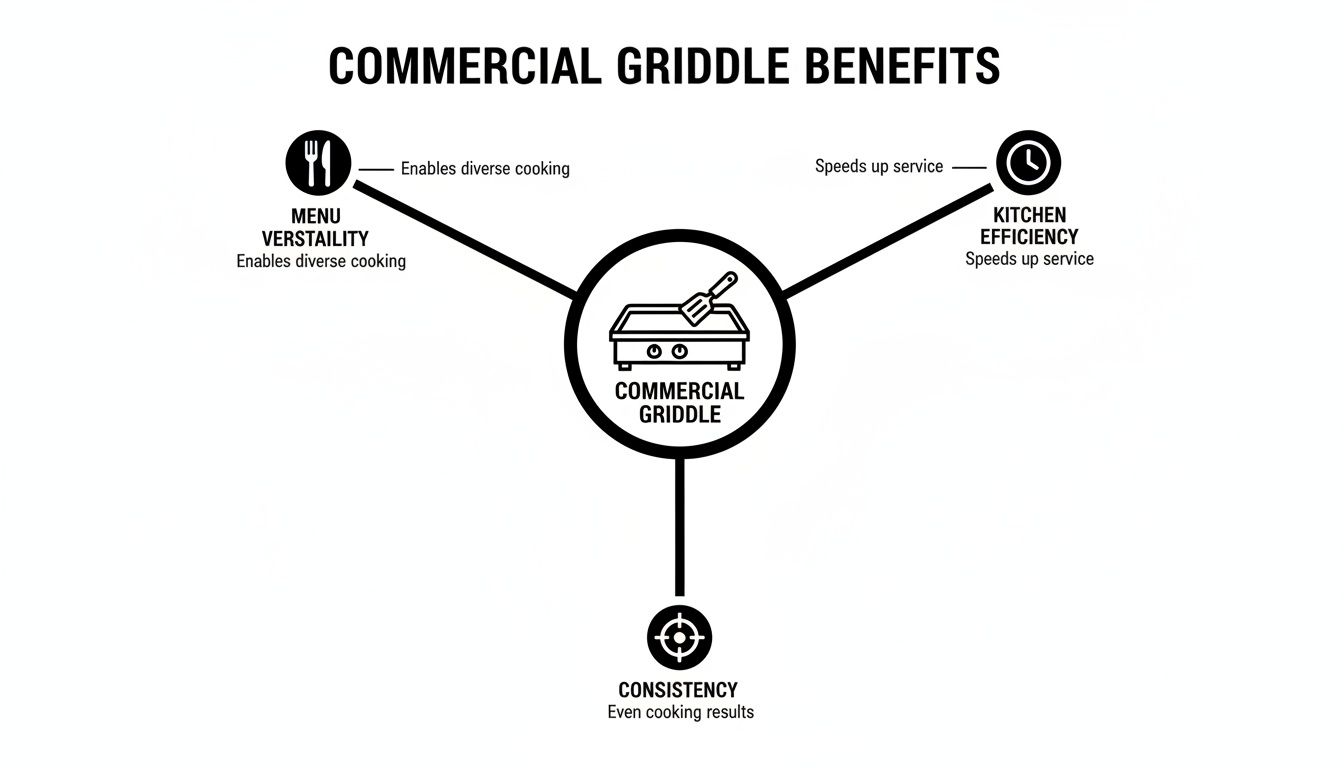
Choosing the right specs is the foundation for a more versatile menu, a more efficient kitchen, and the kind of consistency that keeps customers coming back.
Decoding Power Ratings
Finally, let’s talk about power. When you see wattage and voltage on a spec sheet, don't just gloss over them. These numbers tell you everything you need to know about the griddle's raw heating muscle. Higher wattage means the unit can turn more electricity into heat, which translates to faster preheating and quicker temperature recovery. In a professional kitchen, that's not a small detail—downtime is lost revenue.
In the commercial world, you'll see griddles with power ratings designed for demanding applications. We're talking units that pull 2000–3000 watts or more, with massive cooking surfaces over 300–600 square inches. These are the workhorses built for continuous, all-day service.
Then there's voltage. A commercial griddle will typically be rated for either 120V or 240V. While a 120V unit is convenient because it plugs into a standard outlet, a 240V model is in another league. It needs a dedicated, higher-power circuit, but the payoff is huge: 240V griddles heat up significantly faster and hold their temperature far better under a heavy load. It's why they are the undisputed choice for almost any serious commercial kitchen.
If you want to dive deeper, you can learn more about the differences in our guide on 120V vs 240V griddle performance. By getting a handle on these specs, you're no longer just buying a piece of equipment; you're making an informed decision about a tool that will be central to your kitchen's success.
Essential Features of a Top Rated Electric Griddle
Beyond the basic numbers like plate thickness and power, a few key features really separate the workhorses from the headaches. These are the details that make a real difference in your kitchen's daily grind, from how consistently food cooks to how fast you can clean up at the end of a long night. Getting these right is how you find a top rated electric griddle that feels like part of the team.
The heart and soul of any griddle's performance is its temperature control. This is probably the biggest decision you'll make, as it directly impacts how your cooks use the equipment during a hectic service. It really comes down to two main systems.
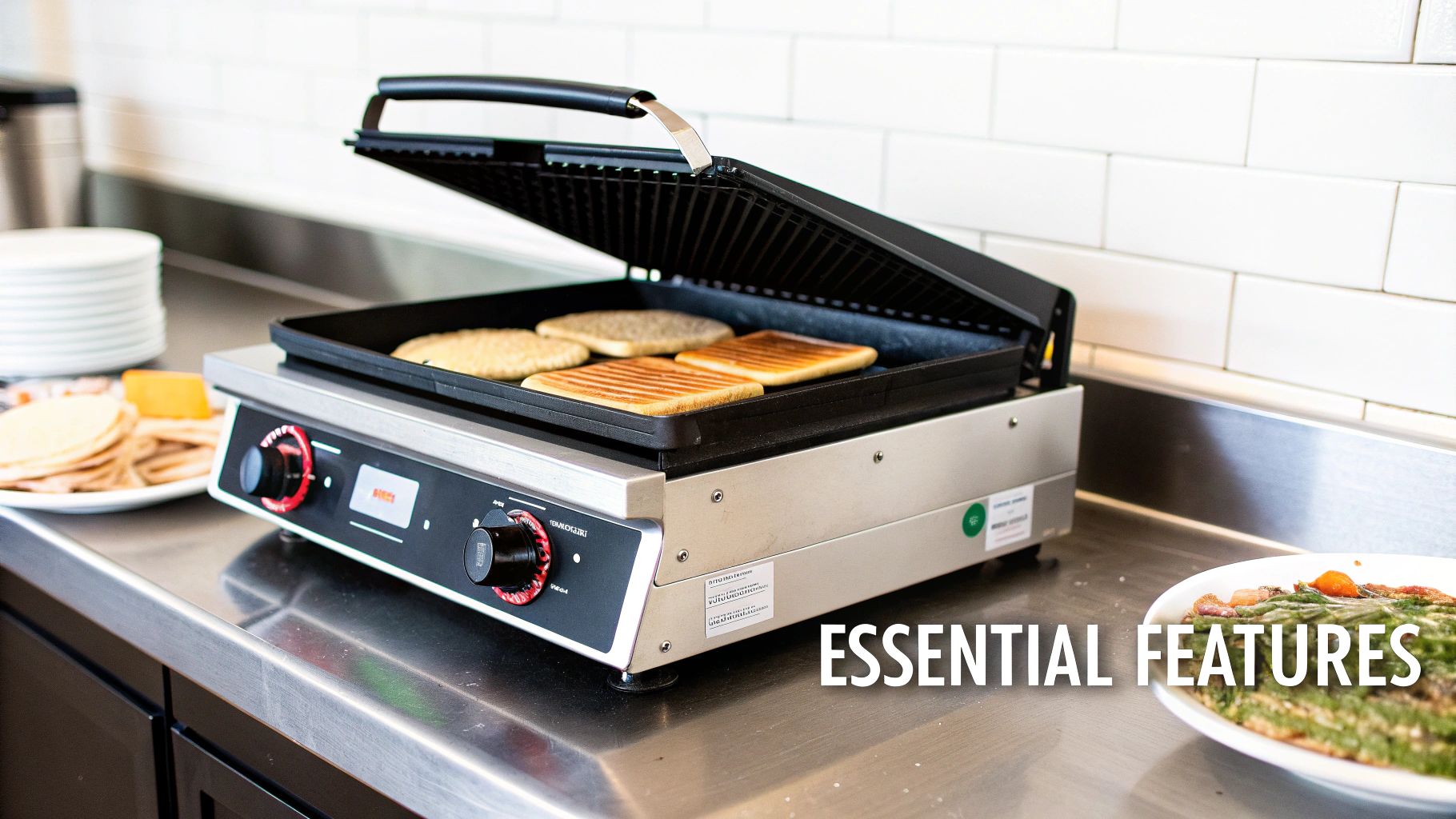
Controls and Heat Distribution
First up are thermostatic controls. Think of this as cruise control for your griddle. A built-in thermostat keeps an eye on the surface temperature, automatically turning the heating elements on and off to hold a specific, pre-set temp. This is a must-have for kitchens that need dead-on consistency for things like pancakes, eggs, and burgers, where even a slight temperature swing can throw off the final product.
The other option is manual controls. These are more like a simple dial with low, medium, and high settings. They aren't as precise, but they give experienced chefs the freedom to create different heat zones across the griddle. You can get a hard sear on one side while keeping cooked food warm on the other, which is a level of flexibility some high-volume kitchens can't live without. For a deeper look at the pros and cons, check out our article on thermostatic vs. manual griddle controls.
No matter which control type you choose, what really separates a top-tier griddle is superior heat distribution. The best models are engineered with powerful, well-placed heating elements that kill the dreaded hot and cold spots that destroy consistency and slow down your line.
Durability and Kitchen Integration
Let's be honest: a commercial griddle has to be tough enough to take a beating. That toughness starts with its build quality, which should be heavy-duty stainless steel. This stuff doesn't rust, it handles constant heating and cooling without warping, and it's a breeze to sanitize. It's the industry standard for a reason.
Another feature that’s critical for safety and cleanup is the grease management system. This isn't just one thing, but a combination of a few smart design choices:
- Splash Guards: Tall, welded guards on the back and sides keep grease from splattering everywhere, making the area safer and cleaner for your staff.
- Drip Trays: Look for a large, easily removable grease tray. It makes end-of-service cleanup much faster and less of a chore.
Finally, think about how the griddle will actually fit into your kitchen. Countertop models are the most versatile; you can place them on any sturdy work surface or equipment stand. In contrast, drop-in models are installed right into a custom-cut counter for a clean, built-in look that can be a real space-saver in a tight kitchen. The right choice really just depends on your workflow and existing layout.
How to Size Your Griddle for Peak Performance
Think of your griddle surface as prime real estate in your kitchen. Choosing the right size is a huge decision, a balancing act between how much you need to cook and how much space you actually have. Go too small, and you’ll create a bottleneck during the dinner rush. Go too big, and you're just wasting energy and precious counter space. The sweet spot is finding the perfect fit for how your kitchen operates.
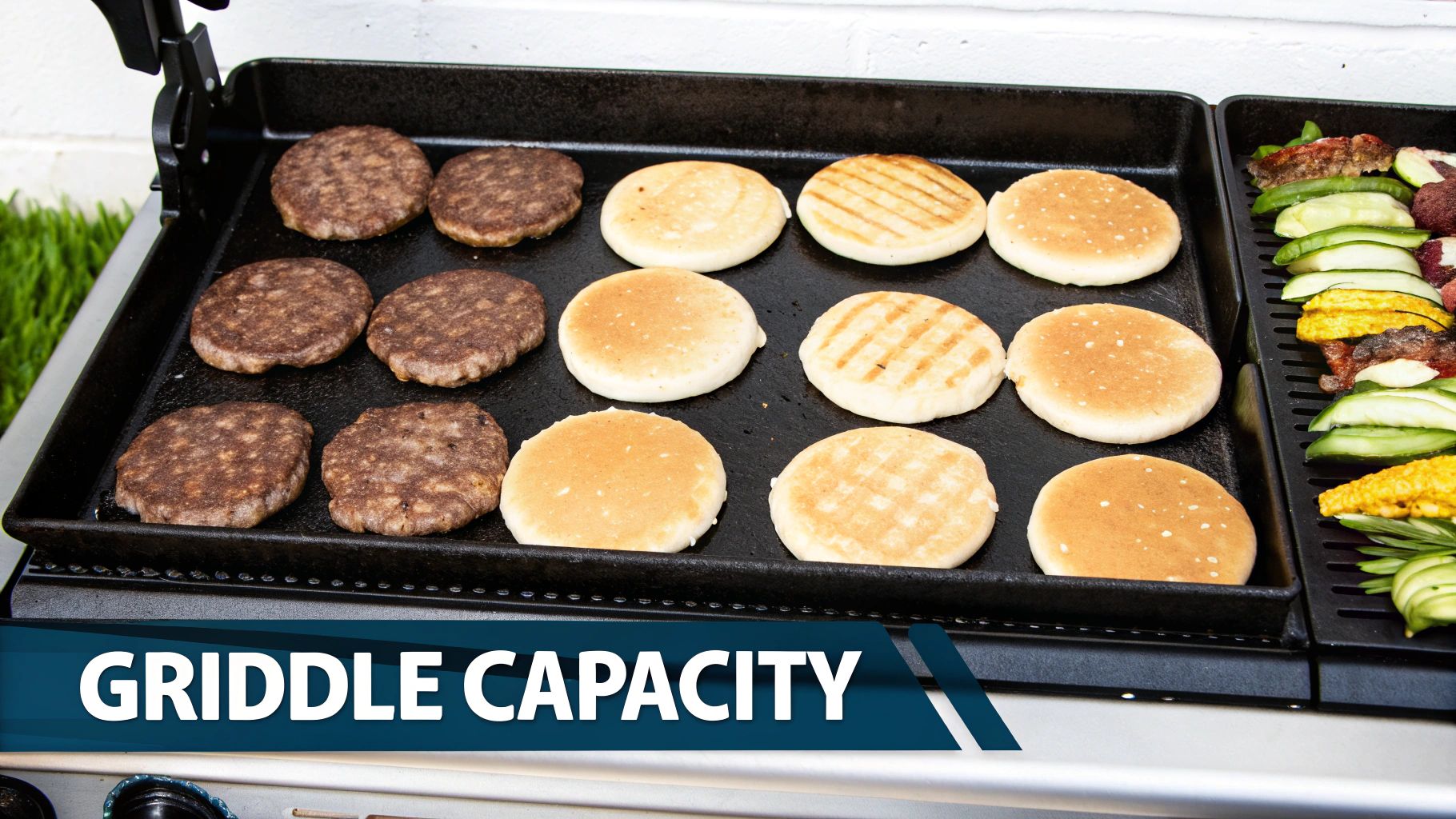
Before you even glance at a product page, look at your menu. What are the high-volume items that live on the griddle? Are you a breakfast joint flipping mountains of pancakes, or a burger spot searing patties from open to close? The single most important step is figuring out how much of that core item you need to cook during your busiest hour.
For a little real-world perspective, a standard 12-inch wide section of griddle can handle about 16-20 burgers per hour. So, if your lunch rush means you're slinging 60 burgers an hour, a 36-inch model should be your starting point—not a 24-inch unit that will have your cooks constantly playing catch-up.
Matching Griddle Size to Your Operation
Every kitchen moves at its own pace. A high-volume diner has totally different needs than a quiet neighborhood cafe, and your griddle size needs to reflect that reality. Getting this right from the start saves you from costly upgrades or frustrating inefficiencies down the line.
Here’s a quick guide to matching common griddle sizes with different kitchens:
-
24-Inch Griddles: Perfect for smaller operations or kitchens with limited space. Think cafes, food trucks with a tight menu, or even as a second, specialized griddle in a bigger kitchen for handling things like eggs or gluten-free orders.
-
36-Inch Griddles: This is the do-it-all workhorse for most full-service restaurants and busy diners. It gives you enough room to juggle multiple menu items at once without everything getting crowded, making it a fantastic choice for a diverse menu.
-
48-Inch Griddles (and larger): These are the beasts, built for the high-volume powerhouses. Institutional kitchens, large catering companies, and bustling all-day-breakfast spots depend on this kind of size to keep up with constant demand and keep ticket times low.
Choosing the right size isn’t just about how much food you can cook; it’s about workflow. A properly sized griddle gives your line cooks room to breathe, organize orders, and maintain quality without being jammed together. That directly translates to faster service and more consistent food.
Calculating Your True Griddle Needs
If you want to get really specific, do the math. Figure out the total square inches you need during that peak hour. Calculate the footprint of your main menu items (a 4-inch burger patty takes up about 12.5 sq. in.) and multiply that by how many you sell in your busiest hour.
From there, add a 20-25% buffer for flipping and maneuvering. This data-first approach ensures you buy a top rated electric griddle that’s a true production partner, not just a shot in the dark.
Leading Brands in Commercial Electric Griddles
When you’re shelling out for a commercial electric griddle, you want to put your money on a sure thing. That means sticking with established brands that have proven themselves in the trenches. In the rough-and-tumble world of a professional kitchen, a few names always rise to the top for their sheer reliability, toughness, and smart design. These are the brands that chefs and kitchen managers stake their reputations on, day in and day out.
Picking a top rated electric griddle usually points you toward industry heavyweights like Vulcan, Star, and Wells. These guys didn't just stumble into their reputations; they built them by engineering equipment that can take a beating and keep on cooking. They get the little things that matter in a commercial kitchen, like how fast a griddle needs to bounce back to temperature during a rush or how simple it needs to be to clean after a 12-hour shift.
What Sets the Top Brands Apart
It's not just about slapping a logo on a piece of steel; it's about what that logo promises. Each of the big players has its own specialty, a feature they've absolutely perfected that caters to specific kitchen needs. This lets you pick a griddle based on what truly matters for your menu and workflow.
For instance, one brand might be famous for its incredibly thick, heavy-duty griddle plates that hold heat like a furnace—perfect for a steakhouse that needs that aggressive, instant sear. Another might be the go-to for its laser-precise thermostatic controls, making it a favorite for diners who need to hold an exact temperature for delicate foods like eggs and pancakes without any guesswork.
The real value of a top-tier brand is the confidence that comes with it. You're not just buying a piece of equipment; you're investing in decades of engineering, field testing, and feedback from professional chefs.
Understanding these specializations is key to making the right call. The demand for this kind of reliable gear is only growing. The global electric griddles market was already valued at about USD 0.14 billion in 2024 and is expected to climb to around USD 0.23 billion by 2033. You can see how the industry is expanding in recent market reports.
Spotlighting Industry Leaders
To help you cut through the noise, let’s take a quick look at what makes some of the leading commercial brands a solid choice for any professional kitchen.
-
Vulcan: A true powerhouse in the commercial kitchen world. Vulcan is known for its rugged, almost indestructible construction and powerful heating elements. Their griddles are built like absolute tanks and deliver consistent, even heat across the entire surface, making them a fantastic all-around workhorse.
-
Star: Star Manufacturing is a master of high-performance countertop equipment. Their electric griddles are famous for lightning-fast preheating and recovery times, which is a massive advantage for high-volume spots where every second counts. You’ll see them cranking out food in busy diners and fast-food joints everywhere.
-
Wells: Wells is all about precision and durability. They’re especially respected for their heavy-duty designs and smart, effective grease management systems that make cleanup less of a chore. A Wells griddle is a long-term investment in quality that’s built to survive the most demanding kitchens.
Ultimately, the right choice will come down to your menu, your daily volume, and your budget.
Your Commercial Griddle Questions, Answered
Even the most seasoned chefs run into questions on the line. When you've invested in a new piece of equipment, you want to get the most out of it. This section is your cheat sheet for the most common questions we get from kitchen managers and chefs about running a commercial electric griddle.
How Do I Properly Season a New Commercial Steel Griddle?
Seasoning is what turns a good griddle into a great one. It’s the secret to that slick, naturally non-stick surface that chefs swear by.
First things first, scrub your new griddle with a bit of mild soap and water to get rid of any oils or residues from the factory. Dry it completely. Now, fire it up and let the surface heat to a steady 300-350°F.
Grab a high-smoke-point oil (canola or grapeseed are perfect) and a clean, lint-free cloth. Apply an incredibly thin layer across the entire cooktop. You’ll see the oil start to smoke—that’s exactly what you want. Let it smoke for a bit, then kill the heat and let it cool down. Wipe off any gummy excess oil. Do this whole song and dance 3-5 times, and you’ll build up a beautiful dark, polymerized layer. That’s the patina, and it’s your key to flawless food release and a protected griddle plate.
What Is the Difference Between a Griddle and a Plancha?
They might look like twins, but the way they cook is fundamentally different. It all comes down to the heat source. A classic plancha has one super-hot, circular heat source right in the middle. This creates a cooking surface with a blistering hot center that gradually gets cooler toward the edges. It’s a design that lets chefs play with temperature by simply moving food around the plate.
A top rated electric griddle, on the other hand, is built for consistency. It uses powerful, thermostatically controlled heating elements spread across the cooktop to maintain one solid, even temperature from corner to corner. When you need to crank out dozens of perfectly uniform pancakes, eggs, or burgers, the griddle is the undisputed king.
How Often Should I Clean My Commercial Griddle?
Every single day. No exceptions. A clean griddle is a high-performing griddle.
Throughout the day, a quick scrape-down between orders is all you need to keep things running smoothly.
The real deep clean happens at the end of service. While the surface is still warm (but not ripping hot), use your scraper to push all the gunk into the grease trap. Then, grab a griddle brick or pad, add a little oil, and give the surface a good scrub. Wipe it down with a clean, damp cloth, and finish with one last, thin coat of oil. This final step is crucial for preventing rust overnight. Whatever you do, keep soap and harsh degreasers away from a seasoned griddle—they'll strip away that perfect patina you worked so hard to create.
This commitment to top-tier equipment is a huge part of why the North American foodservice industry leads the way. In fact, our region accounts for the biggest slice of the pie—around 40–47% of the electric cooking appliance market. You can dive deeper into the numbers in this electric grill market report.
Ready to find the perfect workhorse for your kitchen? Explore the full range of durable, high-performance commercial electric griddles at Griddles.com and get equipped for success. Visit us today at https://griddles.com.