

Best Electric Griddle For Commercial Kitchens
The Atosa 36-Inch Electric Griddle brings a rock-solid stainless-steel frame and spot-on temperature control, so your grill line never skips a beat.
The Omcan 18-Inch Countertop Griddle slips neatly into tight spots and fires up almost instantly—perfect for cafes or food trucks where every inch counts.
When orders flood in, the CookRite 48-Inch Thermostatic Griddle delivers a sweeping surface and fast heat recovery, keeping pancakes, patties, and more moving down the line.
Quick Overview Of Best Commercial Electric Griddles
Top Commercial Electric Griddle Picks Summary
If you’re pressed for time, here’s a snapshot of our Top 5 Commercial Electric Griddles, ranked by reliability, heat recovery, and overall value.
| Model | Cooking Surface | Price Range | Best For |
|---|---|---|---|
| Atosa 36-Inch Electric Griddle | 36" x 20" | $1,200–$1,400 | High-volume diners |
| Omcan 18-Inch Countertop Griddle | 18" x 15" | $350–$450 | Small cafes and food trucks |
| CookRite 48-Inch Thermostatic Griddle | 48" x 24" | $1,500–$1,700 | Large catering kitchens |
| Atosa 24-Inch Electric Griddle | 24" x 18" | $800–$900 | Mid-size diners and QSRs |
| Omcan 36-Inch Electric Griddle | 36" x 18" | $1,100–$1,300 | Ghost kitchens and commissaries |
These five picks give you the key specs—surface area, budget, and ideal kitchen setting—so you can zero in on the best match before digging deeper.
Like choosing real estate for your kitchen, the right griddle depends on footprint, power, and recovery time to keep service flowing.
Key Highlights
- Rapid Heat Recovery lets you tackle back-to-back orders without waiting
- Even Temperature Zones ensure burgers and eggs cook uniformly
- Heavy-Duty Stainless Steel holds up under constant use
- Precise Thermostatic Controls for consistent, repeatable results
To explore detailed specs and pricing, head over to our equipment collection for the complete lineup.
Use Cases And Trade-offs
Every kitchen has its quirks. Match these models to your space, output, and menu style:
- Atosa 36-Inch: Built for 100+ orders per hour in bustling diners
- Omcan 18-Inch: Perfect when counter space is at a premium
- CookRite 48-Inch: Tailored for large-scale banquets and catering
- Atosa 24-Inch: Strikes a balance between capacity and footprint
- Omcan 36-Inch: Offers flexible zones for ghost kitchen setups
These pointers narrow down your shortlist before you dive into specs.
All models come with energy-efficient designs to help manage utility costs.
Next, we’ll break down technical specs like plate materials and thermostat accuracy.
Table Usage Tip
This quick overview primes you for a closer look at performance metrics and cleaning routines. Keep this table handy as you compare features and finalize your choice.
Understanding Commercial Electric Griddle Concepts
Electric griddles depend on precise heat management to cook evenly across a broad surface. Imagine spreading butter on toast—any uneven swipe leaves cold spots or overly browned patches.
The plate’s material, its thickness, and the hidden heating elements team up to hold temperature steady and bounce back quickly after you add cold ingredients.
Surface Material Comparisons
Professional kitchens usually choose from three plate options:
- Stainless Steel – Tough and easy to clean, but needs a light coating of oil or seasoning to keep food from sticking.
- Cast Iron – Holds heat like a champ, perfect for high-volume grilling, though it’s heavy and takes longer to warm up.
- Nonstick Coatings – Make cleanup a breeze, yet they can wear out faster if you’re cooking nonstop.
Picking the right surface is a lot like selecting the ideal pan for each dish—you want harmony between your recipe and the plate beneath it.
Basic Heat Distribution Techniques
- Even Heat Layer mimics that smooth butter spread, so pancakes and burgers cook uniformly without flipping halfway.
- Zoned Heating carves the griddle into temperature “neighborhoods,” letting you sizzle bacon on one side while gently warming eggs on the other.
- Heat Recovery measures how fast the plate returns to your set temperature after you load it with cold food—critical during back-to-back brunch orders.
On a busy Sunday morning, uneven heat zones can turn pancake prep into a juggling act. One chef joked that waiting an extra 20 seconds for a plate to rebound felt like slow-motion pancake flipping.
Consistent heat zones are as crucial to a brunch rush as perfectly aligned grill marks.
The standalone electric griddle market is valued at USD 0.14 billion in 2024 and is projected to reach 0.23 billion by 2033 (CAGR ~5.3%), while related electric grill appliances top $2.79 billion today. Learn more about electric griddles market findings
Power And Safety Essentials
Commercial griddles often draw 3,000 W–12,000 W to heat large plates quickly. Reputable models carry NSF and UL certifications to guarantee safe wiring, grounded plugs, and reliable shutdowns if things overheat.
- Ground Fault Circuit Interrupters step in the moment an electrical surge threatens your kitchen.
- Overheat Cutoff switches flip off power if temperatures spike beyond safe limits.
- Splash Guards keep hot oil contained, cutting burn risks for busy cooks.
Commercial-Grade Construction and Durability
Commercial kitchens demand equipment built to withstand heavy use, rigorous cleaning, and long operating hours. Here’s what to look for:
- Plate Thickness: ¾"–1" steel or iron plates reduce warping and deliver consistent heat retention.
- Welded Stainless Steel Frame: Sealed chassis prevents grease infiltration and supports easy sanitation.
- Heavy-Duty Thermostats: Industrial-grade controls maintain ±5°F precision under continuous cycles.
- Grease Management System: Integrated channels and high-capacity drip trays streamline cleaning and reduce fire hazards.
- Control Integration: Digital interfaces, HACCP data logging, and network compatibility help meet safety inspections and food safety standards.
Built-in safety shields and sealed wiring keep electronics protected from steam and splatter, ensuring durability and uninterrupted service in any busy kitchen.
Understanding these commercial-grade design principles sets the stage for our deep dive into Key Features And Specifications To Evaluate.
Key Features And Specifications To Evaluate
Restaurants and cafes demand gear that holds up under fire—literally. When you’re juggling orders during the lunch rush, consistency becomes non-negotiable.
Picking the right commercial electric griddle means lining up specs with your kitchen’s pace, menu variety, and floor plan. Below, we peel back each critical feature, from plate makeup to safety add-ons.
Cooking Plate Material Comparison
Your griddle’s plate is its backbone. Think of it like picking the ground you build on—each choice has pros and cons.
- Stainless Steel: Resists corrosion and wipes clean in seconds, though it warms up a bit slower.
- Cast Iron: Holds heat like a champ, delivering gorgeous sears, but remember—you’ll need to season and it’s heavy.
- Nonstick Coatings: Perfect for low-maintenance cleanup and easy flipping, yet the surface can degrade if you’re running it hard every day.
Lighter plates fire up quickly, while thicker ones lock in heat longer. Match your material to your menu and cleaning routines.
Understanding Variable Heating Zones
Imagine your griddle as a soccer field. Each heating zone is a position—defenders hold, midfielders cook steady, strikers sear with intensity.
- Low-Heat Zones (150°F–200°F) keep cooked dishes ready without overbrowning.
- Medium-Heat Zones (300°F–350°F) are ideal for pancakes, eggs, and grilled sandwiches.
- High-Heat Zones (400°F–450°F) crank up for steaks, burgers, and quick veggie char.
"Consistent zones on a 36-inch griddle can reduce cooking time by over 20% during peak service."
| Zone Type | Temperature Range | Typical Use |
|---|---|---|
| Low Warm | 150°F–200°F | Holding cooked food |
| Medium Cook | 300°F–350°F | Pancakes and eggs |
| High Sear | 400°F–450°F | Burgers and steaks |
Most commercial units let you tweak each segment independently—just like assigning stations on a busy line.
Evaluating Temperature Controls And Power
Precise temps are the difference between sous-chef-level consistency and kitchen chaos. Digital thermostats deliver ±5°F accuracy, while mechanical knobs handle rough use but can swing wider.
- Check your kitchen’s circuit to match the griddle’s power rating.
- Decide between 120V and 240V models based on available load.
- Validate amperage and phase details with your electrician.
High-wattage machines recover up to 30% faster, cutting downtime between batches. Learn more about voltage requirements in our article on 120V vs 240V models.
Eco-friendly modes on some units dial back wattage during slow periods—nice for trimming energy bills without sacrificing readiness.
Safety Features And Maintenance
Sharp focus on safeguards pays off when the kitchen heats up. Good griddles offer:
- Splash Guards to fend off hot grease.
- Ground-Fault Protection and overheat cutoffs for accident prevention.
- Removable Drip Trays that slide out for swift grease disposal.
- Easy-Clean Surfaces to speed through health inspections.
- Field-Convertible Kits so you can switch to gas down the road, if needed.
Regular upkeep—seasoning steel or iron and wiping heating elements—extends your unit’s life and keeps performance razor-sharp.
Investing in the right safety features reduces liability and ensures uninterrupted service.
Case Study On Small Cafe
A neighborhood spot swapped in a 24-inch stainless griddle with split heating zones. By using one side at 300°F for pancakes and the other at 150°F for holding bacon, they cut cleaning time and kept plates moving.
- 100+ plates per hour served on a single 24-inch unit.
- 15% energy savings thanks to eco-mode during off-peak hours.
- 25% faster daily cleanup with a removable drip tray.
This real-life example shows how specs translate into smoother service and lower costs.
——
Now that you’ve seen the anatomy of a high-performing electric griddle, use this guide as your spec checklist. Compare plate materials, zone control, power requirements, and safety features against your menu demands—and cook with confidence.
Comparing Top Commercial Electric Griddles
When you line up the market’s most popular commercial electric griddles, certain specs jump off the page. From cooking surface to power draw, every detail matters once service starts ramping up.
Below, you’ll find a streamlined snapshot of five heavy-duty units that balance heat recovery, durability, and ease of cleaning. Use this as your launch pad for a deeper dive.
Feature Comparison Of Top Commercial Electric Griddles
Here’s a side-by-side glance at dimensions, wattage, price tags, and warranty coverage.
| Model | Cooking Surface | Wattage | Price | Warranty |
|---|---|---|---|---|
| Atosa 36-Inch Electric Griddle | 36" x 20" | 9600W | $1 200–$1 400 | 1 Year |
| Omcan 18-Inch Countertop Griddle | 18" x 15" | 1800W | $350–$450 | 90 Days |
| CookRite 48-Inch Thermostatic Griddle | 48" x 24" | 12000W | $1 500–$1 700 | 1 Year |
| Atosa 24-Inch Electric Griddle | 24" x 18" | 7200W | $800–$900 | 1 Year |
| Omcan 36-Inch Electric Griddle | 36" x 18" | 9600W | $1 100–$1 300 | 90 Days |
This quick reference should help you spot the model that best aligns with your workflow and budget.
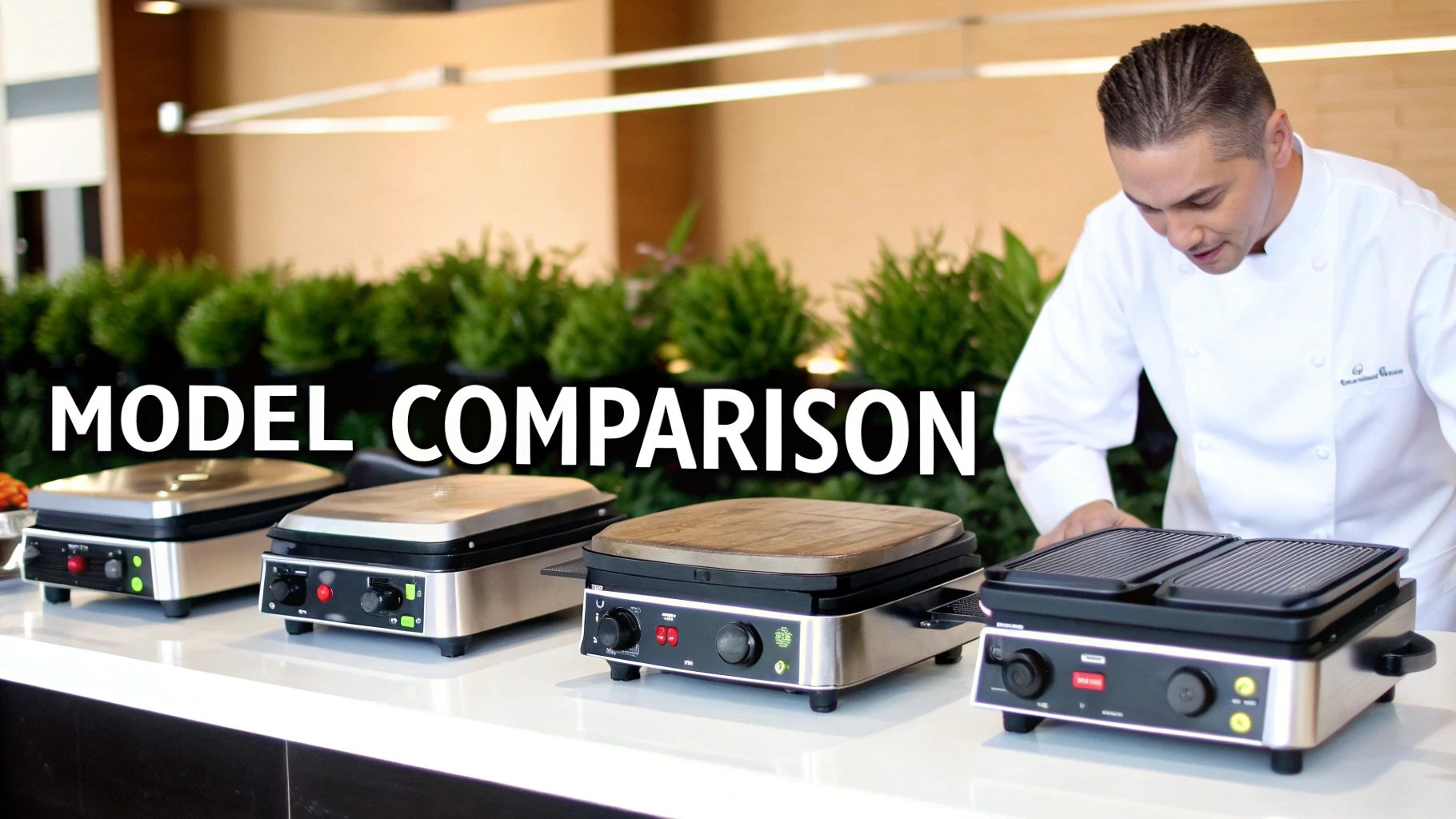
Strengths And Drawbacks
-
Atosa 36-Inch Electric Griddle offers 36" x 20" of cooking real estate and 9600W of power—perfect for breakfast rushes. Yet it tips the scales at over 100 lbs, so you’re not sliding it around often.
-
Omcan 18-Inch Countertop Griddle packs 1800W into an 18" x 15" footprint—ideal for food trucks or pop-up stands. Its slim form, however, limits the number of burgers or pancakes you can flip at once.
-
CookRite 48-Inch Thermostatic Griddle brings 12000W and split-zone control from 150°F–425°F, making it a champ for varied menus. But don’t forget: that 48" x 24" surface eats up counter real estate.
-
Atosa 24-Inch Electric Griddle blends 7200W with 175°F–450°F precision on a manageable 24" x 18" deck—great for cafes. Keep in mind, you’ll sacrifice the extra zone flexibility of a larger unit.
-
Omcan 36-Inch Electric Griddle delivers 9600W through a rugged frame and a detachable grease tray. Its 90-Day warranty might leave you wishing for a little extra coverage.
“Match your griddle choice to volume, menu, and space to guarantee smooth service.”
Real World Recommendations
Every kitchen has a sweet spot. Let these profiles point you in the right direction:
- High-Volume Diners Use Atosa 36-Inch Electric Griddle to serve 100+ plates per hour.
- Mobile Food Trucks Choose Omcan 18-Inch Countertop Griddle for its light footprint and integrated grease tray.
- Catering Services Deploy CookRite 48-Inch Thermostatic Griddle to juggle diverse dishes without faltering on heat recovery.
Next Steps For Buyers
Ready to commit? Tick these items off your list before hitting “buy.”
- Audit your kitchen’s electrical capacity and match it against the griddle’s wattage to prevent tripped breakers.
- Measure your usable counter length and ensure the griddle sits comfortably without cramping prep space.
- Check warranty terms and local service options to reduce downtime if repairs pop up.
- Factor in cleaning cycles by choosing models with quick-release drip trays or removable grease pans.
- Visit Griddles.com for pricing details, free freight offers, and expert guidance.
These actionable steps wrap up your griddle selection process. Always factor in long-term energy usage and plate seasoning requirements to keep performance consistent over time.
Common Commercial Usage Scenarios
When the breakfast rush hits, you need a griddle that bounces back to temperature as quickly as your customers line up. Rapid heat recovery slashes downtime between batches, so your short-staffed team can keep plates moving without breaking a sweat.
This kind of performance turns a single cook into a one-person factory on busy mornings.
Diner Breakfast Rush
- 36-Inch Plates flip dozens of pancakes and fry up eggs in minutes.
- Split-Zone Controls let you sizzle bacon at 350°F while gently cooking omelets at 300°F.
- Stainless Steel Construction resists warping, even under the most relentless service.
“In a busy diner, cutting plate recovery time by 50% increased order throughput during peak hours.”
Every square inch matters when you’re cooking on four wheels. Food trucks juggle tight spaces and power limits, so they lean on compact griddles that fit snugly into trailers and run off generators or RV outlets.
Mobile Food Trucks
- Under-24-Inch Models slide right onto shelves—no custom brackets needed.
- Removable Grease Trays speed up cleaning between city stops.
- Integrated Splash Guards keep grease from turning your cramped kitchen into a slip zone.
In a corporate cafeteria, the menu flips daily to please a mix of tastes. Modular griddles let managers swap plates, expand cooking zones, and dial in exact temperatures. The result? Hundreds of identical servings, every single time.
Corporate Cafeteria Adaptation
| Feature | Advantage |
|---|---|
| Modular Construction | Customize cooking area on the fly |
| Zone Flexibility | Prepare breakfast, lunch, and snacks simultaneously |
| Digital Controls | Maintain temperature within ±5°F accuracy |
Peeling back the global kitchen curtain, North America and Europe command 47.3% of the commercial electric-griddle market today. That clout means heavy-duty, high-capacity models are readily available in those regions. Meanwhile, Asia-Pacific is posting mid-single-digit CAGRs and driving demand for compact, energy-efficient units.
Market Insight North America held 47.3% of the electric-griddle market in 2024, with Europe close behind and Asia-Pacific posting the fastest growth. Read the full regional electric-griddle market report from Archive Market Research.
Regional Market Focus
- North America & Europe prefer larger, high-volume units.
- Asia-Pacific growth fuels demand for sleek, low-wattage models.
- Manufacturers tweak voltage and plug types to match each market’s power standards.
Out-of-town banquets and festivals call for gear that packs flat, sets up fast, and performs consistently. Caterers often choose lightweight electric griddles with fold-down legs and locking plugs—so they can be up and cooking within minutes of arrival.
Large-Scale Catering Events
- 48-Inch Griddles feed hundreds under tight timelines.
- Split Cooking Zones let teams run pancake stations alongside burger grills.
- Quick-Release Legs & Locking Plugs slash setup and teardown time.
Even in emerging markets, pop-up kitchens depend on small electric griddles with lightning-fast heat recovery. Matching plate size, modular zones, and portability to your specific scenario cuts energy bills, reduces bottlenecks, and keeps your service running like clockwork.
How To Choose The Right Commercial Electric Griddle
Buying an electric griddle for your kitchen goes beyond finding the right footprint. It starts with a simple decision framework to balance output, workspace, and budget. Think of your griddle as the engine in a busy assembly line—its capacity sets the pace for everything that follows.
Evaluating Kitchen Volume
Begin by mapping out your typical and peak orders per hour, then factor in future menu growth. This exercise gives you a solid target for how much cooking surface you actually need.
- Use orders per hour as your benchmark.
- Align the griddle’s surface area with that volume.
- Build in extra capacity for surprise rushes.
Once you’ve nailed down volume, shift your attention to menu variety. A fixed lineup of items needs fewer heat zones, while a big, rotating menu benefits from multiple temperature areas—much like dedicating lanes on a busy highway.
Balancing Surface Real Estate
Visualize the griddle plate as prime real estate for burgers, eggs, pancakes, and more. A wider plate provides more “land” to work on, while a smaller model might force you into traffic jams during your peak.
“Choosing the right surface area is like planning a city block: space allocation impacts traffic flow.”
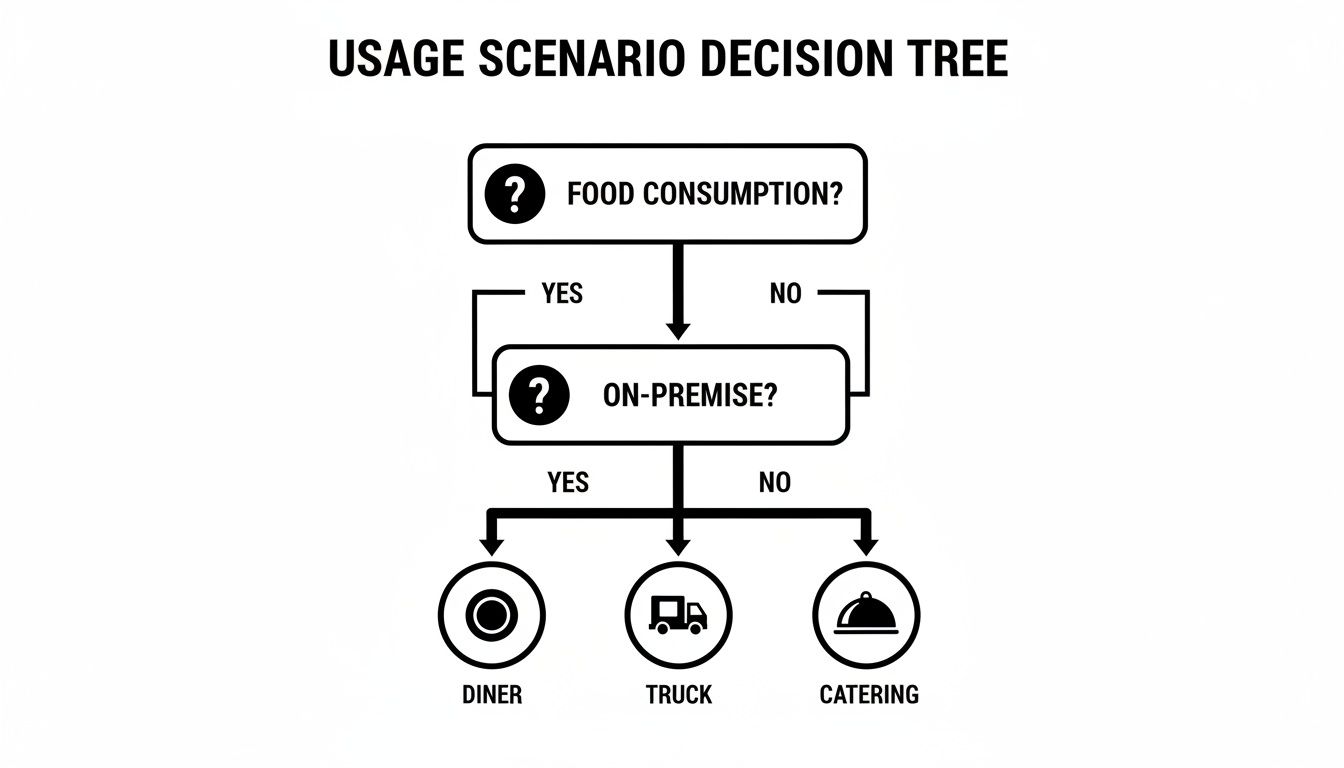
This graphic maps common scenarios—diners, food trucks, catering—to recommended griddle sizes and zone layouts. It’s a quick decision tree for matching your operation to the ideal unit.
Key takeaway: high-volume diners often opt for a 48-inch plate, food trucks run best with 18–24-inch, and caterers love the flexibility of a 36-inch split-zone model.
Checking Workspace And Power
Before you buy, measure your counter’s width and depth. Then swing by the breaker panel to confirm you’ve got the right circuits and amperage. A heavy-duty griddle can draw 12,000 W, meaning a 240 V, 50 A feed.
- Verify your circuit capacity up front.
- Confirm plug type and phase match.
- Plan for ventilation and splash guards.
Planning Installation And Maintenance
A griddle that’s a hassle to clean or install will cost you time—and frustration. Look for designs with easy-remove parts and smooth surfaces that wipe down quickly.
- Check for removable drip trays and easy-clean surfaces.
- Ensure NSF and UL certifications are in place.
- Review warranty details and local service options.
A concise checklist saves hours of frustration during setup.
Commercial Electric Griddle Checklist
- Defined order volume and menu mix
- Surface area matching throughput needs
- Workspace measurements and power specs
- Installation clearance and ventilation plan
- Maintenance schedule and cleaning access
- Warranty coverage and service options
This step-by-step method helps you weigh purchase cost against long-term performance and upkeep. Tick each item off to lock in a griddle that’ll serve you well for years.
Energy Efficiency And Ongoing Costs
Power draw can eat up to 25% of a restaurant’s utility bill. Choosing models with eco modes and adjustable wattage pays for itself over time.
- Switch to standby or eco modes during slow spells.
- Track actual watt-hour usage with kitchen meters.
- Opt for insulated frames to hold in heat.
Think of these energy features like cruise control on the highway: once you hit your target, you maintain speed without pressing the pedal harder, saving fuel without losing momentum.
Next Steps For Buyers
- Cross-check your decision framework checklist.
- Compare shortlisted units on Griddles.com.
- Consult your electrician about power requirements.
- Schedule installation and staff training.
- Set up monthly maintenance to keep performance steady.
Work through these tasks, and you’ll zero in on the best electric griddle for your kitchen and budget. It becomes a dependable partner, from busy brunch services to late-night shifts.
Visit Griddles.com for detailed specs, free freight offers, and expert support to finalize your selection today.
Frequently Asked Questions
Getting clear answers to common concerns can make buying and maintaining a commercial electric griddle much smoother.
What Plate Material Suits Menus?
Choosing the right cooking surface is all about matching it to your menu.
- Stainless Steel: Durable, resists corrosion, and heats evenly.
- Cast Iron: Holds heat like a champ—perfect for searing.
- Nonstick Coatings: Speeds up cleanup when you’re running a busy line.
How Do I Estimate Energy Costs?
You don’t need a complicated formula—just multiply the griddle’s wattage by your local rate.
A 9600 W unit running five hours a day at $0.12/kWh will add about $5.76 to your daily energy bill.
How Often Should I Deep Clean?
Even the toughest griddles benefit from a little TLC.
- Weekly: A deep scrub clears away carbon buildup and keeps heat transfer optimal.
- Daily: Quick wipe-downs and emptying the drain tray prevent grease from hardening.
What Should I Look For In A Warranty?
Don’t get caught off guard—scan the fine print for:
- Coverage on heating elements
- Plate warping and power cord protection
- Guaranteed service response times
Expert Tip: Consistent seasoning and timely filter changes can extend griddle life by up to 20%.
How Can I Avoid Installation Issues?
Before plugging in, double-check that your kitchen’s voltage and amperage match the griddle’s requirements. Leave a few inches of clearance around the unit for proper ventilation and to prevent overheating.
Cleaning Guide
Learn best cleaning practices in our guide on cleaning commercial flat-top griddles.
Ready to fully equip your kitchen? Visit Griddles.com.