

What is a thermostatic control valve: the key to perfect griddle temperatures
Ever wonder how your commercial griddle nails the perfect temperature, especially during a hectic dinner rush? You can thank its unsung hero: the thermostatic control valve.
Think of it as the cruise control for your griddle. It’s the brain behind the heat, automatically pumping the brakes or hitting the gas to hold a precise temperature without you having to mess with the dials every few minutes.
Your Griddle's Secret to Perfect Heat Control
In a high-volume kitchen, consistency is king. Whether you're getting the perfect sear on a steak or a golden-brown finish on a stack of pancakes, you simply can't afford temperature swings. That’s exactly where the thermostatic control valve steps in. This small but mighty component ensures your griddle surface stays exactly where you set it, from the first order of the day to the last.
Imagine trying to keep your commercial griddle at a steady 350°F by constantly adjusting the flame. It'd be inefficient and a total headache. A manual griddle is a lot like that, forcing the chef to constantly babysit the flame. A thermostatic control valve takes all that guesswork out of the equation. It senses the griddle's temperature and automatically adjusts the gas flow to keep the heat rock-steady.
To really see how this impacts your kitchen, let's break down the core functions of this valve.
Thermostatic Control Valve At a Glance
The table below gives a quick snapshot of what this valve does and why it's a game-changer for any commercial griddle.
| Key Function | Benefit for Your Kitchen |
|---|---|
| Automatic Temperature Regulation | Eliminates manual adjustments, freeing up chefs to focus on cooking and plating. |
| Precise Heat Maintenance | Guarantees consistent food quality by preventing hot and cold spots across the cooking surface. |
| Efficient Fuel Modulation | Reduces energy consumption and lowers utility bills by using only the necessary amount of gas. |
| Enhanced Safety and Reliability | Prevents overheating and ensures the griddle operates predictably during long shifts. |
Essentially, this valve transforms your griddle from a simple hot surface into a precision cooking tool.
This automatic control brings some major wins to any professional kitchen:
- Unwavering Food Quality: It gets rid of those pesky hot and cold spots, making sure every inch of your cooking surface delivers the same great results.
- Improved Kitchen Efficiency: Your line cooks can focus on the food, not the equipment. This helps speed up ticket times when you're in the weeds.
- Reduced Operating Costs: By using only the fuel it needs—no more, no less—these valves can seriously cut down on your gas bill.
A thermostatic control valve isn't just a part; it's a promise. It promises that the temperature you set is the temperature you get, which is the bedrock of repeatable, high-quality cooking in any demanding kitchen.
To truly get a feel for how it works, it helps to see it as one of the most critical industrial equipment parts you'll deal with. At the end of the day, its job is to deliver pure reliability, giving you the control to execute your menu flawlessly and profitably.
How Your Griddle Automatically Maintains Temperature
Ever wonder how your commercial griddle just knows how to hold the perfect temperature? The secret isn't magic; it's a clever piece of mechanical engineering called a thermostatic control valve. Think of it like the cruise control for your griddle—a self-regulating system that keeps the heat steady, turning a simple flat-top into a precision cooking machine.
This whole process hinges on a basic law of physics: things expand when they get hot and shrink when they cool down. The valve simply harnesses this natural reaction using a few key parts that work together seamlessly to manage the gas flow to the burners. It’s what ensures the temperature you set on the dial is the temperature you get on the plate.
The Core Components at Work
It all comes down to three main parts doing their jobs. Once you see how they interact, the genius behind the design becomes clear.
- The Sensing Bulb: This is the temperature snitch. It’s a small metal bulb placed right against the griddle plate, constantly measuring the surface heat.
- The Capillary Tube: A thin, flexible tube acts as the messenger, connecting the sensing bulb to the main valve. It's filled with a special thermal fluid that expands or contracts based on the heat detected by the bulb.
- The Main Valve Body: This is mission control. It physically opens or closes the gas line to the burners based on the pressure signals it gets from the fluid in the capillary tube.
This simple diagram shows how these three pieces create a constant feedback loop to keep your griddle’s temperature right where you want it.
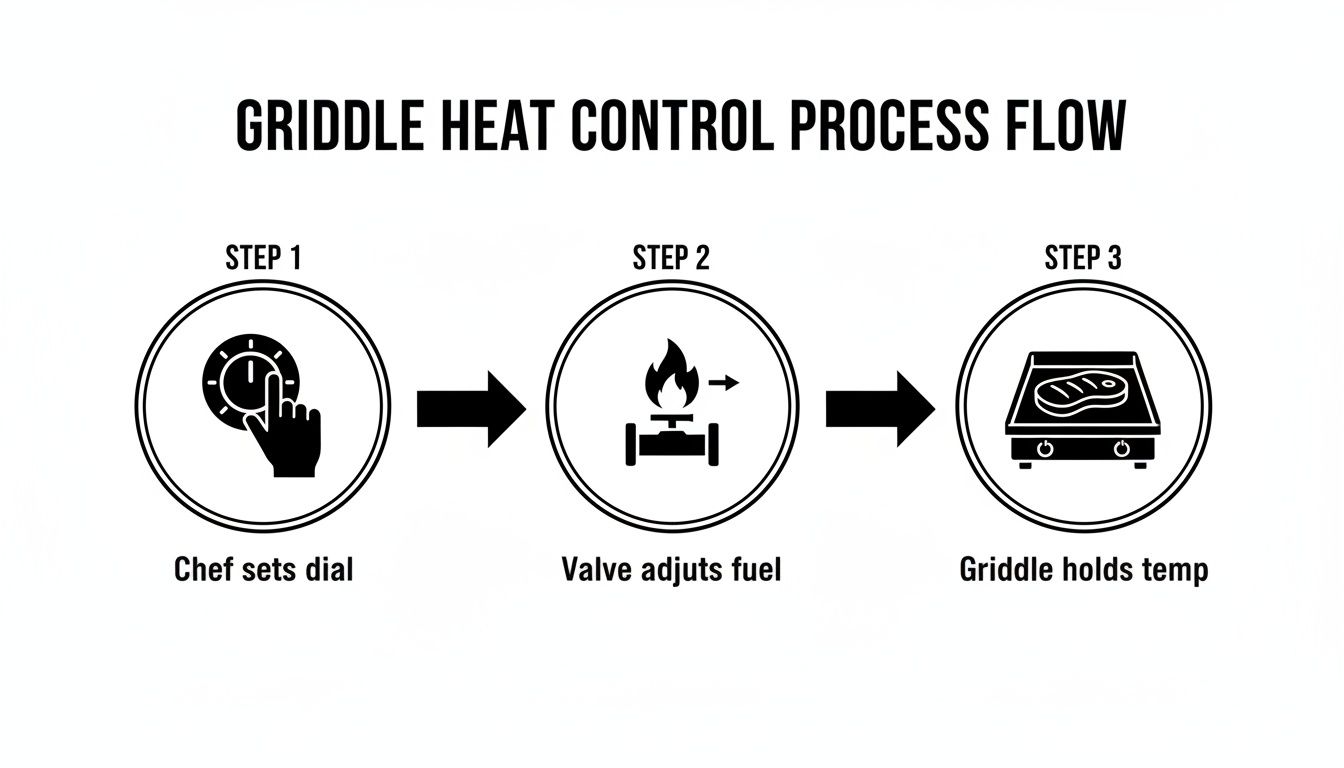
Here's how it plays out during a busy shift: when the griddle plate heats up, the fluid in the sensing bulb expands. This creates pressure that pushes through the capillary tube to the main valve, causing it to slightly close and reduce the flame.
Then, you throw a dozen frozen burger patties onto the hot surface. The griddle cools down, causing the fluid to contract. The pressure drops, the valve opens back up, and the flame gets bigger to bring the temperature back to your set point. This automatic cycle happens over and over, completely eliminating the guesswork.
While the concept feels modern, its roots are deep. Early versions date back to the 1600s, and by 1925, these controls were already being adopted in cooking appliances. Today, that legacy translates to incredible precision in high-volume kitchens, from breakfast spots flipping 1,000 eggs daily to steakhouses searing prime cuts. A good thermostatic griddle can hold temperatures within ±10°F and can even cut down on grease flare-ups by up to 30%.
The real beauty of a thermostatic griddle is its "set it and forget it" reliability. This automation doesn't just deliver consistent food—it frees up your cooks to focus on plating and quality instead of constantly fiddling with the temperature dials.
By letting the valve handle the heat, your kitchen can churn out more consistent food with less effort. This technology is a game-changer for any operation that values precision and efficiency.
Choosing the Right Thermostatic Control for Your Menu
Not all thermostatic control valves are created equal, and the technology running your commercial griddle directly affects how your food turns out. Knowing the difference is crucial for matching your griddle's performance to your menu's needs. The two big players you'll run into are mechanical modulating controls and electric snap-action controls.
Each one has a totally different personality in the kitchen. One is like a dimmer switch, giving you smooth, subtle adjustments. The other is more like a light switch—it's either all on or all off. Which one is right for you? It really comes down to what you're cooking and how fast your kitchen moves.
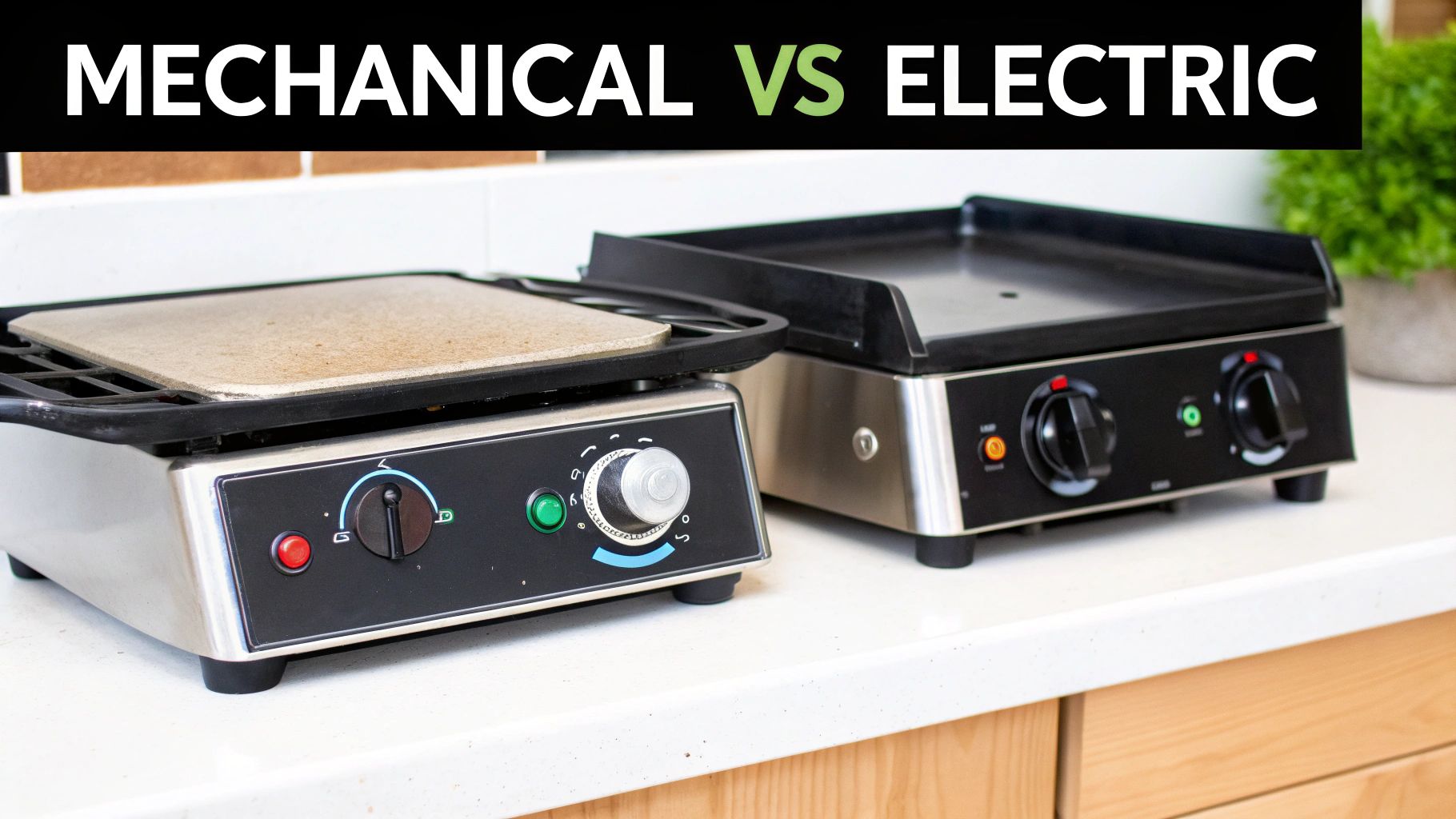
This isn’t just a technical choice; it’s a culinary one that will shape the texture and consistency of everything that comes off your line. Let’s break down how they work and where each one truly excels.
Mechanical (Modulating) Controls: The Precision Artist
Think of a mechanical, or modulating, thermostatic control as the artist of the griddle world. It’s the gold standard when you need absolute precision and stability. This valve doesn't just slam the gas on or cut it off; it modulates the flow, feeding a little more or a little less fuel to hold a remarkably steady temperature.
This constant, gentle tweaking leads to incredibly even heat across the entire griddle plate. It's the perfect setup for anything delicate that can't handle a sudden temperature swing.
- Best for Delicate Foods: You’ll want this for cooking eggs, pancakes, fish, and veggies where precise heat is non-negotiable.
- Ultimate Temperature Stability: By making tiny, nonstop adjustments, it practically erases hot and cold spots, giving you a reliable cooking surface every time.
- Energy Efficiency: These valves are smart with fuel. They only use the exact amount of gas needed at any given moment, which means no wasted energy from overheating and cooling cycles.
Electric (Snap-Action) Controls: The High-Volume Workhorse
Electric snap-action controls, which you'll typically find in electric griddles, run on a much simpler game plan. They work just like a residential thermostat: they turn the heating element on full blast until the griddle hits the target temperature, then shut it off completely. When the temperature dips below a certain point, the power "snaps" back on.
This on-off cycle keeps the temperature within a set range instead of at one exact degree. It’s a tough, responsive system built for speed and power.
A snap-action control is designed for power and recovery. It’s the perfect engine for a busy diner griddle that needs to sear hundreds of burgers and recover heat quickly after being loaded with cold product.
This approach is perfect for kitchens that are all about high volume and fast turnover. It’s a beast for searing and cooking heartier foods that aren't as fussy about minor temperature shifts.
Mechanical vs Electric Thermostatic Controls
To make the choice clearer, here’s a side-by-side look at how these two control types stack up in a commercial kitchen setting.
| Feature | Mechanical (Modulating) Controls | Electric (Snap-Action) Controls |
|---|---|---|
| Operation | Continuously adjusts gas flow for precise temperature. | Turns heating element fully on or off to stay in a range. |
| Heat Stability | Extremely stable; minimal temperature fluctuations. | Less stable; operates within a temperature window (e.g., +/- 15°F). |
| Best For | Delicate items: eggs, pancakes, fish, crepes. | Hearty items: burgers, steaks, frozen foods. |
| Kitchen Type | Fine dining, breakfast cafes, seafood restaurants. | High-volume diners, fast-food, concession stands. |
| Recovery Time | Slower, as it adjusts gradually. | Faster, as it applies full power to reheat. |
| Energy Use | More efficient; uses only the necessary amount of fuel. | Less efficient; cycles between full power and zero power. |
Ultimately, the best control valve is the one that serves your menu. For a deeper dive into how these controls compare to manual options, you can explore our complete guide on thermostatic vs. manual griddles. Understanding these core differences empowers you to select equipment that truly works for your kitchen, not against it.
The Business Case for Precision Temperature Control
So, we've talked about the gears and guts of a thermostatic control valve. But what does it actually mean for your kitchen's bottom line? Let's get straight to it: this little device is a serious financial asset. Its ability to lock in a precise, consistent temperature isn't just a neat feature—it directly drives profitability for any commercial griddle operation.
Think about it. Every time a burger gets scorched on a hot spot or a pancake comes out pale and doughy from a cold zone, that's money heading straight for the trash can. A huge part of the business case here is its direct impact on reducing food waste, which hits your profit margins hard. By taking the temperature guesswork out of the equation, a thermostatic valve makes sure every single item is cooked right, giving you much tighter cost control.
This precision also translates into real energy savings. The griddle only fires up to use the exact amount of fuel it needs to hold that perfect temperature, stopping the costly overuse you often see with manually controlled models.
Driving Profit Through Consistency
Maybe the biggest win of all is unwavering consistency. When a regular comes in for their favorite cheesesteak, they expect the exact same delicious result they got last time. A thermostatic control valve is the engine that makes that happen, order after order.
It's this kind of reliability that builds your reputation and forms the foundation of true customer loyalty.
A reliable thermostatic valve turns your griddle into a predictable profit center. It guarantees that the quality you promise is the quality you deliver, which is the fastest path to repeat business and positive reviews.
This level of precision is an absolute game-changer in high-volume kitchens. Today's top-tier thermostatic griddles can hold temperatures within an incredible ±5°F across thick, heavy-duty plates. That's a massive performance jump. In fact, thermostatic models can slash fuel consumption by 15-25% compared to their manual counterparts. For a busy ghost kitchen pumping out hundreds of orders, that efficiency adds up fast. The American Society of Mechanical Engineers has some fascinating history on how this technology evolved.
Real-World Scenarios and ROI
You can see the return on investment play out every single day, from a food truck trying to conserve propane to a slammed diner serving up flawless meals during the weekend rush.
- Food Trucks: Propane is your lifeblood, and you only have so much. A thermostatic griddle squeezes every bit of performance out of each tank, meaning longer service times and fewer costly refills.
- High-Volume Diners: During a chaotic breakfast rush, your cooks can trust the griddle to hold its temp. This frees them up to focus on plating and managing ticket times instead of babysitting the equipment.
- Ghost Kitchens: In a delivery-first world, food quality is everything. Precision cooking ensures every order that goes out the door perfectly represents your brand, which is a cornerstone of any successful ghost kitchen business plan.
At the end of the day, buying a griddle with a high-quality thermostatic control valve isn't just another expense. It's a strategic move to boost efficiency, protect your reputation, and directly improve your financial results.
Solving Common Griddle Temperature Problems
When your commercial griddle starts acting up, it can throw the entire kitchen line into chaos. One minute you're searing perfectly, the next you're serving undercooked food. A solid thermostatic control valve is the key to consistency, but when it begins to fail, the symptoms can be incredibly frustrating.
Let's walk through how to diagnose these common temperature headaches. Knowing what to look for can mean the difference between a quick in-house fix and an expensive, time-wasting service call.
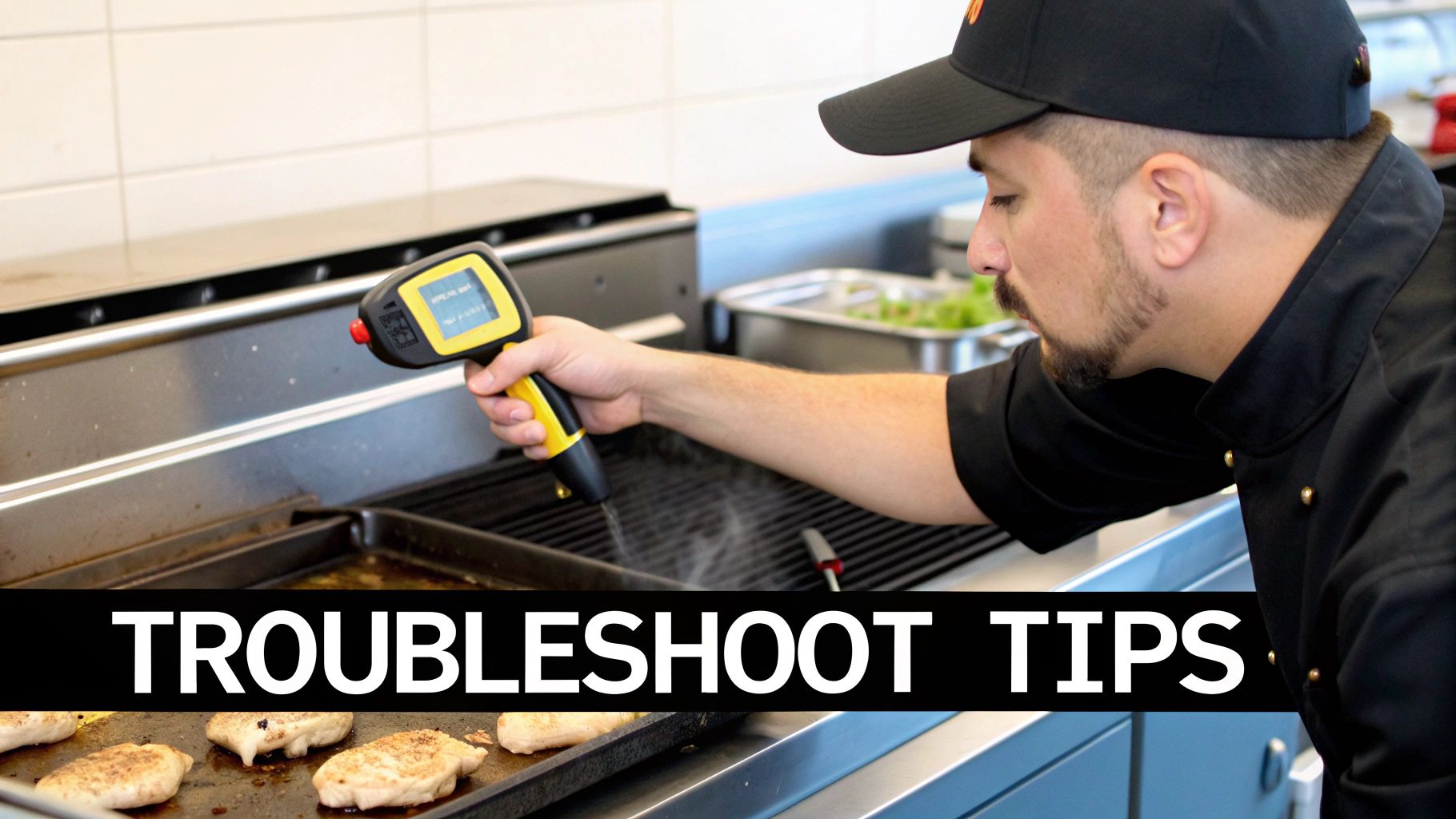
Identifying Symptoms of a Failing Valve
Temperature issues don't just happen. They usually start small and get worse right in the middle of a dinner rush. Keep an eye out for these red flags.
- Hot and Cold Spots: If one side of the griddle is charring burgers while the other side is barely warm, the valve isn't distributing fuel properly. This is a classic sign that something is wrong internally.
- Wild Temperature Swings: Is your griddle rocketing up to dangerously high temps, only to plummet moments later? This "temperature surfing" means the valve can't hold its set point. It's likely sticking open (overheating) or sticking closed (not getting enough gas).
- Griddle Won't Heat Up at All: You've got a pilot light, but the burners just won't fire up no matter how high you crank the dial. This points to a valve that’s completely stuck shut, blocking all gas flow.
- Inaccurate Dial Settings: You set the dial for a perfect 350°F, but your infrared thermometer is screaming 425°F. A major, consistent gap between the setting and the actual surface temperature often means the sensing bulb is on its way out.
Common Causes Behind the Symptoms
Usually, these problems trace back to a failure in one of the valve's key components. Knowing which part does what helps you zero in on the issue.
Key Takeaway: The vast majority of griddle temperature problems come down to a damaged capillary tube or a failing sensing bulb. A kink in that thin tube or a loss of fluid in the bulb makes the entire control system useless.
Start with a quick visual check. Look for any sharp bends, breaks, or kinks in the capillary tube. Think of it as the nervous system connecting the sensing bulb to the valve—any damage severs that communication line.
Today's advanced thermostatic controls are built for serious precision, helping prevent the 10-15% product loss that comes from uneven cooking. Some high-end valves even use ultrasonic flow meters for incredible accuracy. It’s this kind of technology that allows modern griddles to be so efficient, with some models cutting propane use by up to 18%. You can see how far these systems have come by checking out the ASHRAE industry timeline.
If you've looked for obvious physical damage and made sure your burners aren't clogged, the problem is almost certainly inside the valve body itself. At that point, it’s time to call in a pro.
Answering Your Top Griddle Thermostat Questions
Even when you know how a thermostatic control valve is supposed to work, questions always pop up in the middle of a chaotic service. We get it. Here are some clear, no-nonsense answers to the most common questions we hear from chefs and kitchen managers trying to keep their griddles in top form.
How Often Should I Calibrate My Griddle Thermostat?
For any busy commercial kitchen, you should get in the habit of checking your griddle’s thermostat calibration every 3-6 months. Just think of it as a quick wellness check for one of your most important pieces of equipment.
The process is simple. Grab a good surface thermometer and take readings from a few different spots on the griddle plate. Then, compare what the thermometer says to the temperature on your control dial. If you're seeing a consistent difference of more than 15-20°F, that’s your cue—it's time to recalibrate. Doing this regularly is the single best way to ensure food is cooked safely and consistently every single time.
Can I Replace a Thermostatic Control Valve Myself?
Look, it might seem like a manageable fix, but replacing a gas thermostatic control valve is a job best left to a certified professional. Anytime you’re working with gas lines, the stakes are just too high. A mistake here isn't like burning a pancake; it's a serious safety risk.
An improper installation can lead to dangerous gas leaks, fires, or even more damage to your griddle. To protect your kitchen, your staff, and your manufacturer's warranty, always call in a qualified service tech for this one. It's a critical safety step you just can't afford to skip.
The thermostat is the 'brain' that senses the temperature and decides when to act. The thermostatic control valve is the 'brawn' that physically opens or closes to control the fuel flow based on the brain's commands. They are two parts of a single, crucial system.
Are Hot Spots on My Griddle Always Caused by the Valve?
Hot spots are a classic sign that your valve is on its way out, but it's not always the guilty party. While a failing control is definitely a prime suspect when you've got uneven heat, it pays to check a few other common culprits first.
Before you pick up the phone to schedule a service call, take a look at these potential issues:
- Clogged Burner Ports: On gas griddles, grease and food debris can easily block the ports under the plate. This chokes the flame and prevents an area from heating up properly.
- Malfunctioning Heating Element: If you're using an electric griddle, a bad element will create very obvious cold zones on the cooking surface.
- Heavy Carbon Buildup: A thick, baked-on layer of carbon and grease acts like an insulator, physically blocking heat from reaching parts of the griddle plate.
Give your griddle a really good deep clean first. If you’ve scrubbed the burners and the hot spots are still there, then the thermostatic control valve is the most likely problem and needs a professional inspection.
What Is the Difference Between a Thermostat and a Thermostatic Valve?
This is a great question, and it’s a point of confusion for a lot of people. The easiest way to remember it is to think of them as the "brain" and the "brawn" of your griddle's temperature system.
The thermostat is the brain. It's the part you interact with—the dial you turn to set a temperature and the sensing bulb that measures the actual heat. It's the component making the decisions.
The thermostatic control valve, on the other hand, is the brawn. It’s the workhorse that gets the command from the thermostat and actually does something about it. This is the part that physically opens or closes to let more or less gas (or electricity) flow to the heating elements. They’re two separate pieces working together to create one seamless, automated system.
Ready to upgrade to a griddle that offers the precision, power, and reliability your kitchen deserves? Explore the full range of commercial thermostatic griddles at Griddles.com and find the perfect model to elevate your kitchen's performance. Check out our selection today at https://griddles.com.