

A Chef's Guide to Cleaning Your Commercial Griddle with a 3-Compartment Sink
When it comes to kitchen safety, hitting the right 3 compartment sink temperature is an absolute must for cleaning tools from your commercial griddles. That first wash sink has to be at least 110°F (43°C), and for a good reason. It's the critical first line of defense, making sure all that grease and caked-on food from your hard-working griddle spatulas and scrapers gets broken down before moving on.
The Foundation of Griddle Sanitation
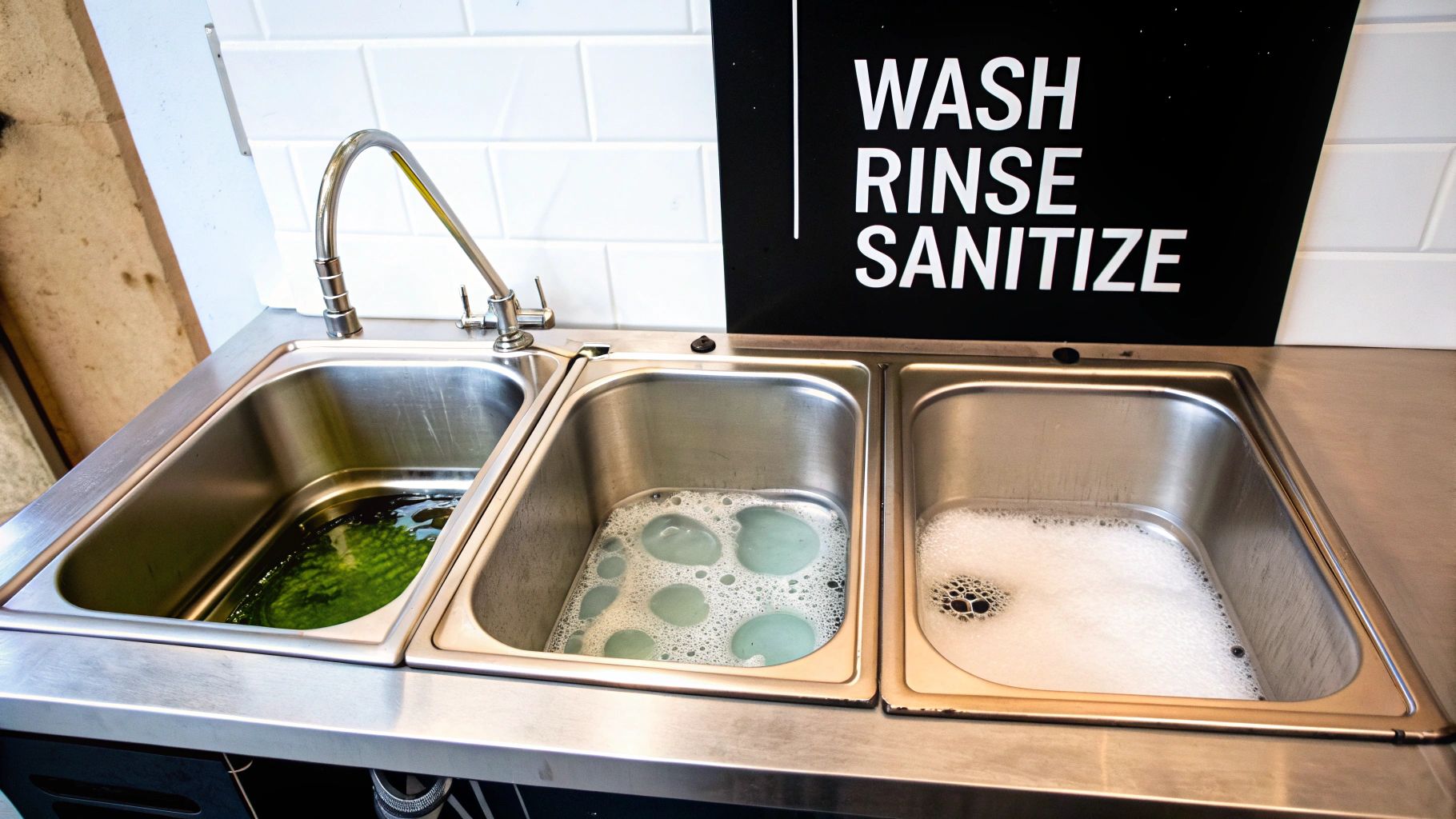
Your three-compartment sink is the unsung hero of your griddle cleaning process. It’s a simple, powerful system built to make sure every spatula, scraper, and grease trap is scrubbed clean of nasty bacteria before it ever touches your griddle surface again. Each basin has a specific job, and if the temperature is off in even one, the whole system for keeping your griddle tools sanitary falls apart.
In the controlled chaos of a commercial kitchen, nailing these temperatures isn't just a good idea—it's essential for passing health inspections and keeping food cooked on your griddle safe. The FDA sets the floor for that first wash sink at 110°F, though many local health departments cap it around 120°F to prevent scalding. This isn't an arbitrary number; it’s what’s needed to cut through griddle grease and fight off foodborne pathogens like Salmonella, which is responsible for over 1.35 million illnesses every year. You can dig deeper into the specific three-compartment sink rules to make sure you're always on the right side of the health code.
The Three Critical Stages for Griddle Tools
The whole wash-rinse-sanitize process is a logical chain reaction. If one link in that chain breaks, the whole thing is compromised, putting your entire griddle station at risk.
Here’s how the workflow is supposed to go for your griddle utensils:
- Wash: The first sink is for the heavy lifting. Hot water and detergent get to work scrubbing away all the visible gunk, grease, and food particles from your griddle tools.
- Rinse: Sink number two is all about clean, warm water. Its only job is to wash away every last bit of soap. Skip this or do it poorly, and the leftover detergent will kill the effectiveness of your sanitizer in the next step.
- Sanitize: The final sink is where the invisible enemies are destroyed. This is where either very hot water or a chemical solution kills off bacteria and pathogens, making your griddle equipment truly safe for reuse.
A three-compartment sink isn't just another piece of kitchen equipment; it's a non-negotiable process for cleaning griddle accessories. Each step—Wash, Rinse, Sanitize—builds on the last to protect your customers and your reputation. Getting the temperatures, timing, and procedures right is the bedrock of food safety.
3 Compartment Sink Requirements At a Glance
To keep things simple, here's a quick cheat sheet summarizing the FDA's core requirements for your sink setup when cleaning griddle tools. Following these guidelines is the best way to ensure you're meeting health and safety standards.
| Compartment | Purpose | Minimum Water Temperature | Chemical Sanitizer Concentration (If Used) |
|---|---|---|---|
| Wash | Remove food, soil, and grease with detergent | 110°F (43°C) | N/A |
| Rinse | Remove all traces of detergent and food particles | 110°F (43°C) (recommended but varies) | N/A |
| Sanitize | Kill remaining pathogens | 171°F (77°C) for hot water sanitizing | 50-100 ppm (Chlorine) or as specified |
This table lays out the fundamentals, but always remember to double-check your local health department's specific rules, as they can sometimes have slightly different requirements.
Mastering the First Sink: The Wash Compartment for Griddle Grease
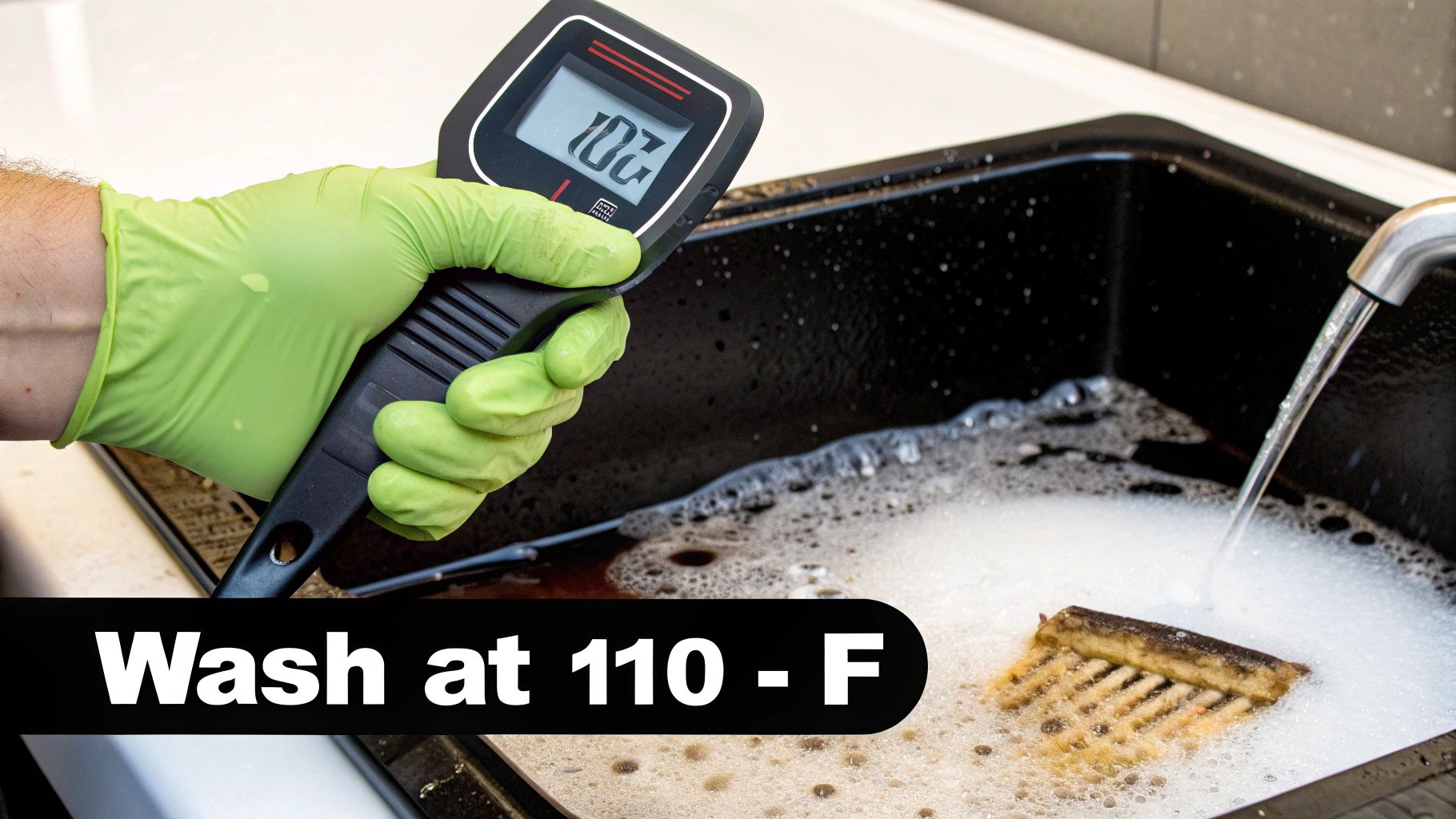
This first basin is where the real fight against griddle grime begins. Think of it as the demolition phase for all the baked-on, greasy residue left on your griddle and tools after a busy service. It's your first, and most important, line of defense.
The success of this whole operation boils down to one critical detail: the 3 compartment sink temperature. The FDA Food Code is crystal clear on this—the wash water must be at least 110°F (43°C). That’s not a friendly suggestion; it's a hard rule backed by science to make sure your cleaning process actually works on tough griddle buildup.
Why Hot Water and Soap Work Together on Griddle Messes
So, what's so special about 110°F? At this temperature, fats and oils from your commercial griddle literally start to melt and break apart on a molecular level. This process, called emulsification, lets your detergent get in there, surround the grease particles, and lift them away from the surface of your spatulas and scrapers so they can be washed down the drain.
Ever tried washing a greasy griddle tool with cold water? You know what happens—the grease just smears around and hardens. But dunk that same spatula in hot, soapy water, and the gunk melts away almost effortlessly. That's the power of heat.
The wash compartment sets the tone for your entire sanitation process for griddle equipment. If the water is too cool or too greasy, you're not actually cleaning your equipment. You're just giving grime a bath before sending it down the line to contaminate the next two sinks.
This first step is absolutely non-negotiable. If you don't get all the physical soil and grease off here, the sanitizer in the final sink won't do a thing. Sanitizer can't get through a layer of griddle grime to kill bacteria, which makes the whole process useless.
Keeping Your Wash Sink in Fighting Shape
Just filling the sink isn’t enough. As soon as you start washing dirty griddle equipment, that water starts cooling down and getting loaded with food bits and grease. A sink full of lukewarm, murky water is a health code violation waiting to happen.
To keep that first compartment doing its job all shift long, your crew needs to:
- Check the Temp Often: Keep a calibrated thermometer handy and make sure the water stays at or above that 110°F mark. No guessing!
- Change the Water Regularly: The moment the water looks cloudy, greasy, or drops below temperature, it’s time for a change. Drain it, scrub the sink, and refill with fresh, hot water and detergent. In a busy kitchen, you might need to do this every couple of hours when cleaning griddle tools.
A hot, clean wash sink isn't just about making the job easier—it's a cornerstone of food safety and staying on the right side of the health inspector.
Why the Rinse Compartment Is So Important for Griddle Tools
After you've battled all the grease and grime in the wash sink, it’s easy to give the second compartment a quick, careless dunk and move on. But hold on—that rinse step is the critical bridge between washing and sanitizing your griddle utensils. Its only job is to get every last bubble of soap and speck of food off your gear.
It's a step that gets overlooked in far too many kitchens, but it's the exact point where your whole sanitation process can fall apart. Why? Because soap is the mortal enemy of sanitizer. If suds from that first sink sneak into the third, they can completely neutralize your sanitizing solution, making it totally worthless. You'll think you're killing germs on your griddle scrapers, but you're really just giving them a bubble bath.
The Science of a Proper Rinse
A solid rinse makes sure the sanitizer in that final compartment can get right to work on the surface of the equipment. Think of it like trying to paint a dusty wall. If you just slap paint over the dust, it's not going to stick right, is it? It's the same idea here. Sanitizer can't get through a film of soap or grease to kill the pathogens hiding underneath your griddle tools.
The whole point is to give the sanitizer a perfectly clean slate to do its job. This is also why keeping a proper 3 compartment sink temperature in the rinse basin matters. While the FDA might not have as many strict rules for this specific sink, the best practice is always to use warm, clean, and constantly flowing water.
The rinse compartment is the silent guardian of your sanitation process. A poor rinse guarantees a failed sanitization, creating a false sense of security and putting your customers at direct risk of foodborne illness from contaminated griddle tools.
Best Practices for the Rinse Sink
To make sure your rinse compartment is pulling its weight, you have to treat it with the same respect as the other two sinks. This isn't just a quick dip and drip; it's a deliberate step to prep your griddle equipment for the final kill.
Nail your rinse every time with these key practices:
- Keep It Clean: The water has to be clear and free of suds. As soon as you see soap bubbles starting to build up, it’s time to drain it and refill. No excuses.
- Use Warm, Running Water: Rinsing under a running tap is the gold standard if you can manage it. If you're using a static basin, change that water often so it doesn't just become a tub of soapy, dirty water.
- Submerge and Agitate: Don’t just dip the corner of a griddle scraper in. Fully submerge it and swish it around. You want the water to hit every single nook and cranny to flush away any leftover residue.
Sanitizing for Ultimate Griddle Food Safety
This is it—the final step. The third compartment is where you win the invisible war against dangerous germs on your griddle accessories. After you've scrubbed the grease off your griddle tools in the first sink and rinsed the soap away in the second, this last dip makes sure everything is genuinely safe to touch food again.
You've got two main ways to sanitize, both approved by the health department: using super-hot water or using a chemical solution. Which one you pick really comes down to your kitchen's setup, but both get you to the same finish line: pathogen-free griddle equipment.
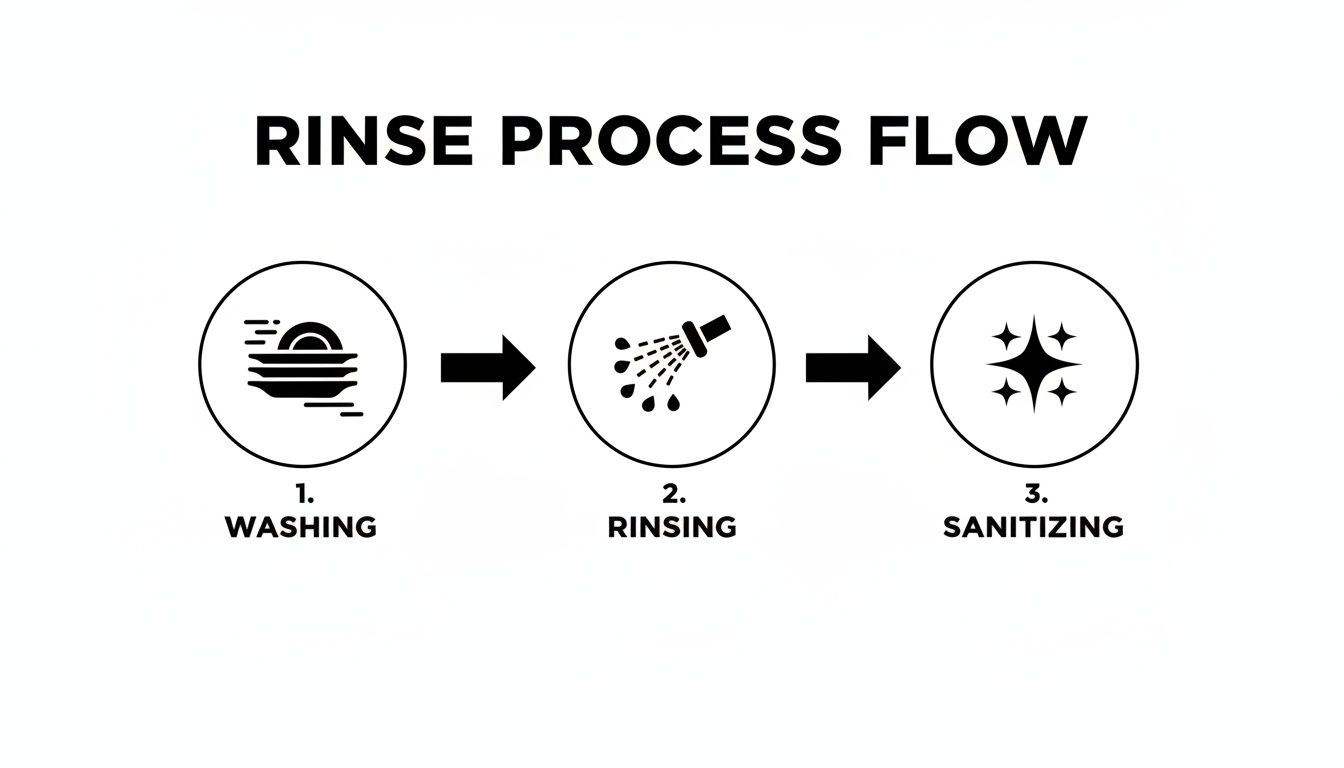
As you can see, the whole process is a logical flow. Each step prepares your griddle tools for the next, ending with that crucial sanitizing dunk that protects your customers.
High-Temperature Sanitizing
Going the hot water route is simple in theory, but it demands serious temperature control in practice. To kill bacteria effectively, your griddle tools need to be completely submerged for at least 30 seconds in water that’s kept at a blistering 171°F (77°C) or higher.
That intense heat basically cooks any lingering bacteria to death. The catch? Keeping water that hot requires a beast of a water heater or a dedicated booster heater, which can be a real hurdle for some kitchens, especially smaller operations or food trucks.
Chemical Sanitizing Methods
If you can't consistently hold water at 171°F, don't sweat it. Chemical sanitizers are your best friend. They get the job done at much cooler temperatures—usually around a comfortable 75°F (24°C)—making them a more practical choice for a lot of folks. The trick is getting the concentration just right, which we measure in parts per million (ppm).
Here are the three big players in the chemical sanitizer game:
- Chlorine (Bleach): This is the old standby for a reason. It's cheap, effective, and readily available. You're aiming for a concentration between 50-100 ppm.
- Quaternary Ammonium (Quats): A bit more sophisticated, Quats are stable, non-corrosive, and have no odor, making them a popular pick. The concentration is higher, usually 200-400 ppm, so always double-check the manufacturer's instructions.
- Iodine: While not as common these days, iodine is a powerhouse, working at a low concentration of 12.5-25 ppm. It acts fast but has a tendency to stain some plastics yellow-brown over time.
The final sanitizing punch is where pathogens meet their end, and it's non-negotiable, especially when you're running gas griddles all day. The FDA is crystal clear: it's either 171°F hot water or an approved chemical like chlorine mixed to 50-100 ppm in 75°F water. You have to prove it with test strips, too—improper sanitizing is a fast track to a health code violation.
No matter which method you use, having the right cleaning supplies for restaurants is half the battle. To really get a handle on this, it helps to understand the common bacteria in kitchen sink environments and what it takes to keep them from taking over your kitchen.
How to Test and Document Sink Temperatures for Griddle Safety
Passing a health inspection isn’t about crossing your fingers and hoping for the best. It’s about having a rock-solid process for cleaning your griddle tools and the paperwork to prove it.
Health inspectors live by the numbers—they don't guess, and you shouldn't either. They will test your water temperatures and check your sanitizer concentration. The best way to ace this part of the inspection is to master how you monitor and log these critical details yourself. It’s your proof.
This proactive habit makes sure every single griddle spatula is verifiably safe. You’ll just need two simple tools: a good thermometer for the water and chemical test strips for the sanitizer.
Essential Tools for Verification
Before you can start logging anything, you need the right gear. These two items are completely non-negotiable in any commercial kitchen and are often the first things an inspector asks to see.
- Calibrated Probe Thermometer: You'll use this to check the water temperature in all three sink bays. "Calibrated" is the key word here—it means you've checked its accuracy (usually in ice water) so you know the readings are trustworthy.
- Sanitizer Test Strips: These little paper strips measure your sanitizer’s strength in parts per million (PPM). Make sure you’re using the right strip for your specific chemical. Chlorine, quat, and iodine strips are not interchangeable, and using the wrong one will give you a false reading.
Think of your logbook as your griddle station's official record. It’s the concrete evidence that proves you are consistently maintaining the correct 3 compartment sink temperature and sanitizer strength, transforming your daily diligence into a powerful compliance tool.
Creating and Using a Temperature Log
Consistent documentation is everything. A simple log sheet posted near the sink makes this easy and keeps your team accountable. At a minimum, this log should be filled out at the start of each shift, every few hours during a busy service, and any time you change out the water.
Your daily log sheet should have columns for:
- Date and Time: Pinpoints exactly when each check happened.
- Wash Sink Temp (°F): The precise temperature reading from your thermometer.
- Sanitizer Type: Just note if it's Chlorine, Quat, Iodine, etc.
- Sanitizer PPM: Write down the concentration your test strip shows.
- Employee Initials: The person who did the check signs off.
This simple routine creates a running record that screams "we take food safety seriously." It’s an invaluable piece of paper to have on hand when an inspector walks through the door. Having this documentation ready to go is a huge part of any successful inspection, as we cover in our comprehensive restaurant health inspection checklist.
By making testing and logging a non-negotiable part of your daily workflow, you stop hoping you'll pass an inspection and start knowing you will. It builds a culture of safety, ensures your griddle wares are always properly sanitized, and protects both your customers and your reputation.
Troubleshooting Common Sink Temperature Problems with Griddle Equipment
Even the most buttoned-up kitchen can run into trouble keeping the 3 compartment sink temperature dialed in, especially during a chaotic dinner rush. When temps drop or sanitizer tests fail, you need to know how to fix it fast to keep the griddle tools moving and the health inspector happy.
More often than not, the prime suspect for lukewarm water is an overworked or failing water heater. If your dish crew is constantly fighting to get the wash water hot enough, it's time to look at the source. A struggling heater doesn't just mess with your dish pit—it can cripple your entire operation. It's always a good idea to know the common signs your water heater is about to fail before you're left with a cold-water crisis.
Wash Water That Cools Down Too Fast
You know the rule: your wash sink needs to stay at or above 110°F. But tossing in a steady stream of greasy griddle spatulas can zap the heat right out of it. Once that water gets too cool, it’s not doing its job breaking down fats, and you're just pushing greasy water around.
Here’s how to fight back:
- Work in Smaller Batches: Don't overload the sink. Washing a manageable number of griddle tools at a time prevents drastic temperature drops and keeps the water effective.
- Pre-Scrape Like a Pro: The more gunk you scrape off the spatula before it hits the water, the less work the hot water and detergent have to do. This simple step keeps your water hotter, longer.
- Install a Booster Heater: If your main water heater just can't keep up with demand, a dedicated point-of-use booster heater for the sink is a total game-changer. This is a key piece of hardware we touch on in our bigger guide to commercial kitchen equipment maintenance.
Inconsistent Sanitizer Strength
When it comes to chemical sanitizers, getting the concentration just right is non-negotiable. Too weak, and you’re not actually killing any pathogens. Too strong, and you risk leaving potentially harmful chemical residue on your clean griddle tools.
If your test strips are all over the place, the problem is almost always the mixing process. Staff should never, ever "eyeball" the sanitizer. Always use measuring cups or auto-dispensers to get a perfect mixture every time.
And don't forget to change it out. Your team needs to be mixing fresh batches of sanitizer frequently—at least every two to four hours, or immediately if the water becomes cloudy or full of debris. An old, dirty solution is a useless solution, giving you a false sense of security and putting you on the fast track to a health code violation.
Your Top Sink Temperature Questions Answered for Griddle Cleaning
Even with a rock-solid cleaning process, questions pop up during the dinner rush about hitting the right 3 compartment sink temperature. Knowing the answers is key to staying fast, safe, and on the right side of the health inspector—especially when you're scrubbing down greasy gear from your commercial griddle.
Here are some of the most common questions we hear from kitchens, with clear answers to get you back to cooking.
Do I Really Need a Thermometer for My Sink?
Yes, you 100% do. Guessing based on how hot the water feels to the touch is a direct path to a health code violation. It’s totally inaccurate, and your health inspector definitely won’t accept it as proof of compliance.
The FDA Food Code is very clear: you need a calibrated thermometer available and in use to check your water temperatures. It's a small piece of equipment that saves you from very big fines.
Can a Dishwasher Replace the Third Sink for Griddle Tools?
In some cases, yes, but it's not a complete replacement. A commercial high-temp dishwasher that can hit the required final rinse temperature for sanitizing can absolutely handle the job of the third sink.
But—and this is a big but—you still have to use the first two sink compartments to properly wash and rinse everything before it goes into the machine. And for those oversized items that won't fit in a dish rack, like your main griddle cleaning tools, the full three-sink process is still your go-to.
Pro Tip: If you find your water heater just can't keep up and hit that 171°F needed for hot water sanitizing, don't sweat it. The easiest fix is switching to an approved chemical sanitizer. This lets you properly sanitize at a much more manageable temperature, usually around 75°F.
How Often Should I Change the Sink Water When Cleaning Griddle Utensils?
You need to drain and refill all three compartments whenever they stop being effective. There’s no hard-and-fast rule like "every 60 minutes," but a solid guideline for a busy kitchen is to change the water every two to four hours.
More importantly, you need to change it immediately if you see any of these red flags:
- The wash water is greasy, full of food debris, or has dropped below 110°F.
- The rinse water is getting soapy and sudsy from carryover.
- Your test strips show the sanitizer concentration has fallen below the required PPM.
Here at Griddles.com, we understand that a clean kitchen is a successful one. We stock the high-performance commercial griddles and kitchen gear built to handle the heat of a busy service and make cleanup less of a chore. Check out our full catalog at https://griddles.com.