

Gas Fittings Quick Connect: A Complete Guide for Commercial Griddles
A gas fittings quick connect system is your key to a safer, faster, and more flexible kitchen. It completely replaces the old-school, permanent, hard-plumbed gas lines that lock your griddle in one spot. Think of it as a heavy-duty, industrial-strength plug for your gas supply; it lets you unplug your griddle, move it for cleaning or a new kitchen layout, and plug it back in without calling a plumber. This one simple upgrade is a must-have for running a truly clean and efficient commercial kitchen.
Why Quick Connect Fittings Are Essential for Commercial Griddles
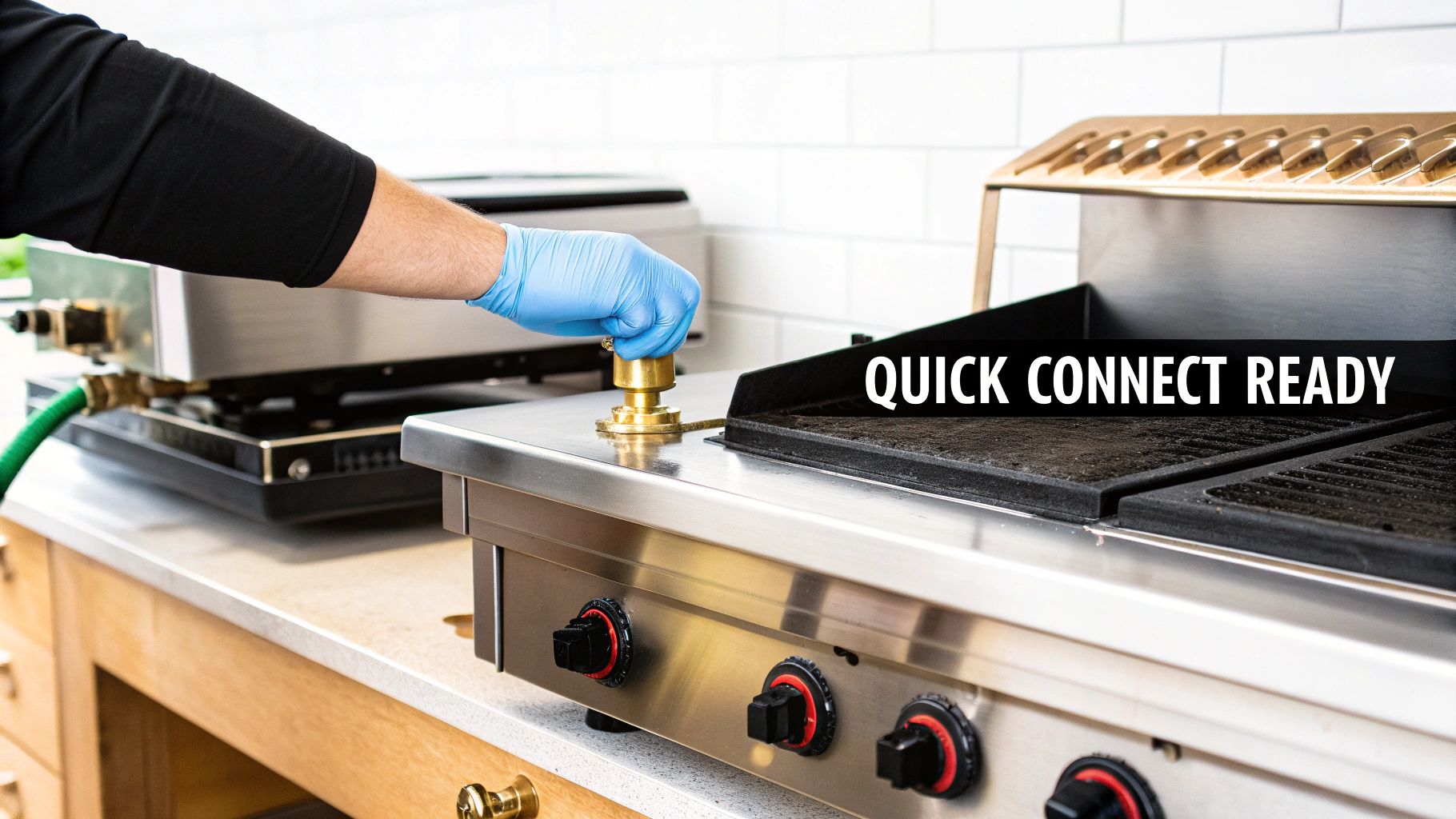
In the fast-paced, high-stakes world of a commercial kitchen, every single minute of downtime is money down the drain. Old-fashioned gas connections are rigid and permanent, which means a simple task like deep-cleaning behind your griddle turns into a major headache. This is where a gas fittings quick connect setup immediately proves its worth.
Picture your griddle as a powerful computer workstation. A hard-plumbed gas line is like soldering the power cord right into the wall socket. Sure, it's secure, but it's totally inflexible. A quick-connect fitting, on the other hand, works just like a regular plug—it gives you the freedom to safely move the appliance and hook it back up in seconds.
The Core Benefits for Your Griddle Operations
This kind of flexibility delivers real, tangible benefits to your kitchen's bottom line, especially if you're running high-output commercial griddles. The freedom to quickly disconnect and wheel out heavy equipment is a complete game-changer for your sanitation and maintenance schedules.
Here are the key advantages:
- Enhanced Sanitation: Roll your griddle away from the wall with ease for a thorough clean. This lets you get to the floors and walls behind it, stopping grease buildup and keeping pests away. It's a huge help in meeting and exceeding health code standards.
- Operational Flexibility: Need to switch up your cookline for a menu change or to improve workflow? No problem. You can reconfigure your griddle station without the cost or delay of bringing in a plumber for every little adjustment.
- Reduced Downtime: If a griddle goes down, you can disconnect it in a snap and swap in a backup unit. This keeps your line moving and orders flying out, even during the busiest rushes.
- Improved Safety: Modern quick-connect fittings are built with safety in mind. Many include thermal shut-off valves that automatically cut the gas flow if a fire breaks out.
A proper gas connection is the lifeline of your commercial griddle. Using a quick-connect setup not only simplifies installation but fundamentally changes how you manage your kitchen's most valuable assets—your space and your time.
Built for the Commercial Kitchen Environment
These fittings aren't flimsy—they're engineered to handle the chaos of a busy restaurant kitchen. For bustling diners, high-volume food trucks, and lean ghost kitchens running commercial griddles, the benefits are crystal clear. You get the power to adapt your workspace on the fly, which is a massive advantage in this industry.
To get a better handle on all the parts involved, you can learn more about how quick fit gas connectors work in our detailed guide. What we've covered here is the foundation you need to understand how to choose, install, and safely use the right fittings for your specific griddle.
Understanding the Different Types of Gas Fittings
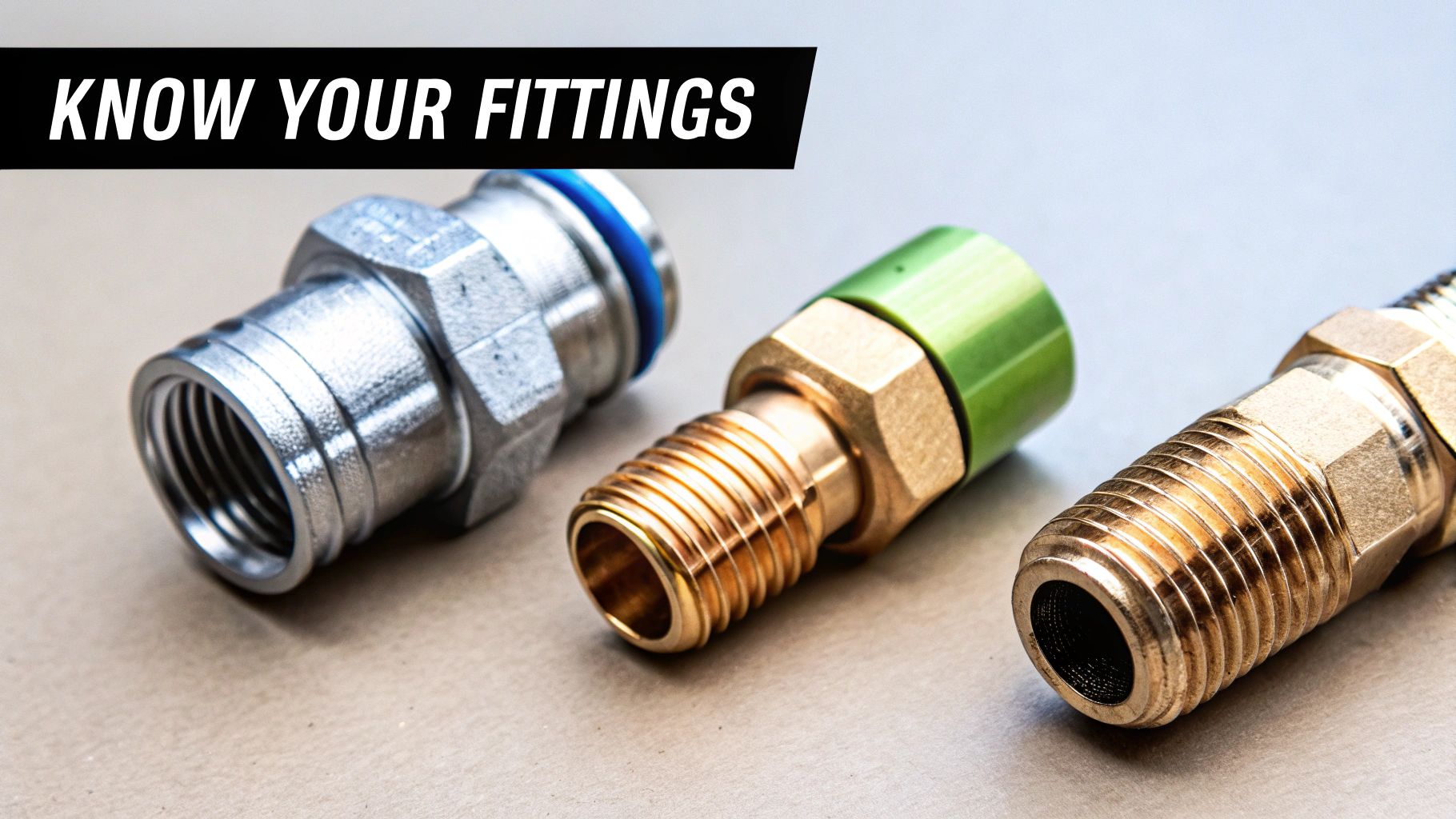
If you've ever glanced at the gas line snaking behind your commercial griddle, that jumble of connectors can look pretty intimidating. But once you get a closer look, you'll see it's really just a few standard parts working together. Getting to know these core components is the first step toward a safe, efficient, and flexible griddle setup.
Think of your gas connection in layers. The foundation is built on permanent or semi-permanent threads—these are the workhorse joints that securely connect pipes and adapters. From that solid base, you build out to the more flexible pieces, like the gas hose and, most importantly, the quick-connect coupler.
Exploring Permanent Connection Types
The most common thread you’ll run into is the National Pipe Thread (NPT). The easiest way to picture how NPT works is to think of a cork being wedged into a bottle. Both the male and female threads are slightly tapered. As you tighten them, they jam together to create a seal. Because it relies on this friction, an NPT fitting always needs a little help from a sealant like PTFE tape or pipe dope to fill any tiny gaps and make the connection completely leak-proof.
Another popular style is the flare fitting. These work a bit differently. Instead of relying on the threads to make the seal, a flare fitting uses two perfectly matched, cone-shaped metal surfaces. When you tighten the nut, it presses these two cones together, forming an incredibly reliable metal-to-metal seal. You'll often spot these where a gas hose connects to a griddle's regulator.
But the real game-changer for a modern commercial kitchen isn't the permanent threads—it's the quick-disconnect coupler that attaches to them. This is the piece that gives your griddle true 'plug-and-play' convenience.
How a Gas Fittings Quick Connect Works
A gas fittings quick connect, often called a Quick Disconnect Coupler (QDC), is a simple two-part system that lets you connect and disconnect your gas line without any tools. It’s specifically designed for repeated use, unlike NPT threads, which can get damaged if you’re constantly tightening and loosening them.
The two parts are:
- The Male Plug: This piece is usually attached to the gas hose running to your commercial griddle. It has a specially shaped tip that opens a valve inside the socket when it's pushed in.
- The Female Socket: This part connects to the fixed gas pipe coming from the wall. It has an internal valve that stays sealed shut, preventing gas from escaping until the male plug is fully inserted.
When you push the plug into the socket, you’ll hear an audible click as an internal mechanism locks them together. This action simultaneously opens the valves in both components, allowing gas to flow to your griddle. To disconnect, you just pull back a collar on the socket. This instantly releases the plug and shuts off the gas flow on both sides.
Many commercial-grade couplers also feature a thermal shut-off—a critical safety feature. If there’s a fire, a fusible link inside the coupler melts, automatically closing the valve and cutting off the fuel supply.
Common Connection Types for Commercial Griddles
To pull it all together, let's look at the different fittings you're likely to find in a typical commercial griddle setup. This table breaks down what each one does and where you'll find it.
| Connection Type | Sealing Method | Common Use on Griddles | Key Feature |
|---|---|---|---|
| NPT (National Pipe Thread) | Tapered threads with sealant | Connecting fixed pipes and adapters from the wall outlet. | Requires sealant (tape or dope) for a proper seal. |
| Flare Fitting | Matched metal-to-metal cones | Connecting the gas hose to the pressure regulator. | Creates a mechanical seal without needing thread sealant. |
| Quick Disconnect Coupler (QDC) | Internal O-rings and valve seal | Connecting the griddle's gas hose to the main supply line. | Allows for rapid, tool-free connection and disconnection. |
Understanding these different parts makes diagnosing issues or upgrading your griddle setup much simpler.
The growing popularity of this technology is impossible to ignore. The quick disconnect couplings market was valued at USD 2.53 billion in 2024 and is projected to hit USD 3.87 billion by 2033. For kitchen operators who rely on top-tier equipment from providers like Griddles.com, these numbers show just how valuable quick-connect tech is for saving time on installation and maintenance, which ultimately keeps operational costs down. You can read more about the growth of this market segment and see how it’s impacting commercial kitchens everywhere.
By being able to spot these fittings, you can confidently trace your gas line from the wall to your griddle and understand how each part works to deliver a safe, flexible fuel source. This knowledge is crucial for smooth daily operations and effective troubleshooting.
Choosing the Right Size and Material for Your Griddle
Picking out the right gas fittings quick connect system is a whole lot more than just grabbing some hardware off a shelf. This is a critical decision that directly affects your griddle's performance and, more importantly, its safety.
Think of it this way: you wouldn't put a tiny fuel line on a monster truck engine and expect it to win a race. It would sputter, stall, and never reach its potential. Your griddle is the same. It needs a steady, uninterrupted flow of gas to keep that cooktop blazing hot, especially when you're slammed during the dinner rush. The wrong fitting will starve your burners, leading to cold spots, slow recovery times, and a frustrated line cook.
Sizing Your Fittings Based on Griddle Power
First things first, you need to know your griddle's BTU (British Thermal Unit) rating. You can find this number stamped on the appliance's data plate. It tells you exactly how much heat energy the griddle is designed to pump out, and a higher BTU means it's thirstier for gas.
A beast of a 48-inch griddle might demand over 120,000 BTUs, which requires a much beefier gas flow than a compact 24-inch countertop model. This is where the diameter of your fittings becomes non-negotiable.
- 1/2 Inch Fittings: These are typically fine for smaller, lower-BTU griddles or countertop units that aren't expected to handle massive volume.
- 3/4 Inch Fittings: This is the workhorse size. It's the standard for most medium-to-large commercial griddles, providing plenty of fuel to keep multiple burners roaring.
- 1 Inch Fittings: You'll see these on seriously high-demand griddles or in kitchens with very long gas lines where maintaining pressure is a challenge.
The golden rule is simple: Always match the size of your gas fittings quick connect system to both the gas hose and the griddle's own inlet connection. If you try to connect a 3/4-inch hose to a 1/2-inch fitting, you’ve just created a bottleneck. That choke point will cripple your griddle's heating power before the gas even reaches the burners.
Getting this relationship right is essential. If you want to dig deeper into making sure your kitchen's entire gas supply is up to the task, check out our guide on selecting the right natural gas line size for your commercial equipment.
Selecting the Best Material for a Tough Kitchen Environment
Once you've nailed down the size, it's time to think about materials. A commercial kitchen is a battlefield of heat, grease, moisture, and harsh cleaning chemicals. Your gas fittings are right in the middle of it all, and they need to be tough enough to survive.
Here’s how the most common materials stack up against the daily grind of a professional kitchen:
| Material | Pros | Cons | Best For |
|---|---|---|---|
| Brass | Fights off corrosion like a champ, very durable, and reasonably priced. | Softer than steel, so it can be damaged if you get too aggressive with the wrench. | The hands-down winner for most commercial kitchens. It’s the perfect blend of durability, reliability, and value for your griddle setup. |
| Stainless Steel | The toughest of the bunch. Superior strength, amazing corrosion resistance, and laughs at high temperatures. | Costs more than brass and can be a bit harder to work with and seal properly. | High-end kitchens, setups exposed to harsh chemicals, or anywhere you need absolute maximum durability for your griddle connection. |
| Plated Steel | Strong and easy on the wallet. | That protective plating is its weak spot. If it scrapes off, rust and corrosion are sure to follow. | Okay for budget-conscious griddle setups, but you must inspect it regularly for corrosion, especially in damp areas under the cookline. |
For the vast majority of commercial griddle setups, brass is the way to go. It delivers rock-solid performance and stands up to the abuse of a busy kitchen without the premium price tag of stainless steel. While plated steel can work in a pinch, it requires you to be extra vigilant. Choose wisely here, and your connection will stay safe and leak-free for years to come.
Propane vs Natural Gas Fittings for Your Griddle
One of the biggest hang-ups in any commercial kitchen is figuring out the difference between propane (LP) and natural gas (NG) hookups for a griddle. While the gas fittings quick connect coupler might look the same and even work for both, the entire system feeding that gas is incredibly specific. Getting it wrong isn't just a headache—it’s a major safety hazard.
Here’s a simple way to think about it: your griddle is a high-performance engine. Natural gas and propane are like diesel and regular unleaded fuel. They both make the engine run, but they have completely different properties, operate at different pressures, and you can't just pour one into a tank meant for the other without disastrous results. Your griddle’s gas system is no different.
The Critical Difference Pressure Makes
The real story here is pressure. Natural gas comes into your building at a very low pressure, usually around 4 inches of water column (WC). Propane, on the other hand, is stored as a liquid in a tank under high pressure and is delivered to your griddle at a much higher pressure, typically around 11 inches WC after it goes through a regulator.
That pressure gap is why you absolutely cannot mix and match parts. A regulator built for low-pressure natural gas will be completely overwhelmed by high-pressure propane. The same goes for the orifices—those tiny, precision-drilled nozzles that feed gas into the burners. Propane orifices are much smaller than natural gas ones. If you try to run high-pressure propane through a larger natural gas orifice, you'll get massive, dangerous flames. Do it the other way, and you'll starve the griddle's burners of fuel, resulting in weak, useless heat.
Many commercial griddles, including those available from Griddles.com, are sold as 'field-convertible.' This means they are shipped ready for one gas type (usually natural gas) but include a conversion kit with the necessary orifices and a reversible regulator to switch to the other.
Understanding Field-Convertible Griddles
When you see a griddle advertised as "field-convertible," it’s great news. It means the manufacturer has packed in everything you need to safely switch from one gas source to another. This is a game-changer for businesses that might move to a new building or for food trucks that live and breathe on propane tanks.
The conversion is usually straightforward and involves two key steps:
- Swapping the Orifices: You'll unscrew the small brass orifices designed for natural gas and install the new ones sized for propane.
- Adjusting the Regulator: This often just means flipping a component on the gas regulator to handle the higher pressure of propane correctly.
For a detailed walkthrough, our guide on a natural gas to propane conversion breaks down the exact steps you need to take. Following this process ensures your griddle fires up safely, burns clean, and heats like it's supposed to, no matter what gas you're using.
The demand for this kind of flexible, reliable gas hardware is growing fast. The market for gas fittings is expected to jump from USD 1,213.7 million in 2025 to USD 1,631.1 million by 2035, with quick-connects leading the charge. This just shows how critical fast, secure, tool-free connections have become in modern kitchens. If you want to dig deeper into other fuel types, this is a great resource for understanding Propane vs. Butane for LPG installations.
Your Step-By-Step Guide to Installation and Leak Testing
Hooking up a gas line to your commercial griddle isn't something to rush. It demands precision and a serious respect for safety. There are absolutely no shortcuts here. Think of this process like prepping for a dinner rush—every step has to be done perfectly, in the right order, with the right tools.
This is your clear, actionable guide for getting a gas fittings quick connect system installed correctly and making damn sure it's leak-free before you even think about firing up that griddle.
Prepping for a Safe Connection
First things first, before you so much as look at a wrench: shut off the main gas supply. Find the valve on the pipe coming from the wall and give it a quarter turn so the handle is perpendicular to the pipe. This is non-negotiable. It ensures no gas can flow while you're working.
Next, get your gear together. You'll need:
- Two adjustable wrenches (one for holding, one for turning).
- A certified gas thread sealant. This means the yellow PTFE tape made specifically for gas, or a pipe dope that's rated for both natural gas and propane.
- Your new quick-connect fitting and hose assembly.
Take a second to double-check that your fittings and hose are the right size and type for your griddle and the gas supply line. A mismatch here will stop you in your tracks.
Nailing the Installation
With the gas off and your tools laid out, it's time to connect everything. This is a methodical job where every single connection is critical.
- Apply Sealant the Right Way: Any NPT (tapered) thread needs sealant. If you're using PTFE tape, wrap it clockwise around the male threads 3-4 times. Start one or two threads back from the very end to keep bits of tape from shredding off and clogging your gas line. For pipe dope, just brush a thin, even coat onto the male threads.
- Tighten the Fittings: Start by screwing the fittings together by hand until they're snug. Then grab your two wrenches. Use one to hold the stationary pipe or fitting completely still and the other to tighten the connection. A good rule of thumb is hand-tight plus one full turn. Go too far and you can crack the fitting; not far enough and you've got a leak.
- Attach the Quick Connect System: Screw the female socket of the quick-disconnect coupler onto your gas supply pipe. Then, attach the male plug to the flexible gas hose that goes to your griddle. Make sure both are tightened down properly with sealant.
- Engage the Quick Connect: Once everything is securely tightened, just push the male plug into the female socket. You should hear and feel a solid "click." That click is your confirmation that the internal lock is engaged and the valve is open.
The All-Important Leak Test
You are not done yet. Your installation is only complete after you perform a thorough leak test. This is the single most important safety check you will do.
Whip up a simple solution of dish soap and water—a 50/50 mix works great. Turn the main gas supply back on. Now, using a small brush or a spray bottle, coat every joint and connection you just made with the soapy water.
Watch each connection like a hawk for a few seconds. If you see any bubbles forming, growing, or foaming, you have a gas leak.
If a leak shows up, turn off the gas supply immediately. Don't light anything. You'll need to disconnect the leaky fitting, clean off all the old sealant, reapply fresh sealant, and retighten it. Then, do the leak test all over again until there are zero bubbles.
Even with a perfect installation, staying vigilant is key. It's always a good idea to know what you're looking for when it comes to recognizing signs of a gas leak in a busy kitchen environment.
The move to these fittings is happening for a reason. The global market for them is set to hit a massive USD 14,031.5 million by 2033. In commercial kitchens, that growth is fueled by pure efficiency—these systems can slash installation time by 40–55%. For restaurants and food trucks using griddles from suppliers like Griddles.com, that's a huge win.
While this guide gives you the critical basics, always check your local codes and the griddle manufacturer's instructions. If you have even the slightest doubt, stop what you're doing and call a licensed professional.
Your Essential Checklist for Buying Griddle Gas Fittings
Alright, you've done your homework. Now it's time to choose the right gas fittings quick connect system to get your commercial griddle fired up safely and efficiently. This checklist is your final walkthrough, cutting through the noise to help you grab the right parts the first time.
Think of it as your pre-flight check for the cookline. Miss one of these points, and you could be dealing with poor griddle performance, serious safety hazards, or the hassle of returning parts. A few minutes now will save you a world of headaches later on.
Confirming Your Griddle and Gas Supply Specs
Before you even think about adding parts to a cart, you need to know your numbers. These details are the foundation of your setup, so grab them directly from your griddle and gas line.
- BTU Rating: Find the data plate on your commercial griddle—it’ll list the total BTU rating. A hungry, high-BTU griddle needs a bigger fuel line, which usually means a 3/4" fitting to keep up with demand.
- Gas Type: Is your kitchen running on Natural Gas (NG) or Propane (LP)? While many fittings handle both, the hose and regulator absolutely must match your griddle's fuel source. No exceptions.
- Connection Sizes: Get out a ruler or caliper and measure the gas inlet on your griddle and the outlet on your gas supply stub-out. They have to match the fitting size you buy, or you’ll create a bottleneck and starve your griddle of fuel.
This simple visual breaks down the core steps for a safe install once you have the correct parts in hand.
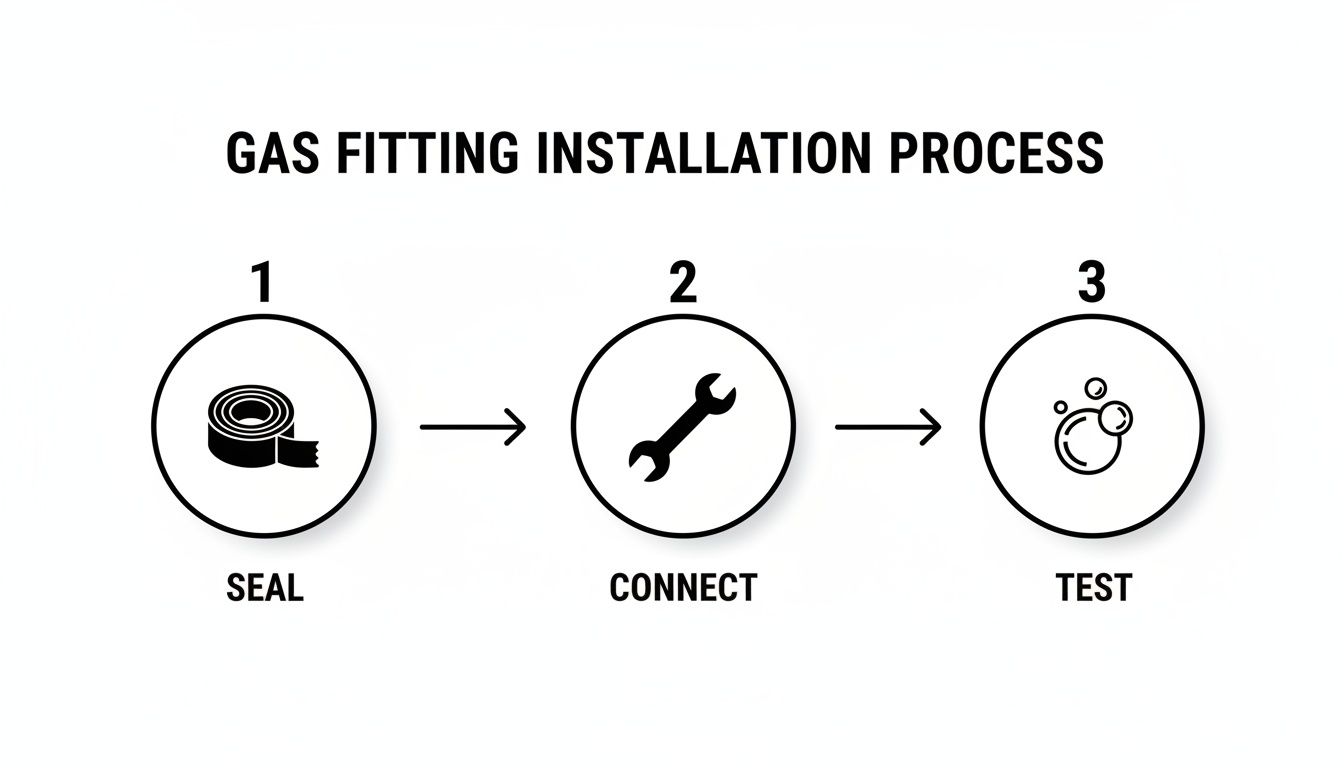
As you can see, there’s a non-negotiable sequence: seal the threads, tighten the connections properly, and always, always do a leak test. It’s the only way to be sure your setup is secure.
Verifying Component Quality and Fit
Once you have your specs locked in, it's time to look at the actual hardware. Quality matters just as much as size and gas type.
The right gas connection is a long-term investment in your kitchen's safety and efficiency. Always prioritize certified, durable components over saving a few dollars on unverified hardware for your griddle.
Use these last few checkpoints to make a smart buy:
- Hose Length: How far do you need to pull your griddle out for a deep clean? Measure that distance and add some slack. You never want to strain the connections. A 48-inch or 60-inch hose is a standard choice for most commercial griddles.
- Material Durability: For a busy commercial kitchen, stick with brass or stainless steel fittings. They’ll stand up to grease, cleaning chemicals, and constant use far better than cheaper plated steel.
- Safety Certifications: Flip the fitting over and look for a stamp from CSA (Canadian Standards Association) or UL (Underwriters Laboratories). This is your proof that the part has been properly tested and is safe for commercial gas griddles.
Ready to build a safer, more flexible kitchen? At Griddles.com, we stock the high-quality, certified gas fittings and hoses you need to connect your commercial griddle with confidence. Find the right connection solution for your kitchen at Griddles.com and get back to cooking.