

Quick Fit Gas Connectors: A Guide for Commercial Griddles
Picture this: you need to pull your commercial griddle out for a deep clean or maybe rearrange the cook line for a weekend special. But you can't. You're tethered to the wall by a rigid, unmoving gas pipe. That’s the frustrating reality in a lot of commercial kitchens, but quick fit gas connectors are the simple, game-changing solution.
Think of them like a heavy-duty USB port for your gas griddle. They provide an instant, secure, and safe connection that completely changes how you manage your kitchen space.
The Secret to a Safer and More Flexible Commercial Griddle Setup
In the chaos of a busy service, every minute of downtime costs you money, and every potential hazard is a risk you can’t afford. While traditional hard-piped gas lines get the job done, they chain your griddle to one spot. This makes thorough cleaning a nightmare and reconfiguring your cook line a major project that requires a pricey visit from a licensed plumber.
This lack of movement isn't just an inconvenience—it's a real safety concern. A big part of running a safe operation is identifying hazards in the workplace, and those fixed gas systems are often overlooked. Staff yanking on a griddle to clean behind it can put immense stress on those rigid fittings, which can lead to dangerous gas leaks over time.
Introducing Modern Agility for Your Griddle
This is exactly where quick fit gas connectors make all the difference for your griddle. By swapping out that fixed pipe for a durable, flexible hose with a secure quick-disconnect fitting, you suddenly gain incredible operational freedom. It’s a modern approach that solves the biggest headaches of old-school setups.
The core benefit is simple: it allows kitchen staff to safely and easily disconnect a griddle for cleaning or relocation, and then securely reconnect it without tools or specialized help. This capability dramatically improves sanitation and operational workflow.
This one upgrade empowers your team to keep the kitchen spotless and adapt your cook line on the fly as your menu evolves. It's a foundational step toward a kitchen that's more efficient, compliant, and—most importantly—safer for your griddle operations.
Of course, knowing your fuel source is just as important. Whether your griddle runs on natural gas or propane, matching it with the right connector system is absolutely critical for performance and safety.
How Quick Fit Gas Connectors Actually Work
To really get why these connectors are a game-changer for commercial griddles, you have to look at their simple but incredibly smart design. The whole system boils down to two main parts that work together: a socket that gets installed on your main gas line and a plug on the end of the griddle’s flexible hose.
Connecting is straightforward and secure. When you push the plug into the socket, you’ll hear and feel a distinct "click" as an internal locking mechanism engages. This creates a rock-solid, leak-proof seal, letting gas flow right to your commercial griddle so it can fire up. The real magic, though, is in the safety features baked right in.
The Built-In Safety Valve
The most important piece of the puzzle is the internal safety valve. You can think of this as the system's brain. As long as the connector is locked in, the valve stays open. But the second you retract the collar on the socket to disconnect the hose, that valve instantly and automatically slams shut. This immediate cutoff stops the flow of gas from the main line cold. It’s what makes the system so safe, preventing a potential disaster if someone accidentally unplugs the hose while moving the griddle.
This diagram shows exactly what problems these connectors solve compared to old-school, fixed gas lines for your griddle.
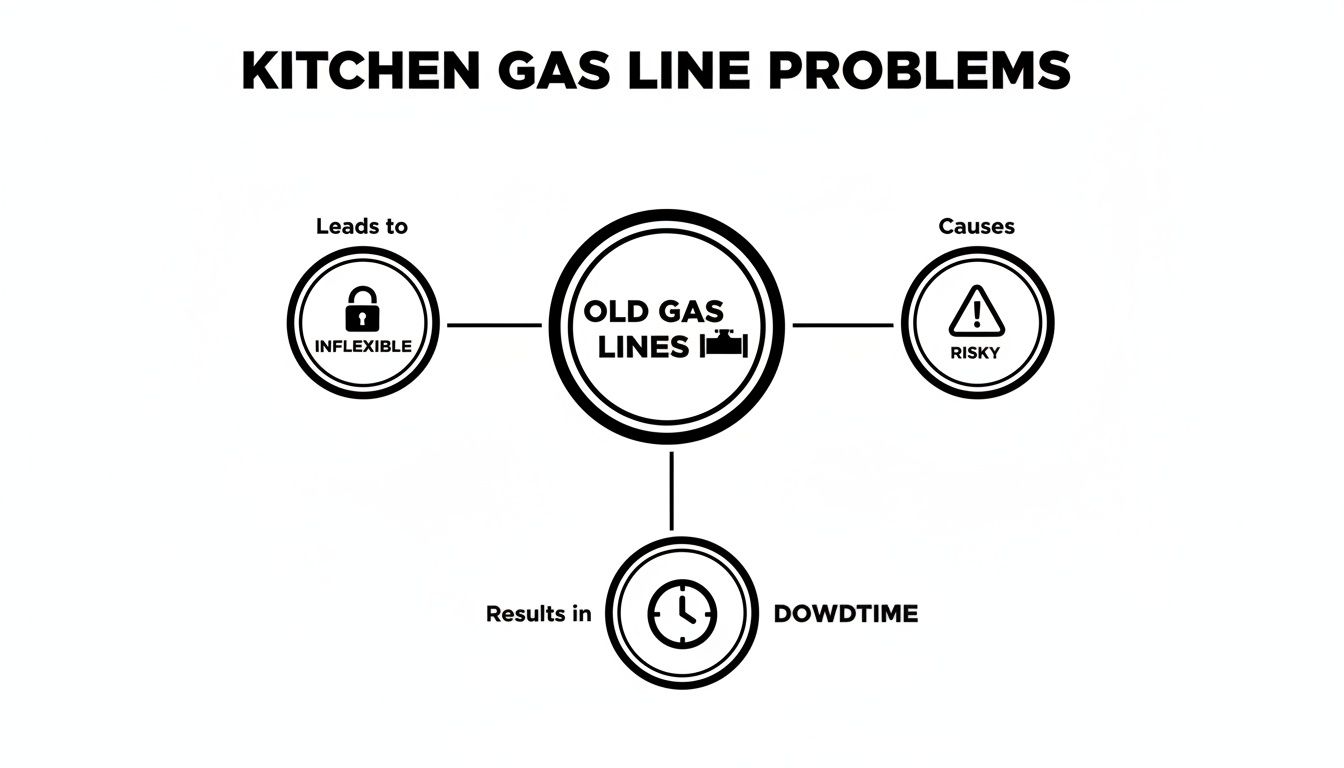
As you can see, traditional rigid piping locks your griddle in place, creates serious safety hazards, and can lead to expensive downtime. A modern quick fit system tackles all of these headaches head-on.
Materials and Durability
Let's face it, commercial kitchens are tough on equipment, and your griddle is no exception. That’s why these connectors are built like tanks. The hoses are usually made from corrugated stainless steel, which gives them the flexibility to move around without kinking or getting crushed. Most are also wrapped in a protective coating—that bright yellow plastic layer you've probably seen—which serves as a clear visual warning that it's a gas line while also shielding it from grease and harsh cleaning chemicals.
You don't just have to take my word for it; the industry is moving this way for a reason. Kitchens everywhere are choosing these solutions for their griddles because they prioritize safety and efficiency.
Of course, getting the right size is critical for performance. For more on that, check out our guide on how to select the correct natural gas line size for your griddle.
Why Your Commercial Griddle Needs This Upgrade
Let's move past the technical jargon and talk about what quick fit gas connectors actually do for your griddle day in and day out. This isn't just a minor tweak to your setup. It's a fundamental upgrade that delivers real, measurable benefits in safety, flexibility, and pure, simple efficiency. Honestly, it completely changes how you manage your most important cooking equipment.
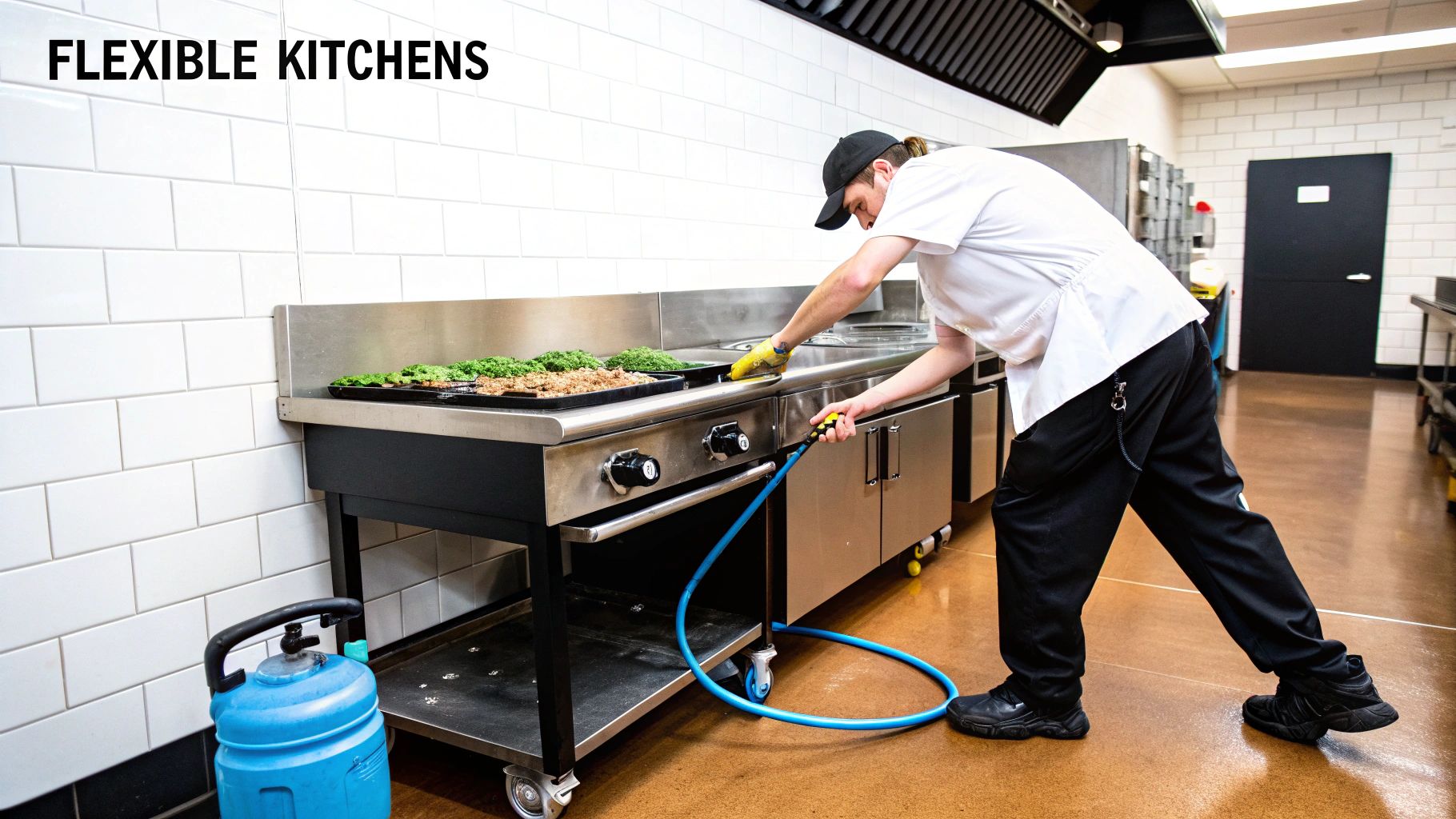
The instant you uncouple the hose, an internal valve snaps shut, stopping the gas flow dead in its tracks. That single feature is a game-changer, erasing the risk of accidental gas leaks when you’re moving the griddle or cleaning. It's the kind of peace of mind you can't put a price on.
Superior Safety and Unmatched Flexibility
Think about your end-of-week deep clean. With old-school rigid pipes, getting behind a heavy commercial griddle is a nightmare, if not downright impossible. That's where grease and grime build up, creating a major sanitation headache. A quick fit connector completely flips the script.
Your crew can safely disconnect the griddle, roll it out, and give the unit and the wall behind it a proper deep clean. Then, they can just as easily roll it back and reconnect it securely in seconds. This flexibility also means you can rearrange your cook line for a special event or a menu change without having to call in a plumber.
We see this all the time with food trucks. Maybe you need to swap out a griddle for a fryer to cater a festival. With quick fit connectors, that's a job that takes a few minutes, not a few hours, putting more money in your pocket.
You simply can't get that kind of agility with rigid, hard-piped connections.
To really see the difference, let’s compare the two systems side-by-side.
Quick Fit Connectors vs Traditional Hard-Piped Gas Lines for Griddles
| Feature | Quick Fit Gas Connectors | Traditional Hard-Piped Connections |
|---|---|---|
| Flexibility | High. Allows easy griddle movement for cleaning and reconfiguration. | None. The griddle is fixed in one location. |
| Safety | Excellent. Automatic shut-off valves prevent gas leaks. | Moderate. Relies entirely on manual shut-off valves. |
| Installation | Fast and simple for the griddle connection. | Complex and slow. Requires a licensed plumber. |
| Cleaning | Easy. The griddle can be moved for full access. | Difficult. Cleaning behind the griddle is nearly impossible. |
| Downtime | Minimal. Hose replacement is a quick swap. | Significant. Repairs require shutting down the line. |
The advantages of a modern quick fit system for your commercial griddle are pretty clear when you lay it all out.
Reduced Downtime and Simplified Compliance
In any commercial kitchen, downtime is the enemy of profit. A problem with a traditional gas line often means shutting down a critical piece of equipment like your griddle and waiting for an expensive service call. Quick fit systems slash that downtime dramatically.
If a hose assembly wears out, replacing it is a straightforward task that gets your griddle back up and running fast. You can dig into some of the market-driving safety improvements that are making this possible.
Finally, using certified quick fit gas connectors for your griddle just makes it easier to stay on the right side of strict local fire and building codes. Health and safety inspectors love these systems because they’re engineered for safety first, helping you sail through inspections without costly delays or getting hit with a list of mandatory fixes.
Choosing The Right Connector For Your Griddle
Picking out a quick fit gas connector isn’t like grabbing a new spatula off the shelf. Get it wrong, and you could starve your griddle of fuel, kill its performance, or even create a serious safety hazard.
To make sure your griddle runs flawlessly and your kitchen stays safe, you need to nail three things: sizing, gas compatibility, and the hose itself.
Sizing And BTU Rating
Think of your gas hose like a water pipe—if it's too small, all you get is a weak trickle. The same idea applies here. Your griddle’s performance depends on getting enough gas.
First, check your griddle's BTU (British Thermal Unit) rating. You’ll find this on the appliance's data plate, usually stuck on the side or back. That number tells you how much heat the griddle can generate, which means it also tells you how much fuel it needs to get there.
Every gas connector has its own maximum BTU capacity. Your job is to pick a connector with a BTU rating that’s equal to or higher than your griddle's. An undersized hose will choke the gas flow, leaving your griddle struggling to get hot and making your cook times frustratingly slow.
Gas Type Compatibility
Next up is your fuel source. You have to be certain the connector is made for the type of gas your griddle uses. Natural Gas (NG) and Propane (LP) operate at different pressures, so their connectors are absolutely not interchangeable. Trying to use a natural gas connector on a propane line is a massive safety risk.
Always double-check the product specs or the small metal tag on the hose. It will be clearly marked for "NG," "LP," or sometimes both. Never just assume it’ll work—verifying compatibility is crucial for preventing dangerous leaks and keeping your griddle running right.
Hose Length And Material
Finally, let's talk about the hose itself. It might be tempting to get an extra-long hose for maximum flexibility, but that’s a recipe for a tripping hazard in a busy kitchen. For commercial griddles, the hose should only be long enough to let you move the unit for cleaning, which is typically no more than 6 feet.
A proper fit keeps the hose from kinking, stretching, or tangling up, all of which can damage the connector over time. You want just enough slack for mobility without adding another obstacle to navigate.
Look for a hose made from corrugated stainless steel. It's the industry standard for commercial griddles because it’s tough and flexible. Most quality hoses also have a protective coating to shield them from grease and harsh cleaning chemicals. This kind of robust construction is a big reason why quick connect fittings are now essential in commercial kitchens. You can learn more about the market trends shaping commercial gas components on futuremarketinsights.com.
By carefully checking these three things—BTU rating, gas type, and construction—you can confidently pick the perfect quick fit gas connector for your commercial griddle.
Installation and Safety Best Practices
When you're dealing with gas, safety is non-negotiable. While the final hookup for your griddle's quick fit gas connectors absolutely must be done by a licensed pro, every kitchen manager should know the process and the ongoing safety checks. Getting this right isn't just about compliance—it's about keeping your griddle running smoothly and your people safe.
First things first: the main gas supply gets shut off. No exceptions. From there, a professional will apply the proper pipe sealant to all the threads before attaching the connector's socket to the main gas line. This step is crucial for creating that airtight, secure seal you need. And remember, this is just one part of the puzzle; it's vital to install natural gas lines safely and correctly from start to finish.
Performing A Leak Test
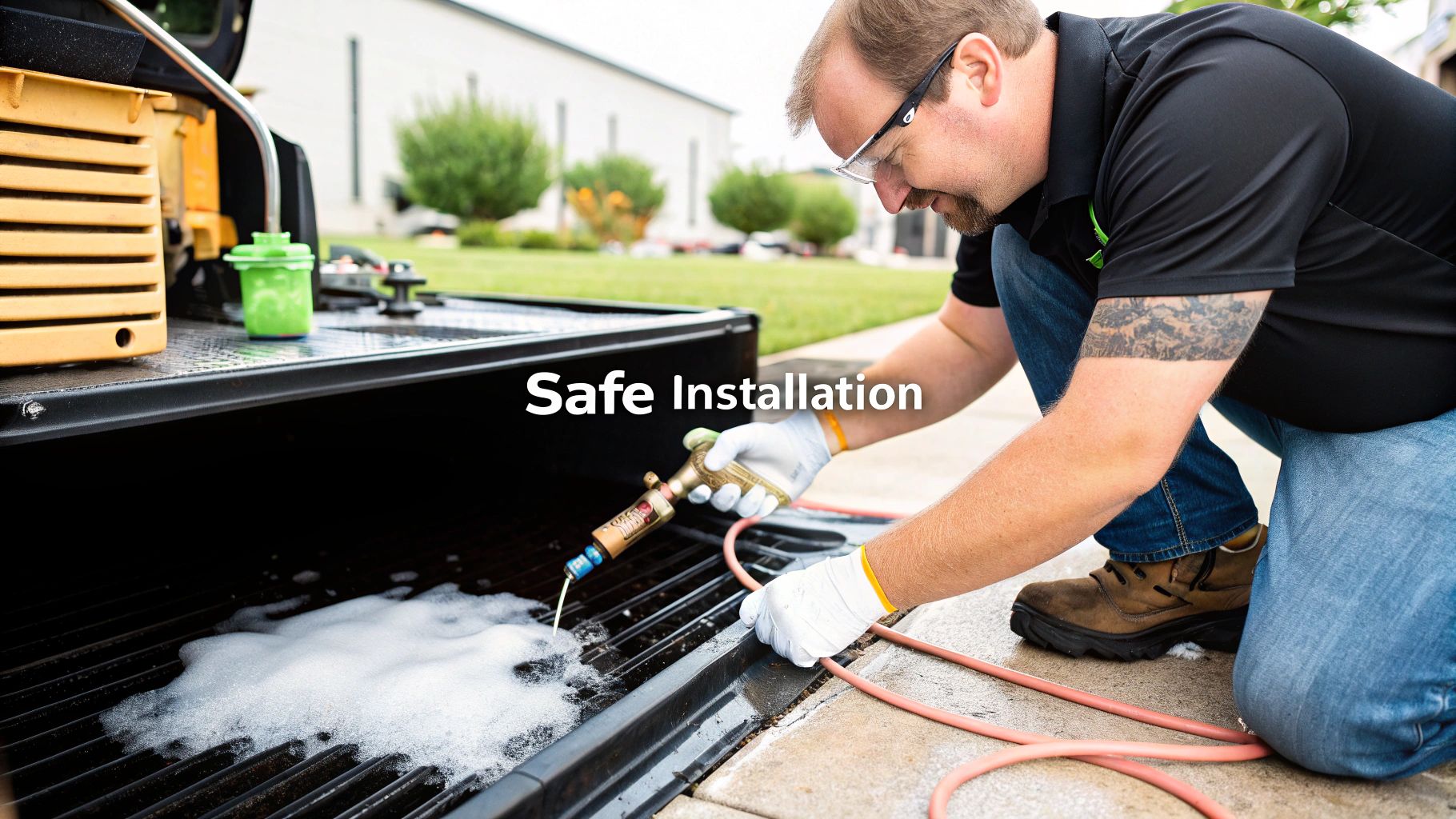
Once the hose is connected to the griddle, it's time for the most important safety check of all: the leak test. It’s a simple but incredibly effective procedure. The installer will turn the gas back on and spray or brush a soapy water solution on every connection point. If you see bubbles forming, that's your sign of a gas leak that needs to be fixed immediately, usually by tightening or resealing the connection.
Crucial Reminder: We can't say it enough—leave the initial installation and any gas line work for your griddle to the qualified professionals. Following local fire and building codes isn't optional. It's a legal requirement that protects your business, your staff, and your customers.
For kitchens that need to be flexible with their fuel, understanding the conversion process is key. If you ever find yourself needing to switch things up, take a look at our guide on how to convert natural gas to propane for your griddle.
The Role Of The Restraining Cable
One of the most overlooked but essential parts of a quick connect system for a griddle is the restraining cable. Think of this strong steel cable as a leash connecting your griddle to the wall. Its job is to stop anyone from accidentally pulling the griddle too far out for cleaning, which could stretch and damage the gas hose or even break the connector. It's a simple part that prevents a potentially catastrophic failure.
A little routine maintenance goes a long way in keeping your setup safe for years to come. Just run through this quick checklist for your griddle's connection regularly:
- Monthly Visual Check: Give the hose a once-over. Look for any cracks, kinks, or worn-down spots.
- Connection Point Integrity: Make sure the connector and the restraining cable are still tightly secured. Keep them clean from any heavy grease buildup that could hide a problem.
- Immediate Replacement: If you spot any damage to the hose, don't even think about patching it up. Replace the entire assembly right away.
Frequently Asked Questions
When it comes to quick fit gas connectors for your commercial griddle, a few questions always pop up. Getting them sorted out is key to keeping your kitchen safe, efficient, and up to code. Let's tackle the most common ones.
Can I Use The Same Connector For a Natural Gas and Propane Griddle?
The short answer is no—unless the connector is specifically marked as dual-rated by the manufacturer. This is a big one. Natural gas (NG) and propane (LP) run at totally different pressures. Using the wrong hose for your griddle isn't just a performance issue; it's a serious safety hazard that could lead to dangerous gas leaks.
Always, always check the specs. The connector itself or its metal tag should clearly state if it's for "NG," "LP," or both. If you have any doubt, don't guess. Call in a professional to confirm you have the right gear before hooking up your griddle.
How Often Should I Inspect My Griddle Gas Hose?
Think of this as a non-negotiable part of your kitchen's safety routine. A quick visual check of your griddle's gas hose should happen at least once a month.
Be on the lookout for any signs of wear and tear, including:
- Cracking or fraying on the outside of the hose.
- Any kinks or sharp bends that could restrict gas flow.
- Thick grease buildup that might be hiding damage underneath.
- Scuff marks from rubbing against other equipment.
Also, whenever you're doing a deep clean, give the restraining cable a quick tug to make sure it's secure and that all the connection points are clean. If you spot any damage, even minor, replace the entire hose assembly immediately. Don't take chances.
Professional Tip: While your kitchen staff can handle the daily operations, the initial hookup of the gas line to your building's supply and the griddle needs to be done by a licensed and insured plumber or gas fitter. This ensures everything is leak-free and meets local safety codes.
At Griddles.com, we're here to make sure you have the right accessories to keep your commercial griddle humming along safely and efficiently. Check out our lineup of commercial griddles and the connection kits to match.