

Gas Quick Connect Fitting: How to Choose and Install Safely for Your Commercial Griddle
Hooking up your commercial griddle shouldn't feel like a permanent, high-stakes plumbing job. Think of a gas quick connect fitting as a secure, heavy-duty docking station for your gas line. It’s a simple piece of hardware that makes it safe and incredibly easy to plug in or unplug your griddle whenever you need to. This small part delivers huge advantages for any modern commercial kitchen.
Why Your Commercial Kitchen Needs a Gas Quick Connect Fitting
In the chaos of a restaurant or food truck, you live and die by efficiency and safety. A fixed gas line—where your griddle is hard-piped straight into the wall—is a major operational bottleneck. Every time you need to pull the unit out for a deep clean, service it, or just rearrange the cook line, it turns into a massive project, often forcing you to call in a professional plumber.
A gas quick connect fitting completely flips the script. It gives your griddle a level of flexibility that's just not possible with rigid, old-school piping. It's like the difference between being stuck with a landline phone from the 90s and having the freedom of a modern smartphone—one keeps you tethered to the wall, while the other lets you move.
The Impact on Kitchen Operations
That freedom translates directly to better kitchen management and, frankly, a much cleaner space. When your griddle can be safely disconnected and rolled out of the way in seconds, your crew can actually get behind and underneath it for daily and weekly cleanings. This isn't just about looking good; it's about crushing health inspections and keeping pests out.
But the benefits of a gas quick connect for your griddle go way beyond just cleaning.
- Simplified Maintenance: Got a griddle acting up during the dinner rush? No problem. You can swap it out for a backup unit in minutes, minimizing downtime and saving sales.
- Enhanced Safety: The fitting has a brilliant internal valve that automatically slams the gas flow shut the second you disconnect it. This built-in feature is your first line of defense against dangerous gas leaks.
- Operational Agility: Need to change your kitchen layout for a special event or a menu overhaul? Easy. You can test new workflows without having to budget for expensive plumbing work.
A gas quick connect isn't a luxury; it's a foundational tool for a flexible and safe commercial kitchen. It turns a static, immovable griddle into a mobile asset that adapts to your daily operational needs.
At the end of the day, this one component helps you build a more efficient and adaptable kitchen, letting you and your team focus on what really matters—pumping out amazing food.
Decoding Gas Fitting Types and Specifications for Griddles
To pick the right gas quick connect fitting for your commercial griddle, you have to know what you’re looking at. The whole setup is a simple two-part system: you have the plug (the male end, which usually goes on the griddle’s gas hose) and the socket (the female end, attached to your gas supply line).
When you push them together, they click into place and form a rock-solid, leak-proof seal. The magic happens when you pull them apart—an internal valve snaps shut instantly, cutting off the gas flow automatically. It’s this smart, simple design that makes them so safe and popular in busy kitchens. But not all fittings are the same; the materials, pressure ratings, and thread types need to be a perfect match for your griddle to run safely and cook properly.
Material Choices: Brass vs. Stainless Steel
The first big decision is what your fitting is made of. This choice directly affects how long it will last and how well it stands up to the daily grind of a commercial kitchen.
- Brass: This is the go-to for most gas fittings. It’s the reliable workhorse you’ll see in countless restaurants. Brass offers good corrosion resistance and is plenty durable for most indoor setups, holding its own against cleaning chemicals and the occasional splash.
- Stainless Steel: If you need the absolute best in durability, especially for a food truck griddle exposed to rain or a kitchen with high humidity, stainless steel is the top-tier option. It provides superior protection against rust and corrosion, ensuring a much longer lifespan under tough conditions.
While brass gets the job done for most, think of stainless steel as an investment, especially for mobile kitchens where it's constantly battling the elements.
Gas Fitting Material and Application Comparison
Choosing the right material isn't just about price—it's about matching the fitting to the environment it will live in. A damp, busy kitchen or an outdoor food truck has very different needs than a climate-controlled indoor setup.
| Material | Corrosion Resistance | Durability | Best For | Common Applications |
|---|---|---|---|---|
| Brass | Good | High | General indoor use, budget-conscious setups | Most commercial kitchens, diners, restaurants |
| Stainless Steel | Excellent | Very High | High-moisture areas, outdoor use, food trucks | Mobile kitchens, coastal locations, wash-down areas |
Ultimately, the goal is to prevent rust and degradation that could compromise the seal and lead to dangerous leaks. For peace of mind in demanding environments, stainless steel is often worth the extra cost.
Matching Pressure and Flow Capacity
After materials, you’ve got to get the technical specs right. Two numbers are critical here: the pressure rating (measured in PSI) and the flow capacity (measured in BTUs). Look at your griddle’s data plate—it will tell you the maximum BTU requirement. This is the amount of gas energy it needs to hit full power.
Your gas quick connect fitting must have a BTU rating that is equal to or, even better, higher than what your griddle demands. Using an undersized fitting is like trying to run a race car on a trickle of fuel. It will starve the griddle, leading to weak flames, slow preheating, and inconsistent cooking temperatures.
This isn’t a suggestion; it’s a non-negotiable for getting the performance you paid for. The market for these fittings is huge—valued at around USD 9.98 billion in 2024—so there are plenty of options. For restaurant owners, this means access to better technology that can slash griddle setup time by 40-55%, getting you up and running faster.
The Importance of Thread Standards
Finally, let's talk threads. The threads on your fitting and your gas line must be a perfect match. No exceptions. In North America, the standard you'll almost always see is NPT (National Pipe Taper).
NPT threads are tapered, meaning they get a tiny bit wider toward the base. When you tighten them down with a wrench and some thread sealant, this taper wedges the threads together to create an incredibly tight, secure seal. Trying to mix NPT with another thread type is a recipe for disaster and will absolutely cause a dangerous gas leak. Before you buy, taking a moment for some background reading on understanding thread types for plumbing fittings is a smart move for a safe connection.
And don’t forget to match your fitting to your fuel source. Our guide on the differences between natural gas vs propane for commercial griddles can help make sure you’ve got all your components lined up correctly.
Matching the Right Fitting to Your Commercial Griddle
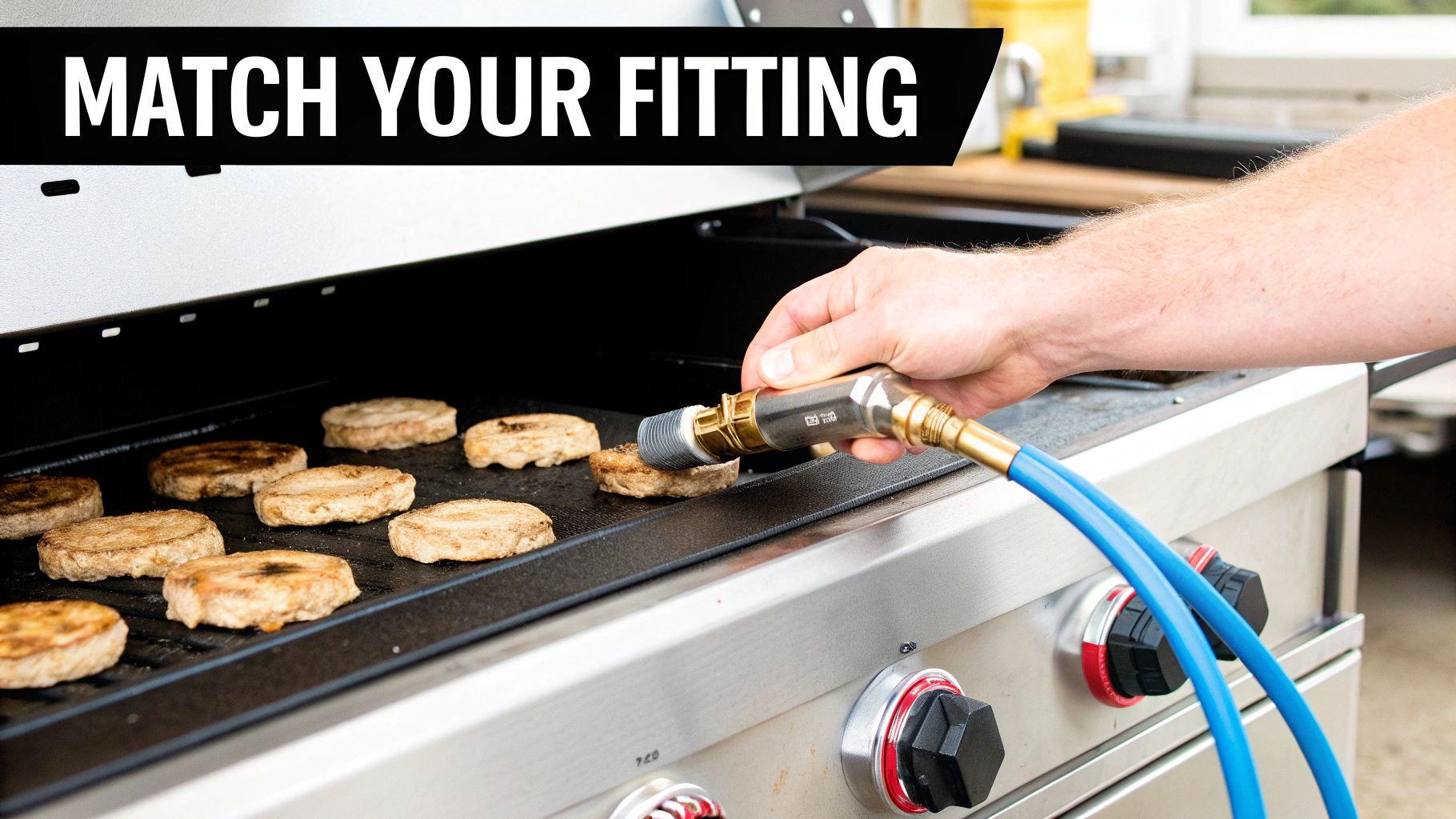
Choosing the right gas quick connect fitting isn't a guessing game. It's about knowing your specific commercial griddle inside and out. The whole process boils down to understanding your fuel source and what your equipment needs to run at its best. Nail this, and you'll have a griddle that performs safely and flawlessly, day after day.
The first big question is: natural gas or propane? Are you hooking up to the building's main line, or are you running off a portable tank? These two fuels aren't interchangeable. They operate at completely different pressures and demand their own specific regulators and hoses.
A natural gas setup is low-pressure, typically around 4 inches of water column. Propane, on the other hand, runs at a much higher pressure—usually about 11 inches of water column. Mix and match these components, and you're asking for trouble, from poor cooking performance to serious safety hazards.
Your Griddle's Data Plate is the Key
Want to take all the guesswork out of the equation? Find your griddle's data plate. This little metal tag, usually tucked away on the back or side of the unit, is your single source of truth. It's the griddle's instruction manual, all in one place.
Think of the data plate as your griddle's birth certificate. It spells out exactly what it is and what it needs, leaving no room for error.
Here’s what you're looking for on that plate:
- Gas Type: It will clearly state whether the griddle is set up for Natural Gas (NG) or Propane (LP).
- Pressure Requirement: You'll see a value measured in Inches of Water Column (" W.C.). This number has to match the regulator on your gas line perfectly.
- Total BTU Rating: This tells you the griddle's maximum appetite for fuel. Your entire gas quick connect assembly—the fitting, the hose, everything—must be rated to handle this BTU load or more.
A common mistake is getting fixated on the pipe size and forgetting about the BTU capacity. An undersized fitting will starve your griddle of fuel. The result? Weak flames, painfully long preheat times, and uneven cooking temps, no matter how high you crank the dial.
Connecting the Dots for a Perfect Match
Once you've got this info from the data plate, you can pick out a compatible gas quick connect fitting with confidence. For example, if your griddle’s plate calls for 120,000 BTU/hr for natural gas at 4" W.C., you absolutely need a fitting and hose assembly certified for at least that BTU load and built for low-pressure NG systems.
Of course, you also have to make sure your gas line can even deliver that kind of volume in the first place. We've got another guide that dives into figuring out the right natural gas line size for your commercial kitchen.
By matching these specs exactly, you're not just connecting a hose. You're creating a safe, efficient, and leak-free system that lets your griddle do what it does best.
Meeting Safety Codes for Commercial Griddle Gas Connections
When you're dealing with gas in a fast-paced commercial kitchen, safety isn't just a good idea—it's the law. A gas quick connect fitting gives your griddle incredible flexibility for cleaning and maintenance, but that convenience has to be built on a rock-solid foundation of safety codes. This goes way beyond avoiding fines; it’s about protecting your people, your customers, and your entire business.
Every single part of your gas line, from the hose to the fitting, has to be certified for commercial use. This isn't the place to cut corners. Look for parts with an ANSI/CSA certification stamped on them. That seal is your guarantee the equipment has been put through the wringer—tested to handle the high heat, grease, and constant jostling of a professional cook line. Slapping a non-certified residential hose on a commercial griddle is a major code violation and, frankly, a massive fire risk.
Mandatory Safety Components
Beyond getting the right parts, fire codes require specific safety gear for any gas griddle that can move, especially one on casters. These aren’t optional upgrades. They are non-negotiable components you absolutely must have to pass a fire marshal inspection. Your insurance company will likely demand them, too.
Two pieces of hardware are always required:
- A Manual Gas Shut-Off Valve: This valve has to be installed in the gas line before the flexible hose and quick connect. It needs to be somewhere obvious and easy to reach, so any staff member can kill the gas flow to the griddle in a heartbeat during an emergency.
- A Restraining Device: Think of this as a heavy-duty, coated steel cable that tethers your griddle to the wall. Its only job is to stop the griddle from being pulled out too far. This prevents the gas hose from being stretched, kinked, or yanked out of the wall—any of which could be disastrous.
The restraining cable is a simple but brilliant safety feature. It’s essentially a seatbelt for your griddle. It makes sure the gas connection is never the thing that stops the equipment from moving, preventing a catastrophic failure.
Understanding NFPA Guidelines
The rulebook for all of this comes from the National Fire Protection Association (NFPA). Specifically, you'll be dealing with NFPA 54 (National Fuel Gas Code) and NFPA 96 (Standard for Ventilation Control and Fire Protection of Commercial Cooking Operations). These are the national standards that most local fire codes are built on. They cover everything from how to install your equipment to the exact type of connectors you can use.
If you don't meet these standards, you won't pass your inspection. That means you could be forced to shut down until you fix the problems.
A proper gas setup is also just one piece of the puzzle. It needs to work hand-in-hand with your kitchen's fire safety system, especially ventilation. To get the full picture, check out our guide on commercial kitchen ventilation systems. When your gas connections and ventilation are in sync, you create a much, much safer place to cook.
Your Step-By-Step Installation and Leak Testing Guide
Alright, let's get hands-on. Safely hooking up a gas quick connect fitting to your commercial griddle isn't complicated, but you absolutely have to do it by the book. This is one of those times where "close enough" isn't good enough.
We'll walk through everything from prep work to the final, all-important leak test. Get this right, and your kitchen will be safer and more efficient for it.
First thing's first, and this is non-negotiable: shut off the main gas supply valve. Before you even think about picking up a wrench, find that valve and turn it off. It's also a good idea to make sure the area is well-ventilated to let any lingering gas dissipate.
Preparing and Connecting the Fitting
With the gas safely off, it's time to prep the threads. You never want to connect metal threads dry; those tiny, microscopic gaps are exactly where dangerous leaks start.
- Clean the Threads: Grab a wire brush and give both the male threads on the gas line and the female threads on your new fitting a good cleaning. You want to get rid of any old pipe dope, gunk, or dirt that could compromise the seal.
- Apply Thread Sealant: Wrap the male threads with 2-3 layers of yellow PTFE tape, which is specifically rated for gas. Make sure you wrap it in a clockwise direction—the same way the fitting will tighten. You can also use a gas-rated pipe dope sealant instead.
- Tighten the Connections: Start by threading the fitting on by hand. Once it’s finger-tight, use two wrenches. One wrench holds the pipe or griddle inlet steady (this is key to prevent damage), while the other tightens the fitting. You're aiming for snug and secure, but do not over-torque it. Cranking down too hard can crack the fitting, and then you're back to square one.
The Critical Soap Bubble Leak Test
Once everything is connected and tight, you have to check your work. A leak test is the only way to be 100% certain the connections are gas-tight. Don't even think about skipping this.
Mix up a simple solution of dish soap and water. A 50/50 ratio is perfect. Now, slowly and carefully turn the main gas supply back on.
Using a small brush or a spray bottle, coat every single connection point you just made with the soapy water.
The science here is simple: if any gas is escaping, it has to push through that soapy film, and it will create bubbles. Watch each joint like a hawk for a few seconds. You're looking for anything from a slow-growing bubble to a tiny, champagne-like fizz.
This simple flowchart breaks down the three pillars of a safe gas connection.
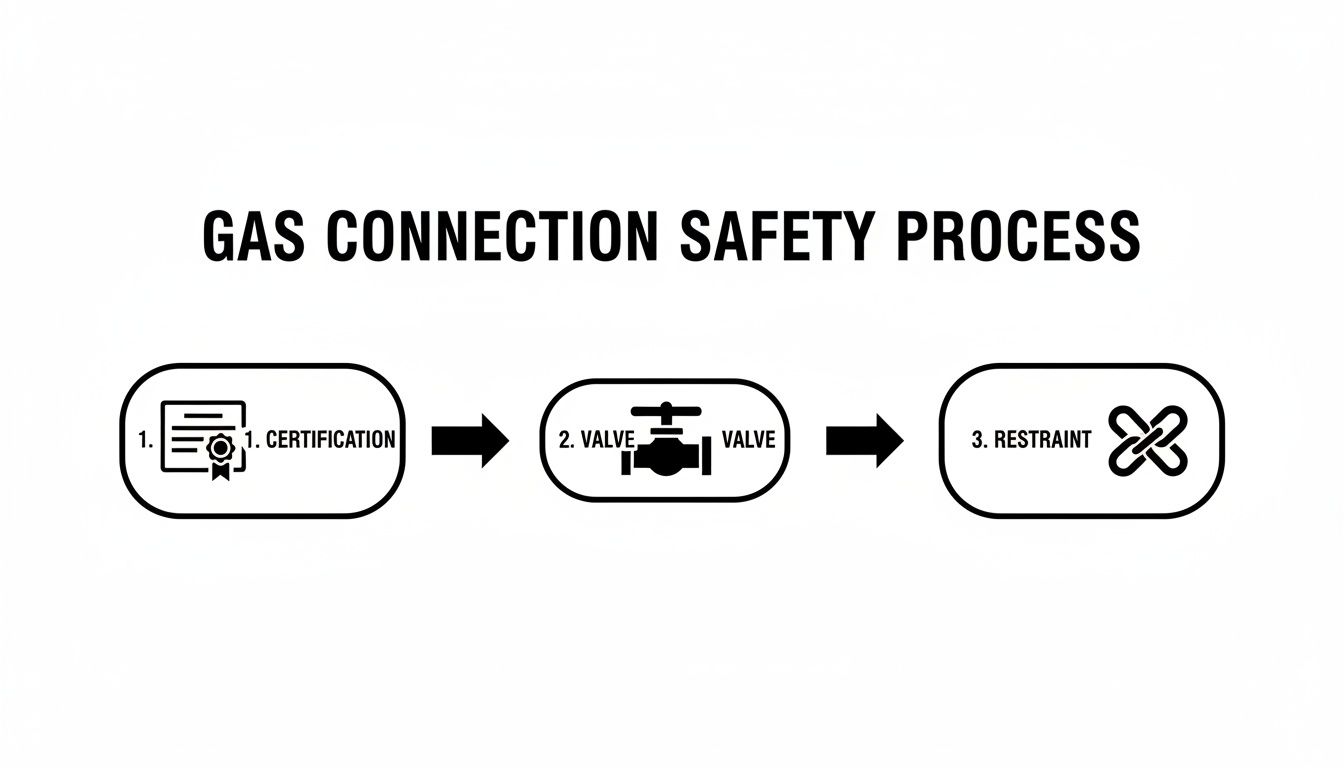
As you can see, a safe setup is about more than just a tight connection; it's about using certified parts, having an accessible shut-off valve, and using proper restraints.
If you see any bubbles forming, shut the gas off immediately. That's a leak. You'll need to disconnect the fitting, thoroughly clean the threads again, reapply your sealant, and tighten it back up. Then, test it again. Never, ever fire up a griddle if you know there’s even a tiny leak.
Troubleshooting Common Griddle Gas Fitting Issues
Even the best gas quick connect fitting isn't a "set it and forget it" piece of equipment. To keep your commercial griddle running smoothly day after day, you’ll need to give your setup a little attention. Think of it as preventative maintenance—a few minutes of inspection can save you from a major headache during a dinner rush.
A good habit to get into is giving the gas hose a quick visual check at least once a month. Look for the obvious stuff: cracks, kinks, or any spots where it looks like it's been rubbing against other equipment. Pay extra attention to the areas right by the fittings, as that’s where a lot of stress happens. You also want to keep an eye out for heavy grease buildup, which can eat away at the hose material over time.
Identifying and Solving Common Problems
Even with regular checks, things can still go wrong. Knowing how to spot the signs of a problem can get you back up and running fast, minimizing that dreaded downtime.
Here are a few common issues you might run into and what to do about them:
- Fitting Won't Connect: You're trying to hook it up, but the male and female ends just won't click. Nine times out of ten, the culprit is debris. Check both ends for stray food particles or grime and wipe them clean with a soft cloth. Sometimes the sleeve on the female connector gets sticky or dirty, preventing it from retracting like it should.
- Reduced Gas Flow: Are your griddle flames looking weak and yellow, and the surface just isn't getting hot enough? This usually signals a blockage. The problem could be a simple kink in the hose, a gas valve that's not fully open, or some gunk that's found its way inside the fitting.
- Faint Gas Smell: This is the big one. An immediate red flag for a slow leak. Shut off the gas supply immediately and do a soap bubble test on all your connections. If you spot bubbles, try tightening the connection and test it again.
Never, ever ignore even a faint smell of gas. While these quick fixes can solve minor problems, a persistent issue is a job for a professional. In a commercial kitchen, safety always comes first.
If you’ve done your leak tests and tried these simple troubleshooting steps but are still having problems, it's time to call in an expert. Professional gas line repair is the only safe option. A licensed technician can find more complex issues with the line or the regulator that go beyond a simple fitting, ensuring your entire system is safe and up to code.
Frequently Asked Questions About Griddle Gas Fittings
Even with the best instructions in front of you, hooking up a gas quick connect fitting can leave you with a few lingering questions. Getting things right is crucial for keeping your griddle running safely and your kitchen humming. Let's tackle some of the most common questions we hear.
Can I Use the Same Fitting for Natural Gas and Propane?
This is a big one, and the short answer is no, not really. While the metal quick-connect fitting itself might be rated for both gases, the complete setup—the hose and the regulator—is absolutely gas-specific.
Natural gas and propane operate at entirely different pressures. Trying to use a natural gas hose on a propane griddle (or vice versa) is a recipe for poor performance at best and a serious safety hazard at worst. Always match the entire hose assembly to your fuel source.
How Often Should I Inspect My Gas Hose and Fitting?
Think of it like a quick health check for your griddle. At least once a month, give the gas hose a good visual inspection. You're looking for any red flags: cracks, deep kinks, or heavy grease buildup that could be hiding damage.
For a more thorough check, you should perform a full soap bubble leak test every six months. You'll also want to do this anytime you move the griddle or disconnect the hose. It's a small task that offers huge peace of mind.
By the way, most places require a restraining device for any movable gas appliance like a griddle, and for good reason. Codes like NFPA 54 mandate them to stop the gas hose from getting stretched, yanked, or damaged, which could easily cause a dangerous leak.
It’s no surprise that these quick disconnects are becoming standard in commercial kitchens. The market for them was valued at USD 2.7 billion in 2024 and is expected to climb to USD 3.8 billion by 2030. That growth, highlighted in reports from Strategic Market Research, shows just how essential they've become for modern cooking operations.
Ready to give your kitchen the flexibility and safety of a proper quick-connect setup for your griddle? At Griddles.com, we carry a full lineup of commercial griddles and all the essential fittings to get you cooking safely and efficiently. Explore our selection today and find the right gear for your operation.