

Quick Connect Gas Fittings for Commercial Griddles
A quick connect gas fitting is your secret weapon for a faster, safer, and way more flexible commercial griddle setup. It lets you hook up and unhook your commercial griddle from its gas line in seconds—no tools, no fuss. What used to be a pain is now a simple click, giving you the kind of agility every commercial kitchen needs.
The Secret to a Faster, Safer Kitchen Workflow
Picture this: It's the peak of the breakfast rush. Your team is flying, and the commercial griddle needs to be hot now. The difference between a clunky, tool-fumbling setup and a smooth start is that tiny but powerful quick connect gas fitting. This isn't just another piece of hardware; it’s the key to keeping your commercial griddle operational when demand is high.
Think of it like a pit crew's air gun versus a standard lug wrench. One is built for pure speed and reliability under pressure; the other is slow and clunky. That’s what this fitting does for your commercial griddle's gas connection—it makes it fast and secure.
Boosting Kitchen Agility and Safety
The real-world benefits of using these fittings on your commercial griddle are huge. We’re talking about more than just convenience; these advantages hit on the core of smart kitchen management.
- Unmatched Speed: In a world where every second matters, these fittings demolish setup time for your commercial griddle. In fact, they can cut connection time by 40-55%, turning a 30-minute chore into a quick 10-minute task. You can dig into more data on kitchen efficiency gains in market growth reports.
- Enhanced Safety: The built-in automatic shut-off valve is a total game-changer for your griddle's connection. The second you disconnect, it kills the gas flow. No leaks, no danger. It's a non-negotiable feature for any busy kitchen.
- Greater Flexibility: For kitchens that deep clean their commercial griddles every night or food trucks that are constantly on the move, being able to safely detach a griddle in seconds is a lifesaver.
By making the connection process so simple, a quick connect gas fitting empowers your staff to handle the commercial griddle with confidence. They can maintain a cleaner kitchen and adapt to menu changes without having to call in a technician.
This small upgrade makes a massive difference in your daily workflow. It smooths out everything from morning prep to nightly cleanup, making sure your commercial griddle is always ready when you are. This is especially important in kitchens where clean spaces and proper airflow are critical, a topic we dive into in our guide on commercial kitchen ventilation requirements.
How a Quick Connect Gas Fitting Actually Works
To really get why a quick-connect gas fitting is a must-have for any modern commercial griddle, you have to look at its simple but incredibly smart design. It’s more than just a connector; think of it as a purpose-built lock and key system for your gas line, designed from the ground up for safety and speed.
The whole thing is made of two main parts. First, you’ve got the plug—the male end—which is what you’ll find attached to your commercial griddle's flexible gas hose. Second is the socket, the female end that gets installed right onto your main gas supply pipe. But the real genius is tucked away inside that socket.
The Anatomy of a Secure Connection
Inside the socket, there's a spring-loaded valve that automatically shuts off the gas. When nothing is connected, that internal valve stays completely sealed, stopping any gas from flowing out. This is the single most important safety feature, preventing a dangerous leak if the hose is ever disconnected from your commercial griddle, whether you're doing it on purpose for a deep clean or it gets snagged by accident.
The moment you push the plug into the socket, it presses against that valve and opens it up, letting the gas flow freely to your griddle. At the exact same time, a locking mechanism—usually a ring of tiny ball bearings—snaps securely into a groove on the plug. This creates a rock-solid, vibration-proof seal that simply won't pop loose during the chaos of a busy dinner rush.
This diagram shows how these simple fittings are the unsung heroes of kitchen efficiency, boosting everything from speed to safety for your commercial griddle operation.
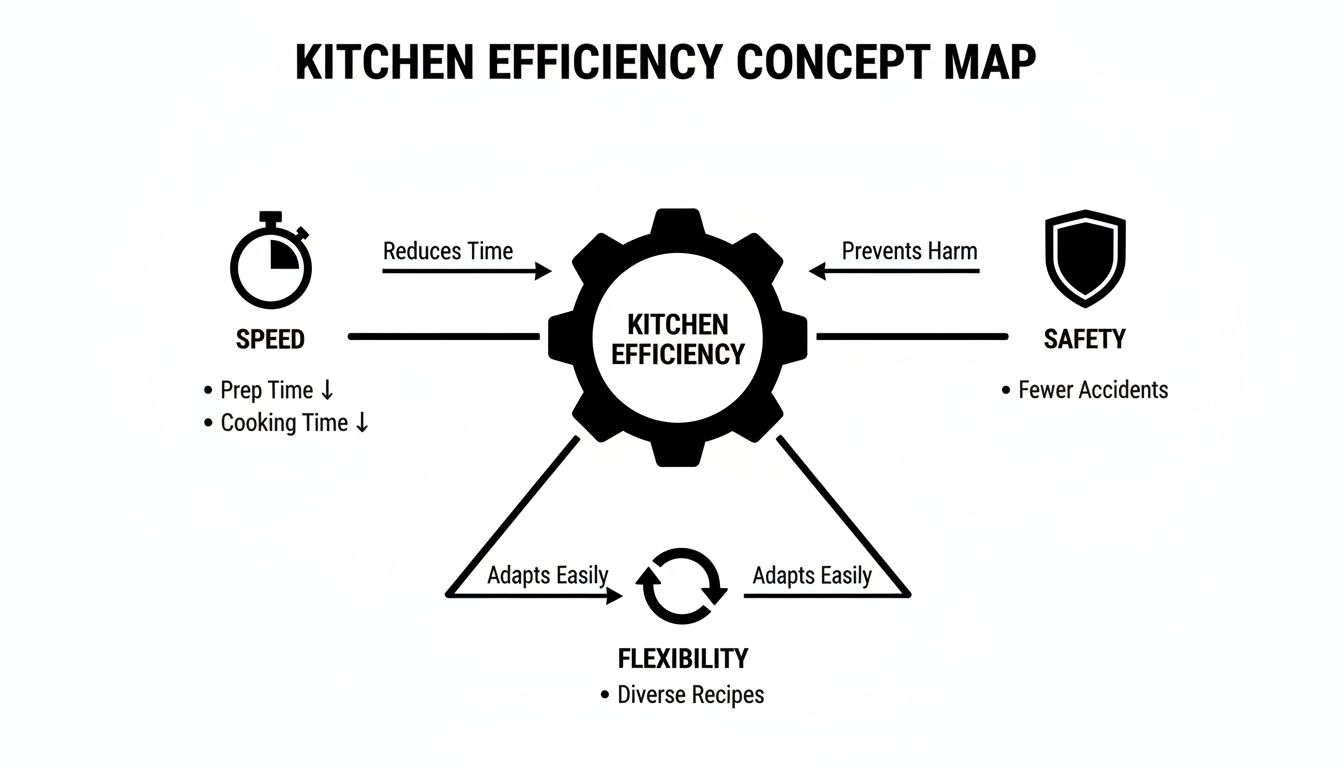
As you can see, the basic function of the fitting directly ties into the most critical parts of running a smooth, high-output kitchen centered around your commercial griddle.
Materials Matter for Durability
In a commercial kitchen, the griddle and its components take a beating. That’s why the materials used for these fittings are chosen specifically for toughness and their ability to resist corrosion.
- Brass: This is the workhorse material for most fittings. It's tough, stands up well against both natural gas and propane, and doesn't rust easily. For most indoor restaurant setups with a commercial griddle, it’s the go-to, reliable choice.
- Stainless Steel: If your commercial griddle setup is exposed to more moisture, harsh cleaning chemicals, or the elements (like on a food truck), you'll want to step up to stainless steel. It offers far superior corrosion resistance and will last longer in those tougher conditions.
By combining that fail-safe valve, a solid locking system, and rugged materials, the quick-connect gas fitting delivers the perfect mix of convenience and peace of mind for any professional commercial griddle setup.
Choosing the Right Fitting for Your Commercial Griddle
Picking the right quick connect gas fitting for your commercial griddle isn't as simple as grabbing one off the shelf. Get it wrong, and you could starve your griddle of fuel, leading to lukewarm spots and painfully slow recovery times during a rush. Even worse, the wrong part can create a serious safety hazard. To get peak performance and a secure setup for your commercial griddle, you've got to match the fitting perfectly to your equipment.
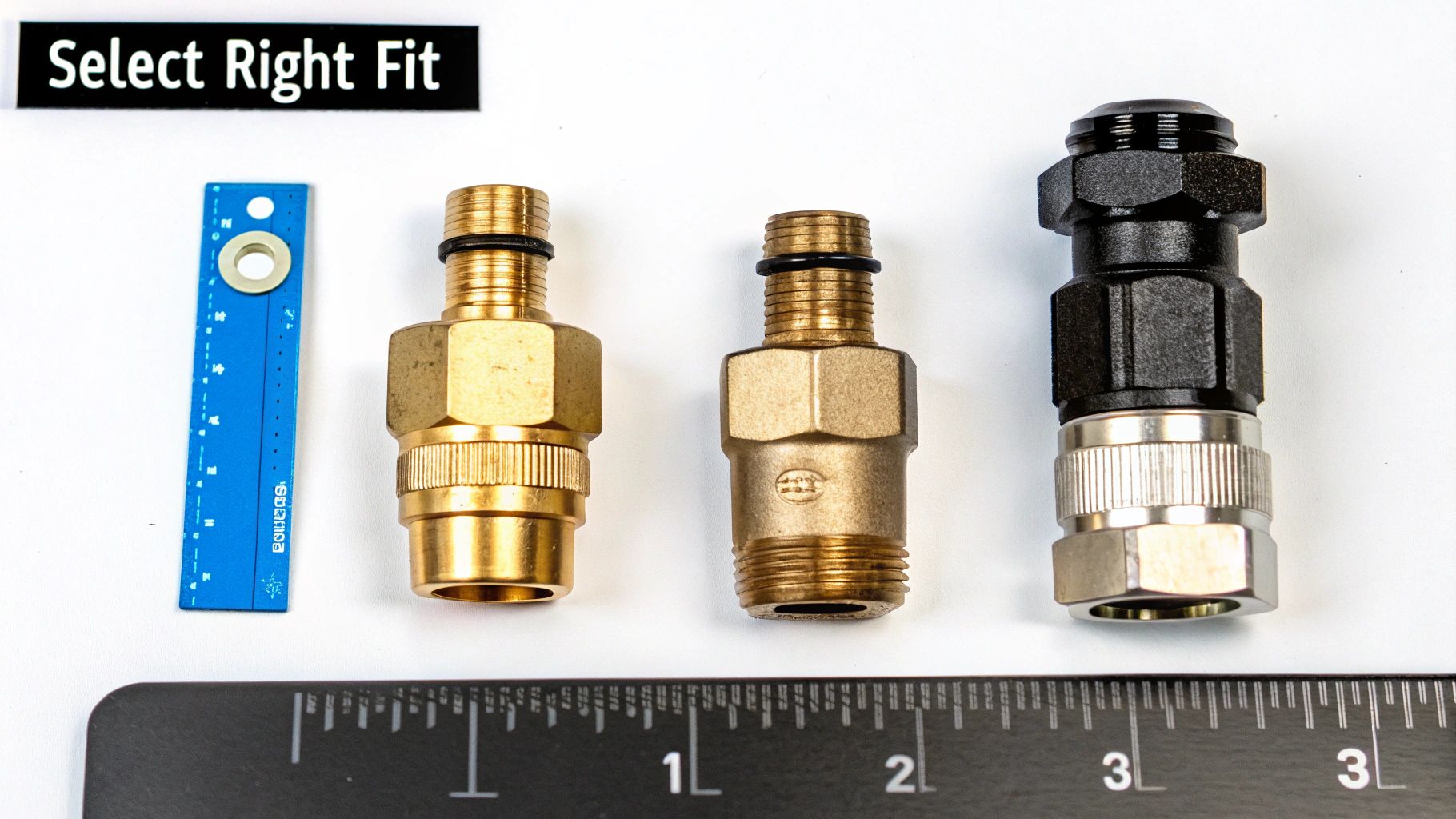
Think of it like this: you wouldn't try to fuel a monster truck through a tiny straw. The same principle applies here. Let's walk through the three most critical things you need to get right for your commercial griddle.
Match the Gas Type Correctly
First things first: fittings for Natural Gas (NG) and Propane (LP) are not interchangeable. This is the golden rule for any commercial griddle. These two gases operate at very different pressures, so the fittings are engineered specifically for one or the other. Using an LP fitting on an NG line can choke the gas flow, and putting an NG fitting on an LP line is asking for a dangerous leak.
- Natural Gas (NG): This is what's typically piped directly into a building for equipment like your commercial griddle. It runs at a lower pressure.
- Propane (LP): This comes from tanks and operates at a much higher pressure, common for food trucks with commercial griddles.
Always double-check your commercial griddle’s specs and your kitchen’s gas supply before buying anything. To get a better handle on the two, check out our guide on the differences between natural gas and propane.
Size and Flow Capacity Matter
Next up, you need to match the fitting’s size and flow capacity to your commercial griddle’s power, measured in British Thermal Units (BTUs). A beast of a 48-inch commercial griddle might demand 120,000 BTUs or more, while a smaller 24-inch countertop unit might only need 60,000 BTUs. An undersized fitting acts like a bottleneck, plain and simple. It restricts the gas and stops the griddle from ever getting as hot as it should.
A fitting that's too small for a high-BTU commercial griddle is a recipe for frustration. You'll experience inconsistent heat, slow pre-heating, and poor performance during a busy service when you need reliability the most.
So, how do you find the right size? Crack open the commercial griddle's manual. Look for its total BTU rating and the required gas inlet size (it's usually 1/2" or 3/4" NPT). Make sure the quick connect fitting you choose is rated to handle that BTU load and matches the inlet diameter. No guesswork allowed.
Look for Safety Certifications
Finally, never, ever buy a gas fitting for your commercial griddle that doesn't have a recognized safety certification mark on it. These logos are your guarantee that the part has been put through the wringer—tested for durability, safety, and performance. In the U.S. and Canada, you'll want to see one of these:
- CSA (Canadian Standards Association): A gold standard for gas appliance components across North America.
- UL (Underwriters Laboratories): A global safety science company that certifies a huge range of products.
- ETL (Intertek): Another common mark showing a product meets North American safety standards.
These certifications confirm that the fitting’s automatic shut-off valve works like it's supposed to and that its materials can handle the heat of a commercial kitchen. Using a non-certified quick connect gas fitting on your commercial griddle isn't just a gamble with your safety; it could get you in hot water with local health and fire inspectors.
Mastering Safe and Compliant Installation
When you’re working with gas lines for a commercial griddle, there’s zero room for error. Safety is everything. While installing a quick connect gas fitting is a job for a licensed professional, understanding the process helps you make sure it’s done right.
A proper installation is all about following a strict, methodical process. It always, always starts with shutting off the main gas supply to the line you're working on. This isn't a friendly suggestion—it’s the absolute first step to prevent gas from flooding the area around your commercial griddle.
Key Steps for a Leak-Proof Seal
Once the gas is off, the entire focus shifts to creating a secure, completely leak-proof connection at the threads. This is where the right tools and techniques make all the difference for your commercial griddle's safety.
- Thread Sealant: A high-quality thread sealant or gas-rated Teflon tape is a must. It gets applied to the male pipe threads, filling any tiny, microscopic gaps to guarantee an airtight seal once the fitting is tightened.
- Proper Tightening: You need the fitting to be snug and secure, but cranking down on it too hard is a rookie mistake. Overtightening can actually damage the threads or the fitting itself, ironically creating the very leak you're trying to prevent. A pro knows exactly how much torque to apply.
Getting this right is a critical safety measure. For any work involving gas lines for your commercial griddle, it's always best to bring in experts who offer comprehensive plumbing services.
The Essential Post-Installation Leak Test
After the quick connect fitting is installed and the main gas supply is turned back on, the job isn’t done. Now comes the most important part: the leak test. It’s a simple but non-negotiable step to confirm the connection to your commercial griddle is perfect. All you need is a solution of soapy water brushed onto every single joint and connection point.
If you see bubbles forming—even tiny ones—that’s your sign of a gas leak. Shut the gas off immediately. The connection needs to be taken apart, re-sealed, and tested all over again. This simple check is your final confirmation that the system is 100% safe to operate. The size of the gas line itself is also a huge factor in both safety and performance; you can learn more about selecting the correct natural gas line size in our detailed guide.
Critical Safety Warning: Always follow your local fire and health codes to the letter. Many areas legally require that any movable commercial griddle on casters must be hooked up with a certified flexible gas hose, a quick connect fitting, and a restraining device. This prevents the hose from being stretched or damaged, which is a major safety hazard.
Knowing these details empowers you to oversee the installation for your commercial griddle, ask the right questions, and maintain a kitchen that isn't just efficient, but is also safe and fully compliant.
Connecting and Disconnecting Your Griddle with Confidence
The real magic of a quick connect gas fitting isn't just in its design—it's how it transforms your daily grind with your commercial griddle. For a bustling restaurant kitchen doing a deep clean every night or a food truck that’s constantly setting up and tearing down, this little piece of hardware is a lifesaver. It turns a potential headache into a simple, safe, and repeatable action.
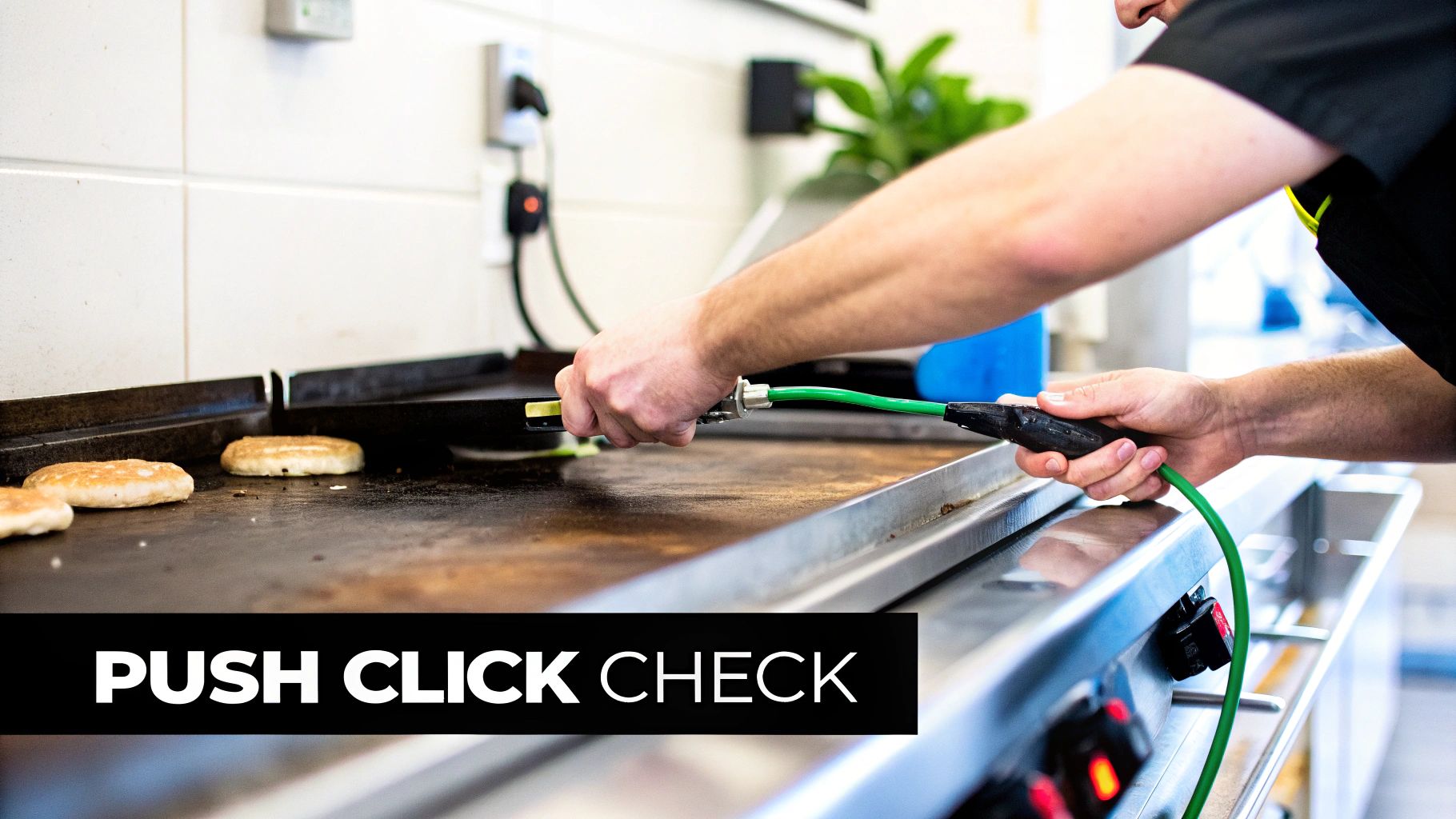
Getting the hang of it is incredibly easy, which means no more hazardous guesswork for your crew. By following a straightforward, memorable process, you can make sure everyone from the head chef to the new hire handles the commercial griddle safely every single time. This is how you cut down on wasted time and keep your operation running like a well-oiled machine.
The Simple Push-Click-Check Connection
Hooking up the gas line to your commercial griddle should be fast and foolproof. You won't need any tools or complicated maneuvers. Just remember this three-step mantra for a secure, leak-free connection. It’s a snap to teach and even easier to remember in the middle of a dinner rush.
-
Push: Take the male plug on the commercial griddle’s hose and push it firmly into the female socket on the gas line. It should glide in smoothly without any real force.
-
Click: Listen for that satisfying, solid "click." That sound is the internal locking mechanism engaging, telling you the fitting is seated and locked in.
-
Check: Give the hose a gentle but firm tug away from the socket. If it’s locked in correctly, it won’t move an inch. This quick physical check is your final confirmation that you have a tight, secure seal.
Nailing this simple procedure ensures every staff member can handle the commercial griddle safely. That kind of standardization is the bedrock of a well-run kitchen where safety isn't an afterthought—it's just how things are done.
The Retract-Pull Disconnection
Getting it disconnected is just as easy. When it's time to pull the commercial griddle out for a scrub-down, the whole thing takes about two seconds.
Just slide the outer collar on the socket backward, toward the gas line. This action releases the internal lock. While you’re holding that collar back, pull the plug straight out. The socket's internal valve snaps shut the moment you disconnect, instantly stopping the gas flow. It’s designed to be completely safe.
Troubleshooting Common Connection Issues
Look, even the best gear has its off days. When your quick connect gas fitting for your commercial griddle decides to be difficult, the fix is usually simpler than you think. We'll walk through the usual suspects so you can get your griddle back in the game quickly and, more importantly, safely.
Let’s start with the most common frustration: the fitting just won't click into place. Before you start wrestling with it, check for the simple stuff. Nine times out of ten, the problem is a bit of gunk—food bits, grease, you name it—stuck in the socket. A quick shot from a can of compressed air usually does the trick. Also, make sure you're connecting it straight on; trying to jam it in at an angle is a recipe for a bad day.
Identifying and Responding to Gas Leaks
The smell of gas is the one thing that should stop everyone in their tracks. It's a code-red situation in any kitchen, and how you react in those first few seconds is critical for keeping your people and your business safe.
Your immediate, no-questions-asked first move is to kill the gas at the main valve. Don't touch light switches, don't unplug anything—just shut off the gas. Once it's off, disconnect the fitting and, if you can do it safely, move the commercial griddle away from the area. Now, take a close look at the O-rings and seals on both parts of the fitting. You're looking for any cracks, dirt, or visible damage.
A damaged or worn-out seal isn't just a small problem; it's a serious safety hazard. Never, ever try to "make it work" with a bad seal. The fitting for your commercial griddle is out of commission until a certified pro can replace it. Period.
Addressing Low Flame and Performance Problems
Is your commercial griddle taking ages to heat up? Are the flames looking weak and lazy? A performance issue like this often points right back to your gas connection. A low flame is the tell-tale sign that your commercial griddle is being starved of fuel, and there are a couple of likely culprits.
First, check that your quick connect gas fitting is actually all the way in. If it’s not fully seated and locked, the internal valve won't open completely, choking the gas flow. Disconnect it and plug it back in firmly until you hear and feel that solid "click." Another possibility is that the fitting is simply too small for your commercial griddle's BTU rating. If that's the case, it's creating a permanent bottleneck, and your burners will never get the fuel they need to hit full power.
Frequently Asked Questions About Gas Fittings
When you're dealing with a quick connect gas fitting for your commercial griddle, a few questions are bound to pop up. Getting the right answers isn't just about efficiency—it's about keeping your kitchen safe, compliant, and running smoothly. We’ve rounded up the most common questions we hear from restaurant and food truck operators just like you.
Can I Use the Same Fitting for Natural Gas and Propane?
The short answer is a hard no. You should never, ever use the same quick connect fitting for both Natural Gas (NG) and Propane (LP) unless the product is specifically marked and certified for both.
Why the strict rule? It all comes down to pressure. NG and LP operate at completely different pressures, and the fittings are engineered to handle one or the other. Using the wrong one on your commercial griddle is a recipe for disaster—it could starve your griddle for fuel and kill its performance, or worse, cause a dangerous gas leak. Always match the fitting to the fuel source your commercial griddle is designed for.
How Often Should I Inspect My Quick Connect Fitting?
Think of this as a non-negotiable part of your kitchen's daily routine. At a minimum, your team should be giving the fitting and the entire gas hose connected to your commercial griddle a quick visual check at least once a month.
During your inspection, be on the lookout for:
- Any cracks or stiffness in the hose
- Corrosion or rust on the metal parts
- Visible wear and tear on the seals
- Anything else that just doesn't look right
We also strongly recommend doing a professional leak test with a soapy water solution at least twice a year. If your commercial griddle gets moved around a lot for cleaning, check it every time you reconnect it. And for food trucks, which are constantly vibrating and on the move, a weekly visual check is an absolute must.
Your first line of defense is a simple inspection. A quick 30-second look-over can prevent a serious safety incident, protecting your team, your customers, and your business.
Is a Quick Connect Fitting Required by Law?
There isn't one single law that covers every city and state, but it's becoming the standard for commercial griddles in most places. Many local fire and safety codes now require them.
For example, the National Fire Protection Association (NFPA) often requires that any commercial cooking appliance on casters or wheels—like a commercial griddle—must use a certified flexible gas hose with a quick connect gas fitting and a restraining cable. This setup is a failsafe—it stops the gas line from getting yanked out or breaking if someone accidentally pushes the griddle too far. The only way to know for sure is to check with your local health department or fire marshal.
Ready to make your kitchen safer and more efficient? You can find the perfect, certified quick connect gas fitting and commercial griddle for your setup at Griddles.com. Give your crew the right tools for the job by visiting us at https://griddles.com.