

110 Volt Vs 220 Volt Commercial Griddles The Definitive Guide
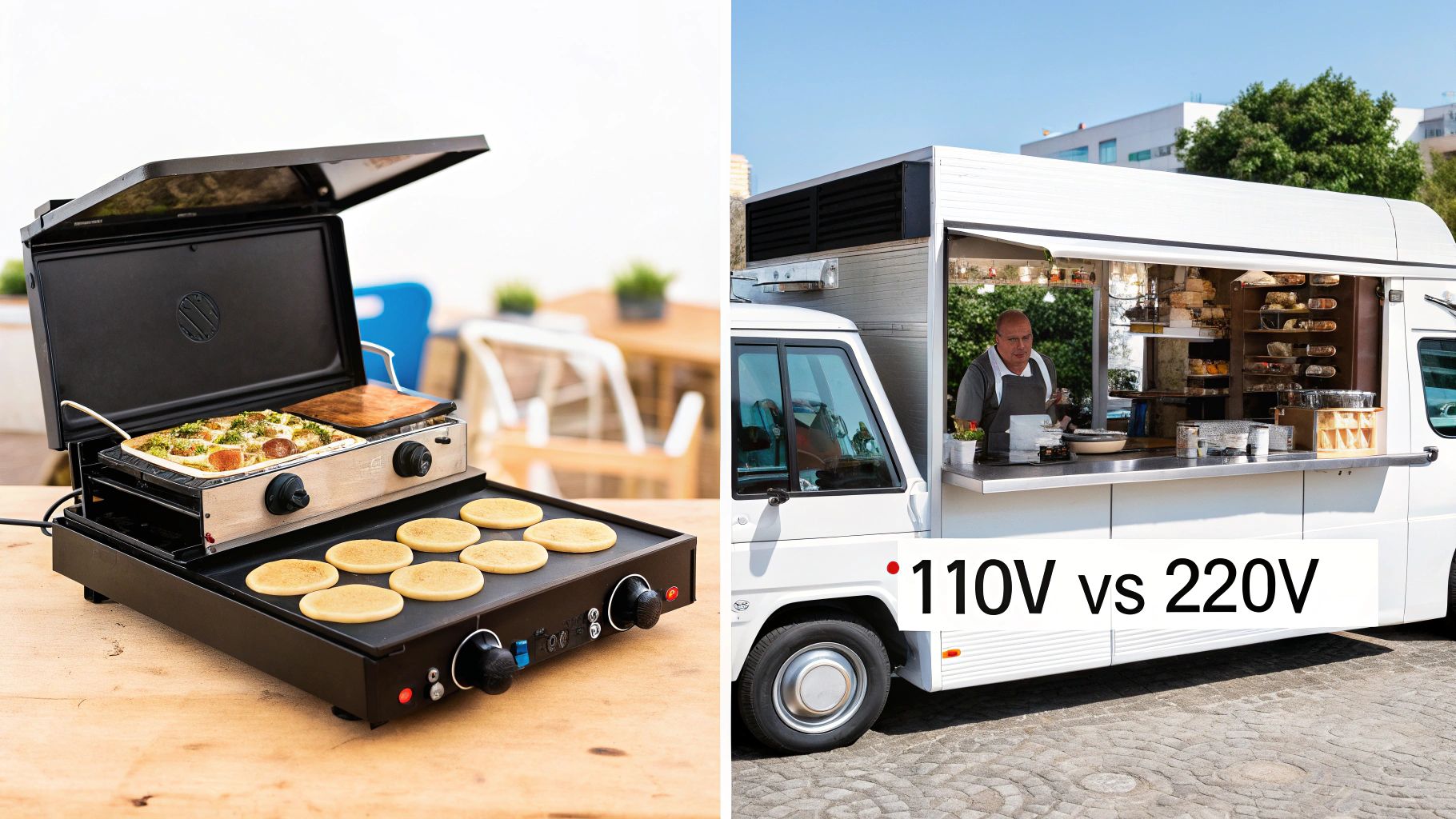
When it comes to commercial griddles, the 110 volt vs 220 volt debate really comes down to power versus convenience. If you’re running a small operation, a food truck, or just need something for lighter use, a 110V griddle is the definition of plug-and-play. But for busy kitchens where speed and performance are non-negotiable, a 220V griddle is the undisputed professional choice, delivering the heating power and quick recovery times you need to keep up with the rush.
Decoding Griddle Voltage: Your First Big Decision
Picking between a 110V and 220V commercial griddle is more than just a technical spec—it’s a fundamental business decision. It will directly affect your kitchen’s speed, the quality of your food, and even your utility bills. Getting a handle on the basics of voltage, amperage, and wattage is the first step to making a smart investment that fits your operation.
Think of your commercial griddle's electricity like water running through a hose:
- Voltage (Volts) is the water pressure. A higher voltage like 220V means more "push" behind the electricity.
- Amperage (Amps) is the width of the hose. This is the volume of current flowing to your griddle.
- Wattage (Watts) is the total water coming out—the actual power your griddle has to get hot and stay hot.
Historical Roots of Modern Kitchen Wiring
This voltage difference is a big deal in North America, and it all goes back to a quirk of history. In the early 20th century, the shift from carbon filament to tungsten light bulbs cemented the 110-volt standard across the country. Tungsten bulb production exploded by an incredible 1,500 percent in just ten years, but it happened too late to change the electrical infrastructure already being built.
For modern commercial kitchens, this means our standard 110V circuits need to pull roughly double the amperage to deliver the same power as a 220V system. This often demands thicker, more expensive wiring for high-powered equipment like commercial griddles. You can dive deeper into the history of global electrical standards on Wikipedia.
Key Takeaway: A 220V commercial griddle doesn't actually use more electricity than a 110V model with the same wattage. It just pulls that power more efficiently with lower amperage, putting less stress on your circuits and wiring.
At-A-Glance Commercial Griddle Voltage Comparison
Sometimes you just need a quick rundown. This table breaks down the main differences between 110V and 220V commercial electric griddles to help you see which one fits your kitchen.
| Attribute | 110-120 Volt Commercial Griddles | 220-240 Volt Commercial Griddles |
|---|---|---|
| Best For | Food trucks, small cafes, low-volume kitchens, and temporary setups. | High-volume restaurants, diners, ghost kitchens, and professional chefs. |
| Performance | Slower pre-heating and temperature recovery; suitable for light duty. | Rapid pre-heating and excellent temperature recovery under heavy load. |
| Installation | Typically plugs into a standard wall outlet. No electrician needed. | Requires a dedicated circuit and special outlet installed by a professional. |
| Electrical Load | Draws higher amperage, increasing the risk of tripping breakers. | Draws lower amperage, providing a more stable and efficient power draw. |
| Initial Cost | Lower upfront cost due to simple plug-and-play installation. | Higher initial cost due to professional electrical installation fees. |
After looking at the table, you can see the choice often comes down to your kitchen’s existing electrical setup and your expected cooking volume. The upfront convenience of a 110V griddle is perfect for some, while the raw power of a 220V model is a necessity for others.
How Voltage Dictates Griddle Power and Performance
In a commercial kitchen, every minute counts, especially during the lunch or dinner rush. The decision between a 110 volt vs. 220 volt commercial griddle isn't just about the plug—it directly impacts performance in ways that can either streamline your service or create frustrating bottlenecks. While both will cook your food, how they deliver power determines their ability to perform under pressure.
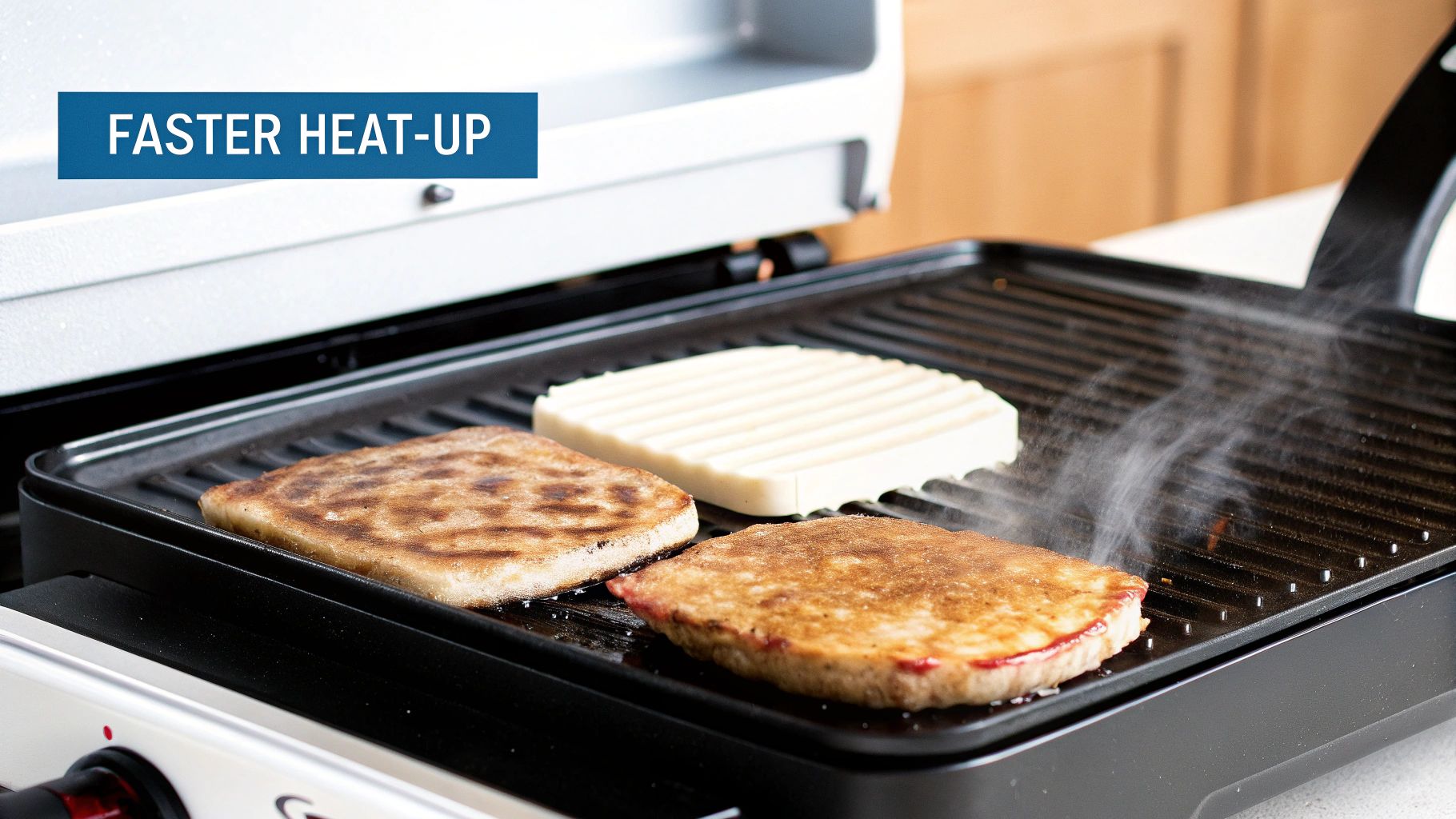
The most obvious difference you'll see is in heat-up speed. A 220V commercial griddle can hit its target temperature way faster, often up to 50% quicker than a similar 110V model. That means less time wasted waiting for the griddle to get ready and a quicker start to your prep or service. Those saved minutes add up fast.
The Critical Role of Temperature Recovery
Forget initial heat-up for a second. The single most important performance metric for a commercial griddle is temperature recovery. This is all about how quickly the unit can get back to its set temperature after you slap a bunch of cold food on it. A griddle that can't recover quickly leads to inconsistent food, longer ticket times, and unhappy customers.
Think about these two real-world kitchen moments:
- Scenario A (The Rush): You have an order for a dozen frozen burger patties. The second they hit that hot surface, they suck a massive amount of heat out of the griddle, causing the temperature to plummet.
- Scenario B (The Finesse): You're making delicate crepes or pancakes that need a perfectly consistent temperature to cook right without burning or sticking.
In Scenario A, a 110V commercial griddle will seriously struggle to reheat. Your cooking times drag out, and you end up with steamed, grey patties instead of beautifully seared ones. A 220V griddle, on the other hand, has the power in reserve to bounce back fast, ensuring a great sear and quicker output. For delicate items like in Scenario B, the stable heat from a 220V griddle prevents the temperature drops that can ruin the texture and look of your food.
A 220V griddle's superior temperature recovery isn't a luxury—it's a must-have for maintaining food quality and speed in any high-volume kitchen. It ensures the tenth burger is cooked just as perfectly as the first.
Understanding Amperage and Circuit Load
The "why" behind this performance difference comes down to simple electrical math: Power = Volts x Amps. To generate the same amount of heat (wattage), a 110V commercial griddle has to pull roughly twice the amperage of a 220V unit.
Let's break it down with a powerful 3,500-watt commercial griddle:
- On a 220V circuit: It would draw about 16 amps. This fits comfortably on a standard 20-amp or 30-amp dedicated circuit.
- On a 110V circuit: It would try to pull over 31 amps. This is way over the limit for nearly all standard light commercial circuits, which means you'll be tripping breakers constantly.
This high amperage draw is the Achilles' heel of powerful 110V griddles. In a busy commercial kitchen where mixers, refrigerators, and lights are all running, a high-amp 110V griddle can easily overload a circuit and shut down your whole line. The lower, more stable amperage draw of a 220V system provides a much safer electrical foundation for a professional kitchen. For a deeper dive, our guide on 120V vs 240V for griddles offers more details.
Remember, the power you actually get can be affected by things like the length and gauge of your wiring, so proper voltage drop calculations are key for an optimal setup.
Analyzing Installation, Wiring, And Electrical Costs
It’s not just about performance. The choice between a 110 volt vs 220 volt commercial griddle comes down to real-world logistics and your budget. Your decision will directly shape how complex the installation is, what kind of wiring you’ll need, and how much you'll spend just to get powered up. Getting this right from the start is the key to avoiding surprise costs and delays.
The biggest draw for a 110V commercial griddle is pure convenience. For the most part, you can just plug them in and get cooking. They use the same standard outlets you have all over your business, which means you can have your griddle up and running almost immediately without calling an electrician.
This plug-and-play simplicity makes 110V griddles a fantastic fit for food trucks, pop-ups, small cafes, or any kitchen that needs flexibility. Of course, that convenience comes with the power limitations we’ve already covered—namely, a higher amp draw that can easily trip a breaker if you're not careful.
The Specialized Needs Of A 220V Installation
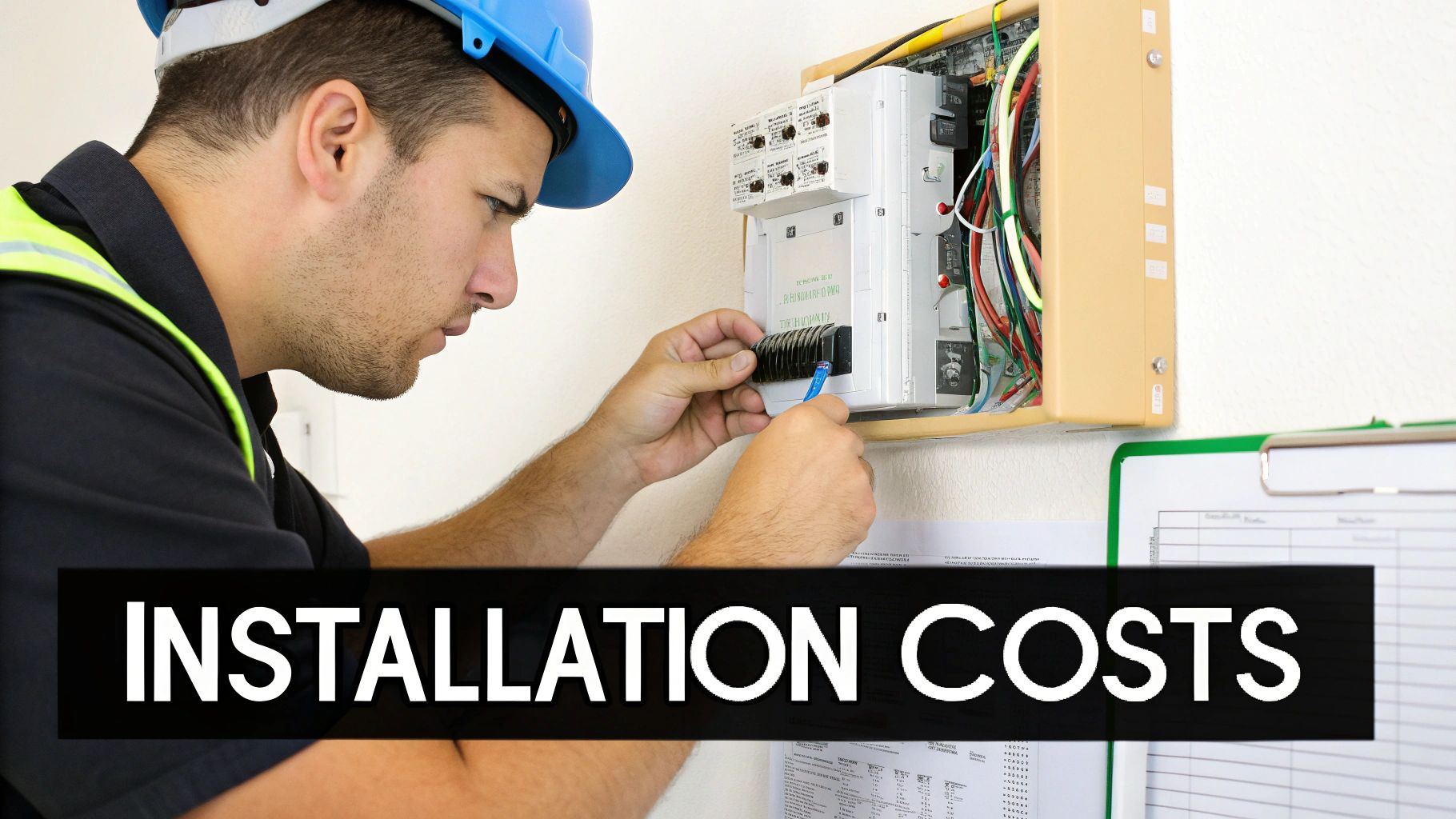
When you step up to a 220V commercial griddle, you’re making a serious commitment to power, and that requires a more involved setup. You can't just plug these machines into any old wall socket. They demand a dedicated, high-amperage circuit run straight from your electrical panel, a job that almost always requires a licensed electrician.
Here’s what installing a 220V commercial griddle usually looks like:
- Running a Dedicated Circuit: The electrician will need to pull a new, thicker wire from your breaker box to where the griddle will live.
- Installing a High-Amperage Breaker: A new double-pole breaker, typically 30 to 50 amps, gets installed in your panel to safely manage the power draw.
- Fitting a Specialized Outlet: The griddle will need a specific outlet, like a NEMA 6-30R or 6-50R, to match its plug.
This isn’t just extra work; it’s a critical part of a safe, high-functioning kitchen. A professional installation guarantees your griddle gets the steady power it needs to perform, all while eliminating the risk of overloaded circuits or electrical fires.
Think of a 220V circuit as an investment in your kitchen’s foundation. It adds to the upfront cost, but it provides the rock-solid power needed for serious commercial cooking and opens the door for other high-performance equipment down the line.
Budgeting For The Electrical Work
The cost to get a 220V circuit installed can vary quite a bit, so you absolutely need to factor it into your commercial griddle budget. The biggest variable is the electrician's labor, which often runs from $75 to $150 per hour. A straightforward job might cost a few hundred dollars, but the total project can easily climb from $300 to over $1,000.
Several things can affect the final price:
- Distance from the Panel: The farther the griddle is from your breaker box, the more wire and time are needed, which drives up the cost.
- Panel Capacity: If your electrical panel is already full, you might need a sub-panel or even a full panel upgrade. This is a much bigger job and will significantly increase the price.
- Accessibility: It’s a lot cheaper to run wires through an open basement ceiling than it is to fish them through finished walls and tight spaces.
Before you buy that powerful 220V commercial griddle, do yourself a favor and get an electrician to look at your setup first. This simple step can save you from major headaches and unexpected bills, and it’s a non-negotiable part of smart restaurant kitchen layout design.
Matching Griddle Voltage To Your Kitchen Type
Picking between a 110 volt and a 220 volt griddle isn’t really about the appliance—it's about your kitchen. You have to match the machine to the mission. Cookie-cutter advice won't cut it, so let's look at real-world commercial kitchen scenarios to figure out where performance, practicality, and your budget meet.
The right voltage is the one that keeps your workflow smooth and your customers happy without causing electrical headaches. What works for a small café is completely different from what a ghost kitchen needs to pump out hundreds of orders. This is where the rubber meets the road.
Food Trucks And Mobile Kitchens
For anyone running a food truck, the 110V vs. 220V griddle debate is a constant tug-of-war. The biggest draw of a 110V commercial griddle is pure flexibility. You can pull up to an event, plug into a standard outlet, and start cooking. That kind of agility is invaluable.
But that convenience has a trade-off. Food trucks make their money during the lunch rush. A 110V griddle can be slow to heat up and even slower to recover its temperature after you slap down a bunch of cold burger patties. That lag means longer ticket times and lost sales.
This is where a 220V commercial griddle, hooked up to a powerful generator, becomes a game-changer. It’s an investment, for sure. But it delivers the muscle you need to handle a non-stop line of customers, searing off burgers and toasting buns without breaking a sweat.
- Go with 110V if: Your menu is straightforward (think grilled cheese or hot dogs), your volume is predictable, and you need to be able to plug in just about anywhere.
- Invest in 220V if: You're slinging steaks or serving massive breakfast rushes. If your business lives or dies by speed and volume, 220V is the only way to go.
Small Cafes And Low-Volume Eateries
In a cozy café, a coffee shop, or a small bistro, a countertop 110V commercial griddle is almost always the right call. These spots just don't see the kind of sustained, high-pressure rushes that demand more power.
You're probably toasting sandwiches, warming up croissants, or making a few eggs to order. A 110V griddle handles that perfectly. Better yet, you just plug it in and go—no need to spend a chunk of your startup capital hiring an electrician for special wiring.
For any business where the commercial griddle is a supporting actor rather than the star of the show, the simplicity and low upfront cost of a 110V model make it a no-brainer. It gets the job done without complicating things.
High-Volume Diners And Ghost Kitchens
Step into a busy diner, a full-service restaurant, or a modern ghost kitchen, and a 220V commercial griddle is non-negotiable. It's not a luxury; it's the engine of the entire operation. These kitchens are defined by relentless demand where slow equipment simply isn't an option.
A 220V griddle maintains rock-solid heat across its entire surface, even when you're loading it up during the dinner rush. This lets a line cook sear steaks on one side while gently warming veggies on the other. For a ghost kitchen juggling orders from three different delivery apps, that level of performance is the only thing standing between a 5-star review and a cancelled order. To see how different models stack up, take a look at our complete guide to choosing an electric griddle.
Putting in the right 220V wiring is a foundational business decision. It’s the electrical backbone that supports the speed, consistency, and profitability of any high-output kitchen.
Navigating Safety, Compatibility, And Global Standards
In any commercial kitchen, safety isn't just a line item on a checklist; it's the bedrock of your entire operation. A common myth we hear is that higher voltage equals higher risk. Let's clear that up: a professionally installed 220V circuit is just as safe as any standard 110V outlet.
The real danger isn't the voltage number itself. It's overloaded circuits and shoddy wiring. In fact, running a high-wattage commercial griddle on a 110V circuit can actually be more hazardous. Why? Because it has to pull a massive amount of amperage to generate enough heat, putting a serious strain on wires and breakers. This increases the odds of overheating and frustrating—or dangerous—tripped circuits.
Griddle Compatibility And Dual Voltage Models
Before you click "buy" on any commercial griddle, checking its electrical specs is an absolute must. Most commercial griddles are built for a single voltage standard. However, you'll occasionally find versatile models designed with dual voltage capabilities. These griddles can run on either 110V or 220V power, offering incredible flexibility for food trucks or any business that might move locations.
But these are definitely the exception, not the rule. Trying to power a commercial griddle with the wrong voltage is a guaranteed recipe for disaster—it can fry your new equipment or even spark a fire. It's also worth getting familiar with equipment tolerances. For anyone wanting a deeper dive into the technical side, understanding coil voltage tolerance provides critical insight for ensuring safety in commercial setups.
A properly wired, dedicated 220V circuit is inherently safer for a high-power commercial griddle than a 110V circuit pushed to its amperage limit. The lower amperage of the 220V system reduces heat stress on wires and components, leading to a more stable and reliable setup.
Understanding Global Electrical Differences
If you're thinking about importing specialty equipment or buying a used commercial griddle from overseas, you have to be mindful of global electrical standards. The 110V system we use here in North America is actually pretty unique. Roughly two-thirds of the world's countries run on higher voltage systems around 220-240V, leaving only about a third on the 110-120V standard.
This 2-to-1 global ratio really matters when sourcing equipment. A commercial griddle made in Europe, for example, will almost certainly be designed for a 220V-240V system. While your phone might have a universal adapter, heavy-duty cooking equipment like griddles often needs a bulky voltage converter. These can add 10-15 percent to your installation costs and create another potential point of failure. You can find out more about these global voltage standards and their history on YouTube.
Using a voltage converter is also inefficient, since power is always lost in the conversion process—not ideal for a permanent fixture in your kitchen. For any operator considering an imported griddle, the smartest and safest route is to have your kitchen wired with a native 220V circuit from the start, rather than messing with clumsy adapters.
Your Final Griddle Voltage Decision Checklist
Alright, let's get down to brass tacks. Making the final call between a 110 volt and a 220 volt commercial griddle really just comes down to being honest about your kitchen's setup and what you expect to throw at it. This isn't just about picking a plug; it's about matching the machine to your mission.
This quick checklist will cut through the noise and point you to the right choice, preventing that awful moment when you realize your new griddle can't keep up or, worse, can't even be plugged in.
First, a quick look at the bigger picture. Where your commercial griddle comes from often tells you what voltage it’s built for.
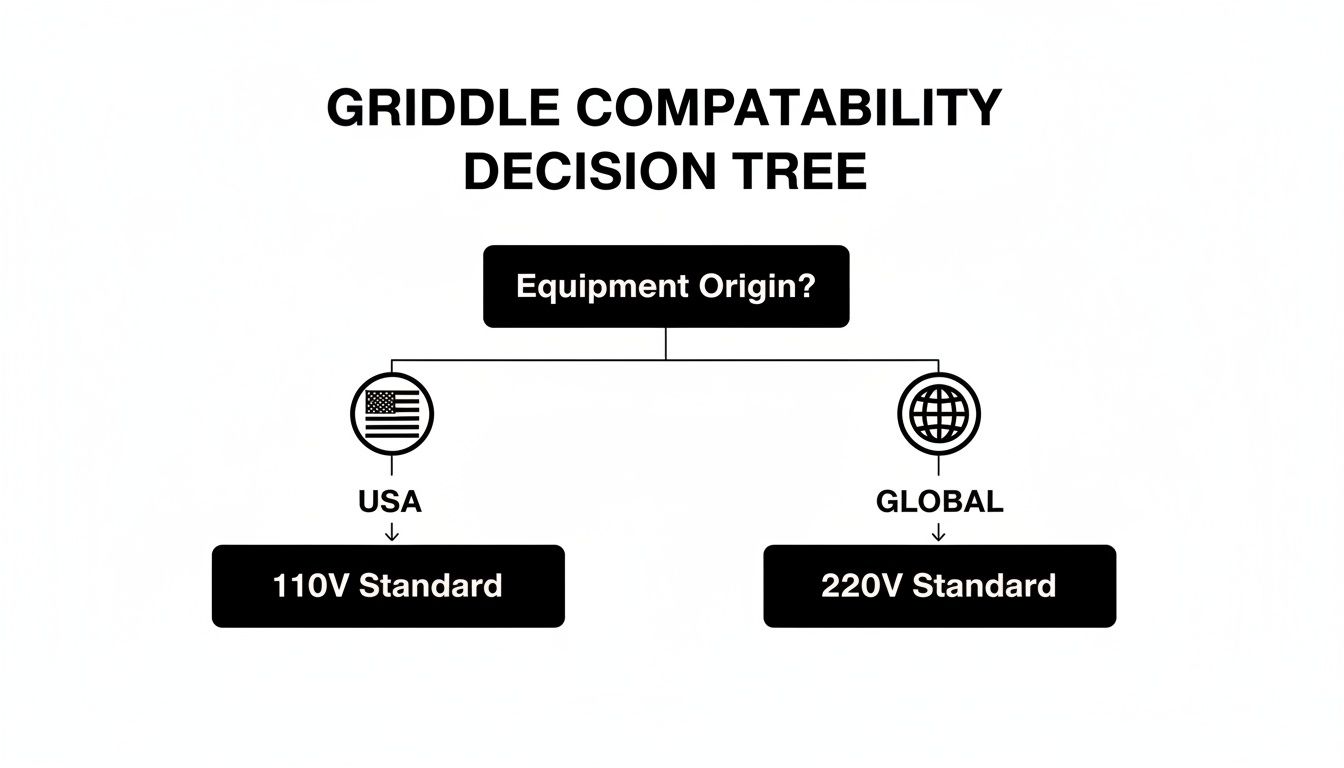
As you can see, commercial griddles made for the North American market are almost always 110V, while those from Europe or Asia are designed around a 220V standard. It’s a simple but crucial detail to keep in mind.
Key Questions to Guide Your Choice
Run through these questions. They'll help you figure out which griddle voltage lines up with your kitchen's reality and your business goals. No fluff, just the facts you need.
1. What’s my real-world peak order volume?
- Low to Moderate: If you have steady but manageable rushes and aren't slinging burgers nonstop, a 110V commercial griddle has plenty of juice. It’ll get the job done without any drama.
- High and Sustained: Are ticket printers spitting fire during your peak hours? You need the raw power and quick recovery of a 220V commercial griddle. It's built for the battlefield.
2. What’s the electrical situation where the griddle will live?
- Standard Outlet Only: If you're looking at a standard wall socket and have zero plans (or budget) to call an electrician, 110V is your one and only answer. It's plug-and-play.
- Ready for More Power: If you’ve already got a 220V outlet or know your electrical panel can handle an upgrade, investing in a 220V commercial griddle is a smart, forward-thinking move.
3. Does my menu need serious heat and speed?
- Simple Stuff: Grilling sandwiches, warming tortillas, or cooking eggs? A 110V commercial griddle is perfectly capable and won't break a sweat.
- Demanding Menu: Searing thick steaks, smashing frozen burger patties, or running a full-tilt breakfast rush with pancakes and bacon? The consistent, blistering heat from a 220V commercial griddle isn't just nice—it's necessary.
The whole decision boils down to this: 110V gives you flexibility and convenience for lower-demand spots. 220V is the required investment for true professional power, speed, and growth. Choose the griddle voltage for the kitchen you're building, not just the one you have today.
Frequently Asked Questions
Even after weighing all the pros and cons, a few questions always pop up when it comes to the 110 volt vs 220 volt commercial griddle decision. Let's tackle the most common ones so you can finalize your choice with complete confidence.
Can I Use an Adapter for a 220V Griddle in a 110V Outlet?
Please don't. The short answer is no, and the long answer is that it's an incredibly dangerous idea. A 220V commercial griddle is built to handle a specific amount of electrical pressure. A simple plug adapter doesn't change the voltage coming from the wall.
Attempting to plug a 220V commercial griddle into a 110V outlet will, at best, fail to power the griddle. More likely, you’ll fry its internal components and create a serious fire hazard. The only "right" way to do this involves a step-up transformer, which is a clumsy, inefficient, and expensive fix compared to just having an electrician install the proper 220V outlet from the start.
Is a 220V Commercial Griddle More Expensive to Operate?
That's a common myth, but no, it isn't. Your commercial griddle's operating cost comes down to its wattage (how much power it uses), not the voltage it runs on. A 4,000-watt commercial griddle will pull the same amount of electricity—and cost you the same on your power bill—whether it's a 110V or 220V model.
In fact, 220V systems are a touch more efficient. Because they draw less amperage, less energy is lost as heat through the wires. While this might save you a few pennies over several years, it’s barely noticeable. The real drivers of your bill are how often you run the griddle and how hot you keep it.
Which Griddle Outlet Should I Use in My Food Truck?
This one's easy. If your food truck has both 110V and 220V hookups, always go with 220V for your commercial griddle. In a high-pressure mobile kitchen where every second counts, that extra power is your best friend.
Using a 220V outlet for your griddle in your food truck gives you a significant competitive edge. You'll get much faster pre-heating and far better temperature recovery during a rush. That means serving customers faster and keeping your food quality consistent.
Plus, the lower amperage draw of a 220V commercial griddle puts less strain on your generator. That frees up valuable power for your other essential gear—refrigerators, fryers, lights—and makes your whole mobile kitchen's electrical system more stable and reliable.
Ready to power up your kitchen with the right equipment? At Griddles.com, we specialize in helping restaurants, food trucks, and ghost kitchens find the perfect commercial griddle to match their needs. Explore our full catalog of high-performance electric and gas griddles.