

LP Gas vs Natural Gas: Choosing the Right Fuel for Your Commercial Griddle
When it comes to choosing between LP gas and natural gas for your commercial griddle, the decision really comes down to one thing: your business setup. LP gas is the go-to for mobile operations like food trucks because it packs a punch and you can take it anywhere. On the other hand, natural gas is the workhorse for fixed locations like restaurants, offering a steady, lower-cost fuel supply for your griddle.
The right choice depends completely on whether your commercial griddle needs that grab-and-go power or the set-it-and-forget-it convenience of a utility line.
Choosing Your Commercial Griddle's Fuel Source
Picking the right fuel for your commercial griddle is a foundational decision. It impacts everything from how fast you can crank out orders during a lunch rush to what your monthly utility bill looks like. This isn't just about flipping a switch; it's a strategic move that needs to align with your business model.
The debate between LP gas vs. natural gas isn't about which one is "better" overall, but which one is the perfect fit for your griddle setup—whether you're running a busy diner, a nimble food truck, or a high-efficiency ghost kitchen.
Key Factors for Your Griddle Setup
To get this right, you have to look at a few critical factors that will shape not just your initial investment but your day-to-day success with your griddle.
- Location and Infrastructure: Can you even get a natural gas line run to your building? If you're mobile or in a more remote spot, portable LP tanks might be your only practical choice for your griddle.
- Cooking Demands: Think about your busiest hours. The high-energy burst from LP gas can be a lifesaver for getting griddles screaming hot in minutes. For the long, steady burn of an all-day service, the consistency of natural gas is hard to beat.
- Budget and Long-Term Costs: Natural gas usually wins on cost per unit of energy, but if you need to install a new gas line for your kitchen, that upfront expense can be a major hurdle.
The core difference is all about delivery and energy density. Natural gas flows right into your kitchen through a pipe, offering an endless supply at a lower pressure. LP gas (propane) comes in high-pressure tanks and delivers more than double the energy per cubic foot to power your griddle.
We're going to break down these variables to help you match the right fuel to the real-world demands of a professional kitchen's griddle. And if you want to dive deeper into the hardware itself, check out our complete guide to commercial gas griddles.
At a Glance: LP Gas vs Natural Gas for Griddles
| Feature | LP Gas (Propane) | Natural Gas |
|---|---|---|
| Best For | Food trucks, mobile catering, remote locations | Restaurants, diners, ghost kitchens with utility access |
| Portability | Highly portable in tanks | Not portable, requires fixed utility line |
| Energy Output | High (approx. 2,490 BTUs per cubic foot) | Lower (approx. 1,030 BTUs per cubic foot) |
| Storage | On-site tanks require space and management | Delivered continuously via pipeline |
| Upfront Cost | Lower (tanks are rented or purchased) | Potentially high (if new line installation is needed) |
The global market for LP gas is on the rise, proving its value as a reliable energy source for commercial cooking. Valued at USD 123.14 billion, it's expected to hit USD 293.83 billion by 2035, which shows just how much commercial operations are coming to depend on it.
For another perspective on fuel choices for fixed kitchen appliances, you can find comparisons on topics like gas versus electric furnaces, which highlights similar cost and infrastructure considerations.
Comparing Energy Output and Cooking Performance
When you fire up a commercial griddle, the fuel choice is about much more than just a flame—it's about raw power and control. The entire debate between LP gas and natural gas boils down to one key metric: energy density, which we measure in British Thermal Units (BTUs). This number dictates how fast your griddle gets hot and how well it keeps up when you're slammed with orders.
On paper, LP gas (propane) is the undisputed champion of energy. It packs a massive punch, delivering around 2,490 BTUs per cubic foot. Natural gas, by comparison, offers about 1,030 BTUs per cubic foot. That's not a small difference; propane has more than double the raw heating potential in the same volume of fuel for your griddle.
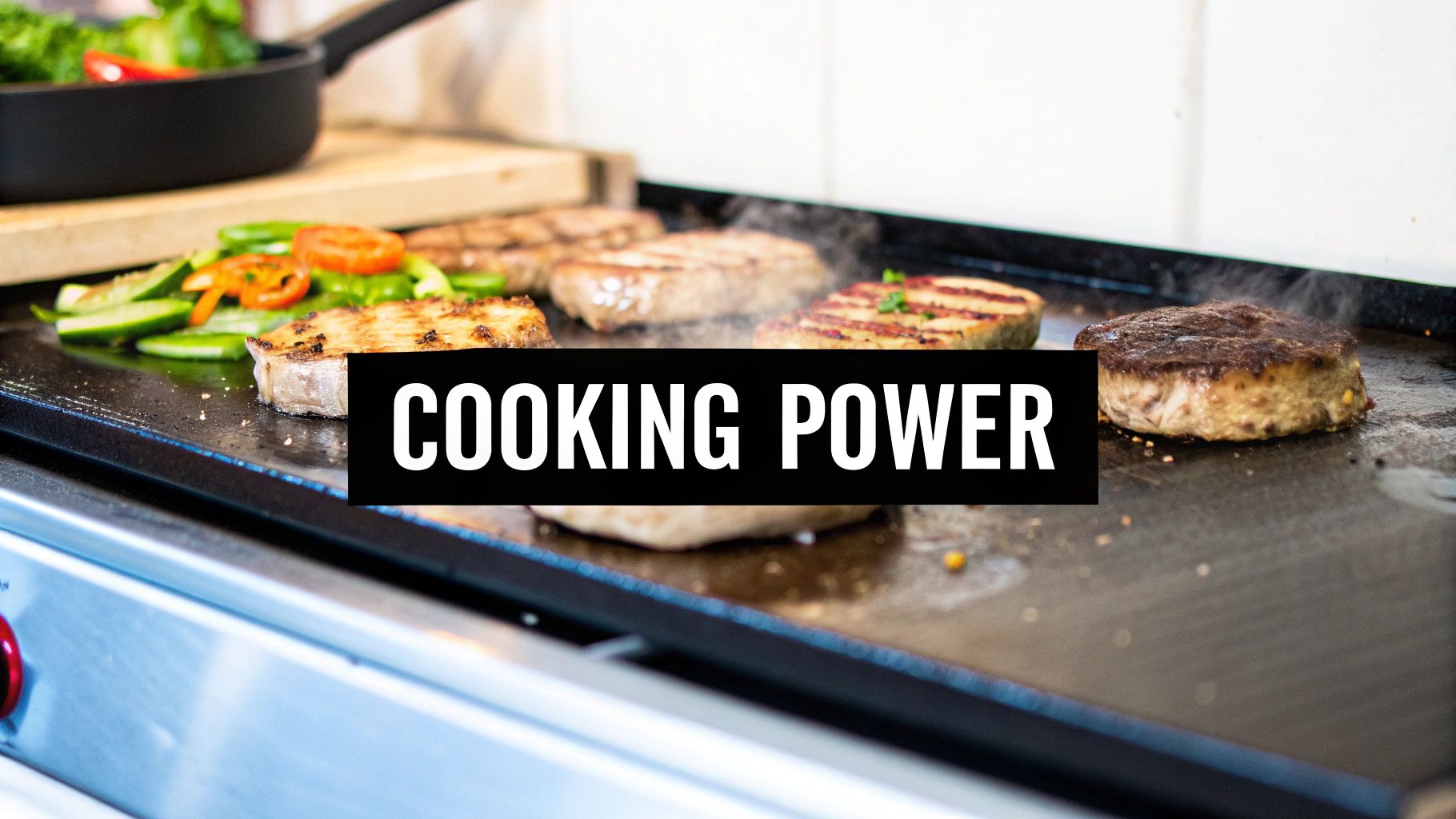
This isn't just a technical spec—it's something you feel on the line. A higher BTU output means faster heat-up times and, crucially, quicker temperature recovery when you load the flat top with cold food.
Heat-Up Speed and Initial Power
For any griddle operation where every second counts, propane’s high energy density is a game-changer. Think of a food truck trying to catch the breakfast rush or a caterer setting up on-site.
-
LP Gas Scenario: That food truck owner using a propane griddle can get a thick 1-inch steel plate ready for searing at 350°F in record time. This speed means they're serving customers and making money almost as soon as they park.
-
Natural Gas Scenario: A classic diner with a griddle hooked into the city’s gas line will see a more methodical, steady heat-up. It’s still plenty powerful, but it might take a few extra minutes to hit that perfect cooking temp. For a kitchen that keeps its griddle hot all day, this initial wait is barely noticeable.
The right choice comes down to your business model. Do you need explosive, on-demand heat for your griddle, or consistent, all-day power?
Temperature Recovery During Peak Hours
This is where the rubber meets the road. The real test for any griddle is how it handles a sudden rush—like when you drop two dozen frozen burger patties on the surface at once. This is where the BTU difference becomes crystal clear.
The real test of a griddle's fuel source isn't how hot it can get, but how well it stays hot. Propane's higher BTU output provides the raw power needed to quickly replace heat lost when dozens of cold items are dropped onto the griddle plate, preventing temperature drops that lead to soggy, unevenly cooked food.
A griddle that can't recover fast enough will steam your food instead of searing it, killing food quality and slowing down ticket times. Propane’s energy density gives it a clear advantage here, helping chefs maintain that perfect Maillard reaction and turn tables faster.
Sustained Performance and Consistency
While propane wins the sprint, natural gas is built for the marathon. It truly shines by delivering unwavering, consistent heat to your griddle for hours on end. For a busy restaurant where the griddle is the workhorse of the kitchen, being connected to a utility line is a massive benefit.
With natural gas, you never have to worry about "fuel fade"—that slight drop in pressure and performance as a propane tank gets low. It guarantees that the griddle's output at 9 PM is just as potent as it was at noon. This rock-solid reliability gives chefs a predictable cooking surface they can count on, making it the top choice for high-volume kitchens running a griddle from open to close.
Getting Hooked Up: Installation and Fuel Delivery Logistics
Beyond BTUs and heat, the real-world differences between propane and natural gas show up in how you get the fuel to your griddle. This is where we move from theory to the practical nuts and bolts of your kitchen’s infrastructure. The entire decision boils down to one simple question: do you need portable fuel tanks or a permanent utility line for your griddle?
For any operation on wheels—food trucks, caterers, pop-up vendors—LP gas is the only way to go. Its whole reason for being is portability. Propane is stored as a liquid under high pressure in tough, transportable tanks. This self-contained approach means you can fire up a powerful griddle pretty much anywhere, from a farmer's market to a wedding venue, no strings attached.
On the flip side, if you're running a brick-and-mortar restaurant, ghost kitchen, or any permanent spot, the convenience of a natural gas line for your griddle is tough to beat. The gas is delivered at a much lower pressure straight from the utility company, giving you an endless supply. No more checking tank gauges, scheduling refills, or—worst of all—running dry in the middle of a Friday night dinner rush.
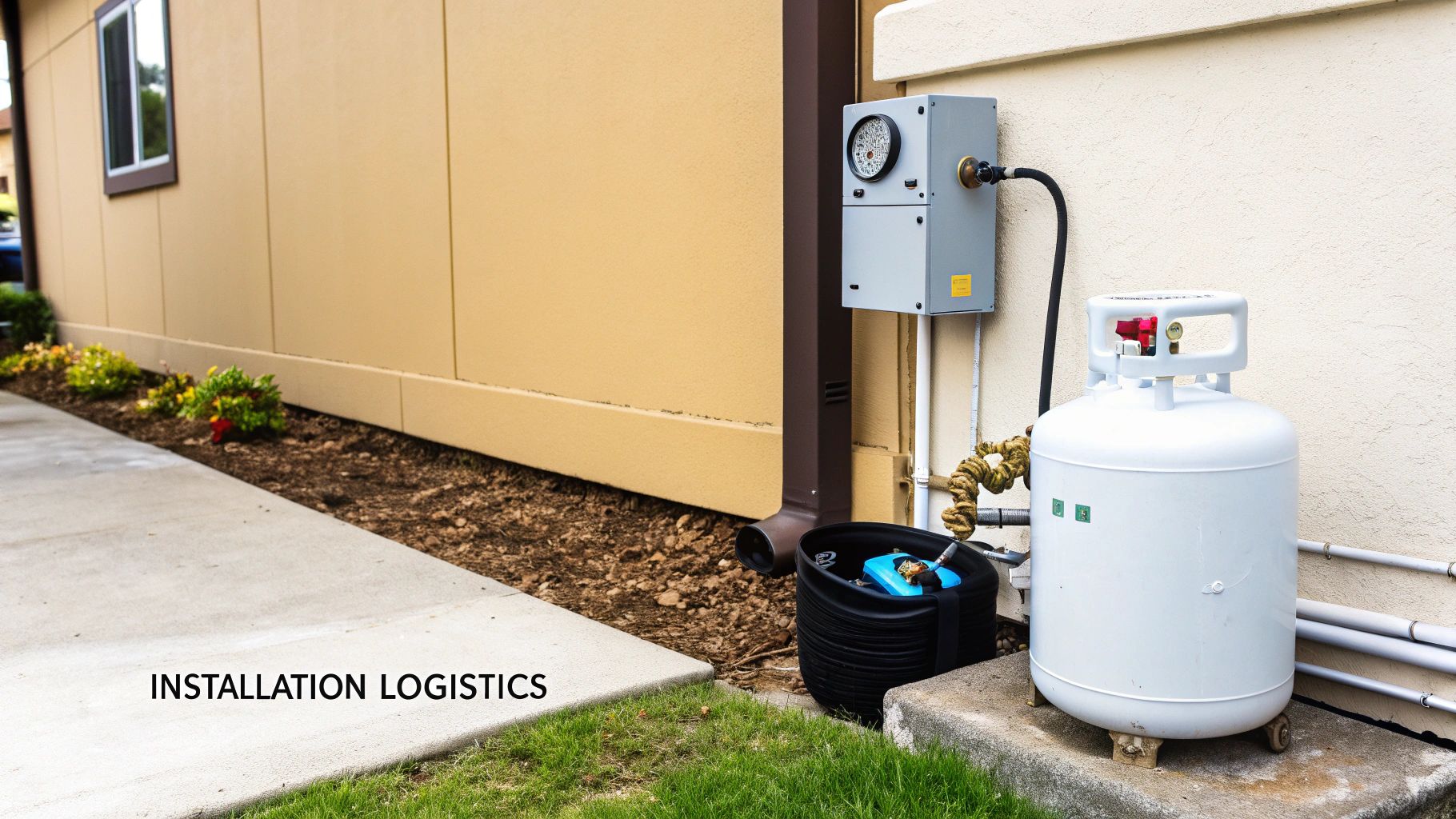
Hardware and Hookup Requirements
Getting your griddle set up for either gas isn't a one-size-fits-all deal. Each fuel type operates at a different pressure and demands its own specific hardware. Getting this right is non-negotiable for the griddle's safety and performance.
- LP Gas (Propane) Setup: This requires a high-pressure regulator that attaches directly to the tank. Its job is to step the pressure way down before the gas ever reaches the griddle. The connections use specific hoses and fittings built to handle propane's higher pressure safely.
- Natural Gas Setup: Here, you're connecting your griddle straight into your building's gas plumbing. You'll need a low-pressure regulator and, crucially, properly sized pipes to ensure enough gas can flow to all your equipment without starving any of it.
Thankfully, most modern commercial griddles, including the ones we carry at Griddles.com, are "field convertible." This means they can be switched from natural gas to propane (or vice-versa) with a conversion kit. These kits usually contain new orifices for the burners and the correct regulator. While it sounds simple, this is a job for a qualified technician. Do it wrong, and you're risking leaks and poor griddle performance. Pipe sizing is also a critical piece of the puzzle; check out our guide on how to determine the right natural gas line size for your kitchen.
The core logistical decision really comes down to your business model. If your kitchen moves, you need portable propane tanks for your griddle. If your kitchen is stationary and has access to a utility main, natural gas offers unmatched operational simplicity.
To help clarify the day-to-day differences, here's a quick side-by-side look at the practical aspects of each fuel source for your commercial griddle.
LP Gas vs Natural Gas: A Practical Comparison for Kitchens
| Attribute | LP Gas (Propane) | Natural Gas |
|---|---|---|
| Delivery Method | Delivered in portable tanks (various sizes) | Piped in directly from a utility provider |
| Best For | Food trucks, catering, mobile vendors, remote locations | Restaurants, ghost kitchens, permanent establishments |
| Supply Management | Requires manual tank monitoring and scheduled refills | "Set and forget" continuous supply |
| Installation | High-pressure regulator, specific hoses and fittings | Low-pressure regulator, connection to building plumbing |
| Portability | Excellent; fully self-contained system | None; tied to a fixed utility infrastructure |
| Upfront Cost | Low (cost of tanks and regulator) | Can be high if a new gas line needs to be run |
This table shows that while propane offers incredible flexibility for your griddle, it comes with the hands-on task of managing your fuel supply. Natural gas, in contrast, eliminates that task entirely, provided you have the infrastructure in place.
Fuel Supply and Infrastructure Realities
Your griddle's fuel choice also has bigger, long-term implications for how you manage your kitchen's supply chain. With propane, you're in the inventory management business. You have to track tank levels, schedule deliveries with a local supplier, and make sure your on-site storage area meets all safety codes. It's an active, ongoing responsibility.
Natural gas just flows. If your building is already plumbed for it, the setup for your griddle is usually pretty straightforward. If it's not, however, you could be looking at a significant upfront cost for trenching and installation, which involves permits and working with the local gas company.
A deeper understanding of natural gas—primarily methane—can also help in assessing fuel quality. For those interested in the technical side, you can learn more about how to measure methane gas to see how the pros do it.
Looking ahead, the infrastructure for natural gas is only growing. The global market for liquefied natural gas was valued at USD 122.55 billion and is projected to hit USD 363.15 billion by 2032, expanding at an 11.5% compound annual growth rate. This signals strong, stable demand and continued investment in the supply network, making it a reliable bet for any stationary kitchen's griddle.
A Nuanced Breakdown of Cost and Availability
When you’re weighing LP gas vs natural gas for your commercial griddle, the conversation always comes back to money. It's easy to get stuck comparing the price per gallon of propane to the price of natural gas per cubic foot, but that's just scratching the surface. A real cost analysis looks at the total picture—from installation day to your monthly fuel bills for the griddle.
The truth is, which fuel is cheaper depends almost entirely on your location and what infrastructure you have to work with. For some kitchens, natural gas is a clear winner for long-term savings. For others, the upfront cost makes it a non-starter.
Upfront Investment: Natural Gas Lines vs LP Tanks
The first major cost hurdle shows up right out of the gate. If your building is already plumbed with a correctly sized natural gas line, you're in luck. The cost to get your griddle fired up is often just the labor for a licensed technician to make the final connection.
But if you don't have an existing gas main, the story changes completely. Running a new natural gas line can be a massive expense, easily climbing into the thousands of dollars. It’s a whole project involving permits from the city, trenching work, and coordinating with the local utility company.
Getting started with LP gas for your griddle, on the other hand, is usually far simpler and cheaper upfront.
- Initial LP Gas Costs: Your main expenses are buying or renting propane tanks and paying for the first fill-up.
- Minimal Infrastructure: You just need a regulator and a secure spot to store the tanks. No heavy construction or utility hookups are needed.
This low barrier to entry is a huge deal for food trucks, pop-up concepts, or any business that needs to watch every penny during startup.
Analyzing the Long-Term Fuel Costs
Once your kitchen is operational, the cost dynamic often flips. On a per-BTU basis, natural gas is almost always the more affordable fuel for your griddle. Since it's delivered straight to your building through a massive underground pipeline network, the distribution costs are lower, and you see those savings on your monthly bill. For a busy restaurant running a griddle from open to close, those daily savings can add up to a serious reduction in operating costs over a year.
Propane has a much longer journey to get to you. It has to be processed, compressed into liquid, hauled by truck, and delivered right to your door. Every step in that supply chain adds to the final price you pay per gallon. Even though propane packs more energy, that extra punch doesn't always make up for its higher unit price, especially in a high-volume kitchen.
The core financial trade-off is clear: Natural gas often means a higher upfront cost for potentially lower long-term fuel expenses for your griddle. LP gas minimizes the initial hit to your wallet but comes with higher per-unit fuel prices and the need to actively manage your supply.
For an established restaurant in a city with consistent business, investing in a natural gas line for your griddle can easily pay for itself over time. But for a rural diner or a catering business with unpredictable volume, the flexibility and lower startup cost of propane just make more sense.
Hidden Costs and Operational Demands
Beyond the price of the fuel itself, each option brings its own set of "hidden" costs tied to management and availability. These factors can hit both your budget and your daily workflow.
LP Gas (Propane) Considerations:
- Tank Management: It's on you to keep an eye on your fuel levels. Running out of propane in the middle of a dinner rush is a nightmare that costs you sales and angers customers.
- Delivery Logistics: You have to schedule and pay for regular refills. Those deliveries are subject to market price swings and extra fees.
- Rental Fees: If you're renting your tanks instead of owning them, expect a monthly or yearly rental fee from your supplier.
Natural Gas Considerations:
- Supply Reliability: Your supply is only as good as your local utility. While outages are pretty rare, when they happen, they can affect a whole area and leave your griddle with no backup.
- Fixed Costs: Your utility bill will have fixed monthly service charges, whether you use a lot of gas or just a little.
Ultimately, the best choice in the LP gas vs natural gas debate is all about your specific situation. You have to take a hard look at your access to infrastructure, your startup budget, and what the day-to-day operations of your business really demand for your griddle.
Navigating Safety Regulations and Maintenance
In any professional kitchen, safety is everything. It's not just about following best practices; it's about meeting the non-negotiable standards set for your griddle and other appliances. When you're deciding between LP gas and natural gas, you're also choosing between two entirely different approaches to safety and maintenance. Getting this right is critical for protecting your team, your customers, and your bottom line.
The core safety difference boils down to the simple physics of each gas. Natural gas is lighter than air, so if a leak happens, it tends to rise and dissipate. LP gas (propane), on the other hand, is heavier than air. This single fact has huge safety implications—a propane leak can cause the gas to sink and pool on the floor, creating a hidden, highly flammable hazard near your griddle.
Propane Safety and Storage Protocols
Because propane is heavier than air, it requires extremely strict rules for storage and ventilation. This is especially true in tight spaces like a food truck. If propane pools near the floor, any ignition source—a pilot light on your griddle, a compressor kicking on, an electrical spark—can lead to disaster.
To manage this risk, propane storage has to follow specific codes:
- Outdoor Storage: Tanks must always be stored upright in a secure, well-ventilated spot outdoors. Never, ever keep them inside a building, vehicle, or enclosed trailer.
- Clearance: Keep plenty of clear space around the tanks, well away from building exits, air intakes, and anything that could create a spark.
- Regular Inspections: Your staff needs to be trained to inspect tanks for rust and damage before every single use. Hoses and connections should also get a quick check for leaks or wear and tear.
Proper ventilation is absolutely essential for any kitchen using a gas griddle. To get a better handle on why airflow is so important for gas appliances, check out our guide on commercial kitchen ventilation requirements.
Natural Gas Safety and System Integrity
With natural gas, the safety focus shifts from portable tanks to the permanent plumbing infrastructure. Since the gas is piped directly into your building to fuel your griddle, the main risk comes from a leak in a pipe, joint, or appliance connection. A leak can slowly fill a space, which is why suppliers add mercaptan—that distinct "rotten egg" smell—to make detection easier.
Maintenance for a natural gas system isn't a daily task; it's about scheduled, professional check-ups.
While natural gas is often seen as a 'set-it-and-forget-it' utility, its fixed infrastructure demands rigorous, scheduled inspections. A small, undetected leak in a pipe behind a wall can be far more insidious than a faulty propane tank connection that's inspected daily.
Key maintenance points include:
- Professional Line Checks: Get a qualified technician to inspect your entire gas line system at least annually for any signs of leaks, corrosion, or damage.
- Appliance Connection Integrity: Make sure every connection from the main line to your griddles is secure and up to local code.
- Emergency Shut-Off Knowledge: Every single person on your team should know exactly where the main gas shut-off valve is and how to use it in an emergency.
At the end of the day, managing safety for LP gas is a constant, hands-on process centered around tank handling. Natural gas safety is more system-based, relying on professional installation and periodic inspections. Both demand serious attention to keep your griddle running safely.
Making the Final Decision for Your Business
Alright, let's get down to it. Picking the right fuel for your commercial griddle isn't just a technical detail—it's a core business decision that impacts your daily workflow, your budget, and how efficiently you can serve customers. After digging into energy, cost, and safety, the final call in the lp gas vs natural gas debate really hinges on one thing: your specific operation.
There's no single "best" fuel for every griddle. For a bustling, high-volume restaurant, the steady supply and lower operating cost of natural gas can be a game-changer. But for a food truck, mobility is everything, making portable LP gas the only logical option for its griddle. Your kitchen's reality is what matters most.
A Framework for Your Kitchen
To make this final step easier, let’s look at the most common kitchen setups where commercial griddles are found. Breaking it down by business type helps clarify which fuel makes the most sense based on location, volume, and budget.
-
Brick-and-Mortar Restaurants: If you have a fixed location with access to a utility line, natural gas is almost always the smarter long-term investment for your griddle. The lower cost per BTU and the fact that you'll never run out mid-shift are huge advantages for consistent, all-day service. Yes, there's an upfront installation cost, but it's a one-time hit that pays for itself with lower monthly bills.
-
Food Trucks and Mobile Caterers: Your business lives and dies by its ability to move. That makes LP gas the clear and necessary choice for your griddle. Its portability gives you the power and freedom to set up shop anywhere, from a farmer's market to a wedding venue, without being tethered to any permanent infrastructure.
-
Ghost Kitchens: This one can be tricky. A ghost kitchen operating out of a large, shared commissary will likely tap into the building's existing natural gas lines for its griddles—it’s cheaper and easier. However, if you're running a smaller, independent ghost kitchen, LP gas could be the better move to keep startup costs low and give you the flexibility to relocate if needed.
This decision tree gives you a quick visual of how to think about this. It all starts with one fundamental question about your griddle's location.
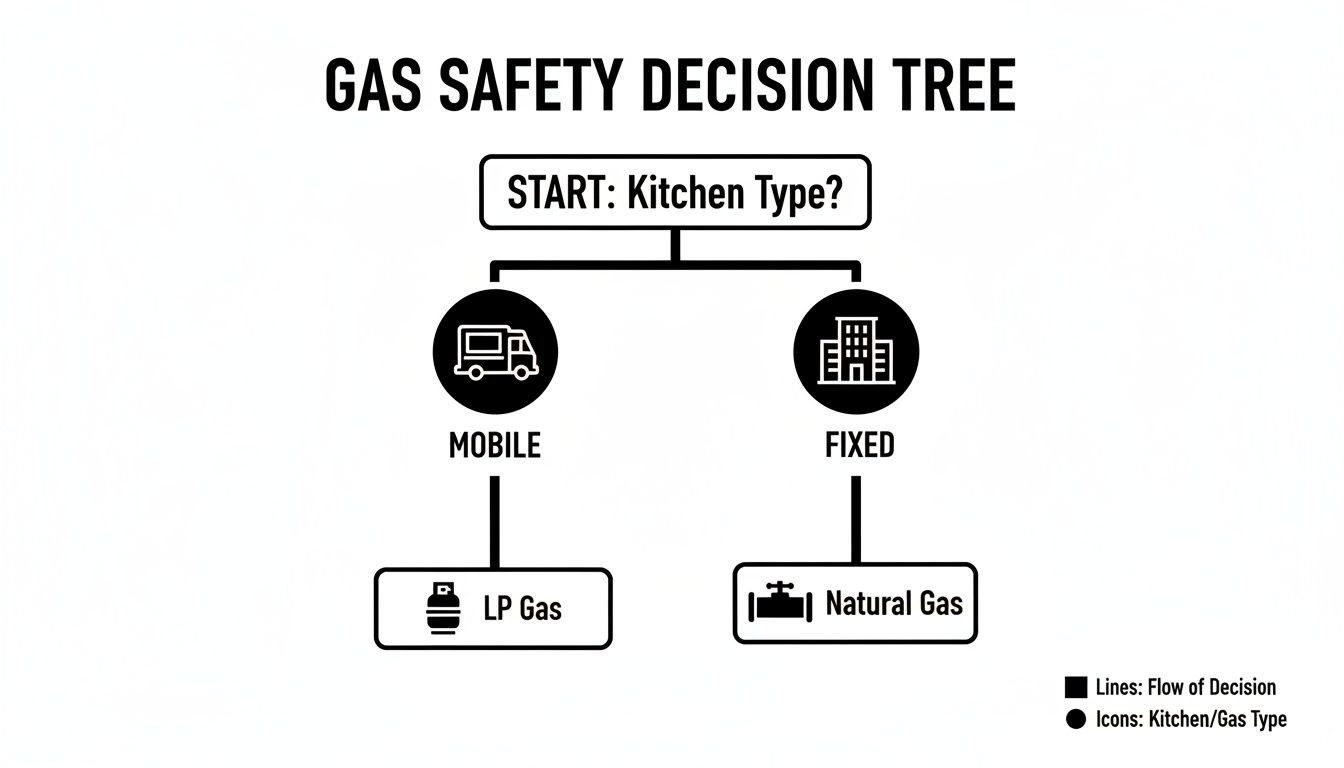
As you can see, the first question is always whether your griddle operation is fixed or mobile. Once you answer that, the path forward becomes much clearer.
At the end of the day, choosing between LP and natural gas is about matching the fuel to your business's DNA. Take a hard look at your location, your budget, and your expected volume. An investment in the right fuel solution doesn't just power your griddle; it supports your long-term growth.
By weighing these practical factors, you can be confident you're picking a fuel source that will let your commercial griddle perform at its absolute best, setting your kitchen up for success from day one.
Answering Your Top Fuel Questions
When you're in the weeds deciding on a new griddle, the fuel source is a huge part of the equation. We get the same questions all the time from chefs and operators, so let's clear the air on the most common ones.
Can I Use the Same Griddle for Both LP and Natural Gas?
Yes, you often can, but it's not a simple plug-and-play situation. Most professional griddles today are "field convertible," which is just industry-speak for being adaptable to either fuel. But you absolutely cannot just swap the gas hose and call it a day.
To switch fuels, a technician needs to install a conversion kit. This isn't just a formality; it's crucial for performance and safety. The kit includes two main things:
- Proper Orifices: These little brass fittings control how much gas gets to the burners. Propane is under higher pressure and packs more energy, so it needs smaller orifices. Get this wrong, and you're looking at a mess.
- Correct Regulator: The regulator's job is to tame the gas pressure before it hits the griddle. Natural gas uses a low-pressure regulator at the appliance, while propane systems have a high-pressure regulator right at the tank.
Trying to run a griddle with the wrong setup can damage the unit, give you terrible cooking results, or worse, create a serious fire hazard. This is a job for a qualified gas technician, period.
Is One Gas Type Safer Than the Other?
Both fuels are perfectly safe when you respect them and follow the rules for your griddle. The safety considerations are just different because of how the gases behave.
The key difference is density. LP gas is heavier than air. If you have a leak, propane will sink and pool near the floor, which can create a concentrated risk of ignition. This is why proper ventilation and outdoor tank storage are non-negotiable for propane users.
Natural gas is lighter than air, so in the event of a leak, it will rise and dissipate much more easily. For natural gas, the safety focus is all about the plumbing. You need regular, professional inspections to make sure the fixed gas lines in your building are in perfect shape.
It's not about which gas is inherently "safer." It's about which safety protocol you're set up to manage. Food truck operators need to be experts in propane tank handling, while restaurant owners must ensure their building's gas infrastructure is professionally maintained for their griddles.
Which Fuel Burns Hotter for Searing?
This is a classic kitchen debate, but it’s based on a misunderstanding. While it’s true that propane has more than double the BTUs per cubic foot, that doesn't mean it "burns hotter" on your griddle surface. The thermostat and burner design dictate the cooking temperature, not the raw power of the gas.
The real-world advantage of propane's energy density is faster heat-up and recovery times. A propane griddle will bounce back to temperature more quickly after you throw down a dozen frozen burger patties. This means you can maintain a rock-solid searing temperature even during the peak of service. A natural gas griddle will hit the exact same temperature, it just might take a few extra moments to recover under a heavy load.
Ready to equip your kitchen with the perfect griddle? At Griddles.com, we offer a wide range of field-convertible models that give you the flexibility to choose the fuel that works for you. Explore our collection of high-performance commercial griddles today at https://griddles.com.