
How to Start a Catering Business Built Around a Commercial Griddle
Before you can fire up a commercial griddle and serve your first client, your catering business begins as an idea. The real work is turning that idea into a profitable reality, which means building a solid foundation first. This stage isn't just about cooking—it's about smart, strategic planning centered on your core piece of equipment: the commercial griddle.
This is where you'll define exactly what kind of griddle-focused food you'll offer and who you'll be serving it to. It's about nailing down your griddle-centric niche, sizing up the local competition, and writing a business plan that actually works. The clearer your vision is now, the easier every other decision will be, from choosing your griddle model to landing your first client.
Building Your Foundation From Concept to Plan
Finding Your Profitable Griddle Niche
Trying to cook everything for every event is a recipe for disaster. The catering world is huge, and the real money is in specialization. When you focus on a specific niche built around the power of a commercial griddle, you become the go-to expert. This makes marketing easier, helps you perfect your menu, and lets you deliver a top-notch experience every time.
Think about where your passion for griddle cooking could really shine. Here are a few popular routes:
- Corporate Catering: This is the world of office breakfasts and lunches. A commercial griddle is perfect for churning out pancakes, bacon, sausage, or a gourmet grilled cheese bar for a team lunch. It often leads to steady, repeat business.
- Wedding Catering: Think beyond the formal dinner. Offer unique griddle-powered options like a late-night slider bar, a build-your-own taco station for a casual reception, or a brunch service for the morning after.
- Social Event Catering: This is your bread and butter for birthdays, graduations, and private dinners. A griddle allows for fun, interactive food stations like hibachi-style cooking or a Philly cheesesteak bar.
- Concession and Festival Catering: If you've got a food truck or a mobile setup, this is your jam. It's all about high-volume, quick-service food that can be cranked out on a commercial griddle without a hitch.
Deciding on a niche is one of the most important first steps. This quick comparison table breaks down some of the key differences to help you find the right fit for your griddle-focused business.
Catering Niche Profitability Snapshot
| Catering Niche | Typical Client | Menu Complexity | Potential Profit Margin | Key Equipment Needs |
|---|---|---|---|---|
| Corporate Catering | Businesses, Office Managers | Low to Medium | 20-30% | Insulated food carriers, chafing dishes, high-volume coffee urns. |
| Wedding Catering | Engaged Couples, Families | High | 30-40%+ | Full mobile kitchen setup, elegant serving ware, portable ovens. |
| Social Events | Individuals, Families | Medium | 25-35% | Versatile cookware, portable bars, decorative platters. |
| Festival/Concession | General Public | Low | 40-50%+ | Commercial griddles, deep fryers, mobile POS system, generator. |
Ultimately, the best niche for you will be one where your griddle skills meet a real market demand, giving you a clear path to profitability.
Conducting Smart Market Research
Got a niche in mind? Great. Now it's time to see if it has legs. Good market research is basically detective work to make sure there's a hungry audience for what you want to cook on your griddle.
Start scoping out the other caterers in your area. Who offers griddle-based menus? What are their price points? You're not looking to copy them—you're looking for the gaps. For example, if your town is saturated with fancy wedding caterers but nobody offers a killer gourmet slider bar, you’ve just spotted a golden opportunity for your commercial griddle.
The goal of market research is to find the intersection of what you love to cook on a griddle, what people are willing to pay for, and what is currently underserved in your community.
This simple flowchart shows how these foundational steps connect, moving you from a big idea to a concrete plan of attack.
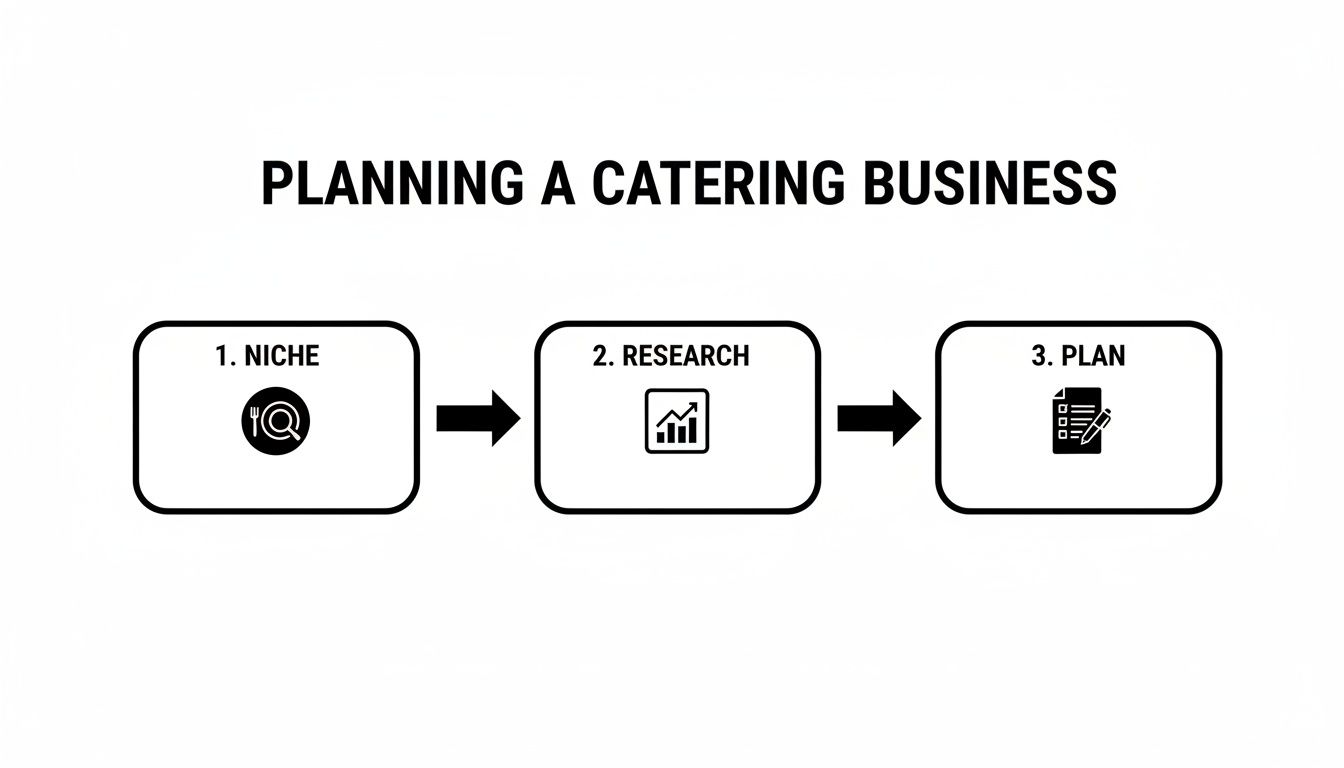
This process keeps you focused and ensures every move you make is deliberate and strategic.
Creating Your Bulletproof Business Plan
Think of your business plan as your roadmap. It's the document that lays out your goals and exactly how you're going to get there. More importantly, it's what you'll need if you want to get a loan or convince investors to back your griddle-based business. It should cover everything from your vision and market analysis to your financial forecasts. If you're new to this, learning how to write a comprehensive business plan is a critical next step.
Jumping into catering right now is a smart move. The global market is set to explode, projected to hit an incredible $498 billion by 2032. The U.S. market alone is on track to grow from $72 billion in 2023 to $124 billion by 2032.
A huge piece of that pie is corporate events, where 53% of buyers are planning to spend even more. Knowing these numbers helps you build a business plan for your griddle-centric service that's grounded in real opportunity.
Navigating Licenses, Permits, and Food Safety
Alright, let's talk about the less glamorous but absolutely critical side of running a griddle business: getting legit. This is all about building a rock-solid foundation of trust with your clients. It’s not just about ticking boxes; it's a clear signal that you're a professional who takes public health and safety seriously.
First thing to know: the rules can change dramatically from one town to the next. Your absolute best first call should be to your local health department. They’ll give you the definitive checklist for your area. The local Small Business Administration (SBA) office is another fantastic resource for navigating the startup maze.
Securing Essential Business Paperwork
Think of these licenses as your official permission slip to operate. Trying to run a business without them is a fast track to hefty fines or, even worse, getting shut down before you've even had a chance to fire up your griddle.
You’ll almost certainly need to get these documents sorted out:
- Business License: This is the basic ticket to entry, required by your city or county to do business. It's non-negotiable.
- Food Handler's Permit: You and anyone on your team touching food will need this. It’s a certification course that covers the fundamentals of safe food handling.
- Catering License: Some areas have a specific license just for caterers. It might have different rules than a typical restaurant, so make sure you get the right one.
- Health Department Permit: This usually involves an inspector visiting your commercial kitchen to ensure it's up to code with proper sanitation and equipment, including your commercial griddle.
Getting these documents in order isn't just a legal hurdle. It's a powerful signal to potential clients that you are a serious, professional operation they can trust with their most important events.
The Non-Negotiable Role of Insurance
Insurance is your financial backstop. In the world of live events, things can go sideways fast. A guest could slip, or your griddle's propane tank could cause an issue. Without the right coverage, one bad day could sink your entire business.
Don't even think about starting without these policies in place:
- General Liability Insurance: This is your core protection. If a guest trips over one of your cords and gets hurt, or if you accidentally damage a venue's property, this is what covers you.
- Commercial Auto Insurance: Your personal car insurance policy will not cover you if you're in an accident while transporting your griddle and other equipment. You need a dedicated commercial policy.
Mastering Food Safety Standards
Your reputation lives and dies by the quality and safety of your food. A single foodborne illness incident can destroy a brand overnight. This is why you have to be absolutely obsessed with food safety protocols.
The gold standard in the industry is the ServSafe certification. Getting certified proves you understand the entire food safety chain, from receiving produce to plating the final dish. This means mastering temperature control, preventing cross-contamination, and enforcing strict hygiene.
A huge piece of this is rigorous cleaning and sanitation of your kitchen's workhorses. Knowing exactly how to clean a commercial griddle isn't just a closing-down task; it's a core food safety procedure. Proper cleaning prevents flavor transfer and dangerous bacterial buildup, which directly protects both your customers and your business.
Equipping Your Kitchen for Griddle-Powered Success
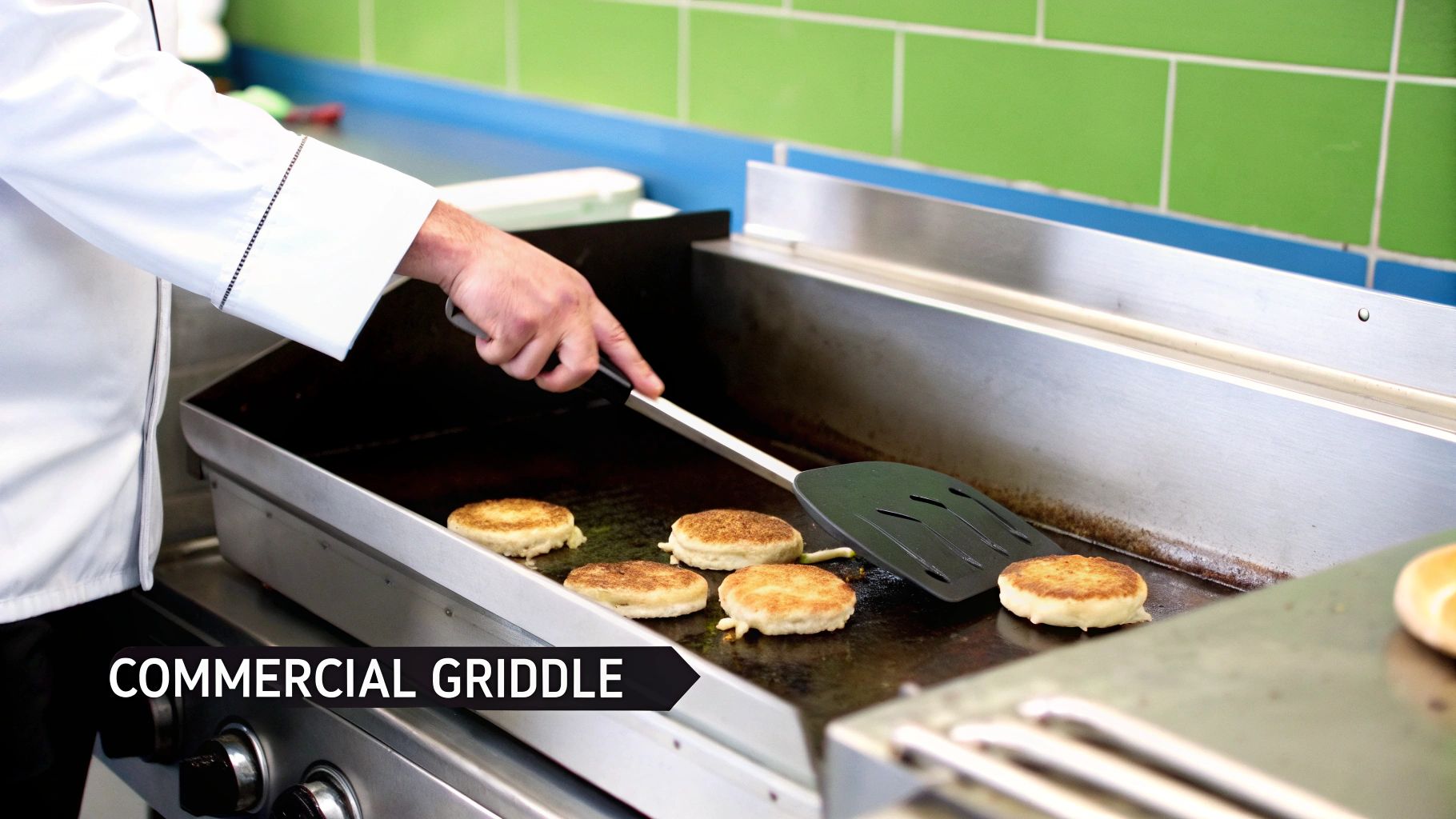
Let's talk about the heart of your operation: the kitchen. Your ability to crank out consistently great food, event after event, comes down to the gear you have on your side. And for a specialized caterer, the undisputed workhorse of the kitchen is a solid commercial griddle.
Think about it. That huge, flat surface is your best friend when you’re staring down an order for a hundred smash burgers or a breakfast service for an entire wedding party. It’s where you get that perfect sear and that lightning-fast turnaround, letting you cook multiple items at once without breaking a sweat. It’s not just a piece of equipment; it’s your key to efficiency.
Why a Commercial Griddle Is a Must-Have
Forget about that little griddle pan in your home kitchen. It won't last a single event. Commercial griddles are built like tanks, designed for the brutal reality of high-volume service. They deliver incredible heat distribution and, crucially, recover their temperature almost instantly.
When you’re slamming down dozens of cold burger patties or pouring batter for pancakes, a lesser griddle will lose heat and stall. A commercial unit bounces right back, ensuring the last item you cook is just as perfect as the first. That reliability is everything when you're on a tight event schedule.
Investing in pro-level gear isn't just a good idea—it's essential for survival and growth. The catering market is projected to grow by an astounding $73.2 billion from 2025-2029. With the industry valued at $118.3 billion in 2025 and expected to hit $180.3 billion by 2035, you can't afford to be sidelined by equipment failure. Rock-solid gear like a thermostatic griddle also means less waste from uneven cooking, which directly protects your profit margins against rising food costs.
Choosing Your Griddle: Gas vs. Electric
Your first big decision is how to power your griddle. There’s no single right answer—it all depends on how and where you'll be cooking.
- Gas Griddles: These are the powerhouses. Chefs love them for their raw heat and instant temperature adjustments. If you’re doing a lot of high-heat searing and need to get up to temperature fast, gas is usually the way to go.
- Electric Griddles: The biggest win for electric models is their ridiculously consistent and even heat. This makes them unbeatable for delicate items like eggs, crepes, and pancakes. They're also your ticket to operating in venues that don't allow open flames or lack gas hookups.
Honestly, the choice often comes down to the gigs you're booking. Gas delivers brute force, but an electric griddle gives you the flexibility to say "yes" to more jobs in more places.
Key Griddle Features That Actually Matter
Once you've picked a power source, don't just grab the first model you see. The details make a huge difference in your day-to-day workflow.
Plate Thickness
The steel plate you cook on is the most important part. A thicker plate, ideally around 1 inch, holds heat like a champ. That means faster recovery times when you're slammed and more even cooking across the entire surface. Don't skimp here.
Thermostatic vs. Manual Controls
This is a game-changer. You'll see two main types of controls:
- Manual Controls: These are your basic high-medium-low knobs. They’re simple and durable, but they lack precision.
- Thermostatic Controls: You dial in a precise temperature (say, 350°F), and the griddle maintains it for you. This takes all the guesswork out of cooking.
For catering, thermostatic controls are the clear winner. They give you repeatable, perfect results every single time, which is exactly what you need to build a stellar reputation.
Grease Management
A busy griddle produces a ton of grease. Look for a model with a smart design—a wide, sloped trough that channels grease into a large, easy-to-remove drip tray. The last thing you want to be doing at the end of a 14-hour day is fighting with a poorly designed grease trap. Easy cleanup is a beautiful thing.
If you’re leaning towards pure power for your kitchen setup, our guide on commercial gas griddles has a lot more detail to help you choose the right one.
Here’s a quick rundown of the essential equipment you’ll need to get your catering kitchen up and running, with a special focus on supporting a griddle-heavy menu.
Essential Catering Equipment Checklist
| Equipment Category | Essential Items | Key Feature to Look For | Why It's Critical |
|---|---|---|---|
| Cooking | Commercial Griddle (Gas or Electric) | 3/4" to 1" thick plate, thermostatic controls | The workhorse for high-volume cooking, from burgers to breakfast. |
| Convection Oven | Even heat distribution, multiple racks | Essential for baking, roasting, and reheating large batches quickly. | |
| 6-Burner Gas Range | High BTU output, durable cast-iron grates | Provides versatility for sauces, soups, and sautéing alongside the griddle. | |
| Commercial Fryer | Rapid recovery time, large oil capacity | For producing crispy appetizers and sides consistently at scale. | |
| Holding | Insulated Food Carriers (Cambros) | Excellent temperature retention (hot or cold) | Keeps food at a safe and appetizing temperature during transport. |
| Holding/Proofing Cabinet | Humidity and temperature controls | Prevents food from drying out during service; crucial for bread and proteins. | |
| Steam Table / Chafing Dishes | Stainless steel construction, fuel or electric | Keeps food hot and ready to serve on the buffet line. | |
| Transport & Setup | Heavy-Duty Utility Cart | Large wheels, high weight capacity | Safely and efficiently move heavy equipment and food carriers. |
| Collapsible Prep Tables | Stainless steel, easy to clean and transport | Provides a sanitary and stable workspace at any event location. | |
| Commercial Coolers | High-capacity, durable construction | Essential for transporting ingredients and keeping beverages cold. |
This checklist covers the absolute must-haves. As your business grows, you can start adding more specialized pieces, but this core setup will give you the power and flexibility to handle most catering gigs with confidence.
Designing Your Menu and Mastering Food Costs
Your menu isn't just a list of dishes; it's the heart of your brand. It's your single most important sales tool, and getting it right is a careful dance between culinary creativity and cold, hard math.
When you're starting out, it’s tempting to offer everything under the sun. Don't. The best catering menus feature dishes that not only taste fantastic but are also practical. They have to hold up during transport, be scalable for a huge crowd, and be easy for your team to serve quickly and efficiently on-site.
Building a Griddle-Centric and Profitable Menu
This is where your commercial griddle becomes your secret weapon. By designing a menu around what this workhorse does best—churning out large volumes of food quickly and consistently—you’re setting yourself up for success. It’s a strategy that creates delicious, crowd-pleasing food that also happens to be incredibly profitable.
Let's talk about some high-margin items that are practically made for a griddle:
- Gourmet Sliders: Think classic beef, smoky pulled pork, or spicy black bean burgers. You can cook dozens at once and offer endless customizations.
- Taco and Fajita Bars: Nothing beats the sizzle of steak, chicken, and veggies hitting a hot griddle. It's an interactive, fun, and popular option for any event.
- Breakfast for a Crowd: Pancakes, French toast, bacon, and sausage are breakfast gold. They are insanely cost-effective and can be produced at an amazing speed.
Centering your menu on griddle-friendly items simplifies your kitchen workflow, cuts down on the need for a ton of specialized equipment, and keeps your food costs in check. If you need a spark of creativity, checking out different breakfast restaurant menu ideas can give you some amazing inspiration for catering packages.
The Critical Skill of Food Costing
Guessing at your food costs is one of the fastest ways to run a catering business into the ground. You absolutely must know the exact cost of every single ingredient that goes into every dish. This process is called food costing, and it's the bedrock of a profitable business.
Get comfortable with spreadsheets. For every single menu item, you need to list every ingredient, its unit price, and the precise amount used in the recipe. For example, if a batch of 50 sliders requires 10 pounds of ground beef and you pay $4.50 per pound, the beef cost for that recipe is $45.00.
You have to do this for everything—from the buns and cheese right down to the pinch of salt and the splash of cooking oil. Once you have the total cost for the entire recipe, divide it by the number of servings (50, in this case) to find your cost per serving. This number is your north star for setting prices.
As a rule of thumb, the catering industry aims for a food cost percentage between 25% and 35%. This means if a plate costs you $5.00 in raw ingredients, your menu price should be somewhere between $14 and $20 to properly cover labor, overhead, and, of course, profit.
Setting Your Catering Package Prices
Once you’ve nailed down your per-serving costs, you can start building your pricing structure. Catering pricing is a bit more involved than just marking up food costs because you’re selling an entire service, not just a plate of food.
The final price you quote a client needs to wrap in several key factors:
- Total Food Cost: Your per-serving cost multiplied by the guest count.
- Labor Costs: This covers everything—prep cooks in the kitchen, chefs on-site, serving staff, and the cleanup crew. Don't forget to pay yourself!
- Overhead Expenses: Every job needs to cover a small slice of your ongoing business costs like kitchen rent, insurance, marketing, and vehicle expenses.
- Profit Margin: This is what's left after all the bills are paid. It's the money that allows you to grow. Aim for a healthy margin of at least 15-20%, if not more, depending on your local market.
A great way to present options to clients is through tiered packages—think Bronze, Silver, and Gold. Each tier can offer different griddle-based menu choices and service levels at clear, easy-to-understand per-person prices. It simplifies their decision and makes your pricing feel transparent and professional.
Building Smart Supplier Relationships
The final piece of the profitability puzzle is your supply chain. The quality and price of your ingredients directly affect your food cost and the reputation you build. This isn't something you can skimp on; building strong relationships with reliable suppliers is non-negotiable.
Go beyond the big-box stores. Hunt down local wholesalers, butchers, and produce markets. They may have minimum orders, but the price-per-unit is often much lower and the quality is usually far better. As you become a loyal, regular customer, you'll find you can negotiate better pricing and get first dibs on special deals, which is crucial for protecting your margins.
Marketing Your Catering Business and Landing Clients
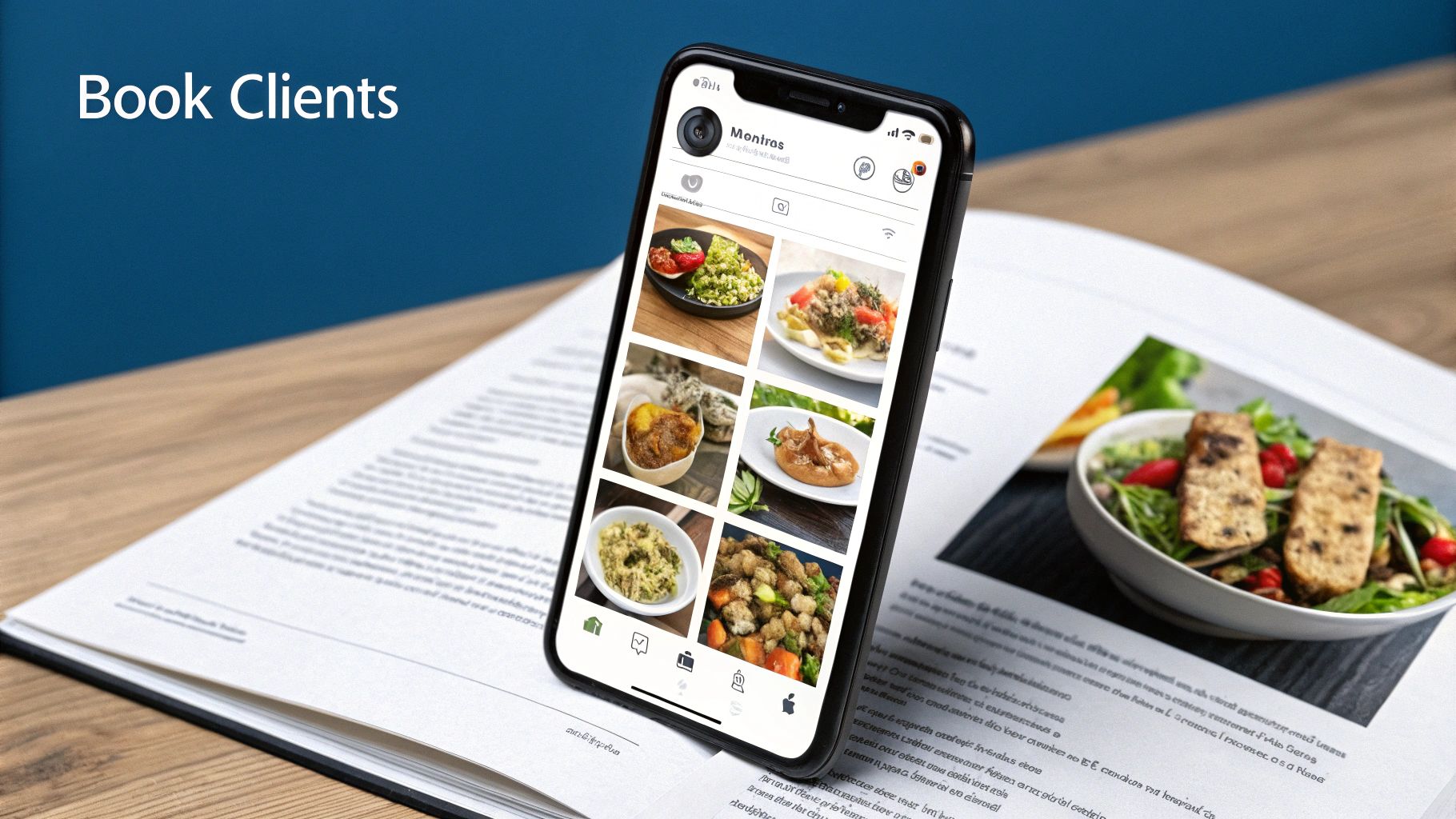
You've perfected the recipes and dialed in your griddle menu. That's a huge step, but even the best food on the planet won't sell itself. Now it’s time to switch hats from chef to marketer. If potential clients don't know you exist, you'll never get the chance to wow them.
Your mission is to build a brand that instantly communicates quality, deliciousness, and reliability. Every single touchpoint—from your website to your Instagram feed—needs to tell a consistent story of amazing food cooked fresh on your griddle. This isn't just about posting food pics; it's about building trust and making it incredibly easy for someone to say, "Yes, I want to hire them."
Building Your Digital Storefront
Think of your website as your 24/7 sales pitch. It's your most critical marketing tool, and it needs to work for you even when you're busy in the kitchen. A clunky, cheap-looking site is a huge red flag for potential clients, so this is one area where you don't want to cut corners.
Let's be honest: people eat with their eyes first. The absolute star of your website has to be your food. Invest in a professional photographer to get mouth-watering, high-resolution shots of your signature griddle dishes. These images do all the heavy lifting, selling the experience before a client even asks for a quote.
Beyond stunning photos, your site needs to be dead simple to use. Make sure it has:
- Clear Menu Packages: Give people a starting point with sample menus and pricing.
- A Killer Photo Gallery: Showcase your food and setup from real events.
- Your Story: An "About Us" page that connects people to your passion for food.
- An Easy Contact Form: Don't make them hunt for a way to request a quote.
Using Social Media to Tell Your Story
If your website is the polished portfolio, social media is where your brand's personality shines. Platforms like Instagram are perfect for caterers—it’s all visual. This is where you connect with your community and turn casual followers into paying clients.
Get creative! Post behind-the-scenes videos of your team prepping for a big event. Show a quick clip of burger patties sizzling on the griddle. Share a glowing review from a happy bride. Use local hashtags that people are actually searching for (like #AustinCatering or #NYCEvents) to get discovered.
A strong social media game does more than just advertise; it builds a community. You're turning followers into fans, and those fans become clients who feel like they already know and trust you.
For new businesses, diving into a complete guide on digital marketing for small business can give you a solid playbook. It’s packed with proven strategies that will help you build an effective online presence from the ground up.
Networking and Building Key Partnerships
Digital marketing is essential, but for a catering business, old-school networking is pure gold. You have to get out there and build relationships with the people who can send a steady stream of business your way.
Start by identifying the key players in your local events scene. Make it your mission to connect with:
- Event and Wedding Planners: They are always on the lookout for reliable caterers with unique offerings, like a mobile griddle station.
- Corporate Event Managers: Find the office managers or HR reps at big local companies. A great move is to offer to drop off a "tasting lunch" of your best griddle sliders.
- Venue Managers: Getting on the "preferred vendor" list at popular wedding venues, conference centers, and event halls is a game-changer.
Crafting Proposals and Contracts That Seal the Deal
When an inquiry comes in, your proposal is your chance to close it. This document should be professional, incredibly detailed, and tailored to that specific client. Don't just send a price list—paint a picture of the entire experience you'll deliver, from the griddle menu and staffing to the service style.
Just as critical is a rock-solid contract. This isn't just paperwork; it’s what protects you and your client by making sure everyone is on the same page. Your contract must spell out:
- The exact menu and all services being provided.
- The total cost and a non-negotiable payment schedule.
- A clear, firm cancellation policy.
- Who is responsible for setup, cleanup, and any equipment rentals.
I'll say it again for the people in the back: never, ever cater an event without a signed contract. It's the single most important document you have for running a professional, secure business.
Common Questions About Starting a Catering Business
As you start piecing together your catering dream, you're going to have questions. Everyone does. Let's tackle some of the big ones that pop up for new caterers, especially looking at how your equipment choices—and specifically your commercial griddle—shape the answers.
How Much Capital Do I Really Need for Equipment?
This is the million-dollar question, isn't it? The truth is, startup costs can be all over the map. If you're running lean and renting space in a commercial kitchen, you might get in the door for $10,000 to $20,000 for your initial licenses, insurance, and basic gear.
But a huge chunk of that budget will be dedicated to your cooking line. Think of a high-quality commercial griddle not as an expense, but as the foundational investment for your entire operation. A reliable 36-inch thermostatic gas griddle, for example, is a serious line item, but it's the engine that drives your menu's efficiency and scale. When you budget, don't just plan for the griddle itself—remember to factor in professional installation, proper ventilation, and all the essential tools like spatulas, scrapers, and cleaning supplies.
Can I Get By with Residential Cooking Gear Initially?
Let me be blunt: no. In pretty much every health district, trying to use home appliances for commercial cooking is a non-starter. Health codes are incredibly strict about this for very good reasons related to sanitation and safety. Using your home griddle for a paid gig is the fastest way to get a visit from the health inspector and a cease-and-desist order.
You absolutely must operate out of a licensed commercial kitchen or commissary. The great news is that many cities have shared-use kitchens you can rent by the hour or day. This is a fantastic, budget-friendly way to start. These places come stocked with the professional-grade equipment you're required to use, including those powerful commercial griddles that can actually handle a catering-sized order without breaking a sweat.
Starting with the right equipment isn't just about following rules; it's about setting a professional standard. A commercial griddle delivers the consistent heat and rapid recovery time needed to produce high-quality food at scale, proving your capability to clients and health inspectors alike.
What Equipment Drives the Most Profitability?
The gear that makes you the most money is the equipment that lets you crank out popular, high-margin food, fast. And this is where a commercial griddle becomes your best friend. It’s a profit-generating machine.
Just think about some classic, money-making catering gigs that are built around a flat-top:
- Corporate Breakfasts: Pancakes, bacon, sausage, and eggs have incredibly low food costs. A big griddle surface means you can cook for dozens of people at once, making these events pure profit.
- Slider Bars: Who doesn't love a gourmet mini-burger? The ability to sear off a hundred patties in just a few minutes is efficiency you can take straight to the bank.
- Festival Concessions: Think cheesesteaks, loaded grilled cheese, and quesadillas. These are high-margin crowd-pleasers that are tailor-made for rapid-fire griddle cooking.
A commercial griddle is so versatile you can build an entire profitable menu around it. This lets you minimize what you spend on other specialized, single-use equipment and truly maximize your return on investment.
How Does My Griddle Choice Impact My Pricing?
Your griddle directly affects two of the biggest factors in your pricing: labor costs and food consistency. A quality griddle with precise thermostatic controls means you get perfectly cooked food every time. That consistency drastically cuts down on food waste from burnt or undercooked items. Less waste equals lower food costs and a healthier bottom line.
Beyond that, a larger, more efficient griddle means one or two cooks can do the work that might otherwise take three. That’s a massive saving on your on-site labor costs for every single event. When you sit down to price out your catering packages, that efficiency allows you to be more competitive while still protecting your profit. The reliability of your griddle gives you the confidence to price your services for what they're worth, knowing you can deliver flawlessly without costly mistakes.
Ready to build a kitchen that powers your profitability? Griddles.com specializes in high-performance commercial griddles and all the essential line equipment you need to launch your catering business. Explore our full catalog and get free, fast shipping on every order at https://griddles.com.