
The Ultimate Guide to Commercial Griddles for Your Food Truck
When outfitting a food truck, the single most important piece of kitchen equipment for your food truck is the commercial griddle. Forget everything else for a moment. This flat-top beast is the workhorse, the money-maker, and the heart of your entire mobile kitchen.
Its raw power and incredible versatility mean you can build a whole menu around it, all from one compact spot.
Why the Commercial Griddle Is Your Food Truck's MVP
Think of the real engine of your business—not the one that gets you from A to B, but the one that cranks out cash. For almost every successful food truck, that engine is a seasoned slab of steel. The commercial griddle is your Swiss Army knife, letting you sling breakfast sandwiches in the morning and then pivot to smash burgers for the late-night crowd without skipping a beat.
That big, flat surface is your canvas. While specialized equipment can only do one thing, a good griddle does dozens of things exceptionally well. In a business where every inch of steel is prime real estate, that kind of flexibility is everything. You simply can't get that level of menu freedom from any other single appliance.
The Centerpiece of Your Menu
Just think about the most iconic and profitable street foods: Philly cheesesteaks, loaded quesadillas, breakfast tacos, and of course, the mighty smash burger. What's the common thread? They all come to life on a griddle. This one piece of equipment defines what you can serve and becomes the core of your culinary identity.
- Breakfast Service: You can have eggs, bacon, sausage, and pancakes all cooking at the same time.
- Lunch Rush: Sear patties, toast buns, grill onions, and melt cheese—all on the same surface, right next to each other.
- Dinner Menu: From seared chicken and steak to sautéed veggies and toasted tortillas, the possibilities are endless.
Because you can crank out a high volume of so many different items, the griddle is what drives your revenue. Any solid food truck equipment list starts with the griddle, and every other piece of gear is chosen to support it.
In the tight quarters of a food truck, every appliance has to fight for its spot. The griddle earns its keep with every single sizzle, proving its worth by blowing your menu wide open while cutting down the need for other bulky, one-trick-pony machines.
Maximizing Profit in a Small Space
In a food truck, space is gold. Nothing gives you a better return on your square footage than a griddle. A standard 36-inch griddle gives you a massive cooking area without hogging the space that separate pots, pans, and burners would devour. This consolidation frees up precious counter space and makes the whole cooking process simpler, letting a small crew pump out a high volume of orders.
When you build your operation around the griddle, your whole workflow gets smoother. Your cook can stand in one spot and manage multiple tickets, which means less running around and faster service times. That efficiency translates directly into more customers served and more money in your pocket, cementing the griddle's status as your most valuable player.
Choosing Your Griddle Fuel: Propane vs. Electric
Okay, you've decided the griddle is the heart of your food truck. Now comes the real gut-check decision: how are you going to power it? This isn't just a technical spec on a sheet; it's a choice that defines your entire operation—where you can park, how fast you can cook, and the flow of your service window. Are you going with the raw, untethered power of propane or the steady, precise control of electricity?
It's like choosing your lead guitarist. Propane is the wild, high-energy shredder, perfect for blasting out powerful riffs and keeping the crowd hyped during a rush. Electric is the technical virtuoso, delivering consistent, note-perfect melodies for dishes that require finesse.
The Power and Freedom of Propane Griddles
There's a reason propane is the classic choice for just about every piece of mobile cooking equipment. It's freedom. With propane, you're off the grid, ready to set up at a music festival in the middle of a field, a remote roadside spot, or a farmers' market with zero electrical hookups. This fuel is all about pure, raw power, and in the griddle world, we measure that in BTUs (British Thermal Units).
A high-BTU propane griddle heats up like a beast and snaps right back to temperature almost instantly after you throw down a pile of cold ingredients. That rapid heat recovery is everything during a lunch rush. When you're flipping a dozen burgers or slamming down cheesesteak orders, a griddle that cools down will steam your food instead of searing it, grinding your ticket times to a painful halt.
But with great freedom comes great responsibility. You've got to wrangle propane tanks, making sure they're locked down tight during transit and stored according to strict local fire codes. And trust me, running out of fuel mid-service is the kind of nightmare you don't wake up from. A reliable supply and backup tanks aren't just a good idea—they're non-negotiable.
The Precision and Consistency of Electric Griddles
On the flip side, electric griddles are the kings of precision. If your menu is built around things that need exact temperatures—think delicate crepes, perfectly browned pancakes, or even tempered chocolate—an electric model gives you a level of control that propane just can’t touch. They rely on thermostats to hold a temperature with surgical accuracy, giving you the same perfect result on the first order of the day and the last.
That consistency makes them a dream for indoor events, commissary kitchens, or those coveted spots in food truck parks with reliable shore power. Another huge plus? They throw off less ambient heat, which is a lifesaver in a cramped metal box during a summer heatwave.
The big catch with electric griddles is their massive appetite for power. You can't just plug a commercial unit into any old outlet. You're looking at a heavy-duty, and often very expensive, generator or a direct, high-amperage hookup. This reality severely limits where you can operate.
Picking your fuel source is a foundational decision that ripples through your whole business, from menu design to location scouting. If you're curious about the specific power demands, you can explore various commercial electric griddle models to see if their requirements line up with your truck's setup.
Propane vs. Electric Griddles: A Food Truck Comparison
To make this choice crystal clear, let's put them head-to-head. This table breaks down the key operational differences to help you decide which fuel source fits your food truck's game plan.
| Feature | Propane Griddles | Electric Griddles |
|---|---|---|
| Best For | Festivals, remote locations, high-volume searing | Indoor events, markets with power, precise cooking |
| Power Source | Propane tanks | Heavy-duty generator or direct hookup |
| Heat Control | Manual, powerful, less precise | Thermostatic, highly precise, consistent |
| Portability | High - operate anywhere | Low - tied to a power source |
| Heat Recovery | Excellent - recovers temperature quickly | Good - can be slower under heavy load |
| Installation | Requires secure tank storage and gas lines | Requires professional electrical wiring |
So, what’s the final call? It really comes down to your business model. If you dream of slinging burgers for massive crowds at outdoor concerts, propane's raw power and go-anywhere attitude is your best friend. But if your vision involves a more permanent spot with stable power or a menu that lives and dies by culinary finesse, then an electric griddle will be your most trusted partner in the kitchen.
Selecting Griddle Size and Plate Thickness
Once you've nailed down your fuel source, the next big decision is the griddle's physical specs. This isn't just about picking a random size; the cooking surface and the thickness of the steel plate are what will make or break your truck's speed, food quality, and overall flow. Getting this right is absolutely fundamental to pumping out great food, fast.
It really all comes down to your menu and how many mouths you expect to feed. A breakfast truck firing off pancakes and tacos needs a massive griddle to handle the morning rush. On the other hand, a smash burger joint might want a smaller, brutally hot surface that’s all about creating that perfect sear.
This chart can help you visualize how your location and menu should guide your fuel choice.
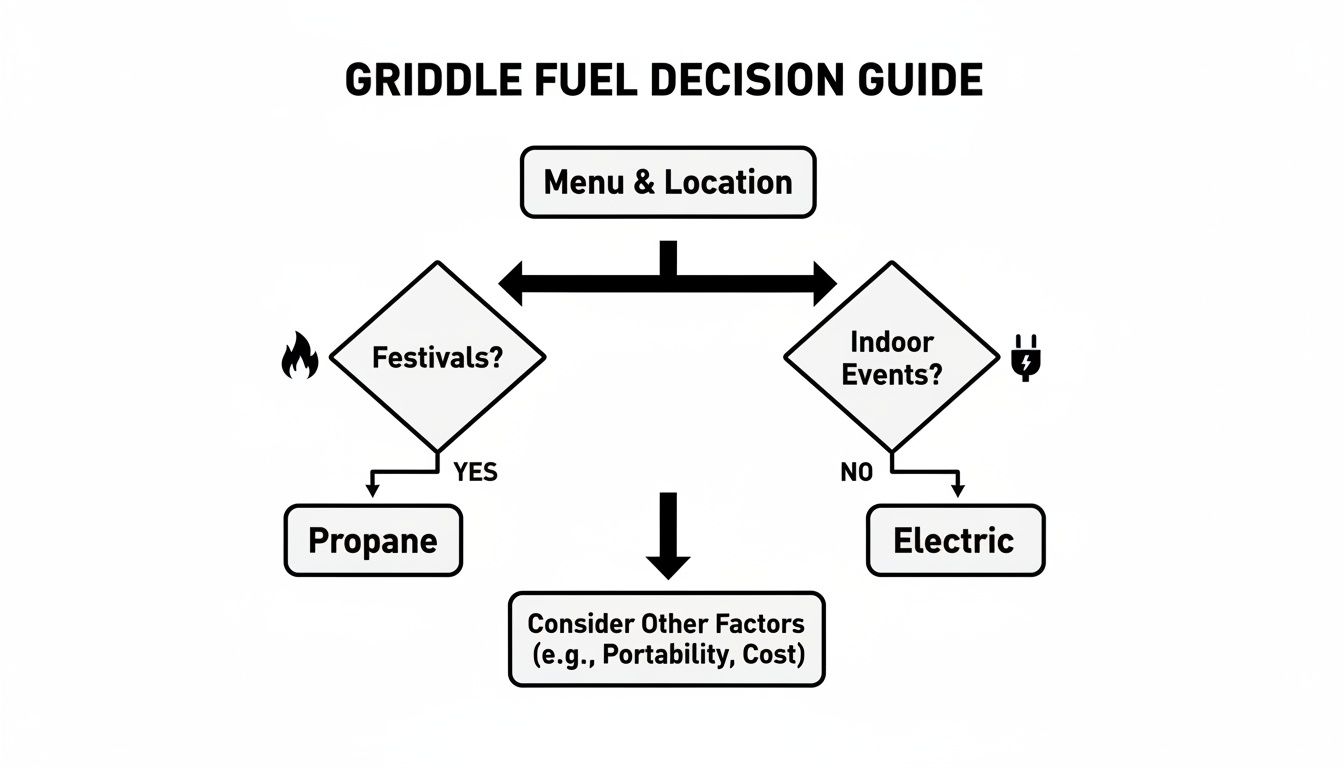
The takeaway is simple: where you plan to operate—be it outdoor festivals or spots with easy power access—is the number one factor in picking your fuel.
Finding the Right Griddle Width
Commercial griddles for food trucks generally come in standard widths like 24-inch, 36-inch, and 48-inch models. The perfect fit depends entirely on your menu's needs and the actual space you have. Before you even think about buying, get in your truck with a tape measure and figure out your cook line, making sure to leave room for ventilation and your other gear.
- 24-Inch Griddles: Perfect for trucks with a super-focused menu or where the griddle plays a supporting role. Think gourmet grilled cheese or searing off veggies for a rice bowl.
- 36-Inch Griddles: This is the sweet spot for a huge number of food trucks. It gives you plenty of cooking real estate for a varied menu and busy rushes without hogging the whole kitchen.
- 48-Inch Griddles: If your concept is built around the griddle—like Philly cheesesteaks or breakfast burritos—this is your workhorse. A 48-inch surface lets your cook juggle multiple orders at once, which is key for maximizing throughput.
The truck itself often makes this decision for you. Mid-sized trucks (16-25 feet) are the most popular in the U.S., holding a massive 50.25% market share. They're big enough for serious commercial equipment but agile enough for city streets. As the U.S. food truck market grows from a projected $1.16 billion in 2026 to $1.59 billion by 2031 (according to Mordor Intelligence), this truck size will continue to dominate, perfectly accommodating gear like 48-inch griddles.
Why Plate Thickness Is a Game Changer
Beyond just the width, the thickness of the griddle plate is probably the single most important factor for cooking performance. The industry standard for a quality commercial griddle is a 3/4-inch to 1-inch thick steel plate. It might not sound like a huge difference, but it completely transforms how the griddle performs under pressure.
Think of it like cooking with a heavy cast-iron skillet versus a flimsy, cheap pan. The thin pan gets hot fast, but the moment you drop cold food on it, the temperature plummets, and you end up steaming your ingredients instead of searing them. The heavy skillet, however, holds that heat and delivers a powerful, consistent sear every single time.
A thick griddle plate acts as a thermal battery. It stores a massive amount of heat energy, ensuring that even when you load it up with cold burger patties or frozen hash browns, the surface temperature stays incredibly stable.
This heat retention is what gives you consistent results, ticket after ticket. It eliminates hot spots and ensures every item is cooked just right. Plus, a thick plate is way more resistant to warping—a common headache with thinner plates that are constantly heated and cooled. Investing in a thick plate is a direct investment in your food quality and the longevity of your equipment. For a deeper dive, check out our guide on the essential commercial kitchen equipment list.
Must-Have Features for a Road-Ready Griddle
A griddle seems simple enough, but a food truck isn’t your typical restaurant kitchen. It’s a kitchen that hits potholes. The constant vibration from travel, the elbow-to-elbow workspace, and the pressure for lightning-fast service create challenges that only a purpose-built, road-ready griddle can handle.
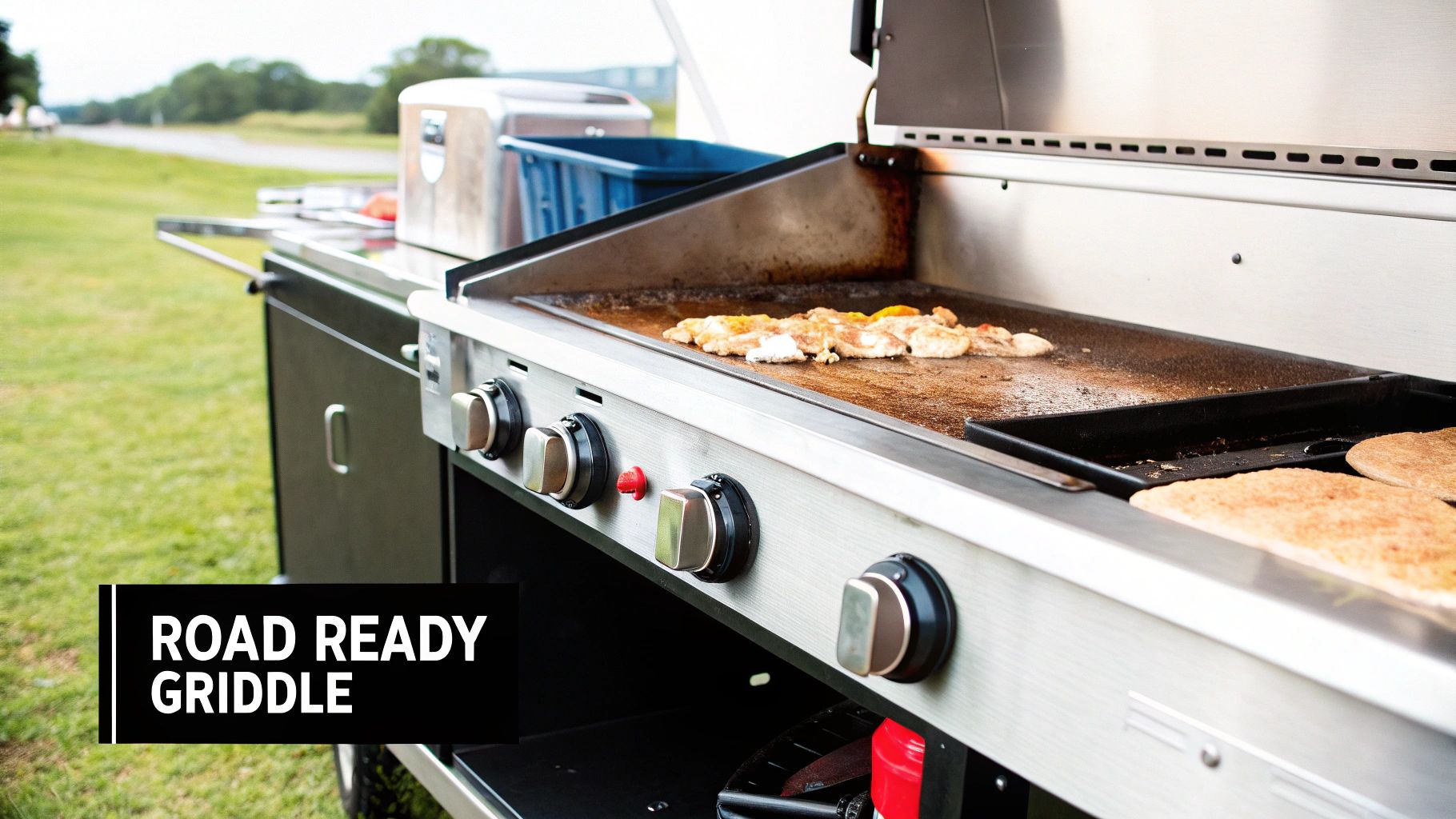
Standard restaurant equipment can literally shake itself to pieces on the road. The best gear for a food truck is designed to take a beating. Think of it like the difference between your daily driver and a rugged off-road Jeep; both have engines, but only one is built to survive the constant bumps and jolts of a demanding journey.
Built-Tough Stainless Steel Construction
Your food truck is a kitchen on wheels, which means one thing: vibration. Every speed bump and highway mile puts immense stress on your equipment. This is why a durable, fully welded stainless steel construction isn't just a nice-to-have, it's completely non-negotiable.
Cheaper models with frames that are just bolted together will rattle loose and fall apart. A fully welded unit, however, acts as one solid piece. It can absorb all that shaking without failing, ensuring your investment lasts for years, not just one food truck season.
Practical Design for Tight Spaces
In a food truck, your workflow is everything. Every inch counts. When it comes to griddles, two of the most critical design elements are the splash guards and the grease trap.
- Tall Splash Guards: When you're working in a tight space, grease splatter is more than a mess—it’s a safety hazard. Look for tall, welded splash guards, usually 3-4 inches high, to contain the grease and keep your cook line clean and safe.
- Large, Removable Grease Trap: You don’t have time to mess with a tiny, awkward grease drawer during the lunch rush. A big, easy-to-remove grease trap makes cleanup fast and painless, both between orders and at the end of a long day.
These details seem small, but they make a huge difference in how smoothly your day runs.
The Great Debate: Thermostatic vs. Manual Controls
How you control the heat on your griddle directly impacts your food quality and speed. The right choice between thermostatic and manual controls really comes down to your menu.
Think of it like being an artist. Manual controls are your primary colors—raw, intense heat perfect for broad strokes, like getting that perfect crust on a smash burger. You get high, medium, and low, and you’re in complete command.
Thermostatic controls, on the other hand, are like having a full palette of pre-mixed paints. You just set the dial to a precise temperature, say 350°F for pancakes, and the griddle’s internal thermostat holds it there. This precision is ideal for delicate items that burn easily, guaranteeing consistency with every order.
A food truck specializing in smash burgers could get by just fine with the raw power of manual controls. But a truck serving a diverse menu—breakfast, quesadillas, grilled sandwiches—will benefit massively from the set-it-and-forget-it consistency of a thermostatic model.
The Game-Changing Field-Convertible Gas Hookup
One of the smartest features you can get on any piece of gas equipment is a field-convertible gas hookup. This gives you ultimate flexibility, letting you switch between fuel sources depending on where you're parked.
It's like being bilingual. When you're out at a festival, you "speak" propane from your portable tanks. But when you’re back at the commissary kitchen prepping for the next day, you can switch over and "speak" natural gas from the building's main line.
This versatility saves you a ton of money on propane when you have access to cheaper natural gas and means you can operate anywhere without needing two different griddles. Many top-tier models even include the conversion kit, making it a simple, practical feature that prepares your business for any opportunity.
Designing Your Food Truck Workflow Around the Griddle
Having the best griddle on the market won't do you any good if it's stuffed in the wrong corner. Think of your griddle as the sun of your mobile kitchen—everything else should orbit around it. A smart layout isn’t about making the truck look pretty; it's about pure, unadulterated speed. Shaving a few seconds off every order adds up to real money during a lunch rush.
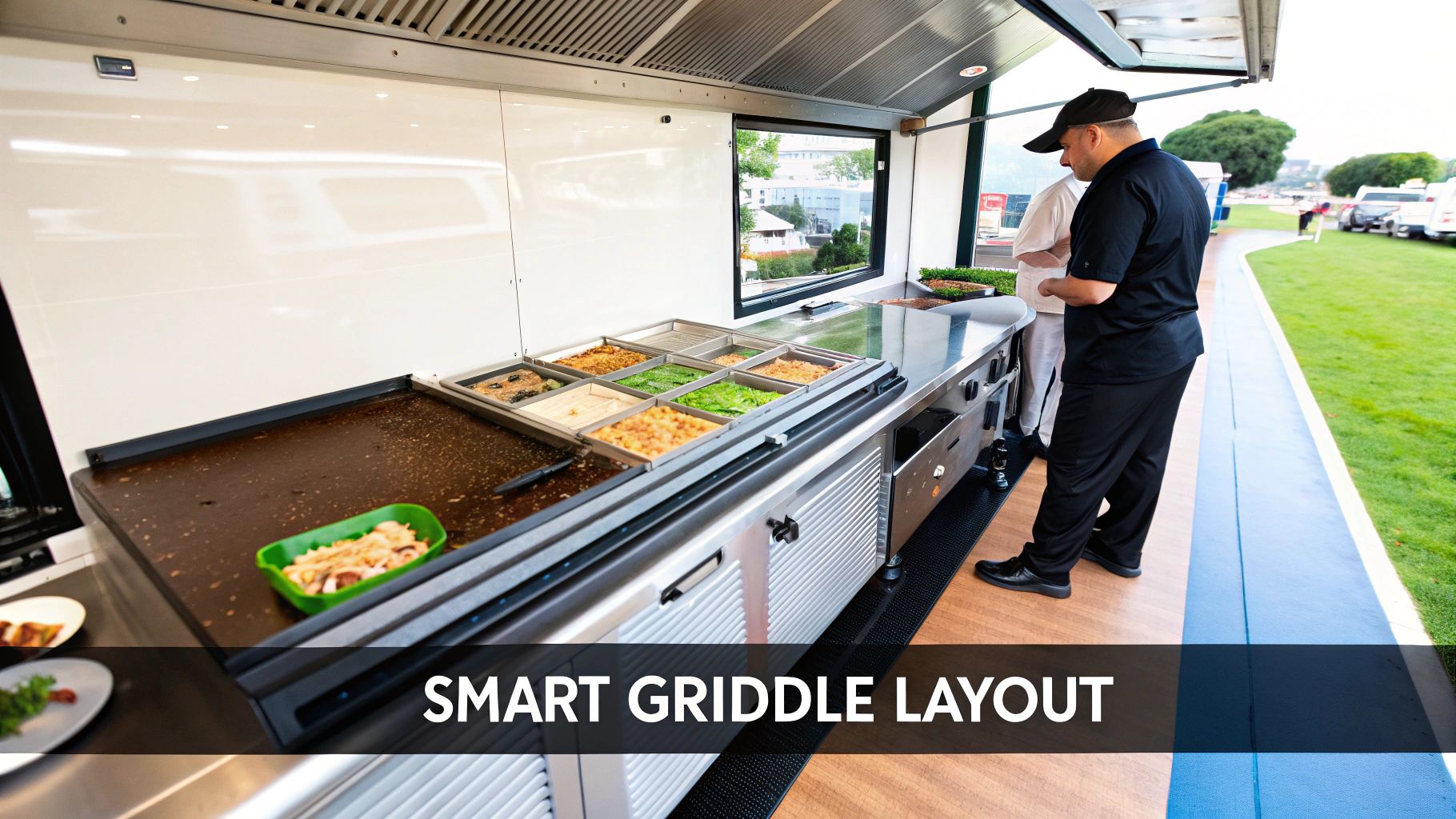
Here's the first and most important rule: the griddle always lives directly under the ventilation hood. This isn't a suggestion, it's a non-negotiable safety and code requirement. It's the only way to properly yank all that heat, smoke, and greasy air out of your tiny workspace. Put it anywhere else, and you're creating a serious hazard that will get you shut down by a health inspector in a heartbeat.
This central placement naturally makes the griddle the anchor of your entire cook line.
Creating the Ultimate Griddle Station
To build a workflow that actually flows, you need to think in terms of a dedicated "griddle station." It's a simple idea with a massive impact. You're pairing the griddle with the gear that supports it to kill any wasted motion. The absolute best partner for your griddle is a refrigerated prep table or a low-boy chef base.
This setup gives your cook a seamless, one-motion process. They can pull open a drawer, grab perfectly prepped ingredients, and slap them right on the hot griddle without taking a single step. That kind of ergonomic design is how you fight fatigue and pump out tickets at a blistering pace.
The goal is to eliminate unnecessary steps. Every pivot, reach, and shuffle a cook has to make adds precious seconds to an order. A well-designed griddle station turns a multi-step process into a single, fluid motion.
Of course, a killer workflow doesn't end at the cook line. You need to connect the customer to the kitchen seamlessly. Integrating one of the best mobile POS systems is the final piece of the puzzle, closing the loop from the moment an order is placed to when it's paid for.
Mapping the Ergonomic Triangle
Let's make this real with a Philly cheesesteak truck. The whole operation boils down to three key points: the griddle, the prep station, and the service window. Your layout should create a tight little triangle between these three spots.
- Prep Station: This is where your steak is portioned and your rolls are lined up, sitting right next to the griddle.
- Griddle: The cook grabs the steak, throws it on the flat top, melts the cheese, and builds the sandwich.
- Service Window: With a simple turn, the finished cheesesteak is passed out to the customer. Done.
This tight triangle keeps your cook planted in one spot, maximizing their output without them running around like a headless chicken. It's this kind of intentional design that lets a two-person crew serve hundreds of people an hour. There's a reason box-style trucks are king in the food truck world—their open interiors are a blank canvas for creating these hyper-efficient layouts. With the global food truck market expected to hit $4.17 billion by 2034, a slick workflow is how you grab your slice. You can dig into more market trends over at Fortune Business Insights.
Safety Protocols for a Mobile Kitchen
Finally, you have to bake safety directly into your workflow design. A griddle is a heavy, hot, powerful beast, and it poses some unique risks when it's inside a moving vehicle.
- Securing the Unit: That griddle needs to be bolted down, either to the floor or the counter. Never, ever rely on its own weight to keep it put while you're driving.
- Clearance and Ventilation: Give the unit breathing room. Follow the manufacturer's specs for clearance on all sides, and keep your vent system and grease filters obsessively clean to prevent fires.
- Gas Line Safety: If you're running on propane, get your gas lines installed by a pro and check them for leaks regularly. And always, always shut off the main valve before you put the truck in drive.
When you design your layout with the griddle as the centerpiece and safety as your top priority, you build a mobile kitchen that's not just profitable, but safe.
Your Top Food Truck Griddle Questions, Answered
Let's be honest, even after doing your homework, staring at a new commercial griddle can be intimidating. We see it all the time—new and even veteran food truck owners run into the same handful of questions when it comes to picking, using, and caring for this workhorse.
So, we've gathered the most common questions we hear and answered them in plain English. Think of this as the practical advice you'll wish you had from day one, covering the real-world stuff you'll face in the middle of a crazy lunch rush.
How Do I Properly Season a New Griddle in My Food Truck?
That brand-new griddle comes with a thin, protective coating from the factory that you definitely don't want in your food. Getting rid of it and building up a beautiful, non-stick cooking surface—a patina—is what seasoning is all about. Done right, it makes cooking cleaner and faster.
First things first, give that new surface a good scrub with warm, soapy water to remove the factory sealant. Dry it completely. Now, fire up the griddle to medium-high heat. You're shooting for a surface temp of 350-400°F.
Once it's hot, pour a very thin layer of high-smoke-point oil on it. Canola, grapeseed, or flaxseed oil are perfect for this. Grab some paper towels with a pair of tongs and spread that oil evenly across every inch of the cooktop. Now, let it cook until it stops smoking, which will take around 15 to 30 minutes. You'll see the steel start to darken.
Wipe away any gunky, sticky oil residue, and then do it all over again. You'll want to repeat this process another three to five times. The goal is a slick, deep black surface. That beautiful, polymerized layer is the secret to a perfect sear and food that never sticks.
What Is the Best Way to Clean My Griddle After a Rush?
When you're slammed, you need to clean your griddle fast. The trick is to work with the heat, not against it. A hot griddle is an almost self-cleaning griddle.
Grab a heavy-duty bench scraper and push all the leftover food bits and grease straight into the grease trap. If you've got some stubborn, burnt-on spots, pour a little warm water or club soda right on them. The steam will work like magic, lifting the gunk right off the steel so you can scrape it away.
Here's the golden rule: Never use soap on a seasoned griddle. Soap is the enemy of your hard-earned patina and will strip it right off. The only time soap should touch that surface is when you're cleaning it for the very first time.
At the end of the night, you can do a deeper clean with a griddle brick or screen to gently polish the surface. When you're done, wipe it bone dry and apply one last, super-thin layer of cooking oil. This protects the steel from humidity and prevents rust from forming while you sleep. And whatever you do, empty and clean that grease trap daily.
Do I Need a Thermostatic or Manual Griddle for Burgers?
Ah, the great debate. The right choice here really comes down to your menu. If you're slinging smash burgers that need a screaming hot surface for that perfect crispy crust, a manual griddle is your best friend. It gives you raw, untamed heat that you control, letting you crank it up to the extreme temps a great sear demands.
But, if you're cooking more than just burgers, a thermostatic griddle brings consistency and control to the table. It has an internal thermostat that holds the exact temperature you dial in, which is a game-changer for delicate items.
Let's break it down:
- The Smash Burger Pro: If burgers are 90% of what you sell, you need the pure power and quick recovery time of a manual griddle. No question.
- The All-Rounder: If you're also making pancakes, eggs, and grilled cheese, the "set it and forget it" precision of a thermostatic model is a lifesaver. It cooks everything perfectly and prevents you from burning food during a rush.
The bottom line? If your truck's reputation is built on the perfect burger, go manual. If you need the flexibility to nail a wider menu, the thermostatic griddle is the smarter play.
Ready to get a griddle that can handle the heat of your mobile kitchen? Griddles.com offers a hand-picked selection of stainless steel griddles tough enough for the road. Check out our collection and get free shipping on every single order.