
Commercial Griddles: The Ultimate Checklist for Catering Success
Your commercial griddle is the single most important piece of gear for pulling off a flawless catering event. It's not just a tool; it's your battle plan's anchor. This one piece of equipment dictates your menu, how fast you can serve, and whether you walk away with a healthy profit.
Why Your Checklist Starts With The Right Commercial Griddle
Forget generic catering lists that start with spatulas and tongs. In the real world of high-volume catering, everything revolves around your main cooking surface. The commercial griddle is the heart of your operation. Its capabilities—or lack thereof—will ripple through your entire workflow, making it the non-negotiable first item on any checklist.
Get this choice wrong, and you're setting yourself up for slow service and unhappy clients. Get it right, and you've empowered your whole team to execute flawlessly under pressure.
Picture this: two food trucks at a packed morning festival. One is struggling with a cheap, flimsy griddle. The thin metal can't hold its heat, and as the orders for pancakes and bacon pile up, the cooking surface goes cold. What should be crispy hashbrowns turn into a pale, greasy mess. The line grinds to a halt, people start walking away, and profits evaporate.
Now, look at the truck next door. They're running a heavy-duty, thermostatic commercial griddle with a thick steel plate. It holds a consistent temperature no matter what they throw at it. Sausage patties are searing perfectly on one side while delicate eggs cook on another heat zone. The line is moving, the food is amazing, and the cash is flowing. That's the difference a professional griddle makes.
Connecting Griddle Features to Profitability
Don't think of your commercial griddle as just another expense. It's the engine that generates your revenue. Specific features have a direct impact on your bottom line, and you need to understand them before you add anything else to your checklist.
- Plate Thickness: A griddle with a 1-inch thick plate retains heat exponentially better than a thin one. This means almost zero recovery time between batches, letting you serve more customers per hour during those critical peak rushes.
- Thermostatic Controls: This is about precision and menu diversity. You can toast buns at a lower temp on one zone while getting a hard sear on burgers right next to it. More menu options mean a wider customer appeal.
- Size and Zoning: A larger, multi-zone griddle lets you cook multiple menu items at once without everything turning into a chaotic scramble. This is pure efficiency that translates directly into higher sales.
A solid commercial griddle checklist is your key to success in a booming market. The global commercial catering equipment scene is expected to jump from USD 13.4 billion in 2025 to USD 19.3 billion by 2035. This growth is fueled by an explosion of food trucks and independent caterers. For these operators, a checklist built around a high-quality commercial griddle is absolutely fundamental.
To help you get started, we've broken down the essential griddle-related categories for your checklist. Think of this as the foundation before you start adding the smaller items.
Core Commercial Griddle Checklist Categories
| Checklist Category | Key Consideration | Impact on Your Catering Business |
|---|---|---|
| Cooking Surface | Material (steel, chrome), plate thickness, and overall dimensions. | Determines heat retention, recovery speed, and how much food you can cook at once. |
| Heat Source & Power | Propane, natural gas, or electric? Do you have the right hookups or fuel tanks? | This is your biggest logistical challenge. Get it wrong, and you're not cooking anything. |
| Temperature Control | Manual or thermostatic? Single zone or multiple independent zones? | Dictates your menu's complexity and your ability to cook different items simultaneously. |
| Portability & Setup | Is it a countertop model? Does it need a specific stand? How heavy is it? | Affects load-in/load-out times and the physical strain on your team. |
Thinking through these core categories first ensures your most critical piece of equipment is perfectly suited for the job.
When you’re weighing options for your checklist, a high-performance model like a Hexclad Griddle is a great example of the kind of quality that won't let you down mid-service.
Ultimately, every other item on your list—from your power source to your holding cabinets—is there to support what your commercial griddle can do. This logic even extends to your prep space; for more on that, see our guide on choosing the right commercial prep table.
Building Your Commercial Griddle Checklist for Every Phase
A solid commercial griddle checklist isn't just a random list of gear; it’s your operational blueprint. I've learned from experience that thinking in phases—Pre-Event, On-Site Setup, and Post-Event Breakdown—is what separates the pros from the amateurs. It turns a simple list into a game plan that helps you dodge those costly, embarrassing mistakes.
When you organize your griddle checklist this way, you're forced to walk through the entire gig in your head. It's the difference between just having a commercial griddle and having everything you need to cook, serve, and pack out without a single hiccup. Let's get into what you need for each critical stage of the job.
Pre-Event Planning: The Foundation of Success
The real work starts hours, sometimes days, before the truck is even loaded. The pre-event phase is all about meticulous prep. This is where you assemble not just the griddle but every last accessory and supply that keeps it running. Your best friend here is a well-organized “griddle go-kit.”
This isn't just a random box. It should be a dedicated, clearly labeled container with everything you need to run and maintain that griddle on-site. Trust me, it’s the small, forgotten items that can bring your entire service to a screeching halt.
Here's what a strong pre-event commercial griddle checklist looks like:
- Core Cooking Tools: You need at least two long-handled spatulas, a heavy-duty grill scraper, and some beefy tongs. Don't cheap out on these.
- Liquids & Seasoning: Squeeze bottles are your secret weapon for speed. Have them ready for oil, water (for steaming vegetables or cleaning), and any signature sauces.
- Cleaning Kit: Pack a dedicated bucket, grill bricks or screens, a bottle of food-safe degreaser, and a big roll of heavy-duty paper towels.
- Safety First: High-heat resistant gloves are non-negotiable. Also, keep a small first-aid kit stocked specifically for burns right there with your griddle gear.
This whole process ties back to choosing the right tool for the job in the first place. Your menu, the number of guests, and your profit goals all dictate which commercial griddle you should even be packing.
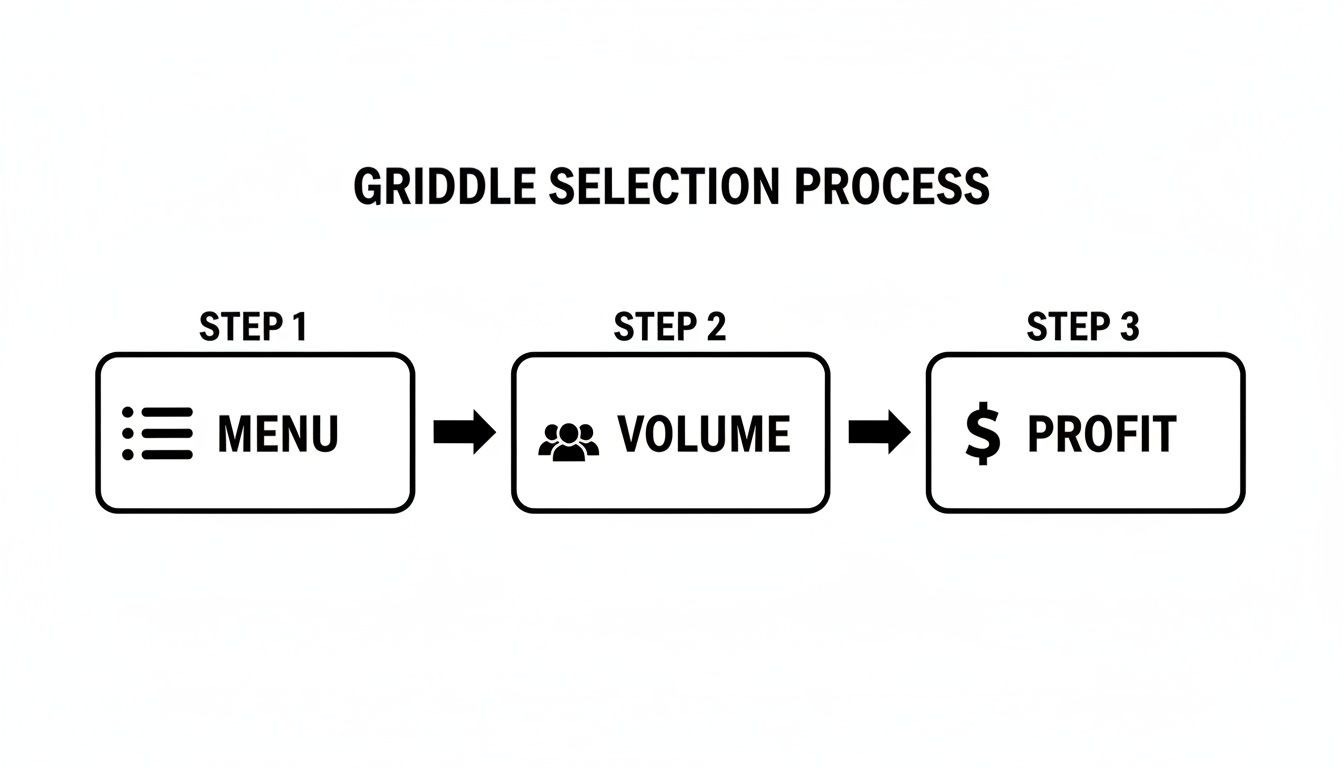
As you can see, picking a commercial griddle is a business decision, not just a cooking one. Your menu directly impacts your bottom line, and the right equipment makes it all possible.
On-Site Setup: From Unloading to First Sizzle
The moment you pull up to the venue, the clock is ticking. Your on-site checklist is all about getting from the truck to cooking as smoothly and safely as possible. It's not just about firing it up; it's about building a stable, efficient cooking station.
First things first: location. Find a spot that’s level, has good ventilation, and is well clear of guest foot traffic. This is a huge safety issue for both your crew and everyone at the event.
A pro tip I swear by: always carry a small bubble level. Tossing it on the griddle surface for a second confirms it’s perfectly flat. This is critical for even cooking and, more importantly, ensures grease flows into the drip tray and not all over the ground.
With your spot picked, it’s time to execute:
- Level It Out: Use that bubble level. If the ground is uneven, use shims to get the surface perfectly flat.
- Hook Up Fuel: Attach your propane tank and regulator securely. Do a quick leak check by spraying soapy water on the connection—if you see bubbles, you have a leak. For electric models, check the outlet's amperage and only use a heavy-gauge extension cord rated for the draw.
- Pre-Heat & Season: Fire up the griddle and let it get hot. I always do a quick touch-up seasoning with a thin layer of high-smoke-point oil. It preps the surface and guarantees a non-stick start.
Post-Event Breakdown: Protect Your Investment
The last guest has left, but your night isn't over. The breakdown is maybe the most important part of the process for protecting your expensive commercial griddle and making sure it’s ready for the next event. Rushing this is how you end up with rust, damage, and a surprise bill for a new griddle.
Your breakdown checklist is all about safety and being thorough. That commercial griddle is a serious burn hazard, so step one is always shutting off the fuel and letting it cool down to a safe temperature. Never, ever try to move or clean a screaming hot griddle.
Once you can safely touch it, the real work starts.
- Scrape It Down: While the griddle is still warm (but not hot!), use your scraper to get all the gunk and grease off. It’s ten times harder when it's completely cold.
- Deep Clean: Grab your grill brick and a little water or degreaser to scrub the surface clean. Wipe everything down with paper towels until they come away clean.
- Protect the Surface: The final step is crucial. Apply a very thin, fresh coat of cooking oil to the entire surface. This is your rust prevention for when the griddle is in storage or rattling around in the truck.
- Secure for Travel: Empty and clean that drip tray. Make sure all hoses, knobs, and loose parts are packed tight so they don’t get damaged on the ride home.
Sticking to a phase-based checklist takes the guesswork out of the equation. It makes sure every critical step is covered, every single time, making your entire operation more professional and reliable.
Adapting Your Commercial Griddle Checklist for Any Event
Any seasoned caterer will tell you a generic commercial griddle checklist is just a starting point. The real game is played on-site, where the environment dictates your every move. A sprawling, high-volume outdoor festival couldn't be more different from a quiet, indoor corporate lunch, and your gear list needs to reflect that reality.
This is where the pros separate themselves from the amateurs. Thinking through the specific challenges of each gig—power, volume, transport, and space—and tweaking your checklist accordingly is what turns a chaotic day into a smooth, profitable one. It's about anticipating problems before they happen.
The High-Volume Festival Checklist
Outdoor festivals are a trial by fire. You're staring down the barrel of non-stop orders for hours on end, with zero room for equipment failure. Your festival checklist has to be all about volume, raw power, and total self-sufficiency.
For these marathon gigs, your commercial griddle is the MVP.
- The Griddle: A 36-inch or 48-inch multi-zone propane griddle is non-negotiable. You need that massive surface area to pump out food, and separate heat zones are crucial for searing burgers on one side while toasting buns on the other.
- Fuel Supply: This is your absolute lifeline. Your list must include at least two full propane tanks, and I always recommend a third as a backup for all-day events. Never, ever assume one tank is enough. I’ve seen that movie before, and it doesn’t end well.
- Essential Accessories: Beyond the basics, you'll need high-capacity squeeze bottles for sauces, multiple scrapers to keep the flat-top clean mid-rush, and a wind guard. That last one is a lifesaver for maintaining consistent heat when the weather inevitably turns.
At an outdoor festival, your setup is an island. You can't just run to the back for more supplies or plug into a convenient outlet. Your success is 100% dependent on what you packed, making a ridiculously detailed checklist your best friend.
The Indoor Corporate Event Checklist
Trading a festival field for a corporate conference room changes the entire game. Suddenly, it’s not about raw power; it's about finesse, safety, and blending into a professional environment. Smoke, noise, and fumes are your biggest enemies here.
Your indoor checklist will look completely different.
- The Griddle: A ventless electric commercial griddle is almost always the right call. It sidesteps all the risks and regulations of using propane indoors and keeps smoke to a minimum. A smaller countertop model is usually perfect for the more controlled volume of a corporate gig.
- Power and Electricals: This is the single most critical point. Your checklist needs a big, bold line item: "Confirm venue outlet amperage." Call ahead. Ask questions. You'll also need a heavy-gauge extension cord that's properly rated for your griddle's power draw, or you'll be the person who tripped the breaker for the entire floor.
- Surface Protection: Remember, you're a guest in someone else's space. Add protective counter mats and a non-slip floor mat to your list to catch any grease splatters. It’s a small detail that shows a ton of professionalism.
The Daily Food Truck Checklist
Running a food truck is a unique beast—part fixed kitchen, part mobile catering operation. Your daily checklist for your commercial griddle isn't about packing for a one-off event; it's about rigorous pre-shift checks that ensure consistency and, most importantly, safety.
This checklist is all about building a solid routine.
- Pre-Shift Safety Inspection: Before a single pilot light is lit, this list should force you to check gas lines for leaks, confirm the fire suppression system is charged, and verify that the griddle is securely mounted. No exceptions.
- Securing for Transport: This is a huge one that rookies often forget. Add a line to your list to double-check that the griddle's drip tray is empty and locked in place. All your tools, spatulas, and knobs need to be stowed so they don’t become dangerous projectiles the second you pull into traffic.
- Operational Readiness: The final check before opening the window. Is the griddle surface clean, properly seasoned, and hot? This simple step prevents agonizing delays when that first wave of hungry customers appears out of nowhere.
To get a clearer picture, see how your core checklist items might shift depending on the job.
Commercial Griddle Checklist Variations by Event
See how essential checklist items for your commercial griddle change based on the demands of different catering environments.
| Checklist Item | High-Volume Festival | Indoor Corporate Event | Daily Food Truck |
|---|---|---|---|
| Griddle Type | 36"+ Propane, Multi-Zone | Countertop Electric | Built-in Propane |
| Power Source | Two+ 20lb Propane Tanks | Venue Outlets (Verified Amps) | Onboard Propane Tanks |
| Top Accessory | Wind Guard | Heavy-Gauge Extension Cord | Mounted Squeeze Bottle Holder |
| Safety Check | Secure Propane Lines | Cord Placement (Trip Hazard) | Gas Leak & Fire Suppression |
| Transport | Carts/Dollies for heavy gear | Protective mats for surfaces | Secure all loose items |
| Sanitation | Multiple Handwash Stations | Discreet Bussing Tubs | Onboard 3-Compartment Sink |
As you can see, while the goal—serving great food—is the same, the logistical path to get there is wildly different.
The entire commercial cooking equipment market is expanding to meet these diverse needs. It's projected to grow from USD 39.01 billion in 2025 to a massive USD 60.48 billion by 2034, with North America leading the charge at a 32.20% share. This boom is fueled by the explosion of food trucks and ghost kitchens that need heavy-duty commercial griddles capable of cranking out 500+ burgers a shift. While ovens still hold the top spot in market share, griddles are the undeniable workhorses of high-volume cooking. Modern 1-inch thick plates provide incredible heat retention and can cut energy use by up to 15%. You can see more on these trends in the commercial cooking equipment market analysis from Fortune Business Insights. This growth proves that matching the right commercial griddle to the right job isn't just a matter of convenience—it's a critical business strategy.
Mastering Commercial Griddle Logistics: Power and Transport
Let's be honest, the most powerful commercial griddle in the world is just a really heavy table if you can't get it to the gig and plug it in. This is where logistics planning comes into play, and it’s a non-negotiable part of your commercial griddle checklist that truly separates the seasoned pros from the struggling amateurs.
This is all about seeing the friction points—power, fuel, and the physical move—before they happen and solving them ahead of time. Get it right, and your setup is smooth and professional. Get it wrong, and you're dealing with tripped breakers, running out of propane mid-rush, or worse, showing up with busted equipment.
Planning Your Commercial Griddle Power Source
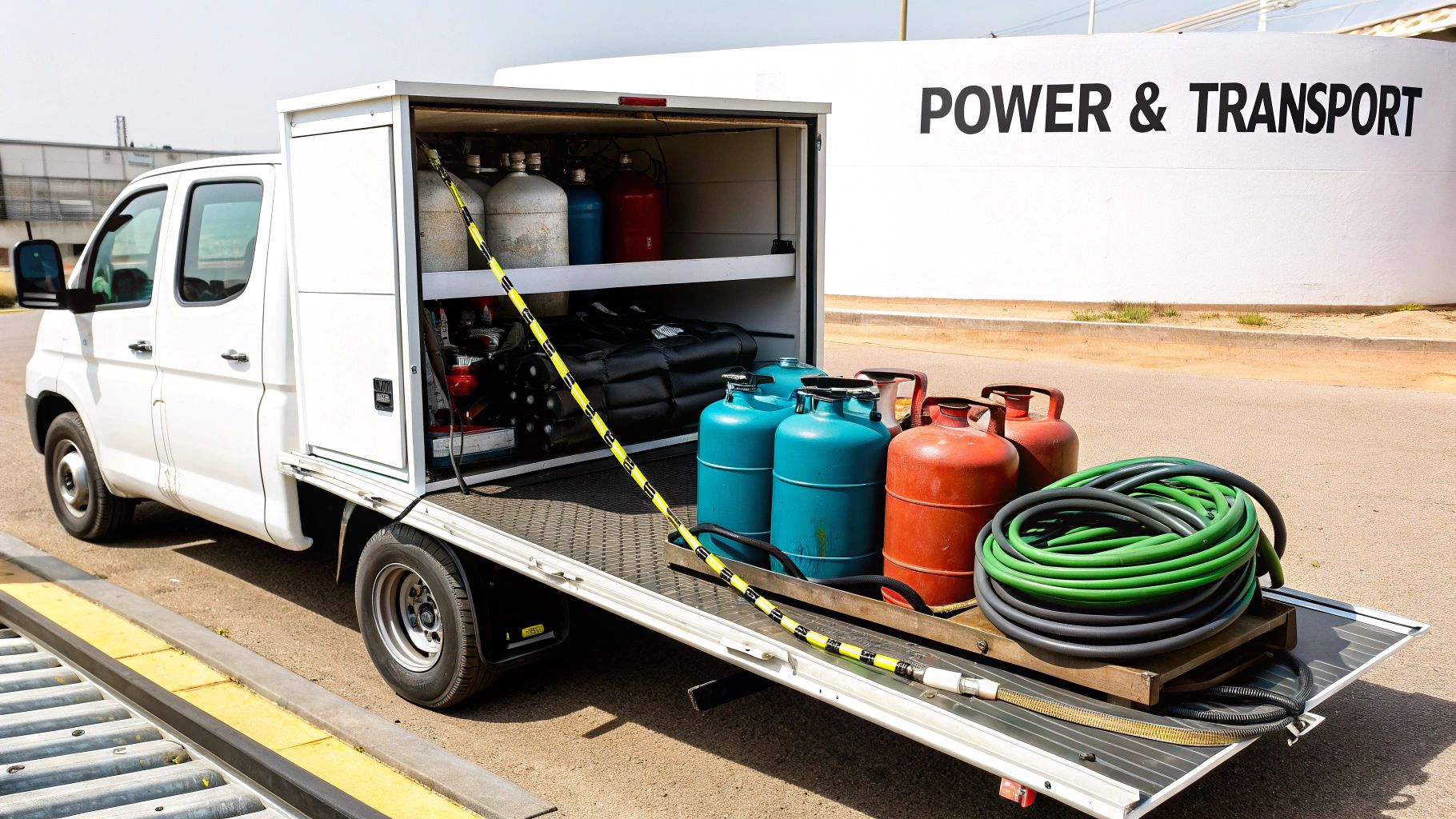
Your commercial griddle's power source basically dictates your entire on-site strategy. Whether you're hauling propane tanks or hunting for an outlet, you need a rock-solid plan.
For propane griddles, it's a simple game of math. First, find your griddle's max BTU rating. A high-performance unit might crank out 90,000 BTUs. At full blast, that’s going to burn through about one gallon of propane every hour. Since a standard 20-pound tank holds around 4.7 gallons, you've got less than five hours of cooking time if you're running it hot.
Never, ever show up to an event with just one propane tank. It's the cardinal sin of mobile catering. Even for a three-hour gig, a tiny leak, a surprise rush of customers, or just a cold day can drain your fuel way faster than you planned. A full backup tank is the cheapest insurance you'll ever buy.
Electric models come with their own set of headaches. The biggest rookie mistake is just assuming the venue has the juice you need. Before you even think about loading the truck, you have to confirm the amperage of the circuits you’ll be using. A beefy electric griddle can easily pull 15-20 amps all by itself. Plug that into a circuit that's already running a coffee maker and a warmer, and you're guaranteed to trip a breaker. We break down the technical side of this in our article covering the crucial differences between 120 vs 240 volts in commercial kitchens.
Safe and Secure Commercial Griddle Transport
Commercial griddles are heavy, awkward, and surprisingly fragile. Drop one or let it slide around in the back of a van, and you can easily damage gas lines, snap off knobs, or ruin sensitive thermostatic controls. Your transport plan needs to be just as detailed as your cooking prep.
Here’s a practical transport checklist to burn into your brain:
- Secure All Loose Parts. Before that griddle moves an inch, pull the drip tray, lock down any covers, and double-check that the knobs are tight. These little pieces are always the first things to get lost or broken in transit.
- Use the Right Tools for the Job. Don't be a hero and try to muscle it. For heavy floor models, you need a heavy-duty moving dolly and a ramp with a gentle slope. Make sure your vehicle has solid, reliable tie-down points.
- Strap It Down Like You Mean It. Use at least two high-quality ratchet straps to lock the griddle in place. The goal here is zero movement. If you can, brace it against a bulkhead to keep it from lurching forward if you have to slam on the brakes.
Beyond just moving it from A to B, having a plan for secure equipment storage is just as important for keeping your gear in top shape. Stashing your expensive equipment in a climate-controlled, safe spot protects it from rust, weather, and theft, making sure it’s always ready for the next job.
Commercial Griddle Safety, Sanitation, and Maintenance Checks
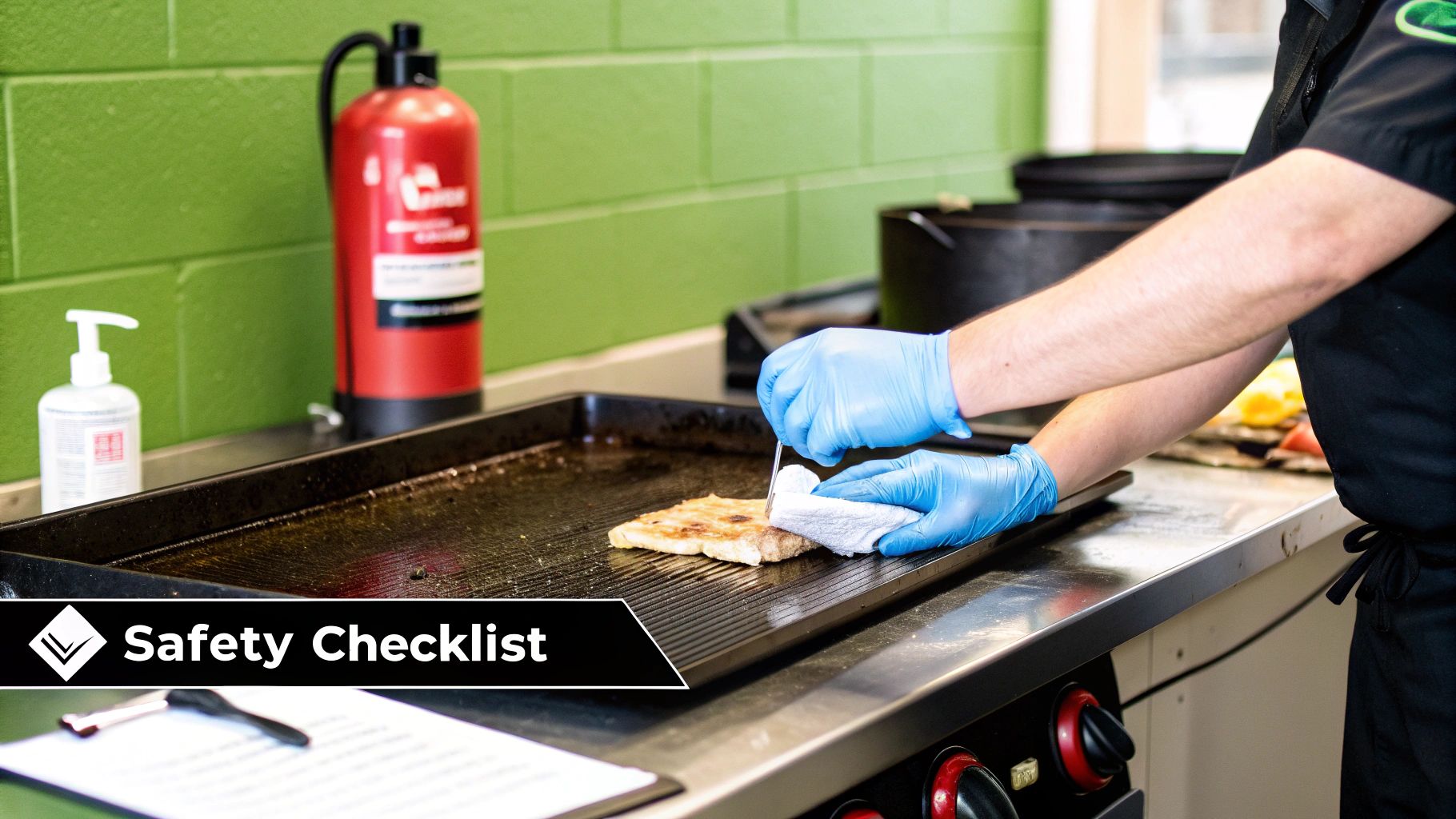
Let's be honest, beyond the food and the setup, the most crucial part of your commercial griddle checklist is what happens during and after the event. Keeping your griddle clean, safe, and well-maintained isn't just "best practice"—it's a non-negotiable part of being a professional. It's how you protect your customers, your crew, and your expensive gear.
If you let these checks slide, you're opening the door to foodborne illness, equipment meltdowns, or even dangerous accidents. Weaving safety and sanitation right into your workflow is the only way to make sure every event goes off without a hitch.
Essential On-Site Sanitation Protocols
In the heat of a catering gig, you don't have time for a deep clean. But you absolutely have to keep that cooking surface sanitary. This is where quick, effective cleaning techniques become your best friend.
Your on-the-fly sanitation checklist has to be all about speed and efficiency.
- Scrape Between Orders: Keep a heavy-duty scraper handy. After you pull a batch of burgers off, scrape the gunk and grease into the trap before you throw on the veggies. This simple move stops flavors from mixing and keeps flare-ups in check.
- Use Water or Ice for a Quick Clean: Here's a pro tip: on a hot griddle, a splash of water or a handful of ice cubes creates a burst of steam that lifts off all that stubborn, cooked-on crud. Just scrape the loosened mess straight into the grease trap.
- Wipe Down with Food-Safe Oil: After a quick scrape, give the surface a fast wipe with a paper towel and a bit of high-smoke-point oil. It keeps the griddle seasoned and ready for the next round of orders.
For a deeper dive into these techniques, check out our complete guide on how to clean a commercial griddle to keep your equipment in prime condition.
Critical Safety Checks Before and During Service
Safety isn't optional. It's a requirement. Before you even think about lighting that pilot or flipping the power switch, you need to run through a series of checks until they become muscle memory. These steps slash your risks and make sure you’re ready for anything.
Think of your pre-service safety sweep as your first line of defense.
- Fire Extinguisher Readiness: Always—and I mean always—have a Class K fire extinguisher within arm's reach. These are specifically made for grease fires and are an absolute must-have if you're running a commercial griddle.
- Proper Ventilation: This is a big one for gas griddles. You have to be in a well-ventilated spot to prevent carbon monoxide from building up. Never, ever operate a propane griddle in a fully enclosed tent or room without proper, professional ventilation.
- Secure Connections: Take 30 seconds to double-check every single gas hose and electrical cord. You're looking for any cracks, fraying, or loose fittings. A quick spritz of soapy water on gas connections is an old-school trick that will instantly show you if there's a dangerous leak.
A well-maintained commercial griddle isn't just about safety; it's a workhorse that drives your efficiency. The kitchen equipment market is projected to grow by USD 41.81 billion from 2024-2029, and that growth is all about reliable, energy-smart appliances. For operations like ghost kitchens, a checklist without thermostatic griddles is a recipe for disaster—they can see their throughput drop by 15-20% without that precise temperature control. It's worth learning about the trends pushing the commercial catering equipment market forward to see how modern commercial griddles are evolving to meet these new demands.
Your Commercial Griddle Questions Answered
Even the most detailed commercial griddle checklist can't prepare you for every little thing that pops up in the field. Let’s be honest, that’s where the real learning happens. Knowing the answers to common problems on the fly can be the difference between a seamless event and a complete disaster.
This section is all about tackling those real-world questions that food truck operators and caterers run into all the time. Think of it as your griddle troubleshooting guide, straight from someone who's been there.
How Do I Season a New Commercial Griddle On-Site?
First off, seasoning a brand-new commercial griddle at an event should always be your plan B. Or C. But sometimes, it happens. If you find yourself in this jam, you'll need a high-smoke-point oil (canola or grapeseed are great), a thick roll of paper towels, and long tongs to save your knuckles.
Here's how to pull it off in a pinch:
- Get that clean griddle surface ripping hot, somewhere between 350-400°F.
- Pour on just a tiny bit of oil. Use the tongs to grip a wad of paper towels and spread that oil into the thinnest, most even layer you can manage. You want to cover the entire cooktop.
- Keep wiping until it almost looks like you've wiped it all off. We're talking a microscopic layer here, not a slick of grease.
- Now, let it cook until the oil completely stops smoking. This usually takes about 15-20 minutes.
- You'll need to repeat this process at least 3-4 times to build up a decent non-stick surface.
My best advice is to handle the initial, more intensive seasoning at your home base or commissary. Doing this ahead of time saves you over an hour of critical setup time when you're on the clock at an event.
What Are the Most Commonly Forgotten Commercial Griddle Items?
It’s almost never the griddle itself. It's the small, absolutely essential tools that get left sitting on a counter back at the kitchen. Forgetting one of these can bring your whole service to a grinding halt.
After years of seeing it happen (and doing it myself a time or two), these are the top five things people forget:
- A Bubble Level: Sounds fussy, but it’s critical. If your commercial griddle isn't perfectly level, grease will pool in one corner or run off where you don't want it, leading to burnt food on one side and raw on the other.
- A Backup Propane Tank: Never trust a single tank. Ever. It's the cardinal rule of mobile cooking for a reason.
- A Class K Fire Extinguisher: That standard ABC extinguisher in your truck isn't designed for grease fires. A Class K is built specifically for kitchen fires, and most health inspectors will look for it.
- A Dedicated Burn Kit: Accidents happen around hot surfaces. Having a proper kit for burns not only is smart but also shows a level of professionalism your clients and staff will appreciate.
- Spare Parts: A little bag with an extra regulator, a few replacement knobs, and some common fittings can turn a day-ending mechanical failure into a five-minute fix.
Can I Use a Residential Griddle for a Small Catering Gig?
I get this question a lot, and my answer is always a hard no. It's a tempting shortcut, but it’s a bad idea for a few serious reasons. Home griddles just aren't built for the abuse of commercial service. They don’t have the BTU power to maintain temperature when you load them with cold food, which means slow cook times and sad, soggy results.
Even more important is the safety issue. Residential griddles don't have the required NSF (National Sanitation Foundation) safety certifications. If a health inspector sees you using uncertified gear, you could be looking at major fines. Worse, if an accident happens, your business liability insurance could refuse to cover it. It's a gamble that's just not worth taking.
How Do I Calculate How Much Propane I Need for My Griddle?
Running out of propane mid-service is every caterer's nightmare. Fortunately, a little math can prevent it. First, find your commercial griddle’s maximum BTU rating in the user manual. A beefy commercial unit might be rated for 90,000 BTUs.
As a good rule of thumb, a griddle running at full blast will burn through about one gallon of propane per hour for every 90,000-100,000 BTUs. A standard 20 lb propane tank holds roughly 4.7 gallons of fuel. So, that gives you just under five hours of continuous, high-heat cooking.
Of course, you’ll be turning the heat up and down, so you can usually stretch that time. But for any event scheduled to last more than four hours, bringing at least one full backup tank isn't just a suggestion—it's non-negotiable.
Ready to build a catering setup that never fails? The experts at Griddles.com can help you select the perfect commercial griddle and accessories to match your menu and business goals. Explore our collection of high-performance, reliable equipment and cook with confidence at every event.