
Choosing Your Commercial Griddle
Picture this: it’s the middle of your busiest lunch rush. Tickets are piling up, and the line is one mistake away from total meltdown. At the heart of this controlled chaos is your most valuable player: the commercial griddle. This is the command center, the essential piece that keeps your kitchen workflow humming, safe, and incredibly consistent.
This guide is your complete roadmap to picking the perfect unit for your kitchen. We'll dive into everything from the must-have components to the long-term payoff, making sure you choose a griddle that takes your kitchen from chaotic to unstoppable.
The Command Center of Your Kitchen Workflow
A commercial griddle is the master of the hot line, but its true potential is only unlocked when it's the right fit for your menu and volume. This is where a griddle stops being just a hot surface and becomes the beating heart of your kitchen's efficiency. It builds a seamless bridge between a raw ingredient and a finished plate, turning a clunky, multi-step chore into one smooth, ergonomic movement.
Think of it as the ultimate workhorse. While burgers, cheesesteaks, or breakfast items are sizzling away, this station delivers consistent, reliable heat across its entire surface. This synergy is what lets your crew move with blinding speed, ensuring every item is cooked to perfection without missing a beat.
Why It's More Than Just a Flat Top
The right commercial griddle isn't just a convenience; it's a direct boost to your bottom line and the entire pace of your operation. By providing a dedicated, high-performance cooking surface, you gain a few critical advantages that elevate any kitchen.
- Faster Service Times: No more waiting for pans to heat up on a range. A griddle's large, ready-to-go surface shaves precious seconds off every ticket, which adds up to huge gains during a rush.
- Better Food Quality: Consistent heat distribution means no hot or cold spots. This ensures food is cooked evenly every single time, from the first pancake of the day to the last burger of the night.
- Rock-Solid Consistency: When your cooking surface performs predictably, orders are more accurate, and every single dish you send out looks and tastes exactly as it should.
At the end of the day, it's all about creating an intelligent, organized workflow. These principles are a huge part of any successful restaurant kitchen layout and design, where each piece of equipment works in perfect concert. This guide will show you how to find a griddle that becomes the most valuable player on your team, making sure every dish you serve reflects your commitment to quality and speed.
Understanding Your Griddle's Anatomy
A commercial griddle is so much more than just a slab of metal over a flame. It’s an engineered workhorse where every single piece is designed to make your kitchen faster, safer, and more organized.
Let's break it down. Think of it as your chef's command center.
The foundation is the griddle plate—your cooking surface. This is where the magic happens. The material and thickness of this plate really matter, affecting everything from heat retention to how quickly it responds to temperature changes.
Below that, you have the heat source, which can be gas burners or electric elements. This is the engine of the operation, delivering the BTUs or watts needed to keep the surface sizzling hot through even the craziest lunch rush.
The Heart of the Operation
But the real game-changer is the combination of the griddle plate and the control system. This is the part of the griddle that dictates performance. It keeps the entire cooking surface at a consistent, even temperature, which is the key to quality and speed. No hot spots, no cold corners, just reliable heat.
An efficient griddle is an absolute powerhouse, and kitchens everywhere are catching on. The market for these units was recently valued at a whopping USD 1.2 billion and is expected to hit USD 1.71 billion by 2032. That explosion in growth tells you just how vital these cooktops have become.
This quick visual shows exactly how a well-designed griddle boosts your whole operation.
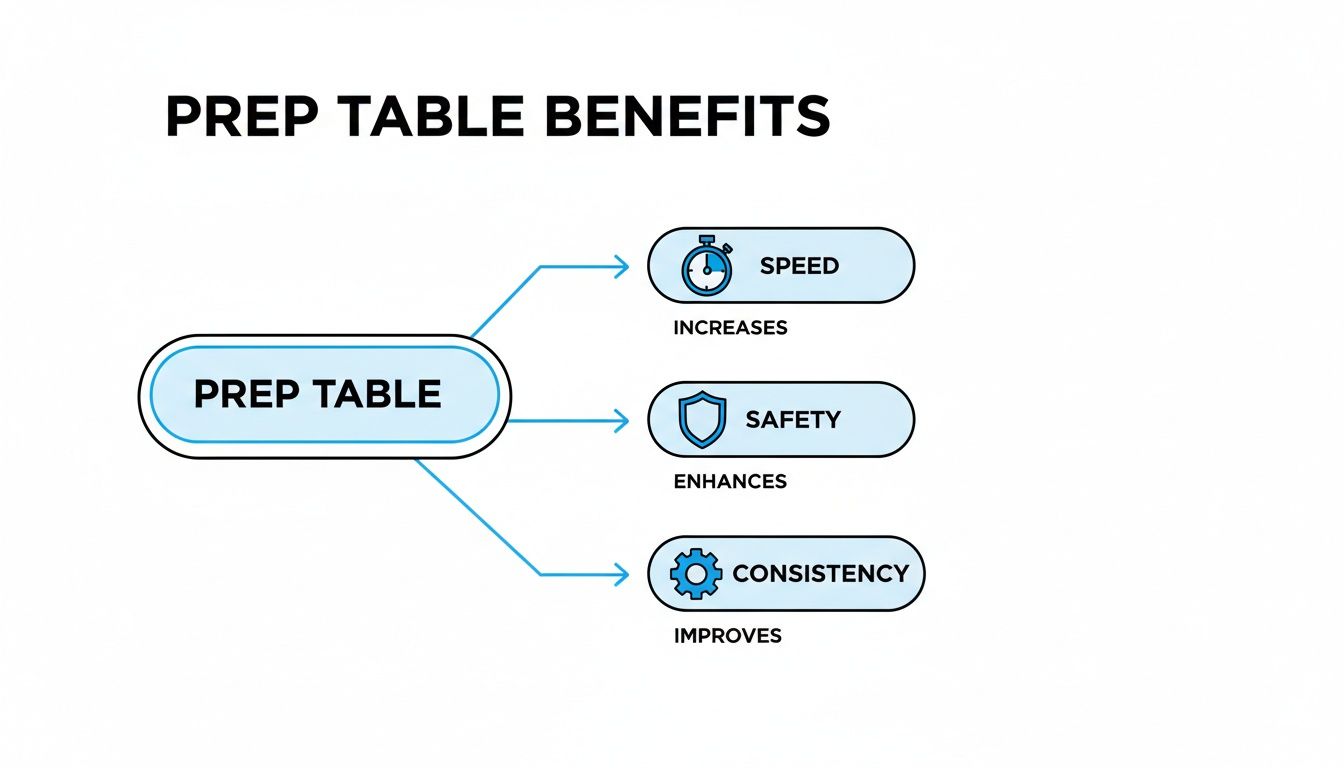
As you can see, the integrated design directly translates to faster ticket times, better food safety through proper cooking, and a more consistent product for your customers.
Key Features and Their Impact on Kitchen Workflow
Beyond the basic setup, a few key features separate the good from the great. Getting to know these components helps you understand exactly how they'll impact your daily grind, making it easier to choose a unit that truly fits your needs.
| Feature | Primary Function | Benefit for Your Kitchen |
|---|---|---|
| Plate Material | Cooking Surface | Steel offers fast heat-up. Chrome resists sticking and is easy to clean. |
| Plate Thickness | Heat Retention | A thicker plate (¾" to 1") holds heat better, perfect for high-volume cooking of frozen items. |
| Control Type | Temperature Management | Thermostatic controls offer precise temperature settings, while manual controls are simple and durable. |
| Stainless Steel Grade | Construction material | Higher-grade stainless steel resists rust and dents, meaning your investment will stand up to the abuse of a busy kitchen for years to come. |
Each of these elements plays a crucial role in creating a smooth, safe, and efficient workflow. Choosing the right combination for your menu and volume can make a world of difference during a hectic service.
Components That Define Performance
Let's dive a little deeper into what makes a high-performance unit.
-
Plate Material & Thickness: Think about your menu. A standard steel plate is a fantastic all-rounder. If you're cooking delicate items like eggs and pancakes, a chrome top is a dream to work on and cleans up in seconds. A thicker plate is essential for slinging burgers all day because it won't lose temperature when you drop a dozen frozen patties on it.
-
Control Type: This is a big one. Manual controls are simple on/off knobs—great for durability. Thermostatic controls, on the other hand, let you set an exact temperature (e.g., 350°F). This precision is critical for consistency and for preventing burnt food.
-
Heat Source (Gas vs. Electric): Gas griddles generally heat up faster and offer more responsive control. Electric griddles can be more energy-efficient and are a great choice for kitchens where gas lines aren't available, like in some food trucks or historic buildings.
A powerful heating system is the difference between a griddle that keeps up with the rush and one that leaves you waiting for it to recover. Rock-solid temperature control is the foundation of food quality.
The material of the unit itself is just as important. Most are built with stainless steel, but not all stainless is created equal. A higher grade will fight off corrosion and dings much better over the long haul. To get the full scoop on materials, check out our guide on stainless steel in commercial equipment. Understanding these details empowers you to judge a griddle not just by its size, but by the quality of its bones.
How To Choose the Right Size and Capacity
Picking the wrong size commercial griddle is a classic kitchen mistake. It’s like forcing your line cooks to wear shoes that are two sizes too small—it’s a guaranteed recipe for frustration, slow service, and a completely busted workflow. Nailing the right size isn’t just about measuring a gap on your line; it’s about realistically matching the unit to your menu and your busiest lunch rush.
A griddle that's too small instantly creates a bottleneck, leading to longer ticket times and chaos when you can least afford it. On the other hand, a unit that’s way too big is just a waste of prime kitchen real estate and will burn through more energy than necessary. The sweet spot is a griddle that handles your current pace with a little bit of breathing room for the future.
Matching Griddle Size to Your Menu
Forget about width for a second. The first thing you need to do is a menu audit. Seriously, take a hard look at your menu and list every single item you plan to cook on the griddle. That, combined with your peak volume, is your starting point for how large your cooking surface needs to be.
A small coffee shop making breakfast sandwiches has totally different needs than a bustling diner famous for its burgers and pancakes.
Think about your busiest hour on your busiest day. How many burgers or pancakes can you fit on the surface at once? Are you constantly running out of space? High-volume kitchens might need a deep, 36" or 48" griddle, while a smaller spot could get by with a compact 24" model.
The real goal here is to map out your production flow so well that you're never held back by a lack of cooking space. When your griddle is sized right, your team stays locked in on cooking orders, not juggling for a hot spot on the flat top.
This kind of smart equipment planning is a big deal in the industry right now. The global market for these griddles recently hit between USD 2.1 to USD 2.41 billion, and it's expected to jump to USD 3.7 billion by 2033. That tells you just how seriously operators are taking workflow. You can see more data on how restaurants are investing in efficiency by reading the full research about the commercial cooking equipment market.
Finding the Right Physical Footprint
Okay, once you know your magic number for production capacity, now you can think about the unit's physical width. Common sizes like 24", 36", and 48" are designed for completely different scales of operation.
- Compact Units (24"): These are the champs of tight spaces. Perfect for a food truck, a small café, or even as a second griddle in a bigger kitchen. They give you the core function you need without eating up your floor plan.
- Mid-Size Units (36"): This is the go-to workhorse for countless independent restaurants and diners. It hits that perfect balance of cooking space and footprint, and one or two cooks can work on it without bumping elbows.
- Large-Capacity Units (48" and up): Built for the big leagues. If you're running a high-volume diner, a busy ghost kitchen, or any spot with a massive breakfast and lunch menu, you need the generous cooking surface these units offer.
To make it even clearer, here’s a quick breakdown:
| Griddle Width | Best For | Typical Use Case |
|---|---|---|
| 24 inches | Food Trucks & Cafés | A focused menu with breakfast sandwiches and burgers. |
| 36 inches | Mid-Volume Diners | A standard menu with pancakes, eggs, and cheesesteaks. |
| 48+ inches | High-Volume Restaurants | Extensive all-day breakfast and lunch menus. |
A Checklist for Your Final Decision
Getting this right really comes down to answering a few honest questions about how your kitchen actually runs. Before you pull the trigger, walk through this quick checklist.
- How many meals are we cranking out during our peak hour? Your rush is the ultimate test for any piece of equipment.
- How complex is our menu? More griddled items equal more cooking surface needed. Simple as that.
- What are our space and utility constraints? Do you have the ventilation and gas/electric hookups for the griddle you want?
- How much physical space can we actually spare? Measure twice, but also think about the flow of traffic around the unit. Don't create a new traffic jam.
- Are we planning to expand the menu in the next year? Always plan for a little growth. A slightly larger griddle now can save you from buying a whole new unit later.
By weighing both your menu needs and your kitchen’s layout, you can pick a griddle that will be a genuine asset, not a daily headache. You can also get more insight by checking out our guide on commercial kitchen equipment sizing.
Installation and Sanitation Best Practices
Dropping some serious cash on a top-tier commercial griddle is a great move, but you only get your money's worth when your whole workflow is just as sharp and clean. Let’s be real: proper installation and a strict cleaning routine aren't just boring chores. They're the foundation for protecting your investment, keeping customers safe, and making sure your kitchen hums along without a hitch.
Getting these things right from the get-go saves you from expensive repairs and keeps the health inspector happy.
A griddle needs a little elbow room to work its magic. Installation is more than just connecting a gas line; it's about creating a safe and functional zone around the unit. Think of it like setting the stage—everything has to be in the right spot for the show to go on.
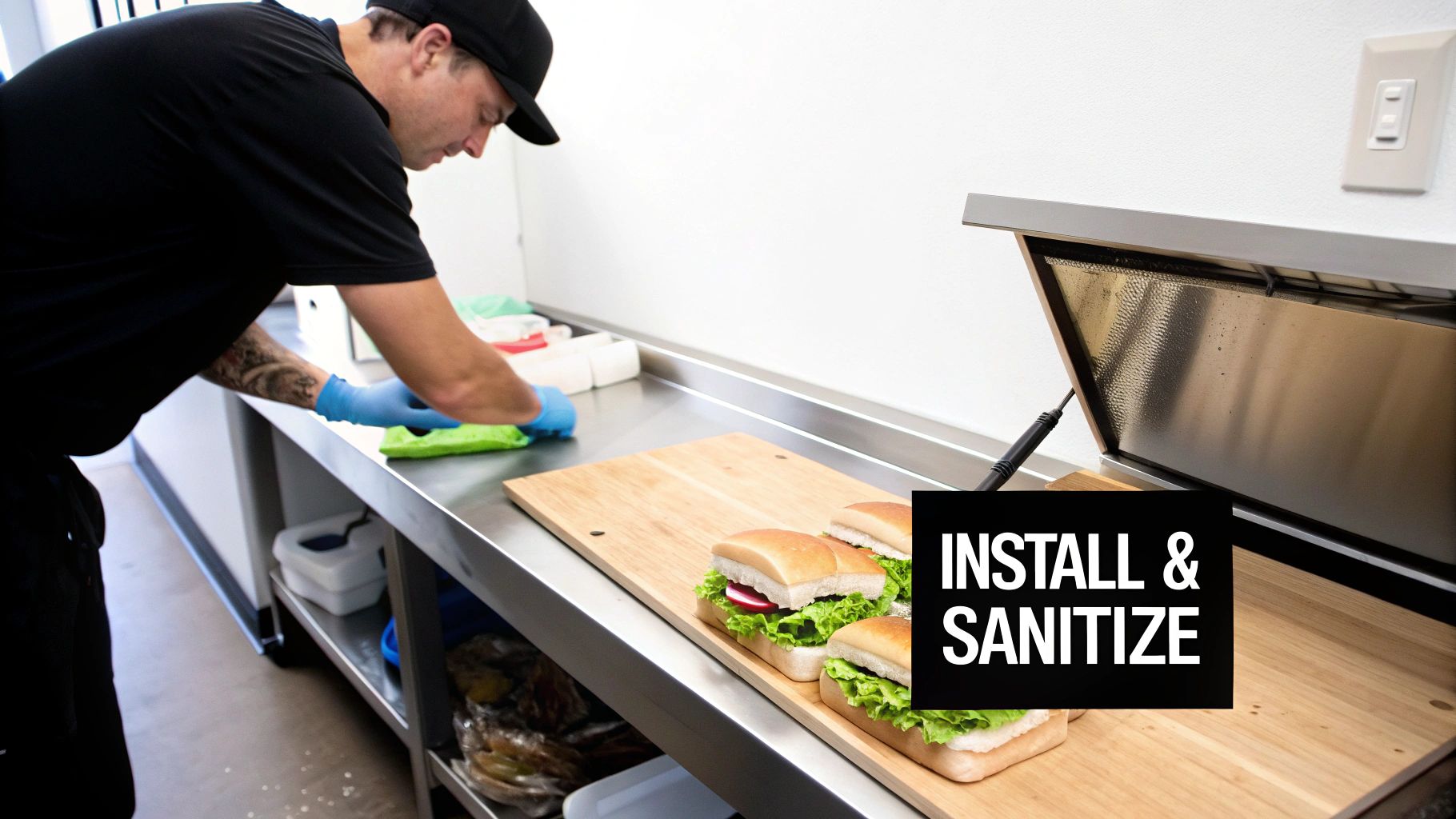
This means leaving enough clearance on all sides of the griddle as specified by the manufacturer. That space is critical for safety, preventing heat from damaging nearby equipment, and giving your staff room to move without getting burned during a rush.
Setting Up for Success
Before you even fire it up, there are a couple of setup checks that can save you a world of pain. One of the most important steps is properly seasoning the griddle plate (for non-chrome surfaces). This creates a natural non-stick surface that prevents food from sticking and makes cleanup a breeze.
An unseasoned griddle is a nightmare. It will cause food to stick, create a burnt-on mess, and lead to inconsistent cooking results. Taking the time to season it correctly is probably the smartest thing you'll do all day.
Once your griddle is in place and seasoned, the game shifts to keeping it spotless. A clean griddle is an efficient griddle, and a consistent cleaning schedule is what prevents flavor transfer and keeps your equipment running strong.
Your Game Plan for Sanitation
In a commercial kitchen, a clean cooking surface is completely non-negotiable. Breaking down the cleaning process into during-service, end-of-day, and weekly tasks makes it easy to stay on top of everything. It's the only way to guarantee food quality and sail through health inspections. And a huge part of that is knowing how to prevent cross contamination in your business, especially when moving from raw proteins to other foods.
Daily Cleaning Checklist (End of Day)
- Scrape the Surface: While the griddle is still warm, use a griddle scraper to remove all food debris and grease.
- Clean with Griddle Stone: Use a grill brick or griddle stone to polish the surface and remove any stubborn, carbonized bits.
- Wipe Down and Re-season: Wipe the surface clean with a damp cloth, then apply a thin layer of cooking oil to protect the steel from rust.
- Empty the Grease Trap: Remove and empty the grease trap, then wash it thoroughly.
Weekly Deep-Cleaning Tasks
- Degrease the Unit: Thoroughly degrease the backsplash, sides, and front of the griddle.
- Check and Calibrate Controls: Ensure that your temperature controls are accurate and functioning correctly.
By making these installation and cleaning habits part of your kitchen's DNA, you’re ensuring your griddle will be a reliable workhorse for years. It's a commitment, but it pays off every single day in quality and longevity.
Optimizing Your Griddle for Any Kitchen
A commercial griddle isn't just another piece of stainless steel. It’s a kitchen chameleon, perfectly capable of adapting to the unique pace and flow of your operation. Its real magic is unlocked when you match it to your specific needs. The raw power of a commercial griddle is unleashed when it's chosen to handle the kitchen's specific demands—whether that's a bustling restaurant or a nimble food truck.
You have to think beyond the spec sheet and really visualize how the unit will fit into your day-to-day grind. For one kitchen, it's a space-saving workhorse. For another, it's the central hub that dictates the speed of the entire service.
The Independent Restaurant Scenario
In a busy independent restaurant, a larger griddle—think 48 inches or more—quickly becomes the command center for the entire hot line. It’s not just for burgers anymore. It’s the go-to spot for searing proteins, toasting buns, and cooking breakfast all day. This frees up critical burner space elsewhere, giving you more flexibility for sauces and other pan work.
The benefits here are pretty straightforward:
- Centralized Workflow: All flat-top cooking happens in one place, which means less running around and less chaos during a rush.
- Increased Capacity: A bigger unit can handle enough food to power through a Saturday night dinner service with fewer bottlenecks.
- Menu Flexibility: Having that extra cooking surface makes it easy to run seasonal specials or build complex dishes without messing up your core setup.
The Food Truck Advantage
Space is everything in a food truck. Every single square inch is prime real estate. In this world, a compact 24-inch commercial griddle isn't just a nice-to-have; it's the absolute cornerstone of your operation. It provides a massive amount of cooking power in one tiny footprint, doing the job of three or four separate pans on a range.
Its impact is immediate:
- Space Maximization: You get essential cooking power without giving up the counter space you desperately need.
- Unmatched Efficiency: With a large, hot surface ready to go, one person can fly through orders.
- Streamlined Service: This kind of setup is what makes lightning-fast ticket times possible, and that's the name of the game in the food truck business.
For any mobile kitchen, the griddle is the engine driving your service. If it's not reliable, you can't serve customers quickly and move on. The line between a smooth, profitable day and a total shutdown often comes down to how well your gear performs.
The Ghost Kitchen Powerhouse
Ghost kitchens live and die by one thing: speed. When your entire business model is built on delivery, ticket times are the only metric that matters. In this high-stakes environment, a smartly chosen commercial griddle is the secret weapon for hitting those time goals while keeping orders accurate.
Many ghost kitchens opt for mid-size 36-inch griddles with thermostatic controls. This setup allows for an almost assembly-line level of production. Different temperature zones can be set up for different foods, which cuts out the guesswork and shaves precious seconds off every single order. It stops being a simple cooktop and becomes a purpose-built machine for pure efficiency.
No matter the setting, the unit's main job is to produce consistent heat, and that is non-negotiable. Unexpected downtime can absolutely cripple any of these business models. That's why part of your job is knowing how to fix equipment not heating problems the moment they pop up to prevent a service meltdown. By choosing the right size, features, and workflow for your kitchen, you turn a simple griddle into a powerful tool that drives real performance and profit.
Calculating Your Return on Investment
Dropping serious cash on a new piece of equipment like a commercial griddle can feel like a big hit to the budget. But you have to shift your thinking—it's not just another expense on a spreadsheet. It's a capital investment, a tool that's meant to make you money.
When you start to break down the return on investment (ROI), you can clearly see how a new griddle actively makes your kitchen more profitable and easily justify the purchase.
Looking at your griddle through a financial lens shows you what it's really doing for your kitchen. This isn't just about cooking food. It's about cooking it faster, more consistently, and with way less waste. All those little efficiencies add up to real, measurable savings that pay for the equipment and then some.
It’s a workhorse that attacks your costs from multiple angles, making it a powerful tool for sharpening up your entire operation.
Quantifying the Real-World Benefits
To actually figure out the ROI of a new commercial griddle, you need to look at three main areas where it generates value. Each one is a direct path to getting your initial investment back and fattening up your profits down the road. Any high-quality griddle is built to deliver in all three.
Here's what you need to track for your ROI calculation:
- Better Labor Efficiency: A griddle with rock-solid heat distribution and precise controls lets your cooks fly. They can work faster with less hand-holding, which means you might not need as many hands on deck to push out the same volume of food. That’s a direct cut to your labor costs.
- Less Food Waste: Consistent, predictable heat means fewer burnt pancakes and undercooked burgers. Every single item you don't have to throw in the trash goes straight back to your bottom line, and that's especially true with pricey proteins.
- More Revenue from Faster Service: When you can shave even 15-20 seconds off each ticket, you can serve more customers during your busiest hours. That increased throughput during the lunch or dinner rush is pure, extra revenue.
A new commercial griddle isn't a cost center; it's a profit-generating machine. By making your workflow smoother and cutting waste, it actively pads your bank account every single day.
A Quick ROI Example
Let's run some simple numbers. Imagine a busy diner finally ditches its old, patchy griddle for a new high-performance model.
- Labor Savings: The new griddle heats up in a flash and holds its temp perfectly, so one cook can handle the station during slower shifts instead of two. That saves $15/hour for 2 hours daily, which works out to $900 in savings every month.
- Food Cost Reduction: Thanks to the precise temperature control, the kitchen cuts down on burnt food by just $10 per day. That might not sound like a lot, but it adds another $300 per month in savings.
- Increased Sales: Faster cooking lets them serve an extra 10 customers during the weekend brunch rush. That brings in an extra $400 in monthly revenue.
In this scenario, the new griddle is generating $1,600 per month in combined savings and new sales. This quick math shows just how fast the right piece of equipment can pay for itself, turning a big purchase into a launchpad for growth.
When you're ready to run the numbers for your own kitchen, our team at Griddles.com can help you find the perfect model to maximize your return.
Frequently Asked Questions
When you're about to invest in a workhorse like a commercial griddle, you’re bound to have some questions. We get it. Here are the straight answers to the things operators ask us most often, so you can buy with confidence and get it right from day one.
What Is the Ideal Temperature Range?
This one depends heavily on your menu. A good rule of thumb is:
- Pancakes & Eggs: 325-350°F
- Burgers & Cheesesteaks: 350-375°F
- Searing Proteins: 400-450°F
The key isn't a single ideal temperature, but having a griddle with precise thermostatic controls that lets you dial in the exact heat you need for each specific food item. This control is what ensures perfect results every time.
How Often Should I Clean the Griddle?
You need to clean it every single day, without fail. A quick scrape-down between orders is essential, but a thorough cleaning at the end of each service is non-negotiable.
A dirty griddle is a kitchen nightmare. It leads to flare-ups, transfers burnt flavors to fresh food, and is a major fire hazard. A clean griddle is a safe, efficient, and high-performing griddle.
The daily cleaning routine should include scraping, using a griddle stone to remove carbon buildup, and wiping it down before re-seasoning with a thin coat of oil. This prevents rust and keeps the surface ready for the next day.
Steel vs. Chrome Griddle Plates
They might look similar, but the cooking surface makes a huge difference.
- Steel Griddles: These are the industry standard. They are durable, hold heat well, and are fantastic all-purpose cooktops. They require regular seasoning to maintain their non-stick properties.
- Chrome Griddles: These have a super-smooth, non-porous surface that is highly stick-resistant and incredibly easy to clean. They don't radiate as much heat, keeping the kitchen cooler, but they can be more expensive upfront.
Choosing the right surface for your menu is key. For high-volume burger joints, steel is king. For kitchens cooking delicate items like eggs all day, chrome is a game-changer.
Can I Use Water to Clean a Hot Griddle?
That's a hard no. Never, ever pour cold water on a hot griddle plate. It's a recipe for disaster.
This rapid temperature change, known as thermal shock, can cause the thick metal plate to warp or even crack. A warped griddle will never heat evenly again, completely ruining its performance. Always let the griddle cool down to a warm, manageable temperature before using any water for cleaning.
Ready to build a faster, safer, and more efficient griddle line? At Griddles.com, we have a curated selection of top-quality commercial griddles designed to withstand the demands of any commercial kitchen. Explore our collection of refrigerated prep tables and find the perfect unit for your business.