

Your Guide to Commercial Griddles Used in Professional Kitchens
Let’s be real—the cost of brand-new commercial equipment can make your head spin. Sourcing commercial griddles used is one of the smartest moves you can make, often saving you 40-70% off the sticker price of a new unit.
That’s a huge chunk of change that can be put back into other critical parts of your business, all without skimping on performance. This isn't about being cheap; it's about being strategic with your capital.
Why Smart Kitchens Invest in Used Commercial Griddles
Every dollar counts when you're launching a restaurant, getting a food truck on the road, or expanding your catering operation. The price tag on top-tier, brand-new gear can easily derail your budget. This is exactly where buying a quality used commercial griddle can be a game-changer.
Think about it this way: you have your eye on a high-performance six-burner range that’s essential for your menu. A shiny new griddle could gobble up the funds you need for that core piece of cooking equipment. By finding a solid, dependable used griddle, you secure your cooking needs for a fraction of the cost. You get the griddle and the range, no compromises needed. It’s a calculated business move, not just a shortcut.
Unlocking Value Beyond the Price Tag
The perks of going used go way beyond just the initial savings. The restaurant industry is always in motion—places renovate, upgrade, or unfortunately, close down. This constant churn creates a steady stream of well-maintained, professionally serviced equipment hitting the second-hand market.
There’s more to the story than just a lower price:
- Proven Reliability: A griddle that’s already put in a few years of solid work in a busy kitchen has proven it can handle the pressure. You're getting a unit with a real-world track record, unlike a new model that might have a surprise factory flaw.
- Immediate Availability: Forget waiting weeks for a new unit to be delivered. Used equipment is almost always on hand and ready for immediate pickup or shipping. You can get your kitchen up and running faster.
- Environmental Responsibility: Giving a perfectly good griddle a second home keeps it out of the landfill. It’s a sustainable choice that cuts down on waste and the resources needed to manufacture new appliances.
At the end of the day, your customers will never know if your pancakes were cooked on a brand-new griddle or a meticulously cared-for used one. But your bottom line definitely will.
This guide will walk you through everything you need to know about navigating the world of commercial griddles used in professional kitchens. We’ll cover where to look, how to inspect a unit like a pro, and how to spot red flags before you hand over any cash. Let's get you ready to make a smart buy that helps your business thrive.
Finding Reliable Used Commercial Griddles
Tracking down the right commercial griddles used for your kitchen isn't just about a quick online search; it's more like a strategic hunt. Knowing exactly where to look is the key to finding a workhorse unit instead of inheriting someone else's headache.
You'll generally find yourself exploring three main avenues: specialized used equipment dealers, the Wild West of online marketplaces, and restaurant auctions. Each has its own vibe, and you’ll need a different game plan for each one.
Exploring Used Equipment Dealers
If you value peace of mind and are willing to pay a little extra for it, starting with a reputable used equipment dealer is your best bet. These folks are specialists. Their entire business model hinges on sourcing and selling gear that actually works. The griddles they offer have usually been cleaned, given a once-over by a technician, and sometimes even refurbished.
That's a huge plus. A good dealer might have already checked the thermostats or cleaned the gas lines, saving you from a surprise repair bill right after you get it installed. Many will even throw in a limited warranty, maybe a 30 or 90-day guarantee on parts, which is something you'll never get from a private seller. Sure, their prices might be a touch higher than what you see on Facebook, but the professional vetting makes it a solid investment. For more tips on choosing the right model, dive into our guide on the best commercial freezer options.
Navigating Online Marketplaces and Auctions
Platforms like Facebook Marketplace and Craigslist are flooded with commercial griddles used by other restaurant owners. You can find some absolute steals here, but you’re also taking on all the risk. The burden of inspection falls completely on you.
When you're messaging an online seller, you have to be your own detective. Don't be timid about asking for evidence.
- Video or It Didn't Happen: Ask the seller for a quick video of the griddle fired up. Crucially, the video needs to show an even flame pattern on a gas model or a surface thermometer showing it reaches and holds the correct temperature.
- Listen to the Machine: For gas models, listen for any hissing sounds that could indicate a leak. For electric, listen for unusual humming or clicking from the controls.
- Scrutinize the Photos: Zoom in on every picture. Look for rust, especially around the base and controls. Major warping or deep scratches on the griddle plate can mean it was abused.
Restaurant auctions are another place to hunt for bargains, but they're almost always "as-is, where-is" sales. What you see is what you get, and once the hammer falls, it's yours.
If an auction offers a pre-sale inspection window, you absolutely must go. This is your one and only shot to physically check the unit out, inspect the surface, and test the controls. Skipping this step is like bidding with a blindfold on.
By adapting your approach for each of these channels, you can sift through the duds and find a reliable griddle that will be a valuable asset in your kitchen for years to come.
The Hands-On Used Griddle Inspection Checklist
Alright, this is the moment of truth. You’ve found a promising used griddle, and now you’re standing in front of it. This isn't the time for a quick kick of the tires; a thorough, hands-on inspection is your best and only defense against buying a dud that will become a money pit.
Think of yourself as a detective. Taking just 15-20 minutes to go through these checks can save you thousands of dollars and a world of headaches later on. It’s the difference between snagging a workhorse and inheriting someone else's expensive problem.
This quick visual lays out the three main routes for finding used equipment. Whether you go through a dealer, browse online marketplaces, or hit an auction, there's a path to the right griddle for you.
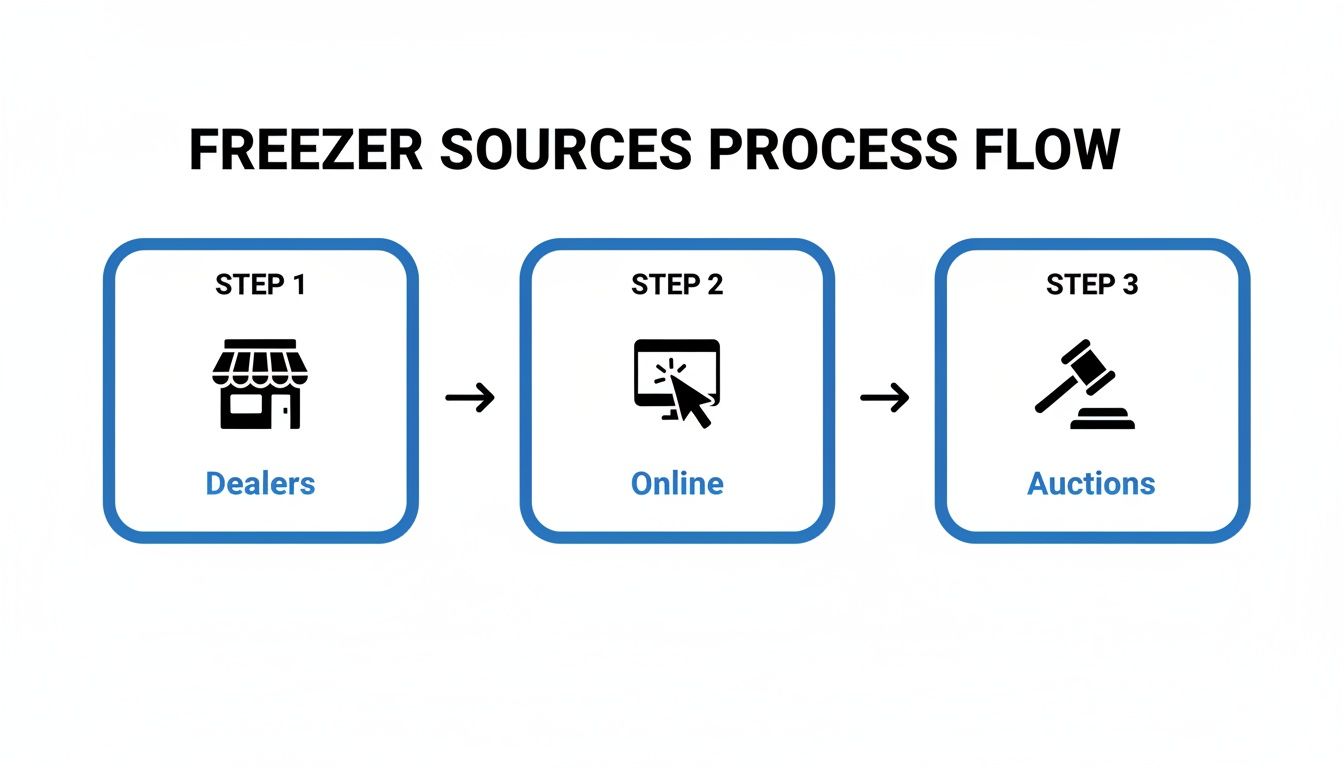
Each path has its pros and cons, but a solid inspection process is non-negotiable, no matter where you source it from.
Burner and Heating Element Check
The heating system is the heart of the griddle. Period. If it doesn't heat evenly, you’ve just bought a very expensive, metal table. When you show up, the griddle must be connected to a power or gas source. If it's not, that's a massive red flag.
First, just observe. A healthy gas griddle has steady, blue flames. If you see sputtering, yellow flames, or notice a strong gas smell, walk away. Those are signs of a serious problem. For an electric griddle, you'll need an infrared thermometer to check for hot spots on the surface.
Next, check the controls. Turn each knob and feel for a smooth, solid action. Wobbly or loose controls can indicate worn-out parts that will need replacing. If the unit has been poorly maintained, the grease traps and internal components may be caked in buildup, which is a fire hazard and a sign of neglect.
Electrical and Gas Line Inspection
Shoddy wiring or a bad gas line isn't just a performance problem; it's a legitimate safety hazard. For electric models, start with the power cord and plug. Look for any exposed wires, deep cracks in the insulation, or burn marks on the prongs. Any of these are immediate deal-breakers.
For gas models, inspect the gas connection hose. Look for cracks, brittleness, or kinks. You're looking for signs of DIY repairs, like electrical tape where there shouldn't be any. Everything should look clean and professionally buttoned up.
Now, check the pilot light assembly on gas models. It should light easily and stay lit. If it's difficult to light or keeps going out, you're looking at a pricey service call right out of the gate.
Structural Integrity and Cooking Surface
The griddle's body and cooking plate are all about performance. Check the exterior for serious rust, especially around the base and splash guards. Minor dings and scratches are just battle scars from a busy kitchen, but big dents could mean it was dropped.
The cooking surface—whether steel or chrome—is absolutely critical. It should be flat. Use a straight edge (like a ruler) to check for any warping or low spots. A warped griddle will cook unevenly and cause oil to pool.
Here's the pro tip: look for pitting and deep scratches on the surface. Minor seasoning buildup can be cleaned, but deep gouges can't be fixed and will cause food to stick. Run your hand over the surface to feel for smoothness.
Inside the grease trap, give it a good look. Is it intact and easy to remove? A clean, well-maintained grease management system is usually a good sign that the whole machine was treated with some respect.
Sanitation and Maintenance History
Finally, trust your eyes and nose. If the unit is excessively grimy, has funky smells, or just looks neglected, it’s a bad sign. Sure, you can clean it, but it often points to a lack of care for the mechanical parts you can't see.
Don't be shy—ask the seller for any maintenance records they have. A reputable dealer will often have this info. Knowing if the burners have been replaced or if the unit was recently serviced gives you a much clearer picture of what you’re buying and what future costs might look like.
To make this easier when you're on-site, I’ve put together a checklist. Keep this on your phone to make sure you don't miss a thing when evaluating commercial griddles used for your kitchen.
On-Site Used Commercial Griddle Inspection Checklist
Use this table as your guide during the inspection. It breaks down what to look for and how to test each critical component quickly and effectively.
| Component to Check | What to Look For | Simple Test / Action |
|---|---|---|
| Heating System | Uneven heating, yellow flames (gas), or slow heat-up time. | Turn the unit on. For gas, check for steady blue flames. For electric, use an infrared thermometer to check for even surface temperature. |
| Cooking Surface | Warping, pitting, deep scratches, or excessive rust. | Place a straight edge across the griddle plate to check for flatness. Visually inspect for any significant surface damage. |
| Power Cord/Gas Line | Frayed wires, cracks, burn marks, or gas odor. | Carefully inspect the entire length of the power cord or gas hose for any signs of damage or wear. |
| Controls & Knobs | Loose, wobbly, or unresponsive knobs and thermostats. | Turn each knob through its full range of motion. They should feel solid and engage properly. |
| Grease Trap | Missing, damaged, or ill-fitting grease collection tray. | Slide the grease trap in and out. It should move smoothly and fit securely. |
| Exterior & Frame | Major rust (especially at the base), large dents, and stable legs. | Walk around the unit and inspect all surfaces. Give it a gentle push to ensure it is stable and doesn't wobble. |
| Thermostat Accuracy | Failure to reach or hold the set temperature. | Bring an infrared surface thermometer. Set the griddle to a specific temp and verify the surface reading is accurate. |
| Maintenance History | Lack of service records or vague answers about past repairs. | Ask the seller directly if they have any maintenance logs or can detail any recent professional servicing. |
Going through these checks systematically will give you the confidence to either make a smart offer or walk away from a future problem.
Calculating Your Griddle Needs and True Costs
Picking a used commercial griddle is about more than just the price tag; it's about finding the right fit for your actual kitchen workflow. Go too small, and you're setting yourself up for a bottleneck during a rush. But get a unit that's way too big, and you're just throwing money away on energy to heat unused space while hogging precious cookline real estate.
Getting this balance right is everything. You need to match the griddle's size to your daily reality, thinking about your menu, how much you cook at peak times, and the physical footprint you're working with.
Sizing Up Your Cooking Requirements
Before you even start browsing listings for commercial griddles used, you need a real-world estimate of the surface area your kitchen demands. Don't eyeball it. Take a hard look at your menu and your busiest service.
For a traditional restaurant, a 36-inch or 48-inch griddle is a common workhorse. This provides enough space to handle multiple orders at once. A small cafe might only need a 24-inch countertop model, while a high-volume diner flipping pancakes all day might need a 60-inch or even a 72-inch model.
Food trucks and caterers are playing a different game entirely. Your space is at a premium, so it’s all about maximizing efficiency. A countertop model is often the best choice. Consider if you need thermostatic controls for precise temperatures or manual controls for simplicity and durability.
Always size your griddle based on your busiest service. If you need to cook 20 burgers at a time for the lunch rush, a 24-inch griddle will constantly hold you back, no matter what a great deal it seemed at the time.
And please, don't forget the tape measure. It sounds simple, but you'd be surprised how many people forget this crucial step. Measure your cookline, any tight doorways, and the spot where the griddle will live. Make sure to leave a few inches of clearance on all sides for ventilation—if you don’t, the unit can overheat and create a safety hazard.
Decoding Energy Types and True Operating Costs
The price you pay upfront for a used griddle is just the down payment. The real cost comes from the gas or electricity it will consume. This is where a little knowledge about operating costs can save you a ton of cash down the road.
A slightly newer used model with better efficiency might cost a bit more, but it can easily save you hundreds in operating costs over its life compared to an older, cheaper energy hog. Gas is typically cheaper to operate than electric, but requires proper ventilation and a gas line hookup. Electric models offer more precise temperature control but can lead to higher utility bills.
The push for efficiency is a huge deal in the commercial cooking equipment market. This industry focus means that even used griddles from the last few years are often worlds better than their predecessors in terms of energy consumption.
Long-Term Value Versus Upfront Savings
It’s easy to get tunnel vision and grab the absolute cheapest griddle you can find. But that’s a rookie mistake. A low sticker price can get wiped out fast by sky-high utility bills and surprise repair calls.
Let's look at a common scenario. You have two options:
- Griddle A: A 10-year-old unit for $600. It seems to work okay, but it has some visible wear.
- Griddle B: A 4-year-old, well-maintained model for $1,100. It’s clean and comes from a place that took good care of it.
You save $500 upfront with Griddle A, which feels great. But that older, inefficient unit could easily add $30-$50 to your utility bill every single month. In just a couple of years, you won't just break even—you'll end up paying more for the "cheaper" griddle. If your operation is large enough to need serious cooking capacity, you might want to learn more about a walk-in freezer to see if that's a better long-term play.
At the end of the day, the smartest buy is the one that offers the best value over time. By calculating your real needs and making energy efficiency a priority, you'll find a used griddle that works for your kitchen and your budget for years to come.
Negotiating the Price and Finalizing the Deal
Alright, you've kicked the tires and done your inspection. You’ve found a solid unit. Now it’s time to put on your negotiator hat. Getting a great price on commercial griddles used in a previous kitchen isn't about being cheap; it's about being fair and backing up your offer with facts. This is where all those notes you took during the inspection really start to pay off.
Every little thing you found—a slightly warped corner on the plate, a wobbly control knob, a few dings on the side—becomes a talking point. It’s all about how you frame it. Instead of bluntly saying, "This thing is beat up," you can say, "I noticed the thermostat knob will need replacing pretty soon, which is a cost I'll have to cover." This simple shift turns your criticisms into objective bargaining chips.
Making a Confident and Informed Offer
Before you throw out a number, you need to do a little recon. Hop online and check out restaurant auction sites, used equipment dealers, and even Facebook Marketplace for the same or similar models. You're looking for griddles with a comparable age, brand, and condition to get a feel for the current market rate. This homework is your secret weapon—it prevents you from overpaying and shows the seller you know your stuff.
When you make your offer, be ready to walk them through your logic. For example: "I see similar units online are going for around $1,200. Based on my inspection, I'd need to get the surface re-seasoned and the pilot assembly cleaned. With those costs in mind, I can offer you $950 today."
Your greatest strength in any negotiation is being truly willing to walk away. If the seller won't budge to a price that makes sense for the griddle's actual condition, don't get emotionally invested. Another used griddle will always pop up.
Closing the Deal and Arranging Logistics
Once you've shaken hands on a price, a few final steps will protect you and your new investment. The absolute must-have is a bill of sale. It doesn't have to be complicated, but it's your proof of purchase.
Make sure it includes:
- Full names and contact info for both you and the seller.
- The date of the sale.
- A detailed description of the griddle (make, model, and serial number are key).
- The final price you both agreed on.
- A line stating it’s sold "as-is," unless you've worked out some kind of guarantee.
Speaking of guarantees, always ask about a warranty. It's a long shot with a private seller, but some used equipment dealers will offer a short 30 or 90-day warranty on parts. It can't hurt to ask, and even a short warranty provides a ton of peace of mind.
Finally, you have to get this beast back to your kitchen. Please, don't try to wrestle a heavy commercial griddle into the back of a pickup truck with a buddy. Hire professional movers or find a freight service that handles heavy equipment. And when you're booking that, knowing how to negotiate shipping rates can save you a surprising amount of cash. Make sure it's strapped down tight and secured to avoid any damage on the ride home. A great deal is only great if it arrives in one piece.
Maintaining Your Used Griddle for Long-Term Value
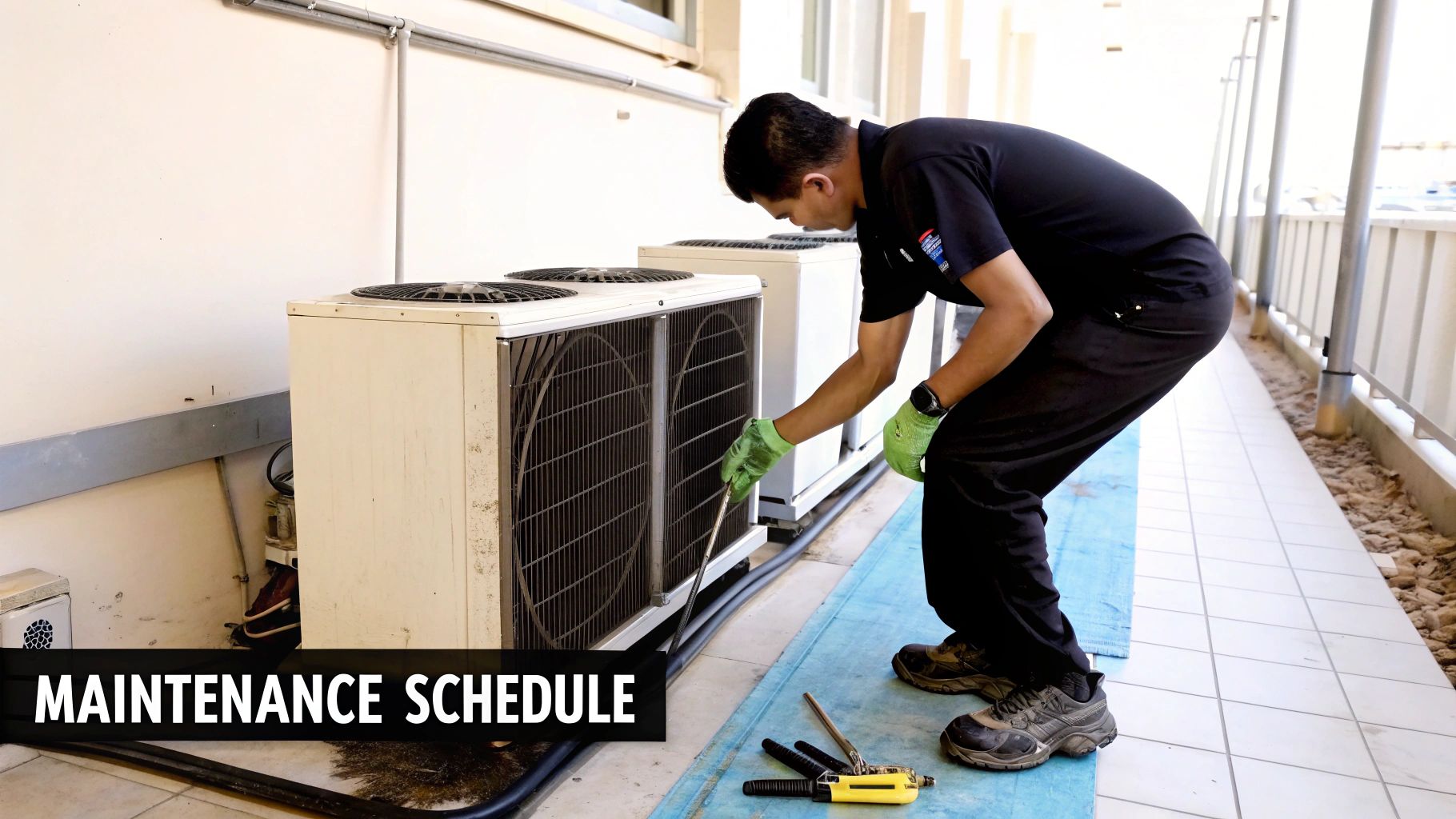
Getting your griddle installed and seasoned isn't the finish line. Far from it. If you want to get the most out of your investment, consistent maintenance is non-negotiable. Being proactive is the single best way to avoid surprise breakdowns and ensure consistent cooking results.
Think of it as cheap insurance. A simple upkeep schedule protects you from service disruptions and those dreaded emergency repair calls. The best part? These tasks are easy to build right into your kitchen's daily, weekly, and monthly routines.
Your Essential Maintenance Schedule
You don't need to spend hours on this. A little bit of consistent care goes a long, long way. By breaking it down, the tasks feel less daunting and it's easier to make sure nothing gets overlooked.
-
Daily Tasks: At the end of every shift, have your crew scrape down the griddle surface while it's still warm and empty the grease trap. This simple action prevents carbon buildup and maintains food quality.
-
Weekly Chores: Pick a slower day to give the griddle a deeper clean. Use a griddle stone to remove any tough buildup and re-season the surface with a light coat of oil. This is also a great time to wipe down the exterior and controls. You can get some great ideas from our guide on how to organize a chest freezer that apply to keeping any station tidy.
Consistent maintenance isn't just about preventing failures; it's about performance. A clean, well-seasoned griddle cooks more evenly and prevents food from sticking, directly impacting the quality of your dishes.
Knowing When to Call a Professional
Some jobs are perfect for your team, but others need an expert. Knowing the difference is crucial for your budget. Daily cleaning and seasoning are all perfect DIY tasks.
But if you start hearing strange noises from a gas line, see the griddle struggling to stay lit, or notice the thermostats are wildly inaccurate, it's time to call a technician. Don't wait. To keep your unit running smoothly for years, it's smart to map out your care with a preventive maintenance schedule template. This brings in a pro on your terms to catch small problems before they become wallet-busting emergencies.
Your Top Questions Answered
When you're in the market for a pre-owned commercial griddle, a few key questions always pop up. Let's get straight to the answers so you can buy with confidence.
How Long Does a Used Commercial Griddle Last?
This is the big one, isn't it? A well-built commercial griddle from a reputable brand can easily last 10 to 20 years, sometimes even longer. The key isn't just the brand name, but how it was treated in its past life.
A meticulously cared-for older griddle will almost always outlive a newer unit that's been neglected. Once it's in your kitchen, how you maintain it will determine whether those initial savings pay off for years to come.
Is a Refurbished Griddle a Better Deal Than a Used One?
Most of the time, absolutely. Buying a griddle "as-is" from a private seller is a roll of the dice—any hidden problems become your expensive headache.
A refurbished unit, on the other hand, has been professionally inspected and serviced. Technicians typically deep-clean it, replace worn components like thermostats or gas valves, and test it to make sure it heats properly. Many dealers even back their refurbished griddles with a warranty, shifting the risk off your shoulders.
That warranty is often the game-changer. It might cost a little more upfront, but it provides a safety net against immediate repair bills that a private "as-is" sale just can't match. It’s an investment in peace of mind.
Can I Finance a Secondhand Griddle?
Yes, and it's a smart move for managing cash flow. Most restaurant owners don't pay cash for big-ticket items, and that includes used equipment.
Equipment leasing is a really popular route, letting you make smaller monthly payments while the griddle generates revenue. You can also look into traditional business loans. Don't forget to ask the equipment dealer, as many offer in-house financing programs specifically for their used inventory. Financing keeps your cash free for things like payroll and inventory, which is crucial for any food business.
Ready to upgrade your cookline? At Griddles.com, we offer a curated selection of new and reliable commercial griddles built to perform. Explore our collection at https://griddles.com and find the right equipment to power your menu.