
Your Ultimate Guide to the Commercial Griddle
Walk into just about any commercial kitchen worth its salt, and you'll see it: the classic commercial griddle. This isn't just a piece of equipment; it's the command center, the true heart of the operation where every dish gets its start.
Think of it as the engine that drives your hot line, turning raw ingredients into profitable plates with incredible speed and consistency.
The Unsung Hero of Kitchen Workflow
A busy commercial kitchen is like a well-oiled machine. The fryer has its job, the oven has its, but the commercial griddle is what makes everything work together. It’s the stage for every critical task, from searing steaks to flipping pancakes.
This goes way beyond simply having a place to cook. It’s about creating a smart, logical flow that cuts down on wasted steps and gets more food out the door. The right griddle lets a chef move from prep to plating without missing a beat, turning raw ingredients into finished plates with total efficiency. It’s no wonder demand for these units is on the rise.
A Growing Industry Standard
The global market for commercial griddles is booming, and it's all driven by the non-negotiable need for speed and consistency in the food industry. One recent analysis predicts a compound annual growth rate (CAGR) of 5.2% from 2026 to 2033, which just goes to show how essential these griddles have become. You can dig into more of this market data over at cognitivemarketresearch.com.
This trend points to a simple truth: kitchen professionals know that a quality commercial griddle isn't just another cost—it's a foundational investment in their business.
The right commercial griddle is the unsung hero of efficiency. It dictates cooking speed, organizes the hot line, and provides the reliable, even heat necessary for consistent food production under pressure.
Whether you're running a high-volume restaurant, a tight-spaced food truck, or a delivery-only ghost kitchen, the core needs are the same. You need a cooktop that can take the heat, handle constant use, and stand up to the relentless pace of a commercial kitchen.
This guide will walk you through everything you need to know to pick the perfect griddle—from plate materials and essential features to sizing and installation—so you can find the ideal centerpiece for your culinary workflow.
Choosing the Right Griddle Plate Material and Thickness
Picking the right commercial griddle goes way beyond just measuring the size. The cooking surface itself comes in different materials and thicknesses, and each one is built for a specific job in a busy kitchen. Honestly, getting this part right can be the difference between a griddle that’s still performing a decade from now and one that’s warped and useless in a year.
Think about it like buying tires for a truck. You wouldn't put highway tires on a rig you're taking through a muddy field. Same principle applies here. The two main players you'll see are steel and chrome griddle plates.
Decoding Griddle Plates: Steel vs. Chrome
Steel griddle plates are the heavy-duty, all-terrain tires of the kitchen world. They are fantastic at holding and transferring heat, making them perfect for high-volume cooking where you need consistent temperatures. This makes them the undisputed champion for cooking fatty foods like bacon and burgers, as the seasoning builds up over time, creating a non-stick surface. They are the workhorses that shrug off abuse and constant use.
Then you have chrome griddle plates. These are your high-performance racing tires—great for delicate items and presentation. The chrome surface is non-porous and non-reactive, so it doesn't transfer flavor between items. This makes it a fantastic choice for cooking delicate items like eggs, fish, and pancakes. A chrome griddle is perfect for open kitchens where appearance matters, as it's easier to keep shiny and clean.
Pro Tip: Your choice of griddle plate directly impacts your menu. Match the material to the job—steel for high-volume and fatty foods, chrome for delicate items and presentation—to protect your investment and keep your kitchen running smoothly.
Understanding Plate Thickness: The Measure of Heat Retention
Once you’ve settled on the material, the next spec to nail down is the plate thickness. This is just a fancy word for how thick the cooking surface is. For commercial griddles, you'll mostly see 1/2-inch, 3/4-inch, and 1-inch options.
- 1/2-Inch: This is the lightest and most common option. It heats up quickly, making it great for breakfast spots or kitchens that need fast response times for on-demand cooking.
- 3/4-Inch: This is the industry sweet spot. A 3/4-inch plate offers a fantastic balance of heat retention and responsiveness, making it a true all-rounder. It can handle most daily cooking tasks, from burgers to breakfast, with ease.
- 1-Inch: This is the heavyweight champion, built for serious abuse. A 1-inch plate is exceptionally thick, making it the go-to for high-volume steakhouses or any operation that needs to maintain searing hot temperatures even when slammed with frozen patties.
To help you decide, here’s a quick cheat sheet for matching the right griddle to your kitchen's demands.
Commercial Griddle Plate Quick Reference
A comparison of common griddle plate materials and thicknesses to help you select the right unit for your kitchen's needs, based on menu and budget.
| Specification | Best For | Key Feature | Consideration |
|---|---|---|---|
| 1/2-Inch Steel | Breakfast diners, quick-service restaurants, light-duty use | Heats up quickly | Less heat retention; can develop cold spots under load |
| 3/4-Inch Steel | All-purpose cooking, burger joints, busy restaurants | The industry standard | Perfect balance of heat retention and recovery time |
| 1-Inch Steel | High-volume steakhouses, institutional cooking, frozen-to-grill | Maximum heat retention | Slower to heat up, higher cost |
| Chrome (any thickness) | Delicate foods (eggs, fish), open kitchens, reducing flavor transfer | Easy to clean, looks great | Higher initial cost, requires specific utensils |
Ultimately, choosing the right spec comes down to being realistic about what you'll be cooking day in and day out.
As you plan your layout, think about how your central griddle connects everything. It should be the hub that makes your kitchen's workflow feel seamless and efficient.
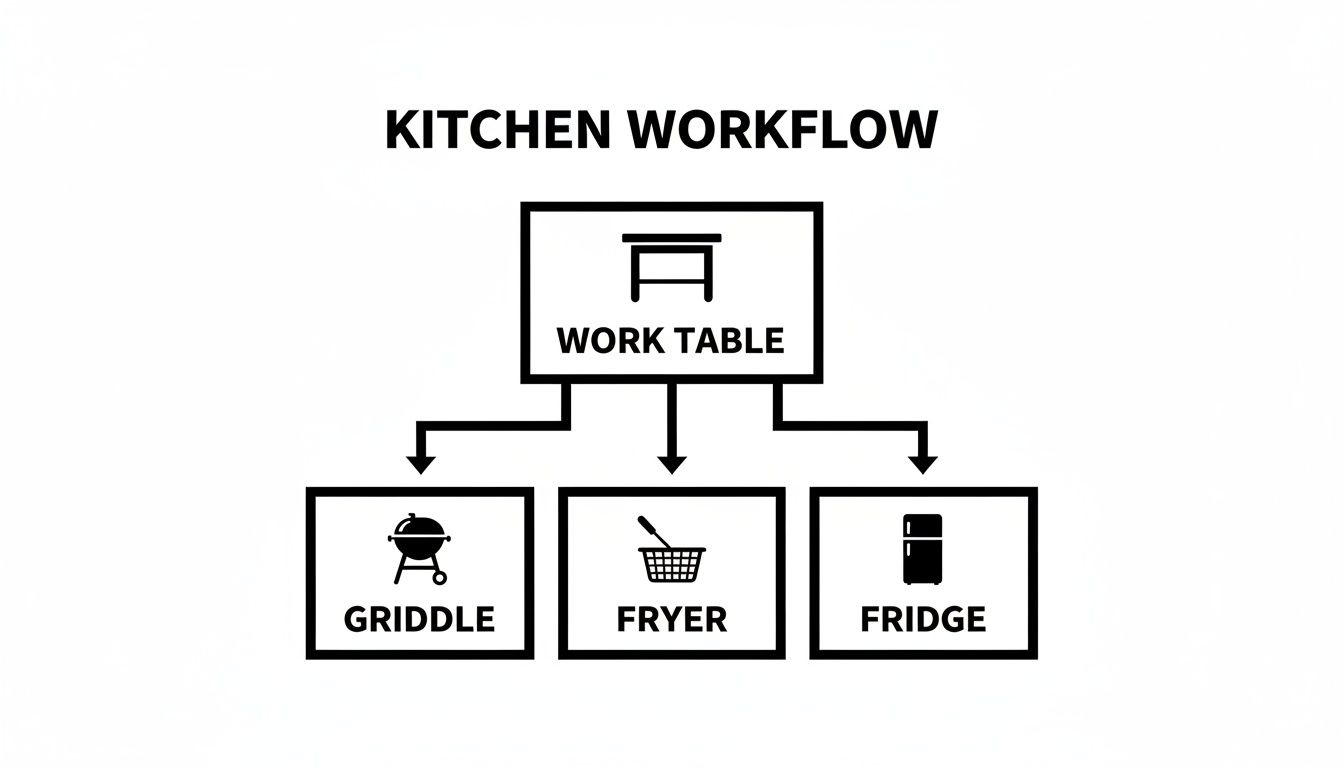
A well-placed griddle minimizes the steps your cooks have to take, linking different stations together and keeping the whole operation moving fast. That’s how you build a truly productive kitchen.
How to Size Your Griddle for Peak Efficiency
Picking the right size for your commercial griddle isn't just about filling an empty spot—it’s about designing a smarter workflow. Go too big, and you waste energy and space. Too small, and you’ve got an instant bottleneck during a dinner rush. The perfect griddle feels like a natural part of your kitchen's rhythm.
Getting the size right is a huge part of learning how to improve restaurant operations. The first step is the easiest: grab a tape measure and get the dimensions of your available cook line. But don't just measure the space. Think about clearance. Your team needs room to move without bumping into each other, and you need proper ventilation. A minimum of 6 inches of clearance on the sides and back is a solid rule of thumb.
Matching Griddle Size to Your Menu and Volume
Once you know your space constraints, think about the griddle’s job. If it’s for a small cafe doing a few breakfast sandwiches, a compact 24-inch griddle is probably all you need to handle the morning rush.
On the flip side, a beastly 48-inch or 72-inch griddle is necessary for a busy burger joint pumping out hundreds of orders an hour. A sprawling 72-inch commercial griddle gives multiple cooks elbow room to work together—one person can be toasting buns on a cooler zone while another is searing patties on the hot zone. This setup crushes traffic jams before they even start.
A well-sized griddle doesn't just cook food; it directs the flow of your entire hot line. It should be large enough to handle your busiest moments without becoming overcrowded.
Think about how this plays out in different kitchens. A food truck is all about maximizing every inch, so a 24-inch countertop griddle makes sense to save space. A ghost kitchen focused on delivery might set up a long, 72-inch griddle as a dedicated assembly line, moving orders from raw to cooked in a seamless flow.
Common Commercial Griddle Sizes
Here are a few standard dimensions and where they fit best in a busy kitchen:
- 24": Perfect for tight spots. Use it for small breakfast menus, side items, or low-volume applications.
- 36": This is your versatile workhorse. It offers plenty of room for one cook to manage a full menu for a small to medium-sized restaurant.
- 48": A great two-person station. One cook can manage proteins while another handles vegetables and buns, often with separate temperature zones.
- 72": The king of high-volume cooking. A griddle this size can support a full team, creating a smooth journey from order ticket to expediting.
When you carefully match your commercial griddle to your menu and your kitchen's layout, you're not just buying equipment. You're building an environment designed for speed and efficiency that empowers your team instead of getting in their way.
Upgrading Your Griddle with Essential Features
A basic commercial griddle is a flat-top powerhouse. But with the right features, it becomes a specialized machine for your specific menu. These aren't just little add-ons; they're strategic upgrades that directly pump up your efficiency, make sanitation a breeze, and bring some much-needed order to the kitchen chaos. Picking the right components means building a cook station that actually works for you.
Think of it this way: a plain griddle cooks. Add the right features, and suddenly it's a multi-zone cooking center, a thermostatically controlled precision instrument, or a high-capacity breakfast machine.
The Non-Negotiable Grease Trough
First up is the grease trough. Honestly, this is so essential it’s standard on any commercial griddle worth its salt. A well-designed grease trough and collection tray makes cleanup infinitely easier and safer. It's the perfect system for managing rendered fat from burgers and bacon, keeping your cooking surface cleaner and reducing the risk of grease fires.
A clean, clear cooking surface is non-negotiable for speed and safety. An efficient grease management system ensures that what you need to remove is always channeled away, but never in your way.
Protecting Your Workspace with Splash Guards
If your griddle is next to other equipment, integrated splash guards are a must. These raised lips at the sides and back of the griddle are your first line of defense against grease and food bits flying onto the wall or adjacent stations. It’s a simple feature that makes a world of difference for sanitation, preventing grime from building up and making your end-of-day cleanup way faster. A griddle with splash guards is a self-contained, easy-to-clean unit.
Splash guards are basically built-in shields for your kitchen. They keep things cleaner, simplify your sanitation routine, and help you stay on the good side of the health inspector.
Gaining Control with Thermostatic Controls
For kitchens that need precision, thermostatic controls are a total game-changer. While manual controls (low, medium, high) are fine for some applications, thermostats let you set and maintain an exact temperature. This is crucial for delicate items like eggs or for ensuring perfect, consistent results on burgers and steaks every single time. That kind of consistency is something manual controls just can't give you.
Choosing the Right Heat Source
The fuel for your griddle really does affect both performance and your utility bills. The two most common types you'll see are gas and electric.
- Gas Griddles: These offer powerful, responsive heat. They're the go-to for most high-volume kitchens and are perfect for achieving a hard sear. They can be fueled by natural gas or propane.
- Electric Griddles: These provide incredibly even and consistent heat across the entire surface. They are often preferred for baked goods like pancakes and are a great option where gas lines are not available.
For even more specialized needs, you can look at setups similar to a refrigerated sandwich prep table to see how integrated cold storage can complement a hot line. At the end of the day, building the perfect griddle station is all about picking the features that solve your kitchen's unique problems.
Why a Commercial Griddle is the Smartest Investment
When you're setting up a commercial kitchen, the temptation to make do with smaller, residential-grade equipment is definitely real. But a commercial griddle isn't just another line item on an invoice—it’s a long-term play for durability, hygiene, and your bottom line. Once you look past the initial price, its true value becomes impossible to ignore.
It really boils down to three things: unmatched durability, uncompromising performance, and a lower cost over the long haul. A commercial griddle is built from heavy-duty stainless steel and thick cooking plates, which means there’s no chance of it failing during a busy service. That feature alone makes it your best friend for acing customer expectations and keeping service standards sky-high.
Built to Outlast the Competition
Just picture the daily beating a cooktop takes in a busy kitchen. A commercial griddle is made for that chaos. It can handle scorching hot temperatures for 12 hours a day, constant scraping with metal spatulas, and the impact of heavy presses that would destroy a consumer-grade unit in a few short months.
The true value of a commercial griddle is measured in years, not dollars. Its ability to perform under constant pressure for over a decade makes it the most cost-effective choice for any serious kitchen.
This is what a commercial griddle is all about: turning a frantic hot line into an efficient, well-oiled machine. In fact, some studies have shown that unreliable or undersized equipment can tank productivity by as much as 40%. A solid commercial griddle flips that script. These units, often built with powerful burners and sturdy stainless steel bodies, are designed to take a relentless pounding day in and day out, boasting a service life of 10-15 years that leaves the alternatives in the dust. You can dig deeper into how these griddles boost kitchen performance over at allsouthern.com.
A Lower Total Cost of Ownership
Sure, the sticker price might be higher at first, but the total cost of ownership is where a commercial griddle really pulls ahead. Residential units can't maintain temperature, leading to inconsistent food and slow ticket times. They break down frequently, forcing you to pay for repairs and lose revenue.
A commercial griddle, on the other hand, just needs good daily cleaning. That’s it.
This incredible longevity means you buy it once and it just keeps working for you, year after year, saving you thousands in replacement and repair bills. When you add in its massive contribution to kitchen efficiency and food quality, the choice becomes crystal clear. A commercial griddle isn't an expense; it’s the smartest investment you can make for your kitchen's future.
Getting Set Up and Keeping It Clean
When that shiny new commercial griddle lands on your doorstep, what you do next is just as important as the purchase itself. Getting the assembly and maintenance right from day one is how you protect your investment and keep your cooking station safe, clean, and humming along for years.
First things first, a wobbly griddle is a kitchen nightmare. It's a safety hazard, sure, but it also messes with your cooking. An uneven surface means grease won't drain properly and heat distribution can be affected. So, when you're installing it, make sure every leg is cranked down tight and use a level to adjust the feet until it's perfectly stable.
Creating a Cleaning Cadence
The secret to a long-lasting griddle isn't a secret at all—it's just consistent cleaning. A simple routine stops grease from building up into a monster and keeps that cooking surface in prime condition. This isn't just about looking good; it's about food safety and being ready for every service.
Here’s a simple rhythm to follow:
- Daily: Give the surface a good scrape while it's still warm. Don't forget to empty that grease trap and wipe down all the exterior stainless steel with a gentle cleaner.
- Weekly: Time for a deeper clean. Grab a grill brick and some oil and give that griddle plate some love. While you're at it, check the burner ports and vents for any gunk and clear it out.
- Monthly: Do a quick safety check. Look over the gas lines and connections for any signs of cracking, wear, or leaks. Catching a small problem here saves you from a massive headache later.
In the heat of service, the last thing you need is equipment failure. A well-maintained griddle is a reliable workhorse; a neglected one is a breakdown waiting to happen, costing you time, money, and stress.
Hygiene is everything in a professional kitchen, and that’s why commercial griddles are built with stainless steel. It’s no surprise that the market for stainless steel equipment is projected to grow at a 5.2% CAGR through 2033. The reason is simple: its non-porous surface can slash bacterial growth by up to 99% compared to other materials when properly cleaned. That's a huge deal for any kitchen serving the public.
If you really want to keep those surfaces gleaming and sanitary, check out our guide on finding the best stainless steel cleaner. The right products make all the difference in keeping your gear in top-tier shape.
Frequently Asked Questions
When you're trying to pick the right commercial griddle, a few questions always seem to come up. Getting straight answers is key to making sure you invest in a piece of equipment that'll work hard for your kitchen for years. Here are a few of the most common things we get asked by chefs and kitchen managers.
What Is the Best Way to Clean a Commercial Griddle
Keep it simple. While the griddle is still warm (not scorching hot), use a scraper to remove food debris and grease into the trough. For the daily wipe-down of the stainless steel exterior, all you need is a soft cloth with some mild soap and warm water.
For a deep clean on a steel plate, a grill brick and a little oil will remove carbon buildup. But whatever you do, never use cold water or ice on a hot griddle plate ("shocking" it), as this can cause the metal to warp.
What is the Difference Between a Griddle and a Grill
A griddle has a flat, solid cooking surface, while a grill has grates with open spaces in between. This makes a commercial griddle incredibly versatile; you can cook anything from eggs and pancakes to burgers and cheesesteaks. A grill is best for items where you want char marks and a smoky flavor, like steaks and chicken breasts.
The solid surface of a griddle allows for more even heat distribution and the ability to cook small or liquid items that would fall through grill grates, making it a cornerstone of many restaurant kitchens.
Do I Need a Gas or Electric Griddle
A gas griddle is the industry standard for high power and fast recovery times, making it ideal for high-volume restaurants that need to sear and cook quickly. They heat up fast and offer immediate temperature adjustments.
An electric griddle provides more consistent, even heat across the entire surface, which is perfect for delicate items like crepes or for kitchens in locations where gas lines are unavailable. The choice really depends on your menu, volume, and utility setup.
Ready to build the perfect workstation for your commercial kitchen? The team at Griddles.com can help you select the ideal commercial griddle and accessories to maximize your kitchen's efficiency and workflow. Explore our complete collection of commercial kitchen equipment today.
Find Your Perfect Stainless Steel Work Table at Griddles.com