

Commercial Griddle Dimensions: The Essential Kitchen Guide
When you’re outfitting a commercial kitchen, commercial griddles are designed with one main goal in mind: to fit neatly onto a typical 36-inch high equipment stand or chef base. That’s why you’ll find most units clock in around 24 to 72 inches wide, 24 to 32 inches deep, and somewhere between 12 to 18 inches tall. These aren’t random numbers; they’re the key to a seamless fit on your cookline.
Why Commercial Griddle Dimensions Matter
Think of your commercial kitchen as a finely tuned machine. Every single part has to fit and work together perfectly. The dimensions of your commercial griddle aren’t just specs on a sheet—they directly impact your kitchen's daily workflow, especially when that griddle is the powerhouse of your operation.
Get the size right, and you’ve created a smooth, efficient workspace with all your tools and ingredients always within arm's reach. A properly sized unit slips right into your cookline, giving your chefs the cooking surface they need without creating a bottleneck. This guide will walk you through the standard dimensions so you can pick a unit that helps your kitchen flow, not fight it.
If you want a wider look at all the cooking options out there, check out our complete guide on commercial cooking equipment: https://griddles.com/blogs/griddle-blog/commercial-refrigerator-sizes
The Industry Standard Size
In the fast-paced world of a commercial kitchen, every inch of space is gold. That's why the 24-inch to 48-inch wide commercial griddle has become the go-to standard. These units are so popular because they offer a balance of high-volume cooking capacity and a manageable footprint, giving you a powerful flat-top without stealing valuable real estate from other equipment.
To really get a feel for how these griddles fit in, it helps to understand standard kitchen cabinet sizes and equipment stands. Knowing this gives you some context for how manufacturers design their units to integrate with the surrounding equipment for that clean, professional look.
A great commercial griddle does more than just cook food. It becomes a critical part of the cookline, speeding up the whole rhythm of the kitchen by providing a versatile and high-output cooking surface.
To make things easier, here's a quick look at the typical dimension ranges you'll encounter.
Standard Commercial Griddle Dimension Ranges
This table breaks down the most common sizes and capacities, helping you quickly match a unit to your kitchen's needs.
| Dimension | Common Range | Typical Cooking Surface Area | Best For |
|---|---|---|---|
| Width | 24" - 72" | 24": ~576 sq. in. | Small cafes, food trucks, tight spaces |
| 48": ~1152 sq. in. | High-volume restaurants, diners | ||
| 60"-72": ~1440-1728 sq. in. | Large-scale operations, extensive menus | ||
| Height | 12" - 18" | N/A | Countertop and equipment stand applications |
| Depth | 24" - 32" | N/A | 24": Standard depth for most cooklines |
| 30"-32": Deeper cooking surface, high capacity |
This table should give you a solid starting point for figuring out what footprint and capacity will work best for your operation.
Breaking Down Width, Height, And Depth
Let's get into the nitty-gritty of what width, height, and depth actually mean for your kitchen's day-to-day grind. Think of setting up your cookline like a game of Tetris; every piece of gear, from your commercial griddle to your fryer, has to slot in perfectly. If it doesn't, you're left with a clunky, inefficient workflow.
Nailing these three measurements isn't just about making the griddle fit. It's about making the entire space work better and faster.
The Importance Of Width
Width is usually the first thing people look at because it determines how much cooking surface you get. The most common commercial widths you'll see are 24, 36, 48, 60, and 72 inches, and each has its place.
A compact 24-inch model is a lifesaver for small kitchens or for adding a dedicated griddle station. But the real MVP of many kitchens is the 36 or 48-inch model. It’s the industry workhorse, giving you enough cooking surface for a busy service without hogging all the room.
For the big players, massive 60-inch or even 72-inch units with multiple thermostatic controls offer tons of space and versatility. They're perfect for high-volume kitchens that need to cook a variety of items at different temperatures simultaneously.
Standardizing Height For Ergonomics
Height is arguably the most critical dimension for creating a seamless and comfortable workspace. You'll find that nearly every commercial griddle lands somewhere between 12 and 18 inches tall.
There's a good reason for this specific range. It’s designed to sit on a standard-height equipment stand or chef base, bringing the cooking surface to a comfortable, ergonomic working height of around 36 inches. This is huge for kitchen efficiency. It means chefs can cook, turn, and plate dishes without unnecessary bending or reaching. The wrong height completely kills this flow and makes for an awkward, frustrating station.
The goal is to create a single, unified cookline where the griddle surface is at an ergonomic height. This design minimizes unnecessary bending and reaching, reducing strain on staff during long shifts.
Mastering Depth For A Flush Fit
Finally, there’s depth—how far the unit sticks out. The go-to depth for almost all commercial griddles is 24 to 32 inches. This range wasn't picked at random; it’s engineered to align with other standard commercial cooking equipment.
This alignment gives your kitchen a clean, professional look by ensuring the griddle sits flush with your other equipment fronts. But more importantly, it saves valuable aisle space. In a busy kitchen, a griddle jutting out is a traffic jam waiting to happen. In really tight spots like a food truck, that flush fit is a total game-changer.
When space is gold, a standard depth allows for that sleek, pro-grade integration. This dimension is a global standard, especially in North America. You can find more insights on these market trends from Dataintelo.
By weighing each of these three dimensions, you’re not just buying a griddle that fits—you’re investing in a piece of equipment that actively makes your kitchen better.
Choosing Between Gas And Electric Units
When you're picking a commercial griddle for your kitchen, one of the first big decisions is whether to go with a gas or an electric model. This choice isn't just about utility hookups; it has a real impact on your kitchen's performance, workflow, and even your menu. The whole difference comes down to one critical thing: heat source and control.
You have to understand how each unit heats up and recovers. Making the right call means your griddle will perform efficiently, even during the busiest rush. The wrong one could slow you down and struggle to keep up.
The Gas Advantage For Power And Recovery
A gas commercial griddle is the traditional powerhouse. It connects directly to your kitchen's gas line and uses open flames to heat the griddle plate. Its key advantage is raw power and rapid temperature recovery.
This power is a total game-changer for high-volume commercial kitchens. It lets the griddle heat up quickly from a cold start and, more importantly, maintain its temperature when you throw on a load of cold food. This means faster cook times and consistent results, order after order.
If speed, high output, and responsive temperature changes are high on your list, gas units are the way to go. They are the workhorses of diners, burger joints, and busy breakfast spots.
The Electric Model For Precision And Consistency
On the other hand, an electric commercial griddle is designed for precision. These models use heating elements embedded beneath the griddle plate, which means they offer incredibly even and consistent heat across the entire surface. There are no hot spots.
It’s like trying to cook on a perfectly heated surface every time. Electric units typically offer more precise thermostatic controls, allowing you to dial in an exact temperature and hold it there.
Failing to choose the right utility type is one of the most common—and costly—mistakes we see. An electric griddle in a high-volume setting might struggle to recover, while a gas griddle might be overkill for delicate items.
Because they offer such precise control, they are a fantastic choice for kitchens that cook more delicate items or where consistency is the top priority. They're also a solid, practical choice for locations without gas hookups, like food trucks or mall kiosks. The key is just making sure you have the required electrical capacity.
Making The Right Choice For Your Operation
So, how do you choose? The gas vs. electric decision really boils down to your kitchen's specific menu, your volume, and your utility setup. To make it a little clearer, here’s a quick breakdown of the two styles:
| Feature | Gas Griddle | Electric Griddle |
|---|---|---|
| Heat Source | Natural Gas or Propane | Electricity |
| Performance | Fast heat-up and recovery | Even, consistent heating |
| Best For | High-volume, fast-paced kitchens | Precision cooking, locations without gas |
| Control | Manual or thermostatic controls | Precise thermostatic controls |
| Cost | Lower utility cost, higher initial cost | Higher utility cost, lower initial cost |
The first step is always to assess your menu and volume. If you're flipping burgers and pancakes all day, the raw power of a gas griddle is the clear winner. But for a more delicate application or a kitchen where precise temperature is non-negotiable, an electric model can be a smart, consistent solution. Both types are typically built tough, and you can learn more about materials in our guide to the benefits of a stainless steel commercial refrigerator.
Mastering Installation And Ventilation Clearances
Installing your commercial griddle correctly is about way more than just setting it on a stand. It's about setting it up for a long, safe, and efficient life on the line. This is your no-nonsense guide to the non-negotiable rules of clearance—the breathing room your unit needs to perform safely, especially when it’s blasting heat next to other equipment.
Think of your griddle as a high-powered engine. That engine creates a lot of heat, not just on the cooking surface but also from the body of the unit. Ventilation is simply how you manage that heat safely. If you don't provide proper clearances, you trap that heat, creating a serious fire hazard and making the kitchen unbearably hot.
This is a one-way ticket to a failed health inspection and a dangerous work environment. Getting the clearances right from day one is one of the most critical things you can do to protect your investment and your staff.
The Critical Role Of Airflow
Every single commercial griddle needs space for air to circulate and heat to dissipate. Ignoring the manufacturer's specified clearances is one of the most common and dangerous mistakes in a commercial kitchen.
A countertop griddle, for instance, typically needs 4 to 6 inches of space on the sides and back from any combustible surfaces. That gap is essential for preventing heat from building up and potentially igniting nearby walls or materials. Without it, the griddle is a major fire risk.
Proper ventilation and clearance are the single most important factors in ensuring the safe operation of your cooking equipment. An improperly installed griddle can be a major fire hazard and will likely violate local fire and health codes.
This diagram nails down the core difference in how kitchen appliances are designed to handle airflow and why their clearance needs are so different.
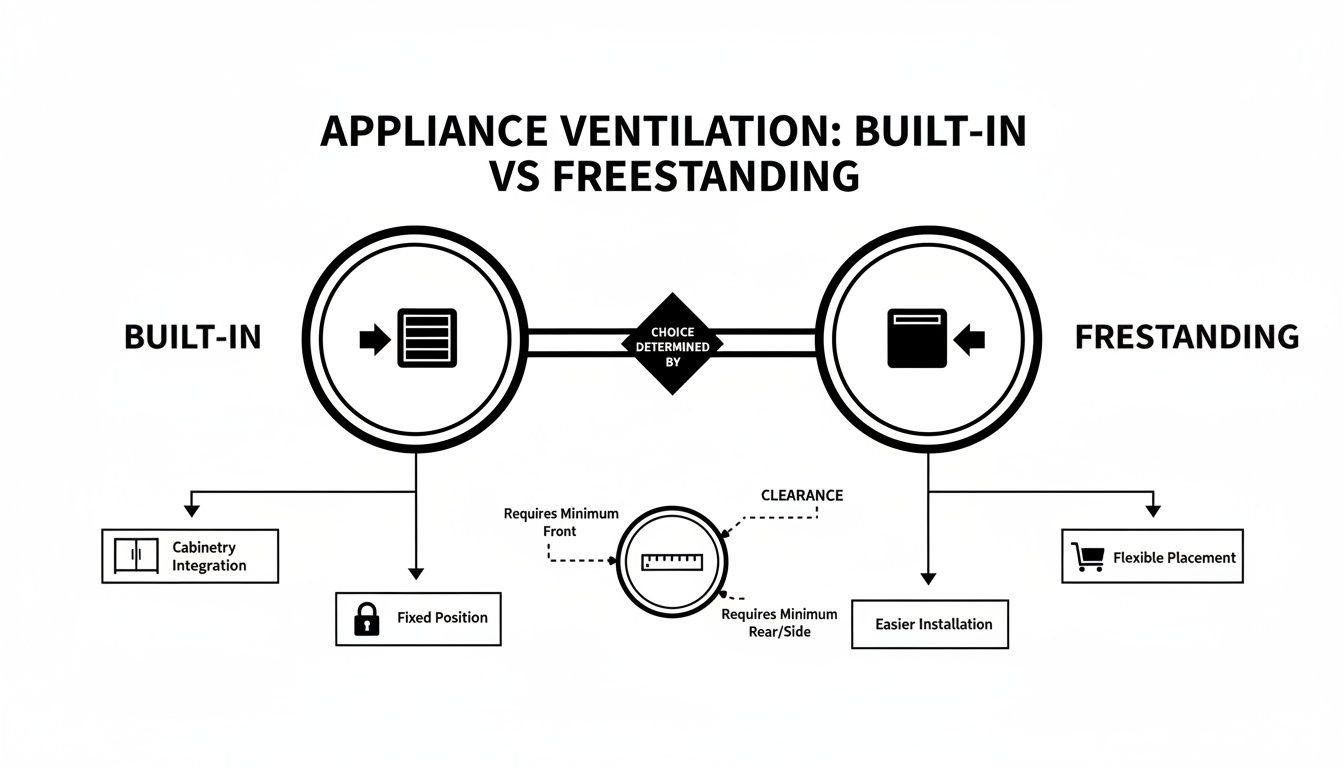
As you can see, all cooking equipment requires significant clearance from combustible materials to operate safely. This is a fundamental principle of commercial kitchen design.
Your Ventilation Clearance Checklist
Here's a quick-reference guide to make sure you get it right every time. Use this checklist to avoid the common installation mistakes that can lead to safety hazards.
| Location | Typical Clearance (Combustible Surfaces) | Typical Clearance (Non-Combustible Surfaces) | Why It Matters |
|---|---|---|---|
| Sides | 6 inches minimum | 0 inches required | Prevents heat from building up between appliances and reduces fire risk. |
| Back | 6 inches minimum | 0 inches required | Crucial for dissipating heat from the back of the unit. Blocking this is a primary fire hazard. |
| Bottom | 4 inches (on legs) | 4 inches (on legs) | All countertop units must be on legs to allow air circulation and for cleaning underneath. |
| Overhead | Must be under a ventilation hood | Must be under a ventilation hood | This is a legal requirement for removing grease-laden vapors, smoke, and heat from the kitchen. |
Sticking to these guidelines is non-negotiable. It prevents fires and keeps the ambient temperature in the kitchen manageable.
Placement Near Other Equipment
Where you place your griddle matters almost as much as how you install it. A cardinal rule of kitchen design is to keep your hot units grouped together under a single ventilation hood.
When a griddle is parked next to other hot equipment like a fryer or charbroiler, it creates an efficient "hot line." However, you must ensure there's enough space for chefs to work safely between units. Also, never place a hot griddle directly next to refrigeration equipment. The heat transfer will force the cooling unit's compressor to run nonstop. If you're planning your cookline, our guide on counter top refrigeration has more solid tips for an efficient setup.
If you have absolutely no choice but to place a griddle near a refrigerator, you must create a thermal break. A simple stainless steel partition or an insulated barrier can make a real difference in reducing that heat transfer, giving your fridge a fighting chance.
Getting ADA And NSF Compliance Right
When you're picking a commercial griddle for a professional kitchen, the tape measure only tells part of the story. The real conversation is about legal and safety compliance. For any professional setup, two acronyms are absolutely non-negotiable: ADA and NSF.
Think of them less as suggestions and more as foundational rules that protect your business, your team, and your customers. Getting this right from the start means you're building a kitchen that's safe, accessible, and ready for inspection day.
Meeting ADA Requirements
The Americans with Disabilities Act (ADA) isn't just a poster on the wall; it lays out clear rules to make sure your workspace is accessible to every employee. For cooking equipment, this directly impacts its placement and controls.
An ADA-compliant setup is built for approachability. It’s not just about a lower height; it's about genuine usability. Here’s what that looks like:
- Counter Height: The cooking surface can't be more than 34 inches from the floor. This simple change makes a world of difference for anyone operating from a wheelchair.
- Accessible Controls: Temperature dials, power buttons, and any other controls have to be on the front of the unit, easy to reach and operate with one hand, without needing to grip tightly.
- Forward Approach: The equipment stand or counter needs to have enough kick space—knee and toe clearance—underneath to allow someone in a wheelchair to pull right up to the unit.
Choosing ADA-compliant equipment and installation is about building an inclusive kitchen where every single member of your crew can work efficiently and safely.
Upholding NSF Standards For Food Safety
If ADA is about accessibility, NSF (National Sanitation Foundation) certification is all about food safety. That little blue NSF sticker is the first thing a health inspector looks for, and it's your proof that the unit is built for easy and effective cleaning.
NSF standards get granular on the materials and construction, all to eliminate any place where bacteria could possibly hide.
- Durable Materials: The unit must be built with non-porous and corrosion-resistant materials. We're talking about food-grade 304-grade stainless steel that won’t rust and is a breeze to sanitize.
- Smooth Seams: Forget sharp interior corners or gaps. NSF units have smooth, welded seams so food particles and grime have nowhere to get trapped.
- Sealed Components: Every joint and seam is completely sealed. This stops grease and gunk from seeping into hidden crevices where mold and bacteria love to grow.
An NSF certification is more than a sticker on your equipment; it’s a guarantee to your customers and health inspectors that you prioritize food safety at every step. It proves the unit is designed to be thoroughly cleaned and will not harbor harmful pathogens.
This dual focus on safety and accessibility drives the market. It's why the 24 to 48-inch width range is so popular in commercial kitchens—it hits the sweet spot between cooking capacity and footprint.
You can dig into more refrigerator dimensions and compliance data to see how these trends play out in the wider industry. By making both ADA and NSF standards your top priority, you're building a kitchen that isn't just efficient, but fundamentally safe and welcoming for everyone.
Your Essential Pre-Purchase Measurement Checklist
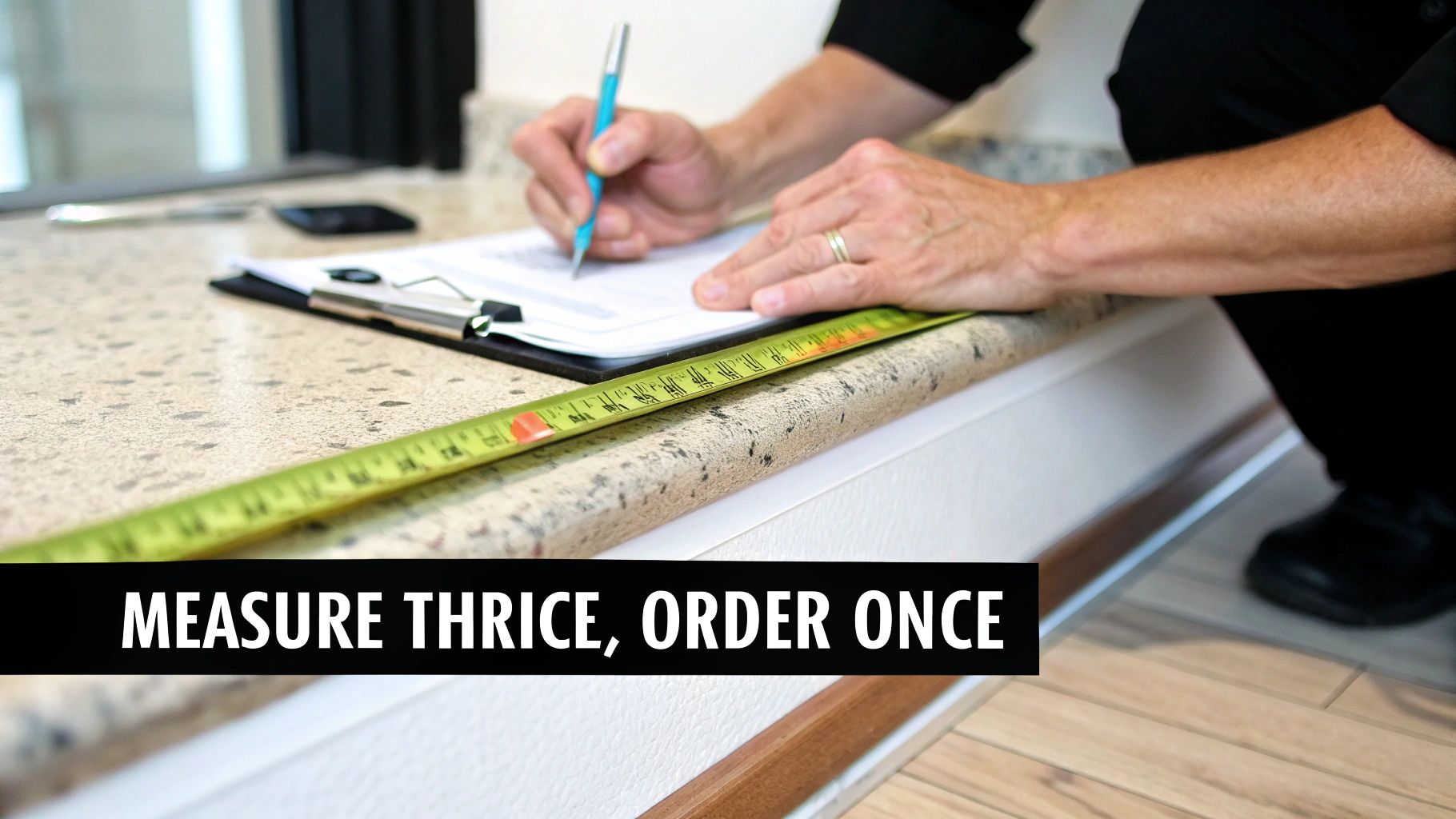
A simple measurement mistake can lead to massive headaches. We're talking expensive returns, frustrating installation delays, and a cookline that’s thrown completely out of whack. Think of this checklist as your insurance policy against a bad fit. I always tell clients: measure thrice, order once. It’s the only way to guarantee your new griddle slides perfectly into place.
This isn’t just about getting a single width, height, and depth, either. Real-world spaces are never perfect. Walls can bow, and the equipment stand you're fitting the unit onto might not be perfectly level. That's why measuring the space at multiple points isn't just a suggestion—it's a non-negotiable step to find and account for those little imperfections.
Step 1: Measure The Core Space
Before you even start looking at models, grab a tape measure. You need to know the exact dimensions of the spot your new unit is going into. This is the foundation of your search and will immediately filter out any units that simply won't fit.
- Width: Measure the opening on your equipment stand or cookline from left to right.
- Height: Measure from the equipment stand to the bottom of the ventilation hood. Ensure there is adequate space for proper ventilation.
- Depth: Measure from the back wall to the front edge of the equipment stand.
These numbers give you the absolute maximum size of a unit you can even consider, but don't go ordering just yet. We haven't accounted for clearance and workflow.
The most common mistake isn't buying the wrong griddle; it's forgetting about the space around the griddle. A unit that fits perfectly on paper will create a fire hazard if it doesn't have proper clearance.
Step 2: Account For Operational And Delivery Needs
Now we need to think beyond the box itself. A griddle needs more than just a stand to sit on; it needs space to work safely and a clear path to get there. These are the details people often forget, and they're just as important as the main dimensions.
For absolute precision, especially in tricky or custom-built spaces, you might even consider looking into how to scan a room in 3D to get a flawless digital model of your space.
Answering these questions before you click "buy" will save you from a world of pain.
-
Working Clearance: Is there enough space around the griddle for your chefs to work safely and efficiently? You need room to move, turn, and handle hot pans.
-
Delivery Pathway: This is a big one. Can you physically get the unit into your kitchen? Measure the width of every single doorway, hallway, and tight corner on the path from the delivery truck to its final spot. Remember to compare this to the griddle's packaged dimensions, which are always bigger.
-
Utility Locations: Where's the gas line or the correct electrical outlet? You need to be sure the unit can be hooked up easily. Using improper connections is a huge no-no and violates safety codes in commercial kitchens.
Walking through this checklist transforms the process from hoping it fits to knowing it will. You can purchase with total confidence, knowing you’re set up for a smooth installation that gets your kitchen up and running without a single hiccup.
Frequently Asked Questions
When you're outfitting a commercial kitchen, a few common questions always pop up. Let's clear the air on the most frequent queries about commercial griddle dimensions and installation so you can make the right call and dodge expensive headaches. Getting this right is key to a powerful cookline, especially when you're looking at commercial griddles.
How Much Clearance Does A Commercial Griddle Need?
This all comes down to safety. A commercial griddle must have adequate clearance from any combustible surfaces.
Typically, you must leave at least 6 inches of space on the sides and back. For non-combustible surfaces like stainless steel, you can often have zero clearance, but always check the manufacturer's spec sheet. The unit must also be installed under a proper ventilation hood system.
Can I Install A Residential Griddle In A Commercial Kitchen?
You really shouldn't. Shoving a residential griddle into a commercial cookline is a recipe for disaster. These units are not built for the high-volume, continuous use of a professional kitchen.
They lack the power, durability, and most importantly, the NSF and UL certifications required by health and fire departments. Using residential equipment will get you shut down during an inspection.
The core difference is the build quality and safety certification. A commercial model is built to withstand constant use and meet strict safety codes, while a residential model is not. It's a matter of professional-grade vs. home-use.
What Is The Main Difference Between A Griddle And A Charbroiler?
It boils down to the cooking surface and method. A griddle has a flat, solid cooking plate, perfect for items like pancakes, eggs, and burgers where you want an even sear.
A charbroiler has open grates over a heat source (gas flames or electric elements). It's designed for grilling steaks, chicken, and burgers, giving them characteristic grill marks and a smoky flavor.
Are Gas Griddles Better Than Electric Griddles?
It depends on your needs. Gas griddles heat up faster and have a quicker recovery time, making them ideal for high-volume kitchens. Electric griddles offer more precise and even temperature control across the surface, which is great for more delicate items.
Performance and menu are the top priorities here. You’re trading a bit of precision for raw power with gas, or the other way around with electric.
Ready to build an efficient and powerful cookline? Griddles.com has the high-performance commercial griddles you need to keep your kitchen running smoothly. Explore our full catalog and get free shipping on every order at https://griddles.com.