

Gas vs Propane Griddles The Definitive Commercial Kitchen Guide
When you're picking a fuel source for your commercial griddle, the choice boils down to a simple trade-off. Natural gas is your ticket to lower long-term fuel costs if you're in a fixed location. On the other hand, propane delivers serious power and portability, making it the go-to for mobile kitchens or remote setups. The right call depends entirely on whether you value utility savings more than operational freedom.
Choosing Your Griddle Fuel: Natural Gas vs. Propane
Deciding on the fuel for your commercial griddle is one of those foundational choices that will echo through your daily operations and your monthly bills. This isn't about which gas is "better" in a vacuum; it’s about what’s strategically sound for your kitchen. Let's cut through the noise and compare natural gas and propane on the metrics that actually matter to your bottom line: energy output, running costs, and the headaches of installation.
We'll get into the specifics of why a bustling urban restaurant with a gas line hookup has different needs than a food truck that has to bring its power source along for the ride. My goal here is to give you a clear, practical framework to make the right decision for your business.
Key Decision Factors at a Glance
This infographic gives you a quick visual breakdown of the big three considerations—cost, performance, and installation—for each fuel type.
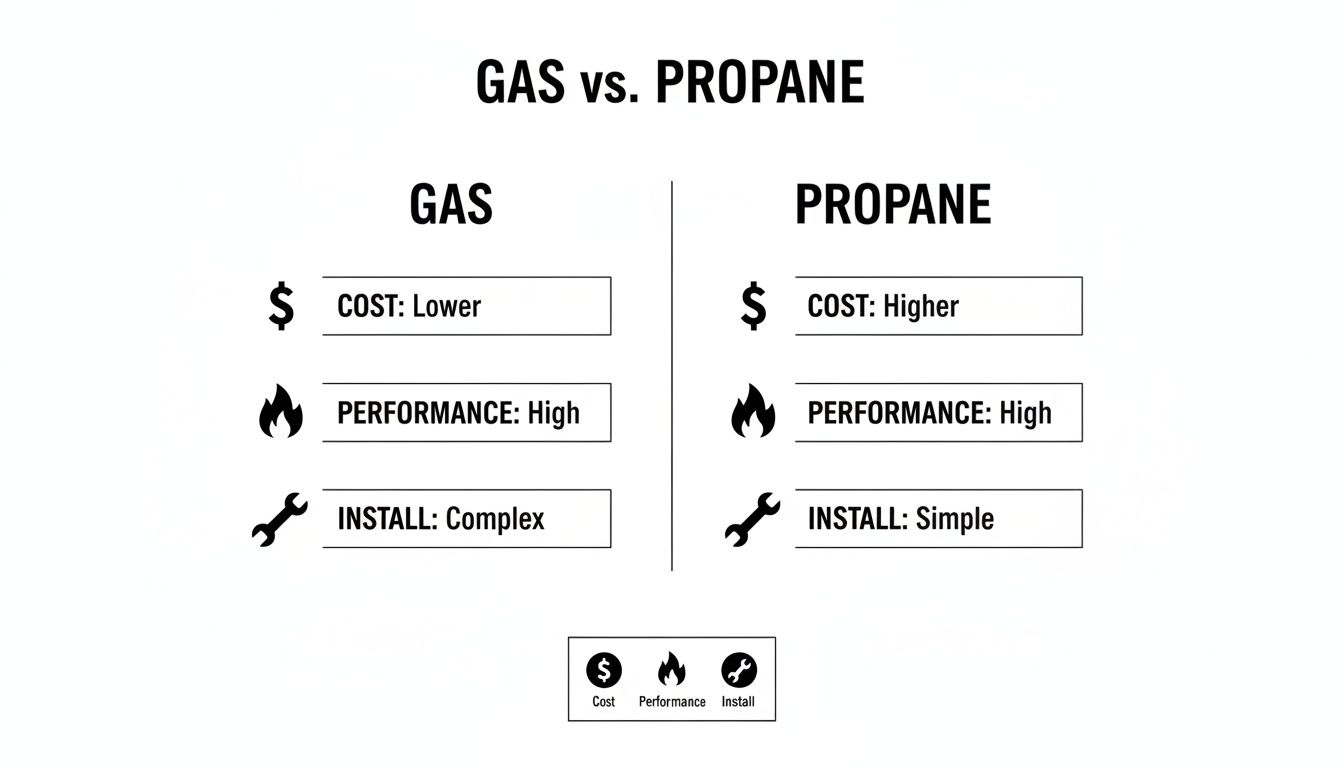
As you can see, natural gas usually wins on long-term cost efficiency. But when it comes to raw power and the flexibility to set up anywhere, propane is the clear champion.
To make this even clearer, I've put together a quick decision matrix. This table sums up how each fuel stacks up specifically for running a commercial griddle, highlighting the key points we'll dig into next.
Quick Decision Matrix: Natural Gas vs. Propane
| Attribute | Natural Gas (NG) | Liquid Propane (LP) |
|---|---|---|
| Primary Advantage | Lower long-term operational cost | Portability and higher energy output |
| Best For | Permanent restaurants, diners, cafes with utility access | Food trucks, caterers, pop-ups, remote locations |
| Installation | Requires a licensed plumber to connect to a gas main | Requires tank setup and a reliable supplier |
| Energy Output (BTU) | Lower energy density per cubic foot | Higher energy density; heats faster |
| Availability | Limited to areas with established utility infrastructure | Available anywhere via portable tanks or bulk delivery |
| Upfront Cost | Potentially high if a new gas line is needed | Generally lower, involving tank purchase/lease |
This table simplifies the choice, but the nuances are what matter. A permanent location can justify a higher upfront cost for decades of savings, while a mobile business has to prioritize self-sufficiency above all else.
Fuel Performance and Cooking Efficiency
When you're comparing natural gas and propane, the conversation really has to start with raw power. How does the fuel you pick actually perform on the cooktop? In a busy commercial kitchen, speed is everything, and your choice of gas directly affects how fast your griddle heats up, recovers from a cold load, and keeps the line moving. It all boils down to understanding the energy packed into each fuel.
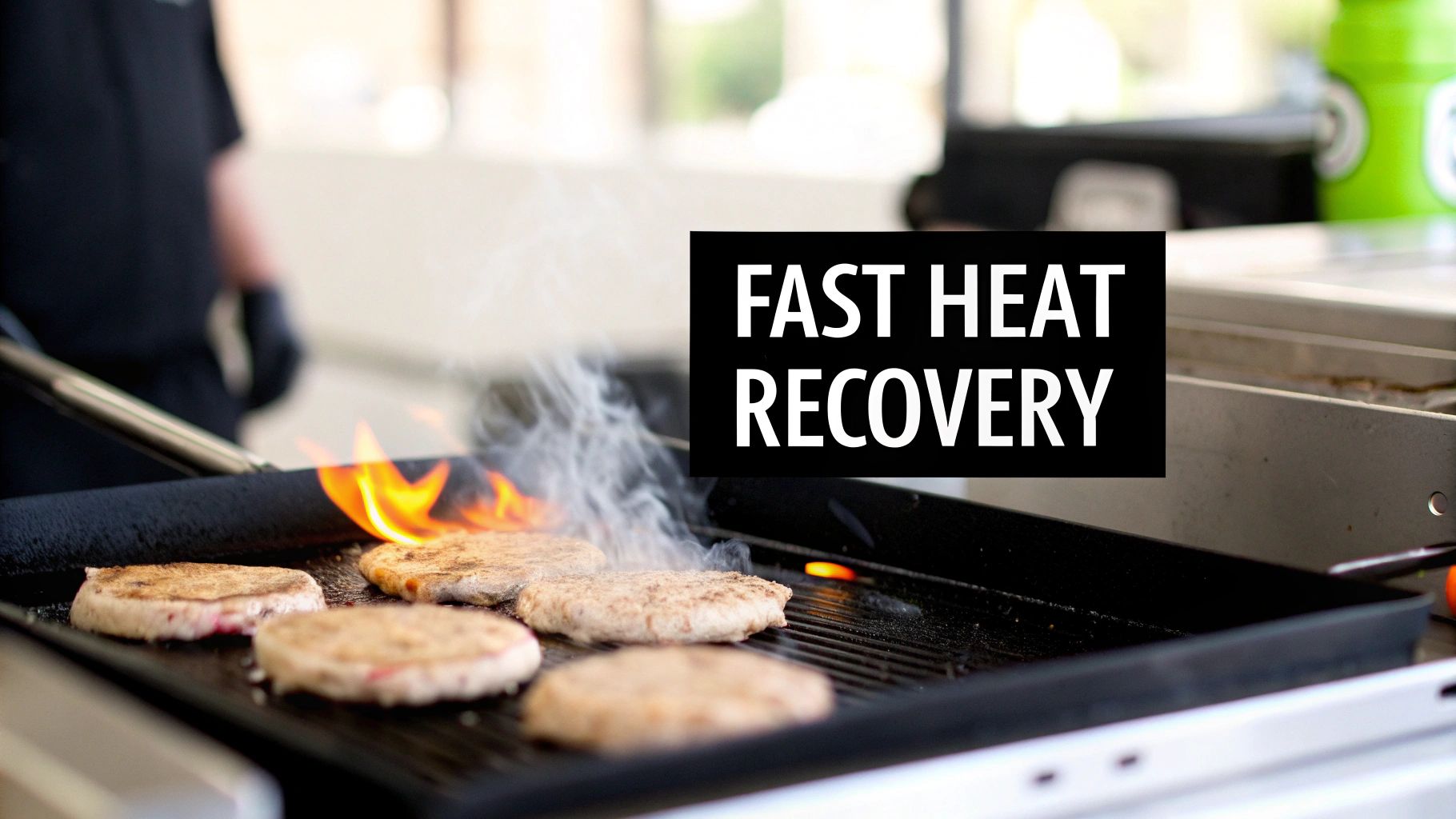
The key number to look at is the British Thermal Unit (BTU), which is simply a measure of heat energy. More BTUs mean more heat, faster. This is where propane pulls way ahead.
Propane is a much more energy-dense fuel. It delivers around 2,490 BTUs per cubic foot. Natural gas, on the other hand, comes in at about 1,030 BTUs per cubic foot. That means propane packs more than double the punch in the same amount of space. This isn't just a technical spec; it's something your cooks will feel every single shift.
How Energy Density Translates to Kitchen Speed
Think of it like this: natural gas is your reliable, steady V6 engine—it gets the job done consistently. Propane is the same engine with a turbocharger bolted on. It gives you a massive burst of power exactly when you need it.
That "turbo" boost makes a real difference in two critical areas for any griddle operator:
- Faster Preheat Times: A propane griddle will get up to cooking temperature noticeably faster from a cold start. Shaving even a few minutes off the morning prep routine is a win.
- Quicker Temperature Recovery: This is the big one. When your line cook drops a dozen frozen burger patties onto the hot surface, the griddle's temperature instantly crashes. Propane’s higher energy output helps that surface get back to the right temperature much faster, leading to more consistent sears and shorter ticket times.
During a slammed lunch or dinner service, that fast recovery time is a total game-changer. It means less temperature drop-off between batches, a more consistent product, and ultimately, more customers served per hour.
Physical Properties and What They Mean for Safety
Beyond just BTUs, the physical behavior of each gas has a major impact on your kitchen design and safety rules. These aren't minor details—they dictate your ventilation needs and emergency plans.
The single most important difference is their density compared to air:
- Natural Gas: Lighter than air. If there's a leak, it rises and tends to dissipate, which makes it a bit safer in a well-ventilated kitchen.
- Propane: Heavier than air. This is crucial. A propane leak means the gas will sink and collect in low spots like floor drains or basements. This creates a serious fire hazard if it finds an ignition source.
This one characteristic leads to completely different installation and safety codes, which we’ll dig into later. The main takeaway here is that your fuel choice has consequences that extend far beyond the griddle itself. Our own guide on commercial gas griddles dives deeper into how these factors influence equipment selection.
And of course, raw power is only one part of the equation. It's always smart to keep general energy efficiency considerations in mind to get the complete financial picture. While both fuels will cook your food just fine, propane’s higher energy density gives it an undeniable edge in speed and recovery—a massive advantage in any high-demand kitchen.
Analyzing the True Cost of Operation
Forget the sticker price for a moment. The real debate between natural gas and propane often boils down to your bottom line, not just today, but for years to come. Your griddle is a long-term investment, and its total cost is shaped by daily fuel expenses and what you spend just to get it fired up.
To figure this out, you have to compare apples to apples. Natural gas is sold by the therm (which is 100,000 BTUs), while propane is sold by the gallon (about 91,500 BTUs). The only way to get a true cost picture is to compare the price per BTU, not just the unit price from your supplier.
Calculating Your Ongoing Fuel Expenses
Let's run some numbers. Imagine a busy diner with a 48-inch commercial griddle cranking out orders for 10 hours a day. That griddle has a total output of 120,000 BTU/hr. Of course, it won't be on full blast every single minute, but this number gives us a solid baseline for projecting costs.
- Natural Gas Scenario: If your local utility charges $1.50 per therm, running that griddle at full power for one hour uses 1.2 therms. That’s a cost of roughly $1.80.
- Propane Scenario: Now, let's say propane is going for $3.00 per gallon. To get the same amount of heat, you'd need about 1.31 gallons, which comes out to around $3.93 for that same hour.
That difference might not sound like much, but over a month of flipping pancakes and searing burgers, it adds up fast. For any stationary business with access to a gas line, natural gas almost always wins on long-term operational savings.
The core financial takeaway is simple: on a per-unit-of-energy basis, natural gas is almost always the more affordable fuel. The real question becomes whether the upfront installation costs justify these ongoing savings.
The Upfront Investment: Infrastructure and Installation
This is where the financial script can flip entirely. The initial cost to get your griddle connected and burning can vary wildly, making the cheaper long-term option the more expensive one at the start.
If you’re moving into a space that already has a properly sized natural gas line, you’re in luck. Your only major cost is hiring a licensed plumber to hook everything up safely. But if you need to run a new line from the street or upgrade an existing one, you could be looking at thousands of dollars in trenching, permits, and labor.
Propane, on the other hand, is all about a lower barrier to entry.
- Tank Setup: You can either lease tanks from a supplier (often with a supply contract) or buy them outright. Leasing keeps your initial cash outlay low.
- Regulators and Hoses: All you need are the right regulators and certified hoses to connect the tanks to your griddle—these are relatively inexpensive parts.
- No Major Construction: Forget digging up sidewalks. Propane avoids the cost and headache of major plumbing work, getting you operational much faster.
This plug-and-play nature is exactly why propane is the undisputed king of the mobile food world. For a food truck, pop-up, or catering business, the portability and low setup cost are everything. You can be serving customers in hours, not weeks.
Think of it this way: a brick-and-mortar restaurant might spend $5,000 to install a new natural gas line, but if they save $200 a month on fuel, they’ll see a return on that investment in just over two years. A food truck, however, can get set up with propane for under $500, prioritizing getting the business open now over long-term fuel economy. The "cheaper" choice really depends on where you're cooking and how fast you need to get started.
Installation and Utility Requirements
Choosing between natural gas and propane goes way beyond the fuel itself. This decision defines how you'll set up your kitchen, who you'll need to hire, and the infrastructure you’ll rely on every single day. The real comparison starts when you trace the path from the fuel source all the way to your griddle.
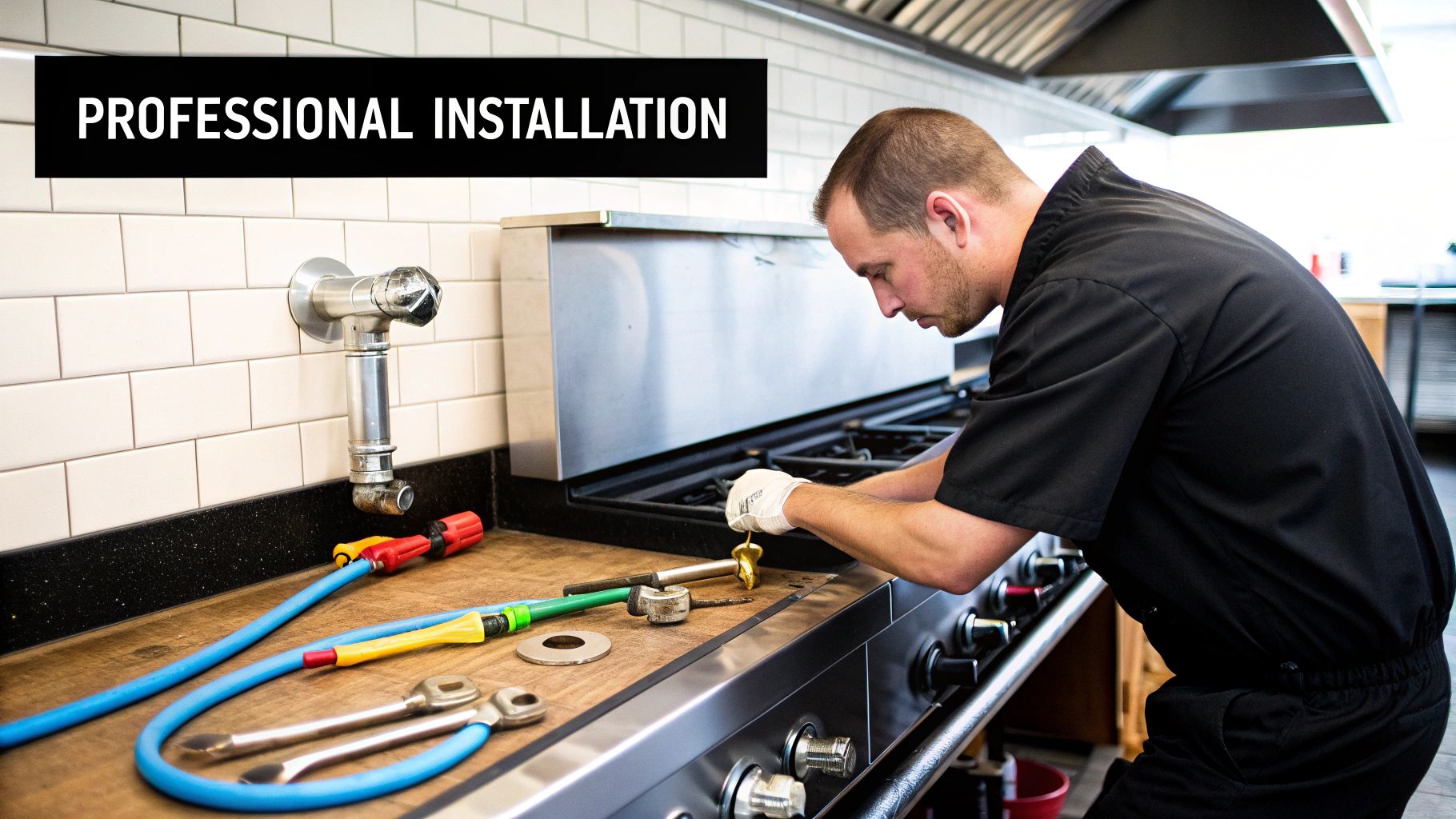
For a brick-and-mortar restaurant, tying into the building's natural gas line is almost always the most logical move. But let's be clear: this is not a DIY weekend project. It’s a job that absolutely requires a licensed plumber for permits, code compliance, and physically tapping into the main utility.
Natural Gas: The Plumbing Professional Path
The biggest job with a natural gas hookup is making sure your griddle gets enough fuel pressure to do its job. A high-output, 48-inch griddle is a beast with a huge appetite for gas. If the pipe is too small, you'll starve it, leading to weak flames, slow heating, and food that just doesn't cook right.
Your plumber will handle the critical calculations, but you need to know what’s involved:
- Pipe Sizing: A pro has to size the gas line to handle the total BTU load of your griddle.
- Pressure Testing: Once installed, the entire line is pressure-tested to ensure there are zero dangerous leaks. This isn't optional.
- Code Compliance: Every fitting, valve, and piece of pipe must meet strict local building and fire safety codes.
Getting this right is a major part of your initial budget and timeline. For a much deeper look at this, check out our guide on how to determine the right natural gas line size for your commercial kitchen.
Propane: The Logistics of On-Site Fuel
Going with propane presents a completely different set of challenges—and freedoms. It’s all about managing your own fuel supply. The huge advantage here is being independent from utility lines, which is why it’s the go-to choice for food trucks, caterers, and any spot without an existing gas hookup.
With propane, your focus shifts to the tanks. This means more than just picking a size; you have to follow strict rules about where they can be placed. Tanks need to be a certain distance from buildings, ignition sources, and property lines. You'll also need to line up a reliable local propane dealer for refills or tank swaps so you never, ever run out mid-service.
Propane gives you incredible freedom to operate anywhere, but it puts the responsibility of fuel management squarely on your shoulders. A great relationship with a dependable supplier is just as critical as the griddle itself.
The Ultimate Flexibility: Field Convertible Griddles
So what happens when your business takes off and you move from a suburban spot with propane tanks to a downtown location with natural gas? This is where field-convertible griddles are an absolute game-changer. These units are built to run on either fuel, giving you amazing flexibility as your business grows or relocates.
The ability to switch fuel types is a big reason why gas-powered equipment dominates the commercial market. It future-proofs your investment, protecting you from having to buy all new gear down the road.
The conversion itself is a job for a certified technician, but it’s pretty straightforward. It involves swapping out a few small brass parts called orifices and adjusting the gas regulator. It's a simple, professional service call that can save you thousands of dollars in the long run.
Navigating Safety Codes and Kitchen Regulations
When you're deciding between natural gas and propane for your griddle, safety isn't just a priority—it's the whole game. Both fuels are perfectly safe when you follow the rules, but their physical properties are completely different, leading to a unique set of codes for each. Getting this right from day one is what separates a smooth opening from a failed inspection.
The biggest difference comes down to one simple fact: gas density. Natural gas is lighter than air. If a leak happens, it rises and spreads out, especially in a well-ventilated kitchen. Propane is the opposite; it's heavier than air. This is a critical distinction because leaking propane can sink and pool on the floor, creating a serious fire risk if it finds a pilot light or spark.
Ventilation and Leak Detection Protocols
Your first line of defense is always proper ventilation. Both fuels require a powerful exhaust hood to handle the heat and fumes, but the underlying safety requirements are not the same. This is something you absolutely need to hash out with your HVAC contractor and the local fire marshal before any installation.
For kitchens running on propane, the rules are extra tight to prevent that low-lying gas from building up. This usually means installing enhanced low-level ventilation. It also almost always includes a strict ban on using propane equipment in basements or any below-grade space. To get a handle on your obligations, it's worth reading up on the general requirements for commercial kitchen ventilation systems so you know you're compliant.
Good ventilation is step one, but you also need reliable leak detectors.
- Natural Gas Detectors: These go up high, near the ceiling, because that's where the gas will travel first.
- Propane Gas Detectors: These must be installed down low, close to the floor, to catch any pooling gas before it becomes a danger.
Handling and Storage Rules
Beyond how the gas behaves in the air, the rules for storing and handling the fuel itself are worlds apart. These practical, space-related issues often end up being the deciding factor for many kitchens.
With natural gas, it’s all about the plumbing. The focus is on the integrity of the permanent gas lines running through your building. You'll need regular inspections from a certified pro to check for any corrosion or damage. Every kitchen also must have clearly labeled and easy-to-reach emergency shut-off valves for the main gas line and for the griddle. Train every single person on your staff where they are and how to use them—no excuses.
Propane safety, on the other hand, is all about managing the tanks, whether they're portable cylinders you swap out or a large stationary tank outside.
Local fire codes get extremely specific about propane storage, and they don't mess around. You can't just keep extra tanks in a back closet; indoor storage is usually forbidden or limited to tiny amounts. Tanks belong outdoors in a locked, secure, and well-ventilated cage, set at a required distance from doors, windows, and any potential ignition sources.
This means you need a dedicated, compliant spot for outdoor storage and a safe process for bringing cylinders in and out. For food trucks, tanks have to be securely mounted on the exterior of the vehicle—never inside with the cooking equipment. Sticking to these codes isn't just about passing an inspection; it's about the fundamental safety of your team and business.
Making the Right Choice for Your Business Model
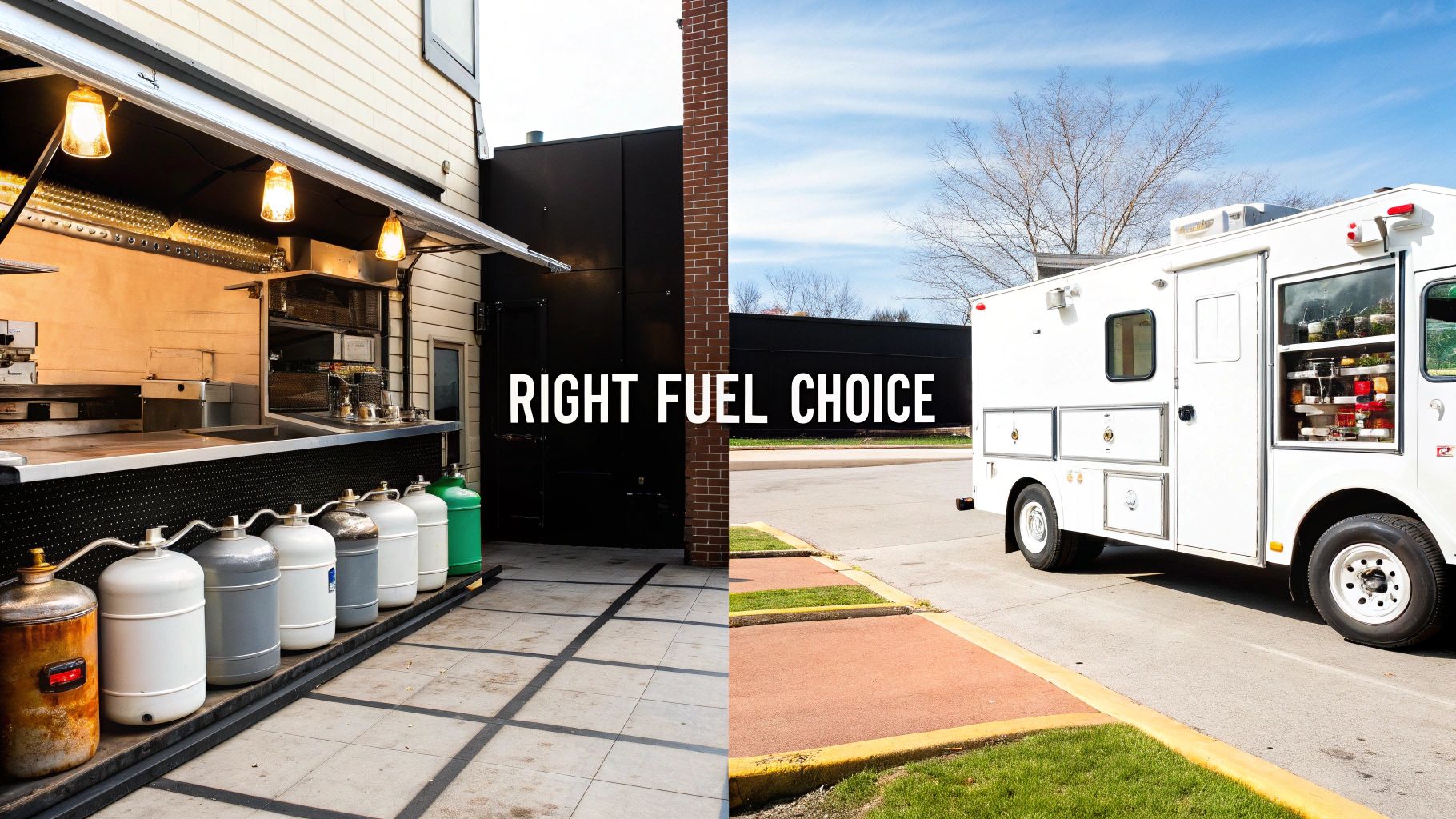
All the talk about BTUs and cost per therm gets a lot simpler when you apply it to your real-world kitchen. The best fuel isn’t just a number on a spec sheet; it’s the one that clicks with how you operate—whether you need rock-solid stability, on-the-go mobility, or the flexibility to adapt. Let’s look at which fuel makes the most sense for three common kitchen setups.
For the Permanent Restaurant or Diner
For any brick-and-mortar spot, natural gas is almost always the superior long-term investment. Your business isn't moving, so you can handle the one-time cost of installing a dedicated gas line. Once that's done, you get to enjoy cheaper operational costs for years, or even decades.
The logic here is straightforward. Lower daily fuel costs mean better profit margins over the life of your griddle. When stability and predictable expenses are your best friends, a utility connection is the way to go.
For the Food Truck Operator
The choice is just as clear for a mobile kitchen: propane is the undisputed industry standard. Its portability is everything. It's what lets you fire up the griddle and serve customers wherever you can find a parking spot. The entire food truck model is built on being self-sufficient, and propane delivers that independence in easy-to-manage tanks.
Plus, the lower setup cost is a huge deal for a startup where every dollar counts. You completely sidestep the impossible expense and logistics of a natural gas line, letting you get your business rolling right away.
Your food truck is a self-contained unit, and so is its power source. Propane’s combination of high energy output for fast cooking and complete independence from fixed utilities makes it the only practical solution for a kitchen on wheels.
For the Ghost Kitchen
Ghost kitchens, the delivery-only powerhouses, are the interesting middle ground. The right fuel here depends entirely on the building you’re working out of.
- Leased Commissary Space: If you're renting a station in a big, established commissary kitchen, you're almost certainly using whatever the building provides—which is usually natural gas.
- Standalone or Converted Spaces: For operators setting up in smaller industrial units that might not have a heavy-duty gas line, propane is a fantastic workaround. It gets you the high-powered equipment you need without sinking a ton of money or time into major construction.
The decision for a ghost kitchen is less about the business type and more about the real estate. Adaptability is the name of the game, which is why a field-convertible griddle from Griddles.com is such a smart move. It gives you the freedom to set up shop in any facility you move into.
This kind of operational flexibility is a huge advantage, especially since North America is the biggest market for gas-powered cooking equipment. That means no matter which fuel you choose, you’ll find plenty of great equipment and support. You can explore more about these market dynamics to see how they affect your buying power.
Frequently Asked Questions
When you're trying to choose between natural gas and propane for your commercial griddle, the same questions tend to pop up. We hear them all the time. Getting straight answers is key to making a smart buy for your kitchen.
Here’s what most operators want to know.
Can I Convert a Griddle from Natural Gas to Propane Myself?
This is a big one. Even though many commercial griddles are "field-convertible" and come with the conversion kit right in the box, this is absolutely a job for a pro. Don't try to DIY this one.
A proper conversion involves swapping out tiny brass orifices for every single burner and carefully calibrating the gas regulator. Get it wrong, and you're looking at major trouble—inefficient flames that create deadly carbon monoxide, dangerous gas leaks, or a fried piece of equipment. Hiring a professional ensures the work is done safely and meets all local fire and building codes. It’s about protecting your staff, your customers, and your investment.
Does One Fuel Type Cook Better Than the Other?
Honestly, when it comes to the food on the plate, your customers will never know the difference. The real distinction is in performance during a rush. Propane packs more energy punch, so it heats a cold griddle faster and recovers its temperature more quickly after you slap down a big order of frozen patties.
But once a quality commercial griddle with a heavy, thick steel plate is hot, it stays hot. Both fuels maintain that heat effectively. The griddle's build quality matters way more for consistent cooking than the gas feeding it. The only real performance difference you'll notice is in that initial heat-up speed.
Is Natural Gas Always Cheaper to Operate Than Propane?
Nine times out of ten, natural gas piped in from a utility line is cheaper per BTU than propane delivered from a supplier. For any fixed-location business already hooked up to a gas main, this means lower daily fuel costs. Simple as that.
But "cheaper" is about the total cost, not just the monthly bill. If you don't have a gas line and need one run from the street to your kitchen, the huge upfront construction cost could erase years of potential fuel savings.
For a food truck, a catering business, or any kitchen off the beaten path, propane isn't just an alternative—it's often the only game in town. You have to look at the full picture, including installation and infrastructure, to know which is truly the more economical choice for you.
Ready to get cooking with a high-performance griddle that gives you the freedom to choose your fuel? Griddles.com offers a handpicked selection of field-convertible natural gas and propane models built for the grind of a commercial kitchen. Explore our collection of commercial griddles today and find the perfect workhorse for your operation.