
Mastering the Art of How to Cook on a Griddle Commercially
Knowing how to cook on a griddle is one thing. Truly mastering it in a high-volume professional kitchen—that's a different game entirely. It's about turning that massive slab of steel from just another appliance into the most profitable workhorse on your line.
This guide isn't about basic recipes. It’s about the core techniques of temperature control, strategic heat zones, and bulletproof workflow. It's about precision, speed, and consistency, order after order.
Mastering the Commercial Griddle
Welcome to the heart of your kitchen. This guide is for the pros: the line cooks juggling tickets in a packed diner, the food truck owners slinging burgers, and the ghost kitchen managers who live and die by efficiency. We’re digging into the skills that separate a good griddle cook from a great one.
It’s about commanding that flat-top during a chaotic service, making sure every plate that goes out is consistent, delicious, and profitable. We'll focus on the fundamentals that make it all happen:
- Precision Preheating: Getting the entire surface perfectly and evenly heated before the first order hits. No shortcuts.
- Strategic Heat Zones: Setting up dedicated high, medium, and low-temp areas to cook different items simultaneously without burning or undercooking anything.
- The Perfect Sear: Nailing that Maillard reaction on everything from smash burgers to fluffy pancakes.
- Efficient Workflow: Managing your station like a machine to pump out volume without ever compromising on quality.
This simple three-step process is the foundation for every successful griddle session.
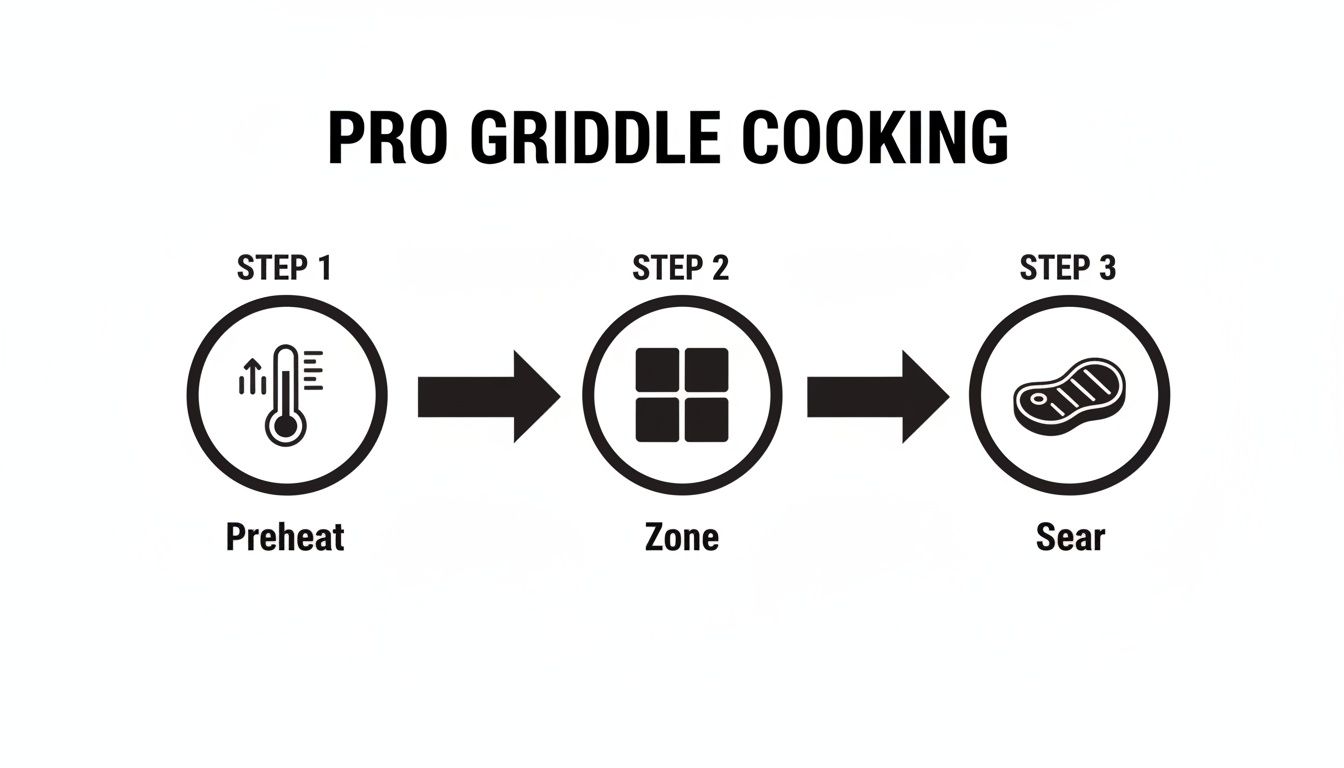
As you can see, consistent results start long before the food ever touches the steel. It's all in the prep.
The Griddle's Role in a Modern Kitchen
Flat-tops have been the backbone of commercial cooking for a century, powering diners and fast-food joints. Today, they're more important than ever, with U.S. commercial griddle sales expected to hit USD 208.5 million by 2035.
Why the staying power? High-volume kitchens depend on their thick, even-heating plates to cook dozens of items at once without the flare-ups you get from a charbroiler. That efficiency hits the bottom line hard. Some benchmarks even show a good griddle setup can cut labor needs by 25% during a busy service, making them absolutely essential.
Choosing the Right Equipment
The griddle itself is the heart of the station. Commercial kitchens rely on large, built-in units, which are the focus of this guide. These powerful machines are designed for high-volume output and consistent temperature management.
For specialized menus or mobile operations, even within the commercial space, different gear like the Yoder Cast Iron Reversible Griddle can offer unique advantages for specific applications.
The real art of griddle cooking isn't just about heat; it's about control. A great griddle cook knows their surface intimately—where the hot spots are, how quickly it recovers, and exactly how to manipulate temperature zones to orchestrate a complex order.
Establishing Your Foundation with Heat Zones
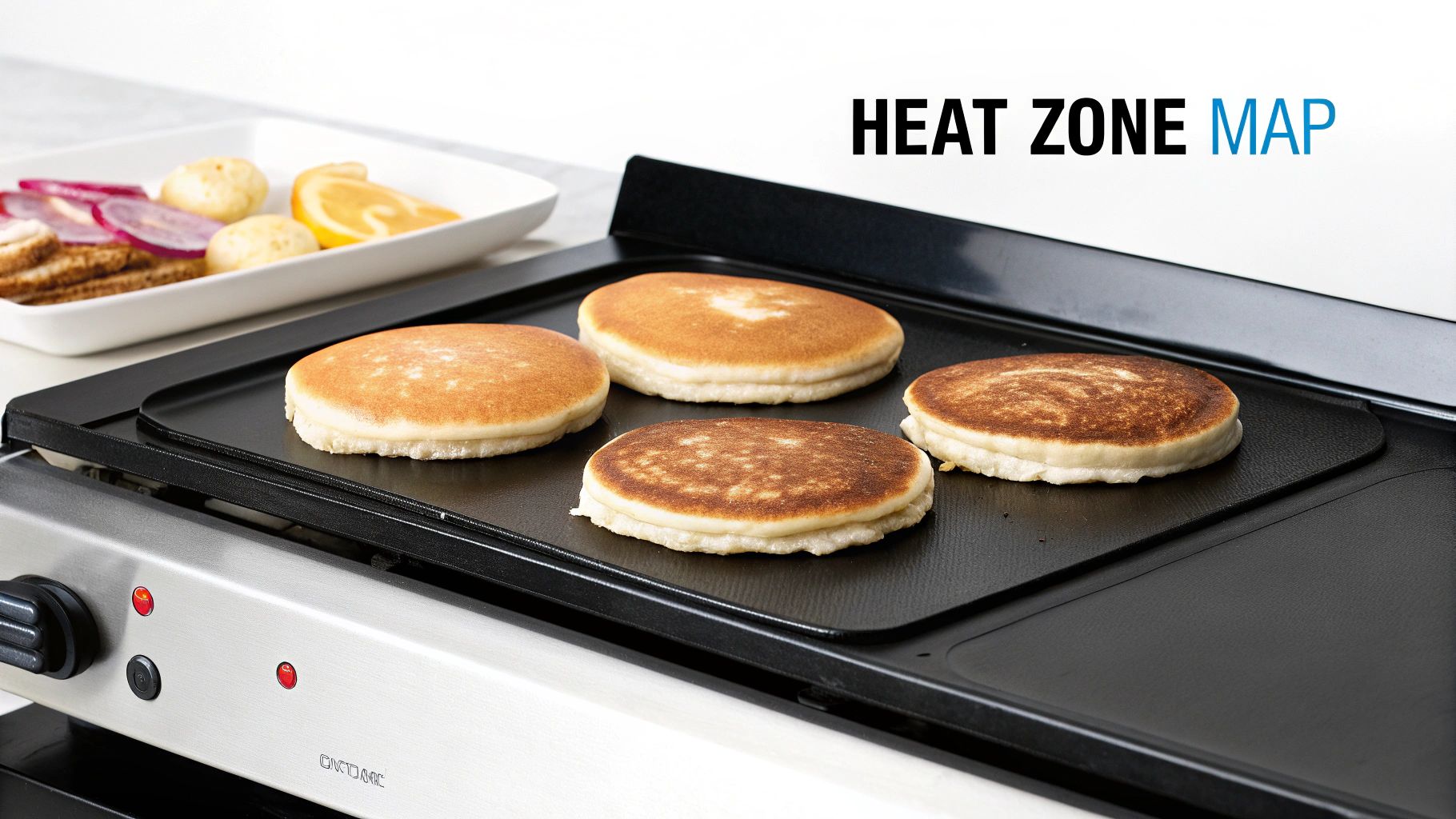
A cold griddle is a useless one. Before you even think about dropping food, you need to get that steel plate properly heated. This isn't a two-minute job; give it a solid 15-20 minutes to let the heat spread evenly across the entire surface. This crucial step burns off any cold spots and sets you up for consistent results.
And don't trust the temperature dial alone. That little knob is measuring the heat under the steel, not the actual cooking surface where the magic happens. Grab an infrared thermometer and take a quick reading. It's the only way to know for sure that your griddle is ready for action.
The Power of a Three-Zone System
Here’s where real griddle mastery begins: creating distinct heat zones. This simple strategy turns your flat-top into a versatile, high-output machine, letting a single cook juggle multiple items for an order without breaking a sweat. Any good thermostatic griddle is built for this kind of setup.
The idea is to create three different temperature areas on the griddle surface. Each one has a specific job during a busy service. Get this right, and your kitchen's workflow will be smoother than ever.
- High-Heat Searing Zone (400-450°F): This is your hot spot, right over a main burner. Use it for getting that perfect, hard sear on smash burgers, steaks, or chicken. This is where you develop that beautiful crust and flavor.
- Medium-Heat Cooking Zone (325-375°F): Right next to your searing zone, this area is your workhorse for things that need even, moderate heat. We're talking golden-brown pancakes, fluffy eggs, and perfectly toasted buns that won’t scorch.
- Low-Heat Holding Zone (200-250°F): Think of this as your landing strip. It's just warm enough to keep cooked bacon, sausage, or finished burger patties hot without turning them to leather while you plate the rest of the order.
Nailing these zones is the key to timing everything perfectly and pushing plates out of the window faster.
Why This Griddle Strategy Works
This zoned approach is exactly why commercial griddles are absolute workhorses in the food industry. The global market for these flat-tops hit USD 2,015 million in 2023, with commercial kitchens making up nearly 60% of all sales. It makes sense when you consider that U.S. restaurants serve around 4 billion burgers a year—many of which come off a 30-inch griddle capable of handling over 20 items at once.
For operators, a well-designed unit with good splash guards and drip trays can slash cleanup time by up to 50%, which directly translates to more table turns per day.
The most valuable real estate in a high-volume kitchen is often the griddle surface. A cook who understands how to manage heat zones isn't just cooking food—they are directing traffic, managing timing, and maximizing output, turning steel into profit.
Practical Application and Temperature Control
Mastering your zones means knowing exactly where every piece of food belongs and when. You might start bacon on the medium zone to gently render the fat, slide it to the high-heat zone to get it crispy, then move it to the holding zone to wait. At the same time, you could be toasting buns on the medium zone and searing burger patties on high.
It’s like being a conductor of an orchestra—every section has its part to play. To help you dial in those temperatures, here's a quick guide.
Commercial Griddle Temperature Guide
This table breaks down the ideal temperature ranges and oil choices for some of the most common items you'll be cooking on the line.
| Food Item | Target Temperature Range (°F) | Recommended Oil | Pro Tip |
|---|---|---|---|
| Pancakes & French Toast | 350-375°F | Clarified Butter | Get those perfect golden-brown circles without burning the outside. |
| Eggs (Scrambled/Fried) | 300-325°F | Butter or Bacon Grease | Lower heat prevents rubbery eggs and gives you more control. |
| Bacon & Sausage | 325-350°F | None (Self-Rendering) | Start on medium heat to render the fat, then crisp it up. |
| Smash Burgers | 400-450°F | High-Smoke Point Oil | You need that intense heat for the perfect Maillard crust. |
| Steaks & Chops | 400-450°F | Canola or Grapeseed Oil | A hard sear is key. Finish thicker cuts in the oven if needed. |
| Onions & Peppers | 325-375°F | Olive Oil or Butter Blend | Cook until tender and caramelized for maximum flavor. |
| Toasted Buns | 325-350°F | Butter | Watch them closely! They can go from golden to burnt in seconds. |
Think of these as starting points. Every griddle has its own personality, so you'll fine-tune these numbers as you get to know your equipment.
For a deeper dive, check out our comprehensive griddle cooking temperature chart. It's a great resource for dialing in precise temperatures for everything from seafood to potatoes and will help you become a true heat zone expert.
Nailing Core Menu Items Like Proteins and Breakfast
Okay, your heat zones are set. Now for the fun part. This is where the magic happens during a slammed breakfast or lunch rush, turning your flat-top into the most profitable piece of equipment in the kitchen.
It’s no surprise that commercial flat-tops now dominate over 60% of the restaurant market, especially as casual dining and food trucks continue to boom. North America and Europe alone account for 80% of that usage. A modern 48-inch thermostatic griddle can hold its temperature with an incredible ±5°F accuracy, letting a single cook crank out over 200 servings an hour. For a diner hitting 500 covers a day, that kind of efficiency is gold—slashing cooking times by 15% and boosting throughput by up to 40% compared to an old-school charbroiler.
The Art of the Smash Burger
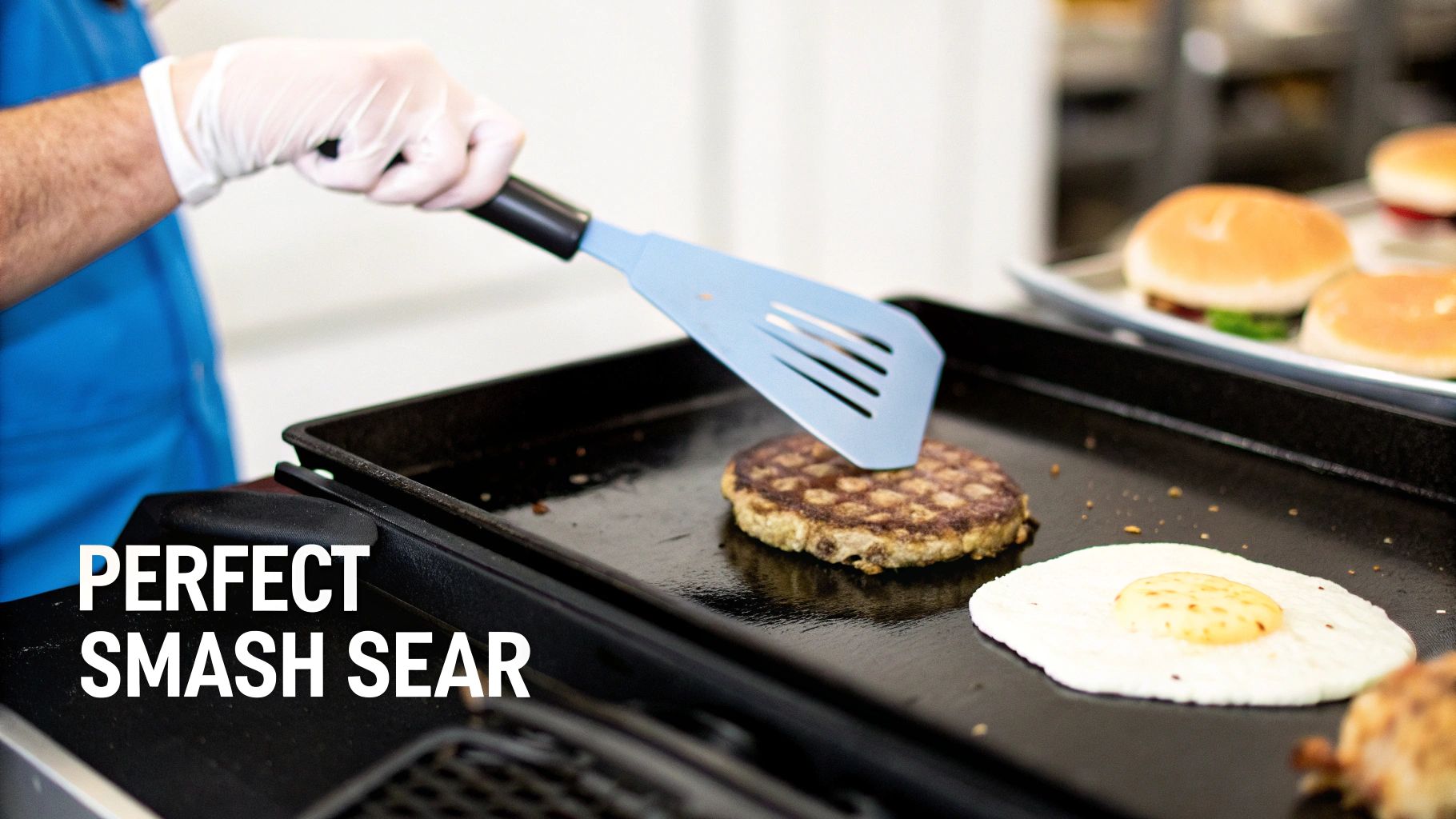
The smash burger is a griddle classic, but getting it right is a game of inches and seconds. The whole point is to create that incredible, crispy crust—the Maillard reaction at its finest—without squeezing all the life out of the beef.
The secret? Start with cold, loosely packed pucks of ground beef, about 3-4 ounces each. Drop a puck straight onto your hottest zone, which should be roaring at 425-450°F. Then, using a heavy burger press or the back of a stiff, sturdy spatula, smash it down hard and fast. Hold that pressure for about 10 seconds to get it paper-thin with those signature lacy edges. Don’t touch it again. Just wait until you see the juices bubbling up through the patty and the edges are deep, dark brown. That one perfect smash is what separates an okay burger from an unforgettable one.
Mastering Temperature Control for Eggs
Eggs are fussy. They go from perfect to rubbery in a heartbeat, which is exactly why your heat zones are so critical.
- Over-Easy & Sunny-Side-Up: These need gentle, consistent heat. Cook them in your medium zone at around 325°F. A little clarified butter is your best friend here, preventing sticking without burning.
- Scrambled Eggs: For soft, fluffy curds, aim for a cooler spot around 300°F. Keep them moving with your spatula. If they sit still, they’ll form a solid sheet and overcook.
- Omelets: Start them at 325°F to set the base quickly. As soon as it’s set, slide the omelet to a cooler edge of your medium zone to cook the fillings through before you make the final fold.
This kind of control is how you juggle multiple egg orders without breaking a sweat. For some fresh ideas, check out our guide to creative breakfast restaurant menu ideas.
The difference between a good breakfast and a great one is often temperature. A cook who can hold a perfect 325°F for eggs while searing bacon at 375°F on the same surface is a master of their station.
The Secret to Flawless Pancakes
Great pancakes are all about one thing: consistent heat. The sweet spot is a steady 375°F. Any hotter and the outside burns before the middle is cooked through. Any cooler and you get sad, pale, chewy flapjacks.
Use your infrared thermometer to check the temp before you pour that first ladle of batter. Your signal to flip is when you see bubbles forming and popping all over the surface, and the edges start to look dry. A quick, clean flip onto a well-oiled spot is the key to that perfect, even, golden-brown finish. Honing this technique is a must; after all, perfecting griddle pancakes is the foundation of any great breakfast service.
Perfecting Bacon Every Time
Want perfectly crisp, flat strips of bacon every single time? Stop throwing it onto the hottest part of the griddle. That’s how you get burnt, shriveled bacon.
Instead, lay your bacon strips out on a cooler zone, somewhere between 325-350°F. This low-and-slow start allows the fat to render out completely without the bacon curling up. Once most of the fat has cooked out, you can slide the strips to a hotter area for that final crisping. Then, move them to your holding zone to keep them warm and ready for service. No more burnt bits, just perfectly flat bacon for every plate.
Expanding Your Menu with Vegetables and Sandwiches
Don't let your griddle's potential stop at breakfast and burgers. Once you’ve got those core items humming, it's time to really open up the menu with killer vegetables and specialty sandwiches. This is where a good griddle cook separates themselves and turns the flat-top from a morning workhorse into an all-day profit machine.
Too many kitchens treat vegetables as an afterthought. On a griddle, they can be the star. The massive, direct-heat surface gives you a char and caramelization that you just can't get from a sauté pan, especially when you're slammed. Think perfectly blistered fajita veggies or deeply sweet caramelized onions. Your flat-top is built for this.
This kind of versatility lets you build out your menu, push ticket averages higher, and squeeze every ounce of value from your equipment.
Getting a Hard Sear on Vegetables
That deep, flavorful char on vegetables is a signature griddle move, and every cook needs to have it in their back pocket. For things like onions and bell peppers for cheesesteaks or fajitas, you need that high-heat zone cranked up to 375-425°F.
Here’s a critical tip: toss your veggies in a high-smoke-point oil before they even touch the steel. This gets a perfect coating on every piece and stops them from just steaming in their own moisture. Once they hit the heat, leave them alone. Let that dark, blistered crust develop before you start moving them around. That direct contact is what builds that smoky, intense flavor customers love.
A Gentler Touch for Delicate Seafood
While a screaming hot griddle is great for veggies, you'll destroy delicate items like fish fillets or shrimp with that same approach. A classic rookie mistake is going in too hot, causing the proteins to seize and weld themselves to the surface. The secret is all about temperature control and the right kind of fat.
Dial your medium-heat zone back to around 350-375°F. And instead of plain oil, reach for clarified butter. It gives you all that rich, nutty flavor of butter but with a much higher smoke point, so it won't burn on you. This creates a beautiful, non-stick buffer that lets you gently cook seafood, keeping it tender and moist.
Clarified butter is the griddle cook's secret weapon for anything delicate. It delivers the flavor of butter with the heat tolerance of oil, creating a non-stick shield that's perfect for flaky fish, scallops, or shrimp.
Building the Perfect Grilled Sandwich
A great grilled sandwich is a license to print money, and your griddle is the perfect tool for the job. Whether it's a simple grilled cheese, a towering Reuben, or a panini-style melt, the mission is always the same: a crispy, golden-brown outside with a perfectly gooey, melted inside.
Success here is all about managing your heat. If the griddle's too hot, the bread will burn long before the cheese has a chance to melt. You want a medium-low temperature, somewhere in the 325-350°F range. This allows the heat to slowly penetrate the bread and get everything inside melted and delicious without scorching the crust.
For that legendary crunch on the outside, you’ve got two great options:
- Butter: The timeless choice. Use softened butter and get a thin, even layer all the way to the edges of the bread. No dry corners.
- Mayonnaise: This is a pro-kitchen trick. Mayo is basically just oil and egg, so it browns beautifully and evenly without burning as quickly as butter. The crust you get is unbelievably crisp and golden.
Once your sandwich is assembled, get it on the griddle and give it some gentle pressure with a spatula or a grill weight. This ensures you get even contact with the steel for a perfect crust. A few minutes per side is all it takes to create a sandwich that will fly off the line.
Optimizing Your Griddle Workflow for Peak Service
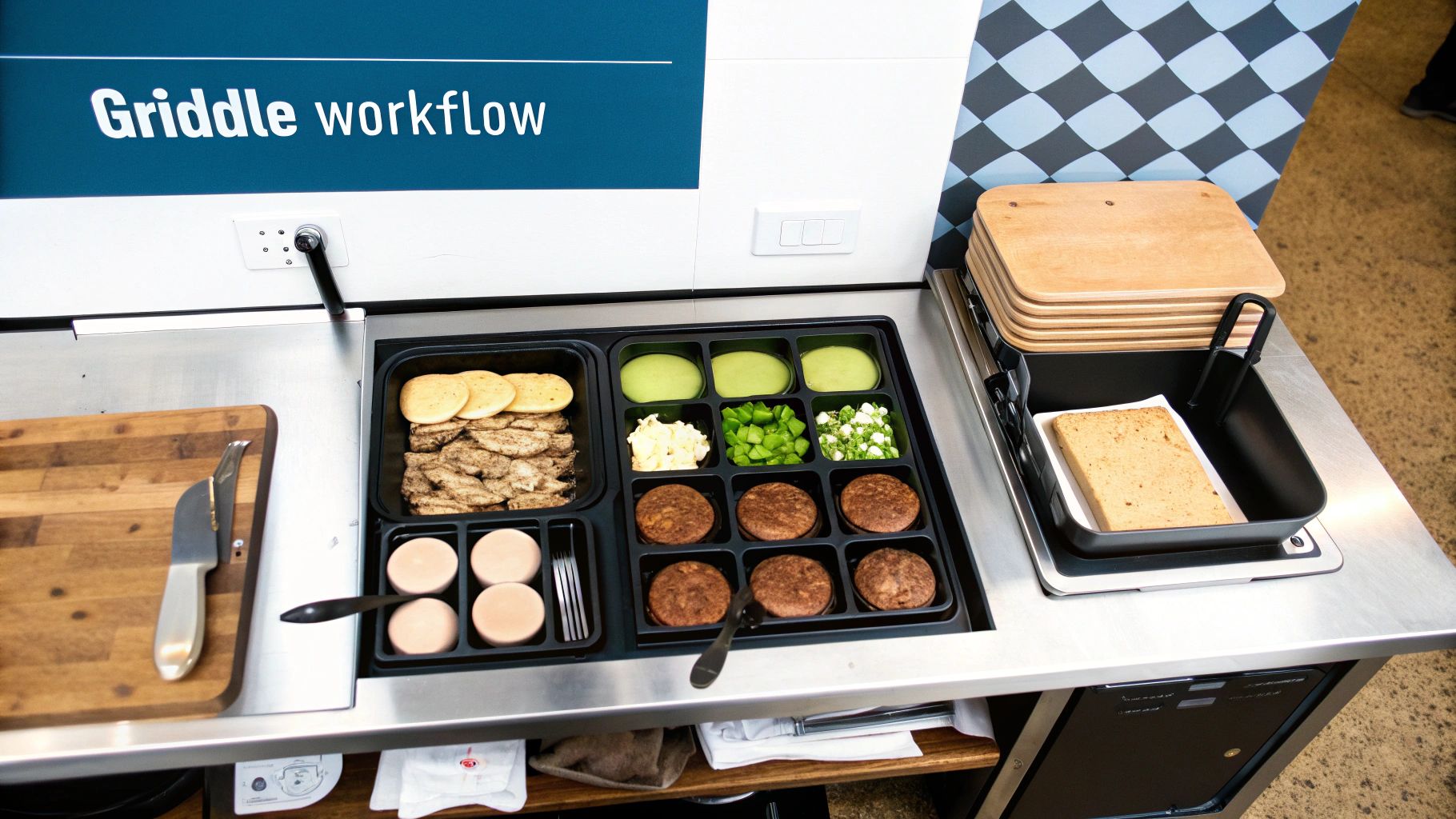
When the tickets start flying, knowing how to cook on a griddle is less about cooking and more about conducting an orchestra. Raw speed means nothing without control. A killer workflow is what separates the pros from the rookies, turning the chaos of a dinner rush into a smooth, rhythmic process that gets plates out fast and right.
A dialed-in station isn't just for show. It's about cutting out wasted motion, shaving seconds off ticket times, and guaranteeing every single dish is up to spec.
The Griddle Map Concept
First thing's first: you need a "griddle map." This is your mental blueprint for the flat-top, assigning specific real estate to different foods. This isn't just about heat zones; it's about food safety and pure, unadulterated efficiency.
Maybe your left side is for raw proteins only—burger patties, chicken, steak. The right side can then be your "safe zone" for finishing touches, like toasting buns or melting cheese on a Philly. This simple mental division is a game-changer for preventing cross-contamination. You can't have raw chicken juice trickling into your finishing hash browns. A clear map makes sure that never happens.
Mise en Place for Griddle Dominance
Your workflow really begins hours before service. For a griddle cook, a perfect mise en place is everything. Every moment you spend fumbling for an ingredient or trying to portion something mid-rush is a moment you're falling behind.
Your setup needs to be built for speed:
- Pre-portioned Proteins: Burger pucks, chicken breasts, and steaks should be portioned and ready to grab from lined sheet pans or individual containers.
- Sauces in Squeeze Bottles: Get your oils, water for steaming domes, and finishing sauces into squeeze bottles. They need to be right there, ready to go. No one has time to wrestle with a gallon jug.
- Toppings Ready to Deploy: Diced onions, peppers, cheese slices—have them in containers and arranged in the order you'll need them.
With this prep, an order for three cheesesteaks becomes a fluid set of motions, not a mad dash around the kitchen.
A griddle cook's speed is determined not by how fast their hands move, but by how little they have to move them. An organized station where everything is within a pivot's reach is the foundation of an efficient service.
Tool Management and Food Safety
The right tools are extensions of your hands, but only if you use them correctly. You wouldn't use one knife for raw chicken and veggies, right? Same rule applies here.
- Spatula Discipline: This is non-negotiable. Have separate, clearly marked spatulas for raw proteins and cooked foods. A simple trick is using a red-handled spatula for raw meat and a black-handled one for everything else.
- The Bench Scraper is Your Best Friend: This tool is your workhorse. Use it constantly to clear grease, scrape off char between orders, and herd ingredients. A clean surface is key to preventing flavors from mixing and food from sticking.
- Grill Press and Tongs: A heavy press is a must-have for killer smash burgers. Long-handled tongs are your go-to for flipping bacon or sausages without getting your knuckles burned.
Communication with the Line
Your griddle station isn't an island. You have to talk to the rest of the line. Clear, constant communication is the glue that holds a service together.
Shout out when you're dropping a well-done steak that's going to take time. Give a "one minute on burgers!" call so the fry cook can drop fresh fries. This back-and-forth ensures that all parts of an order come together at the exact same time, sending a perfect, hot plate out to the customer, every single time.
Essential Maintenance for a High-Performance Griddle
In any commercial kitchen, your griddle is a workhorse—a true revenue engine. But like any high-performance machine, it demands respect. If you want consistent, top-quality results day in and day out, a neglected flat-top just won't cut it. Proper maintenance is about so much more than just looking clean; it’s about protecting that cooking surface, preventing yesterday's bacon from flavoring today's pancakes, and making sure your investment lasts for years.
Let's be real: a dirty griddle is a liability. When you let old grease and carbon build up, you get a sticky, foul surface that torches food in some spots and leaves it raw in others. That gunk acts like an insulator, completely wrecking your temperature control. A strict end-of-shift cleaning routine isn't just a good idea—it's non-negotiable for any professional who wants to cook on a griddle without constant headaches.
The End-of-Shift Clean-Down
The absolute best time to clean your griddle is while it’s still warm, but not ripping hot. Kill the heat and let it cool down to about 300-350°F. At this temperature, the heat becomes your best friend, helping to lift off all that baked-on grease and food debris with minimal effort.
Your first move is to grab a long-handled bench scraper. Using firm, steady strokes, push all the loose bits—grease, food scraps, carbon flakes—straight into the grease trap. Work your way across the entire surface methodically. This initial scrape clears away the vast majority of the day's mess.
Tackling Stubborn Carbon Buildup
For that tough, petrified carbon that a simple scraper won't touch, it's time to break out the griddle brick or a good pumice stone. With the surface still warm, drizzle on a little cooking oil to lubricate the steel. Now, using a holder to save your hands from the heat, scrub the entire surface in small, circular motions.
The gentle abrasion from the griddle brick will pulverize that carbon buildup without gouging your griddle plate. Once you've broken it all down, scrape the gunk into the grease trap and give the surface a final wipe with a damp, heat-resistant cloth. A thin coat of food-safe polish at this stage can also help protect the steel from rust overnight.
Here's a pro tip that gets overlooked far too often: empty and clean the grease trap every single day. A full trap isn't just gross; it's a serious fire hazard and a sanitation nightmare waiting to happen. Ignoring it can lead to dangerous grease fires and unwanted attention from the health inspector.
Restoring the Non-Stick Surface
After a deep clean, especially when you've used a griddle brick, you've essentially stripped away some of that beautiful, non-stick seasoning you've worked so hard to build. The final, most important step is to put it back. This quick re-seasoning process creates a fresh polymerized layer of oil that ensures food won't stick during the next service.
A good seasoning is the soul of griddle cooking. If you're looking for a deep dive into this crucial skill, check out our comprehensive guide on how to season a griddle for peak performance.
Here's the quick end-of-day re-seasoning process:
- Make sure the griddle is totally clean and dry.
- Bring the heat up to around 350-400°F.
- Using a clean, lint-free cloth, apply a super-thin, even layer of a high-smoke-point oil (canola or grapeseed work great) across the entire cooktop.
- Let the oil heat until it starts to smoke slightly. That's the magic happening—it's called polymerization.
- Once the smoking stops, shut it down. Your griddle is now perfectly seasoned and ready to crush tomorrow's service.
Your Commercial Griddle Questions Answered
Even the most seasoned chefs run into questions trying to get the absolute most out of their flat-top. The little details are what separate a decent service from a truly great one. We've pulled together the most common questions we hear from commercial kitchens to help you master every aspect of how to cook on a griddle.
From keeping that perfect non-stick surface to preventing the kitchen from smoking out during a rush, these answers will help you handle the most common headaches.
How Often Should I Season My Commercial Griddle?
When your griddle is brand new, it needs a good, thorough seasoning before you cook anything on it. After that initial setup, the real secret is consistency.
A light re-seasoning after every single clean-down is the best way to maintain that beautiful, slick surface. Just heat the clean griddle to about 300-350°F, wipe on an incredibly thin layer of oil, and let it heat until it polymerizes. Turning this into a daily closing ritual keeps your griddle non-stick and ready for action.
What Is the Best Way to Control Flare-Ups and Excess Smoke?
If your kitchen is filling with smoke, the culprit is almost always one of two things: the wrong kind of oil or a buildup of old grease. Stick to high-smoke-point oils like canola, grapeseed, or clarified butter to handle the high heat.
Flare-ups? That’s usually a grease problem. When you're in the middle of a busy service cooking fatty foods like bacon or burgers, you have to stay on top of the grease. Scrape it into the drip tray constantly. A clean griddle is a safe griddle, and it won't smoke you out.
The key to controlling your griddle environment is proactive maintenance. Consistent scraping and using the right oil for the job prevent most smoke and flare-up issues before they can disrupt your service.
Can I Cook Different Foods at Once Without Flavor Transfer?
Absolutely. This is where a griddle really shines, but you need to be disciplined. Your heat zones and your bench scraper are your two best friends here.
Let's say you just finished a batch of heavily seasoned onions. Before you drop a delicate order of eggs in that same spot, give it a quick, hard scrape. A fast scrape and a wipe with an oiled towel are usually all it takes to prevent your customer's scrambled eggs from tasting like sautéed onions.
When it comes to allergens, though, there are no shortcuts. You must always use a designated, separate, and thoroughly cleaned area to guarantee food safety and prevent cross-contamination.
Ready to upgrade your kitchen's workhorse or build out a new line? Griddles.com offers a curated selection of high-performance commercial griddles built to withstand the demands of any professional kitchen. Find the perfect flat-top for your needs at https://griddles.com.