
Your Essential Guide to Food Truck Commercial Griddles
When we talk about food truck cooking equipment, the commercial griddle is the undisputed MVP. It's more than just a flat-top; it's the high-powered, do-it-all heart of your entire mobile kitchen. The griddle you choose will shape your menu, your workflow, and ultimately, how much money you make on the road.
The Indispensable Workhorse of Your Mobile Kitchen
Picture your griddle as the main stage where your menu performs. It’s where you’re slinging sizzling bacon and fluffy pancakes for the morning crowd and then pivoting to perfectly seared burgers and quesadillas for the dinner rush. That massive, consistent cooking surface is what makes speed and quality possible when you're under pressure in a tight space.
Every single inch of counter space is gold in a food truck, and the griddle's sheer versatility is its biggest advantage. It takes the place of multiple pans and burners, condensing your entire cooking process into one efficient hub. This consolidation is a game-changer for a successful food truck layout. And let's be honest, a smart layout is everything; this guide is great for mastering efficient commercial kitchen designs to get the most out of your truck.
Why Your Griddle Choice Is So Important
The griddle you pick directly impacts every single service. A model with excellent heat retention can power through back-to-back orders without its temperature crashing, which means faster ticket times and happier customers. That's the kind of performance that separates a decent food truck from a must-visit one.
Here’s why this is probably the most critical equipment decision you'll make:
- Menu Versatility: A top-notch commercial griddle lets you cook almost anything. From classic American diner food to complex global street eats, it can all happen on that one surface.
- Operational Speed: Nothing beats a griddle for cooking multiple items at once. It's the key to crushing a long line of hungry customers quickly and keeping things moving.
- Profitability Driver: A reliable griddle supports a diverse, high-volume menu. It’s a direct contributor to your bottom line, paying for itself with every single order you serve.
Think of your griddle less as a purchase and more as an investment in your truck's ability to pump out quality food at speed. It's the engine that drives your service window.
Choosing wisely from the get-go means you'll have a dependable workhorse that can handle the bumps in the road and the heat of a slammed lunch rush. While the griddle is the star, it's just one piece of the puzzle. To see how it all fits together, check out a complete food truck equipment list to make sure you have all your bases covered.
Choosing The Right Griddle Fuel For Your Food Truck
How you power your commercial griddle is one of the biggest decisions you'll make for your mobile kitchen. This isn't just about flipping a switch; it directly impacts your daily setup, how fast you can serve, and even where you can park. The right fuel is the lifeblood of your food truck cooking equipment, ensuring you can crank out order after order during the most intense rushes.
For the vast majority of food truck operators I've worked with, propane is the undisputed king. It’s the ultimate grab-and-go power source, delivering the raw, immediate heat you need to get a perfect sear on a burger without being chained to an electrical outlet. Its self-contained tanks give you the freedom to set up shop just about anywhere, from a busy downtown street corner to a remote music festival.
The chart below shows how your core decisions, like fuel type, are tied directly to your truck’s profitability and overall workflow.
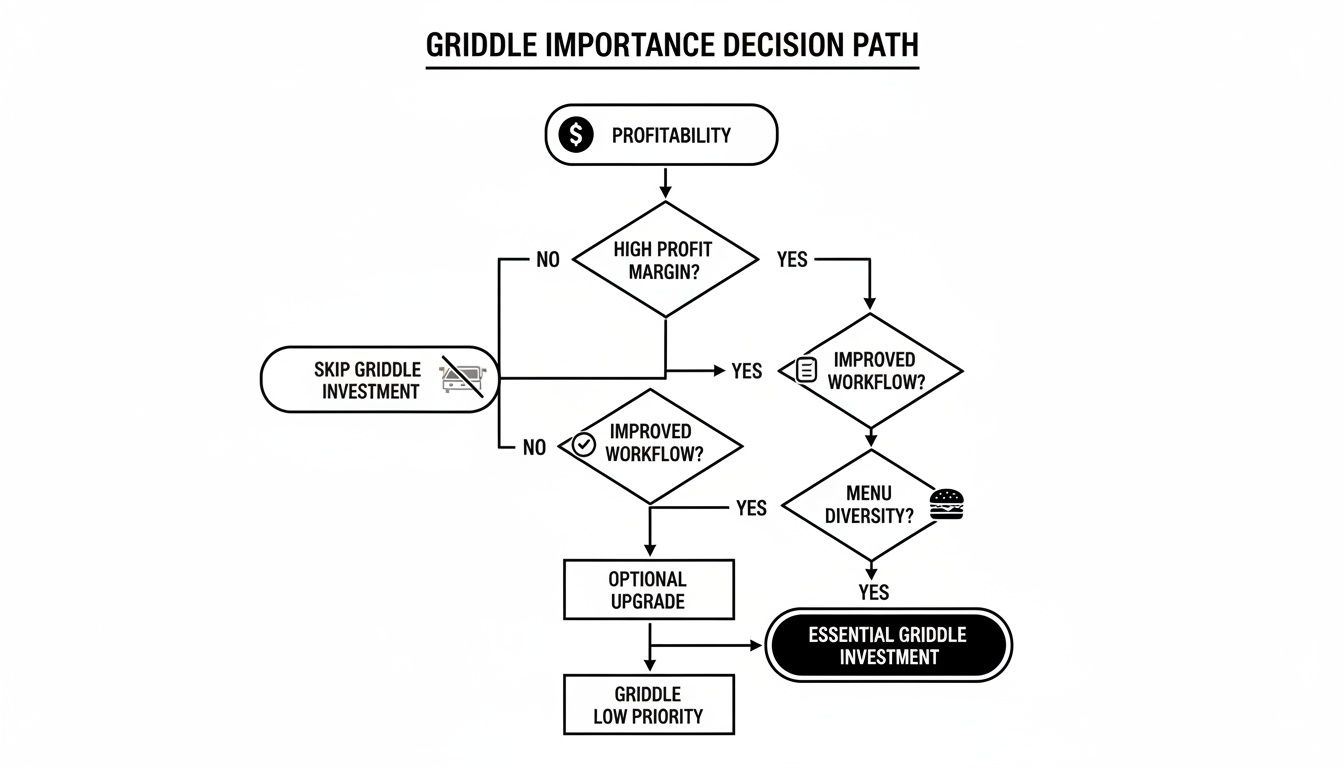
As you can see, smart equipment choices are the foundation of a successful operation. It all flows from picking the right tools—and the right fuel—to support your menu.
To help you visualize the trade-offs, here’s a quick comparison of the main fuel types you'll be considering for your food truck griddle.
Griddle Fuel Type Comparison for Food Trucks
| Feature | Propane Griddles | Electric Griddles | Natural Gas Griddles |
|---|---|---|---|
| Mobility | Excellent. Tanks are portable and easy to swap. | Limited. Requires shore power or a huge generator. | Not an option. Needs a fixed utility line. |
| Heat Output | High & Fast. Great BTUs for quick heat-up and recovery. | Slower. Takes longer to heat and recover temperature. | High & Fast. Excellent heat, but not mobile. |
| Best Use Case | All-purpose daily food truck operations. | Indoor events, catering with power access, secondary unit. | Brick-and-mortar restaurants. |
| Upfront Cost | Moderate. | Varies, but can be high for powerful units. | Moderate. |
| Operating Cost | Moderate. Refilling tanks is a regular expense. | Can be low with shore power, very high with a generator. | Generally the lowest fuel cost. |
| Installation | Requires professional installation and safety checks. | Plug-and-play with the right outlet. | Requires a licensed plumber. |
This table makes it clear why propane is the standard for mobile kitchens, but also shows where electric griddles can fit into your business plan.
Propane: The Mobile Kitchen Powerhouse
Propane's dominance in the food truck world boils down to two things: portability and power. You aren't tied to a utility line like with natural gas; propane lives in transportable tanks you can mount right onto your vehicle. That freedom is the food truck business model.
More importantly, propane burns hot. It delivers the high BTUs (British Thermal Units) needed to get a thick steel griddle plate searing hot and keep it that way, even when you slap down a dozen cold burger patties. That rapid heat recovery is what keeps you from getting bogged down during a rush, ensuring every single order is cooked right and served fast. For a deeper look at the specs, this guide on natural gas vs. propane for commercial cooking explains why propane (LP) is the clear winner for mobile rigs.
Of course, working with propane means being serious about safety. No shortcuts.
- Proper Storage: Tanks absolutely must be stored upright and secured in a well-ventilated compartment, far from any ignition source.
- Regular Inspections: Get in the habit of checking your hoses and connections for leaks. A little soapy water in a spray bottle will show you any bubbles, confirming your seals are tight.
- Professional Installation: This is non-negotiable. Always have a licensed pro install your gas lines to meet local fire codes.
When Electric Griddles Make Sense
While propane rules the road, electric commercial griddles have carved out a very specific and useful niche. Think of them as your special-teams player. An electric griddle can be a total game-changer for indoor events, farmers' markets, or catering gigs where open flames are a no-go. If you have access to "shore power"—a dedicated, high-voltage outlet—you're good to go with zero fumes or tanks.
The problem comes when you try to run one off a generator. Commercial electric griddles are serious power hogs. You'll need a big, expensive, and loud generator to keep one running, which drives up your fuel costs and creates a noisy environment for customers and staff.
The bottom line is this: An electric griddle is a fantastic tool for specific jobs where you know you'll have a beefy electrical hookup. For your day-in, day-out street service, propane is far more reliable and flexible.
Many veteran food truckers land on a hybrid strategy. They run a main propane griddle for the heavy lifting and keep a smaller countertop electric griddle on board. This gives them the best of both worlds: the raw power needed for daily service and the flexibility to take on a wider range of high-value catering events.
How To Select The Right Griddle Size And Plate Thickness
In a food truck, every single inch of counter space is prime real estate. Your commercial griddle is going to eat up a big chunk of that space, so choosing the right size is a make-or-break decision. It’s a constant tug-of-war between what your menu demands and what your kitchen can physically handle. And that decision goes hand-in-hand with another critical factor: the thickness of the steel griddle plate itself.
Picking the right griddle dimensions isn't just about busting out a tape measure. It's about thinking through your workflow. A little 24-inch griddle might look like a great space-saver, but it’ll become a massive bottleneck during the lunch rush when you're trying to sling burgers, toast buns, and sauté onions all at once. On the flip side, a beastly 48-inch unit gives you a ton of cooking real estate but might leave you with zero room for a fryer or prep station.
Matching Griddle Size to Your Menu and Volume
For most food trucks, the sweet spot is a 36-inch griddle. There's a reason this size is the industry workhorse—it gives you enough surface to create different heat zones without completely hijacking your cook line. It’s the perfect balance for handling a diverse menu and a steady line of customers.
Here’s a quick breakdown to help you figure out what's right for your truck:
- 24-Inch Griddles: These work best for trucks with a super-focused menu, like gourmet grilled cheese or breakfast burritos. It can be a great second griddle, but you’ll feel the squeeze if it’s your main unit.
- 36-Inch Griddles: This is the go-to for most concepts. Think burgers, cheesesteaks, tacos, and full breakfast menus. It gives you the breathing room to manage multiple orders at the same time.
- 48-Inch Griddles: You only need this beast if your entire concept is built around the flat-top and you’re expecting crazy long lines. If you're a high-volume griddle machine, this is your guy.
Before you pull the trigger, map out your cook line. Seriously. Get some painter's tape and mark out your truck's counter space on a floor or a big table. Place cardboard cutouts for your griddle, fryer, and prep areas to see how it all feels. This simple exercise can save you from a very expensive headache.
Why Plate Thickness Is Your Secret Weapon
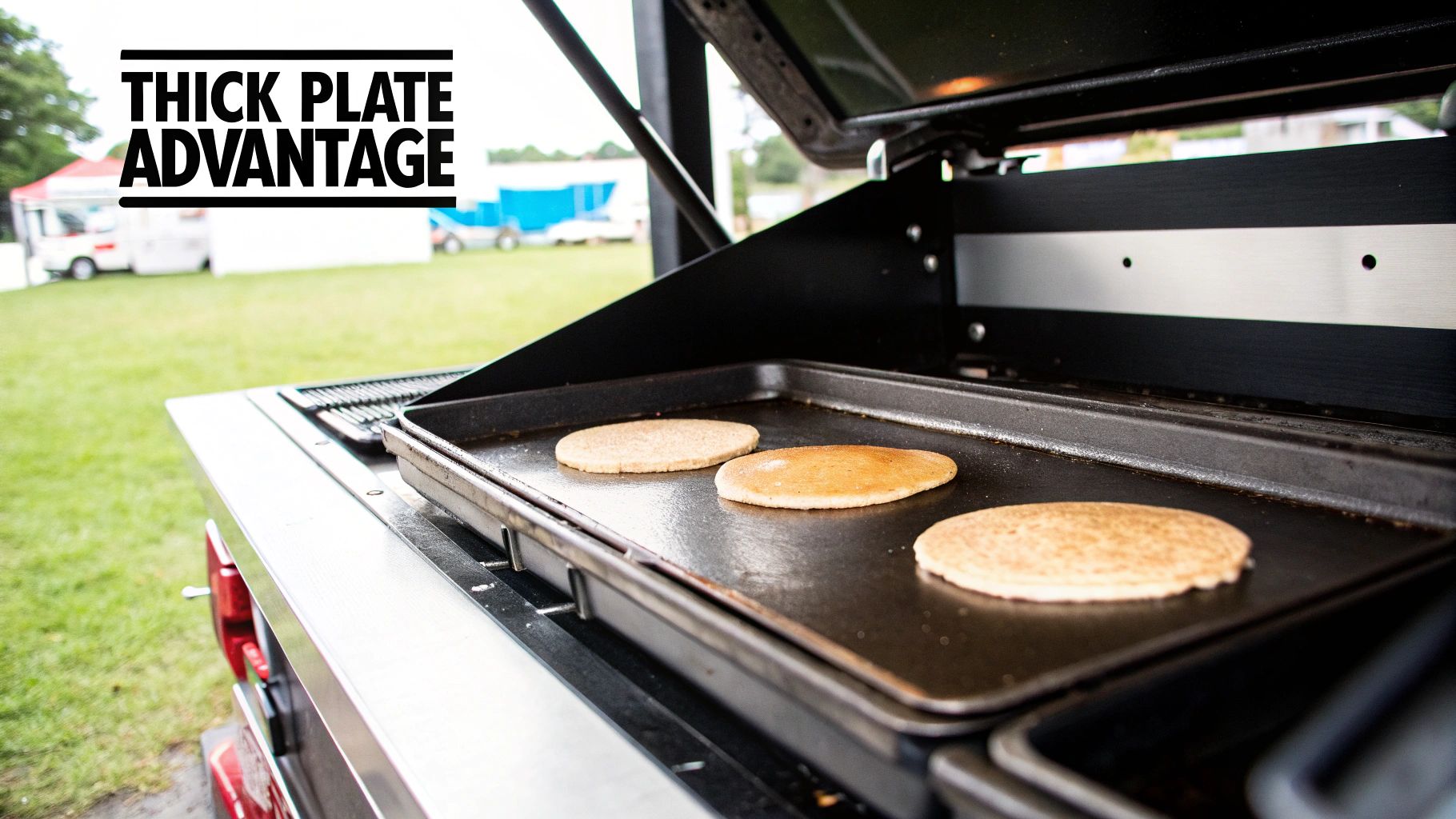
Once you've nailed down the width, the next spec you need to obsess over is the thickness of the griddle plate. Think of the griddle plate like a thermal battery. Its job is to soak up and hold a ton of heat from the burners and then dump that heat evenly into your food.
A thin plate heats up fast, but it loses that heat just as quickly. The second you drop a bunch of cold food on it—like frozen burger patties or a big scoop of pancake batter—the temperature craters. This is what leads to inconsistent cooking, longer ticket times, and sad, steamed burgers instead of ones with a perfect, crispy sear.
A thick griddle plate is your insurance policy against the chaos of a busy rush. A standard 1-inch thick steel plate stores an enormous amount of thermal energy, acting as a buffer that maintains a consistent surface temperature even when you load it up with cold food.
This incredible heat retention is what lets you power through a crazy service without your equipment failing on you. It means your 50th burger of the day comes out just as perfect as your first. That kind of consistency is everything when it comes to building a loyal following in the cutthroat food truck game.
The U.S. food truck market isn't just a trend; it's a powerhouse in the food industry. Valued at USD 1.16 billion as of 2026, the economic impact of mobile kitchens is massive. And it's not slowing down—projections show the market hitting USD 1.59 billion by 2031, growing at a 6.53% compound annual rate. This tells you one thing: people love good food on wheels. It's also interesting to see that trucks in the 16 to 25-foot range dominate the market, holding a 50.25% share, proving that operators have found the sweet spot between cooking power and agility. You can discover more insights about the U.S. food truck market on mordorintelligence.com.
Getting to Know Your Griddle: Controls and Must-Have Features
The size of your commercial griddle is one thing, but how you control it is what really matters during a busy service. The controls and a few key features are what separate a kitchen workhorse from a piece of junk. This decision really boils down to two types of controls, and picking the right one depends entirely on your menu.
Your choice here directly affects your cooking precision and how your team works. One style is like having a scalpel for delicate jobs, while the other is pure muscle. It's all about matching the tool to the food you're selling.
Thermostatic Controls: The Precision Tool
Think of a thermostatic control as the "set it and forget it" option for your griddle. You dial in an exact temperature—say, 350°F for perfect pancakes—and an internal thermostat kicks the burners on and off to keep it right there. That kind of pinpoint accuracy is a lifesaver for anything that can go from golden-brown to burnt in a heartbeat.
This precision makes a thermostatic griddle the clear winner for menus heavy on:
- Breakfast stuff: We’re talking eggs and pancakes, which are super sensitive to heat spikes.
- Delicate proteins: Think fish fillets or thin chicken breasts that need gentle, consistent cooking.
- Melty goodness: For quesadillas or grilled cheese, you need steady heat to melt the inside without torching the tortilla or bread.
If turning out the exact same product every single time is your goal, a thermostatic model gives you the control to make it happen.
Manual Controls: The Rugged Workhorse
On the flip side, you have manual controls. These are as straightforward as it gets: simple low, medium, and high knobs for each burner. There's no thermostat, just you controlling the flame's intensity. This setup is built for high-heat, high-speed cooking.
Manual griddles aren't about finesse; they're about raw power. Their simpler mechanical design also makes them incredibly durable, which is a huge plus in the rough-and-tumble food truck world. They're perfect when you just need to blast food with heat, like getting a hard sear on burgers or charring up some veggies.
Your menu dictates your controls. If you're cooking delicate eggs, you need the precision of a thermostat. If you're smashing burgers all day, the rugged simplicity of manual controls is your best bet.
Non-Negotiable Features for Any Food Truck Griddle
No matter which control type you land on, some features are simply non-negotiable for a griddle that's going to live in a mobile kitchen. These are the things that help it survive the constant vibration of the road and the brutal pace of service. There's a reason the global commercial cooking equipment market is a multi-billion dollar industry—operators need gear that can take a beating. That market is expected to grow by another USD 4.8 billion between 2024 and 2029, largely thanks to the boom in quick-service options like food trucks. You can read the full research on the commercial cooking equipment market on technavio.com.
Here are the features you absolutely must look for:
- Heavy-Duty Stainless Steel Construction: Your truck is going to hit bumps and potholes. A griddle with a weak frame will rattle itself to pieces. You need a fully welded, robust stainless steel body to ensure it lasts.
- Tall Splash Guards: Grease gets everywhere in a tight space, and that's a safety and sanitation nightmare. Tall, welded splash guards on the back and sides are essential for keeping hot grease contained on the cooktop where it belongs.
- A Big, Easy-to-Access Drip Tray: During a rush, you don't have time to stop and fuss with a tiny, hard-to-reach grease trap. Look for a large-capacity drip tray that slides out easily from the front so your crew can empty it quickly and safely without missing a beat.
Mastering Griddle Installation And Daily Maintenance
Let's be honest—proper installation and daily care are your best defense against chaos. Your commercial griddle isn't just a piece of metal; it's the heart of your food truck cooking equipment. Treating it right from day one is what separates the pros from the amateurs, ensuring it pumps out profits reliably. This is about more than just cooking—it's about safety, compliance, and keeping your star player in the game.
Getting the installation right is non-negotiable. It all starts with proper clearance. You absolutely need a minimum of 6 inches on all sides and the back from any combustible surfaces. In the tight confines of a food truck, that buffer zone is the only thing stopping heat transfer from turning into a fire.
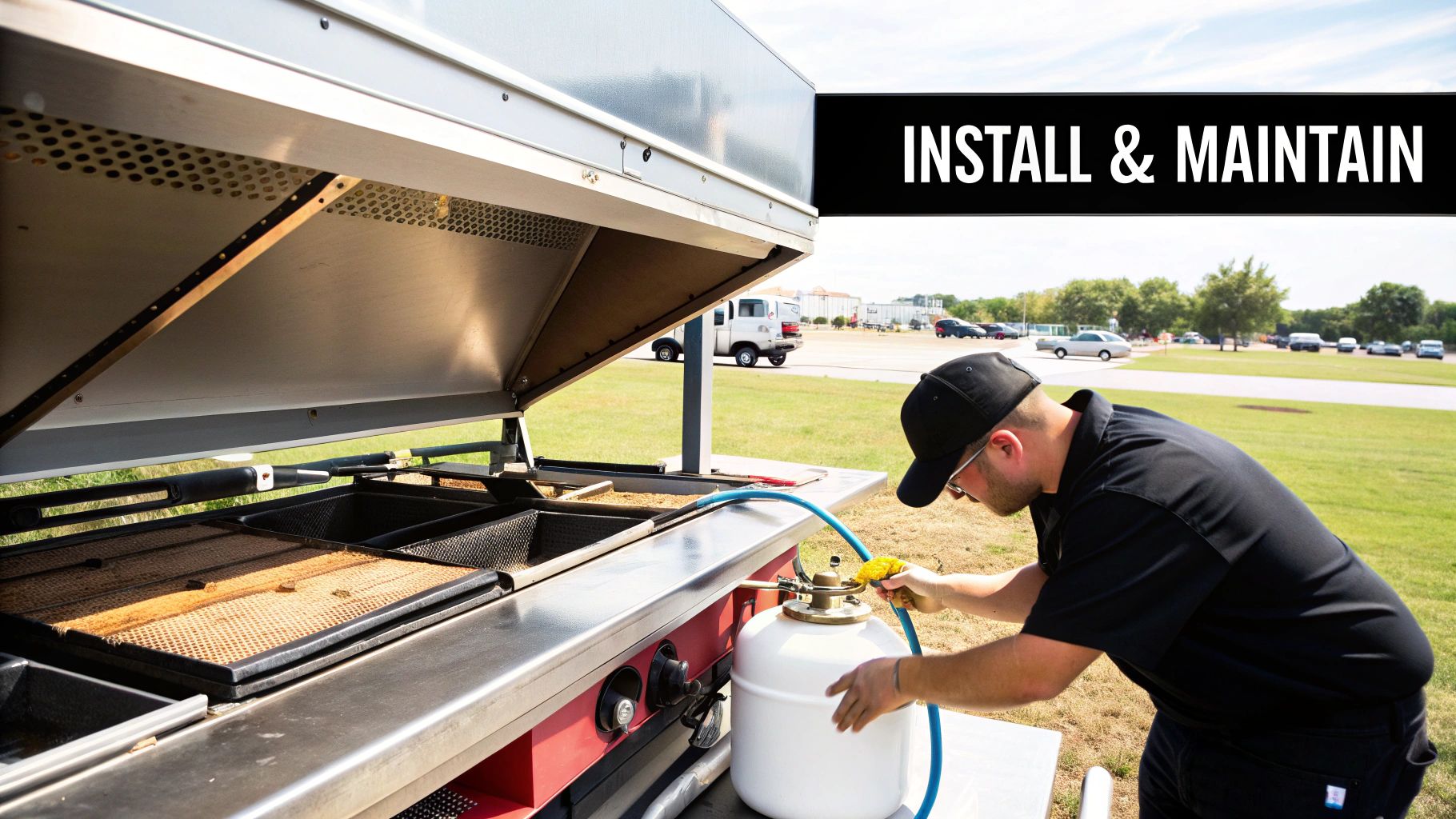
Securing your propane lines is just as critical. A quick spray of soapy water on every connection point is your best friend here. If you see bubbles forming, you've got a leak that needs to be fixed immediately. Don't cut corners; always have a licensed gas technician handle the final hookup to ensure everything is up to code and 100% safe.
The Initial Seasoning Process
Before you even think about throwing a burger on it, you have to season your new commercial griddle. This isn't optional. This simple step creates that beautiful, natural non-stick surface and shields the steel from rust. Think of it as laying the foundation for the thousands of incredible meals you're about to serve.
- Wash the Surface: First, wash the griddle top with warm, soapy water to get rid of any factory grease or shipping gunk. Rinse it well and dry it completely with a clean cloth.
- Apply Oil: Pour a thin layer of a high-smoke-point oil (canola or flaxseed oil work great) onto the surface. Use a cloth or paper towels to spread it evenly across the entire plate, getting into all the corners.
- Heat It Up: Fire up the griddle to medium-high heat, somewhere around 350-400°F. You want to let the oil heat until it starts to smoke—that’s the magic happening as it bonds to the metal.
- Cool and Repeat: Once the smoke dies down, turn off the griddle and let it cool. Wipe away any excess oil and then do it all over again 2-3 more times. You're building up a strong, slick, dark patina that will make cooking a dream.
Proper seasoning does more than just stop food from sticking. It seals the porous steel, creating a protective barrier that makes daily cleanup a breeze and prevents rust from taking hold in your truck's humid environment.
Your Daily Griddle Maintenance Routine
Consistency is everything. A few minutes of care at the end of every single shift will save you from hours of misery later and seriously extend the life of your griddle. This simple routine keeps your cooking surface flawless and ready for whatever the next rush throws at you.
And it's not just about keeping the equipment nice. Health inspectors love to check your cooking surfaces. A clean griddle is a huge checkmark on any food truck health inspection checklist, so make this daily cleaning regimen your first line of defense.
- Scrape While It's Warm: The best time to clean is right after you shut down for the day, while the griddle is still warm (but not blazing hot). Grab a bench scraper and push all the food bits and grease into the drip tray.
- Use Water and a Griddle Brick: Pour a little warm water onto the surface. The steam it creates will help lift any stubborn, caked-on gunk. Then, use a griddle brick or pad to gently scrub the surface in a circular motion until it's smooth again.
- Wipe and Re-Oil: Wipe the surface clean with a damp cloth, then dry it completely. To protect it overnight, finish by applying a paper-thin layer of cooking oil across the entire surface.
- Empty the Grease Trap: Never, ever let the grease trap sit full overnight. Emptying it is a non-negotiable part of your closing duties to keep pests away and prevent nasty, rancid smells.
For a deeper dive into tackling serious buildup, you can learn more about how to clean a commercial griddle in our complete guide. Remember, food truck operators often face intense regulations that directly impact equipment costs. The strict rules, especially in states like California, mean you have to invest heavily in things like stainless-steel interiors and top-tier sanitation systems. These compliance costs are real; California's average food truck brings in USD 482,751 a year, a number that shows both the incredible revenue potential and the serious capital needed to meet those high standards.
Your Top Questions About Food Truck Griddles, Answered
When you're building out a food truck, the commercial griddle is one of the biggest pieces of the puzzle. It's the heart of so many menus, and getting the right one is a huge decision. We hear the same questions time and again from new owners, so we've put them all in one place to give you the straight answers you need.
Think of this as a no-fluff guide to picking and caring for your commercial griddle. We'll skip the confusing tech specs and get right to what really matters on the truck.
What's The Best Griddle Size For A New Food Truck?
Hands down, for most new trucks, a 36-inch griddle is the king. It’s the perfect middle ground—big enough to crush a lunch rush without eating up every last inch of your counter space. With a 36-inch, you can have burgers searing on one side and buns toasting on the other without feeling cramped.
A 24-inch model will feel small fast, creating a bottleneck right when you get busy. On the flip side, a 48-inch griddle is usually overkill unless your menu is 90% flat-top items and you're planning to work massive festivals from day one.
The most important step? Get out your tape measure. Check your counter depth, your layout, and the space under your vent hood. The 36-inch is the industry standard for a reason, but it still has to physically fit in your truck.
Should I Go With Manual Or Thermostatic Controls?
This one comes down to what you're cooking. It's like choosing between a sledgehammer and a scalpel—both are great tools, but for very different jobs.
Thermostatic controls are all about precision. They have an internal sensor that holds the griddle at an exact temperature, which is a lifesaver for more delicate foods.
- Pancakes and Eggs: They need that consistent, even heat to cook through without burning.
- Fish Fillets: You don't want to blast delicate fish with scorching heat. A thermostatic griddle gives you that gentle, controlled cook.
- Grilled Cheese: Getting that perfect golden-brown crust while the cheese melts all the way through is a game of steady, medium heat.
Manual controls—with their simple low, medium, and high knobs—are built for raw power and taking a beating. They have fewer parts to break, cost a bit less, and are perfect for high-heat cooking. If you're smashing burgers or slinging cheesesteaks all day, a manual griddle is a nearly indestructible workhorse you can rely on.
How Often Does My Griddle Really Need To Be Seasoned?
That first, deep seasoning when the griddle is brand new is non-negotiable. That’s what builds the slick, non-stick surface you're after. But after that initial job, you really don't need to do a full re-seasoning very often.
Honestly, the daily act of cooking with oil and butter constantly maintains and improves that seasoning layer. The trick is a simple end-of-day routine, not a massive re-seasoning project every month.
Just scrape it down while it's still warm, wipe it clean, and spread a super-thin coat of oil across the surface. That’s it. This five-minute task will keep rust away and preserve that beautiful black patina. The only time you'd need a full-on re-seasoning is if the griddle was left to rust or developed a thick, gummy carbon buildup from neglect.
Can I Run A Natural Gas Griddle On Propane?
Yes, and this is a key feature you should be looking for. Any good commercial griddle will be "field convertible." This just means it's designed to be switched from natural gas (NG), the stuff piped into buildings, to liquid propane (LP), which is what every food truck uses.
Most new griddles come with a small conversion kit right in the box. It involves changing out some tiny brass nozzles (called orifices) and adjusting the gas regulator. While the parts are included, this is not a DIY job.
You absolutely need to hire a licensed gas technician to do the conversion. They have the right tools to check for leaks and ensure it's running safely and efficiently. Trying to do it yourself can void your warranty, get you in trouble with the fire marshal, and create a serious safety risk on your truck.
At Griddles.com, we live and breathe this stuff. We focus on getting food trucks the tough, high-performance cooking equipment they need to succeed. From the perfect 36-inch propane griddle to a full line of kitchen gear, we offer free shipping and fast delivery to get your truck's kitchen fired up. Find the right griddle for your mobile kitchen at https://griddles.com.