
The Ultimate Food Truck Griddle Guide
Your commercial griddle is more than just a piece of metal—it's the engine driving your food truck's success. This single slab of steel directly shapes your menu, dictates your service speed, and ultimately, determines your profit margin.
Think of your food truck grill as the stage where your culinary vision comes to life.
Why Your Commercial Griddle Is the Heart of Your Food Truck
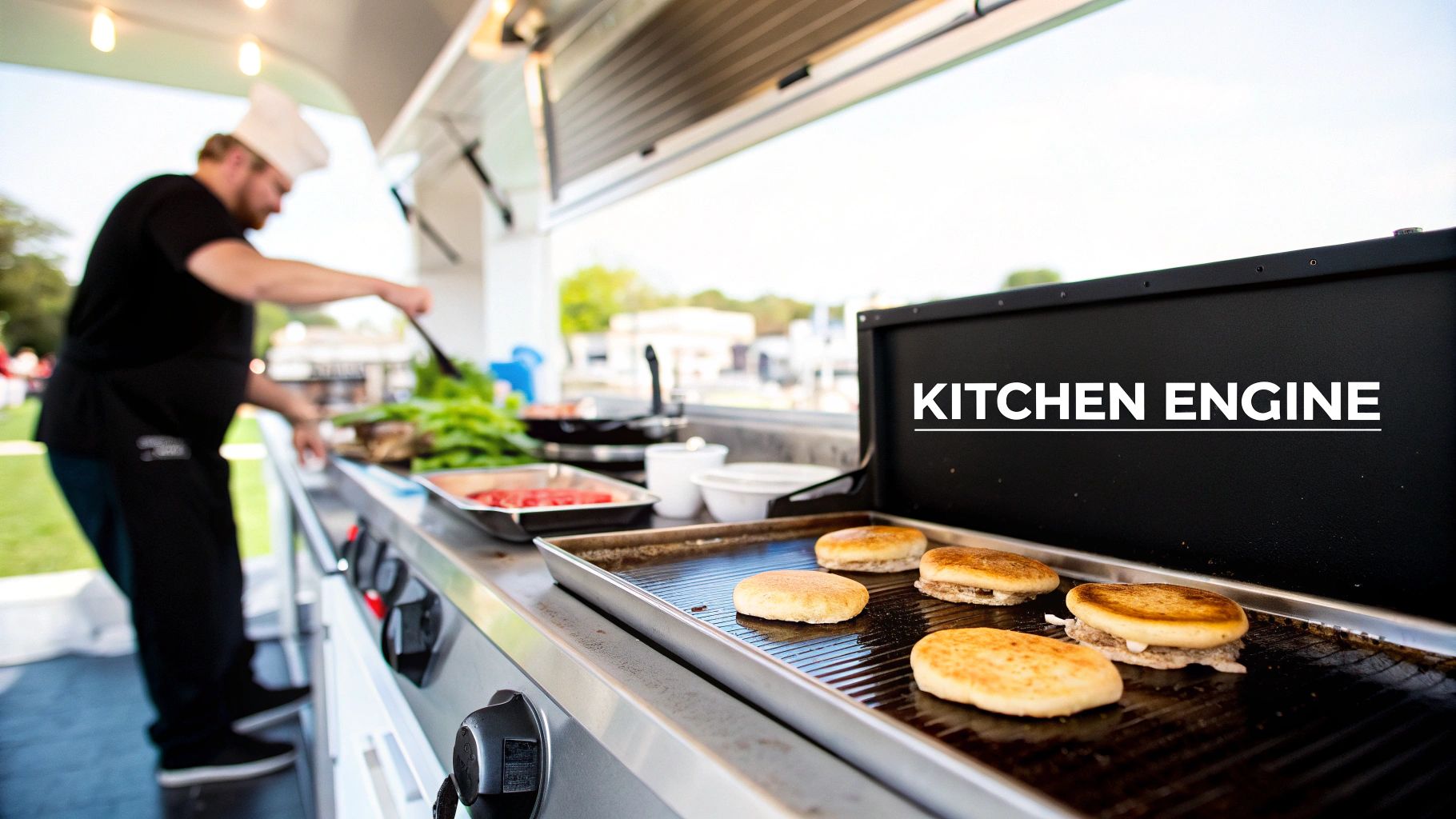
In the tight quarters of a mobile kitchen, every inch of counter space is prime real estate. Every piece of equipment has to earn its keep. Nothing pulls its weight quite like a commercial griddle—it's the versatile workhorse responsible for the sizzle that draws a crowd and the consistent quality that keeps them coming back.
From flipping pancakes at dawn to searing off your signature smash burgers for the late-night rush, the griddle is the foundation of countless successful food truck menus. Unlike other specialized cookers, a high-quality flat-top gives you incredible flexibility. This means you can easily tweak your menu for a seasonal special or test out new ideas without needing a complete kitchen overhaul.
The Engine of Speed and Volume
In the food truck game, success often boils down to one simple metric: throughput. When you’re staring down a long line of hungry customers during the lunch rush, your ability to get orders out quickly and correctly is what separates a great day from a frustrating one. This is where a professional-grade griddle truly shines.
A powerful commercial griddle is built for rapid heat recovery. It holds its temperature even when you slam it with cold ingredients, ensuring every single order is cooked perfectly without grinding your service to a halt.
The food truck industry is a bustling, competitive market, with a total value pegged somewhere between $1.09 billion and $4.36 billion. The most successful trucks can pull in over $492,545 annually, and a huge part of that comes from churning out high-volume classics like burgers and tacos on a reliable griddle. You can find more details on food truck profitability on cloudwaitress.com.
More Than Just a Cooking Surface
At the end of the day, choosing your food truck griddle is a core business decision. It doesn't just decide what you can cook, but how much you can sell and how well you can serve your customers. Investing in the right unit is an investment in your brand's reputation, your efficiency, and your long-term success.
A well-chosen griddle is a true asset, delivering:
- Menu Versatility: Execute a wide-ranging menu, from breakfast to dinner, on a single surface.
- Consistent Quality: Turn out perfectly cooked food time after time, building trust with your customers.
- Maximum Profitability: Power through peak rushes with speed, maximizing sales when it matters most.
- Operational Durability: Built to withstand the bumps, vibrations, and heavy use of a mobile kitchen.
Ready to dive in? This guide will walk you through everything you need to know about choosing, installing, and maintaining the perfect commercial griddle for your food truck.
To get started, here's a quick cheat sheet summarizing the big decisions you'll need to make.
Key Decision Factors for Your Food Truck Griddle
| Factor | Key Consideration | Impact on Your Food Truck |
|---|---|---|
| Fuel Source | Propane or electric. | Affects power needs, portability, and installation complexity. |
| Size & Throughput | How many burgers can you cook per hour? | Directly impacts your potential revenue during peak hours. |
| Heat & BTUs | Power needed for fast heat-up and recovery. | Crucial for maintaining speed and quality during a rush. |
| Ventilation | Hood and fire suppression system requirements. | A major safety and code compliance consideration. |
| Codes & Safety | Local health and fire department regulations. | Non-negotiable for legal and safe operation. |
| Cleaning | Ease of daily cleaning and long-term maintenance. | Saves time and labor, ensuring food safety. |
This table is just a starting point. Each of these factors involves critical details that can make or break your operation, and we'll explore them all in the sections ahead.
Choosing Your Fuel Source: Propane vs. Electric Griddles
The very first fork in the road when choosing a griddle for your food truck is the power source. Picking between propane and electric isn't just a technical spec—it dictates where you can park, how much cooking muscle you have, and how dialed-in your temperatures can be. It's the difference between slinging burgers at a remote music festival or serving paninis inside a corporate convention center.
Think of it like choosing an engine for a race car. A propane griddle is your raw, powerful V8—it gives you incredible power and can run just about anywhere. An electric griddle is more like a precision-tuned electric motor—it offers instant, exact control but needs to be plugged in. Your business model will tell you which engine you need to win.
The Raw Power and Freedom of Propane
For most food truck owners, propane is the go-to, and for one big reason: total freedom. With propane tanks, your kitchen is completely self-contained. You can roll up to a farmer's market, a roadside pull-off, or a festival in the middle of a field without ever thinking about power hookups. That kind of mobility is the soul of the food truck business.
Beyond just portability, propane delivers pure, unadulterated heat. We measure this in British Thermal Units (BTUs), and propane griddles put up some serious numbers, often clearing 90,000 BTUs for a typical 36-inch model. That high output means faster preheating and, more importantly, lightning-fast heat recovery. When you slam a dozen cold burger patties on the flat top during the lunch rush, a high-BTU propane unit gets back to searing temperature almost immediately.
In a food truck, being able to hold consistent, ripping-hot temperatures during a huge rush is everything. Propane gives you the thermal horsepower to keep the line moving without sacrificing food quality.
Of course, all that power comes with responsibility. Running propane means you have to be buttoned-up on safety codes. That means professionally installed gas lines, the right ventilation, and regular check-ups. You'll need to get familiar with components like RV propane gas regulators to keep things running safely and efficiently.
The Precision and Compliance of Electric Griddles
While propane brings the muscle, electric griddles win the game of precision and control. Electric units often use thermostatic controls that hold the surface temperature with surgical accuracy. This is a huge deal if your menu includes delicate items like crepes, fish, or perfectly cooked eggs that can't handle wild temperature swings.
That precision leads to incredibly consistent food, every single time. But the real kicker for electric is access. Many indoor venues, office parks, and stadiums have strict "no open flame" policies. If your business plan involves catering corporate lunches or setting up inside an event hall, an electric griddle isn't just a good idea—it's a requirement.
But there are two main hurdles with electric: power and recovery.
- Power Source: A commercial electric griddle is thirsty for power. You'll almost always need a 240V connection, which means you're chained to a heavy-duty generator or a venue's shore power.
- Heat Recovery: Compared to propane, they just don't bounce back as fast. During a really intense service, that slower recovery time can become a real bottleneck.
You can check out a wide variety of professional electric griddle options for commercial kitchens to see how these features play out in real-world models. The right choice comes down to being honest about where you'll be cooking. Are you a roadside warrior or an indoor event specialist? The answer will point you straight to the fuel source that will power your business.
How to Size Your Griddle for Maximum Profit
Picking the right size griddle for your food truck isn't just about what fits. It’s about what sells. This is a core business decision that can make or break your service speed—and your revenue—during that critical lunch or dinner rush.
Think of your griddle as the main engine of your mobile kitchen. If it's too small, you've just created a bottleneck that leaves customers waiting and potentially walking away. Go too big, and you're just burning expensive propane and wasting precious inches that could have been used for more prep space or another under-counter fridge.
Translate Your Menu Into Square Inches
First things first, you need to map out your menu and get real about your sales projections. The goal here is to calculate your peak hour throughput—that’s the magic number of how many of your top-selling items you must be able to cook at the same time to keep that line moving.
Start with your star player. For most trucks, that’s going to be the burger, the taco meat, or the Philly cheesesteak.
- Calculate Item Footprint: How much physical space does one serving take up? A classic 4-inch smash burger patty needs about 16 square inches (4x4 inches) of hot steel.
- Determine Peak Demand: How many burgers do you honestly expect to have cooking at the exact same moment during your busiest hour? If you think you'll sell 60 burgers in that hour, and each one takes 4 minutes to cook, you'll need to have 4 burgers on the heat at all times just to keep your head above water. To actually get ahead of the rush, you'll probably need space for 8 to 12.
- Do the Math: If you need to cook 12 four-inch burgers at once, you’ll need a bare minimum of 192 square inches (12 patties x 16 sq. inches) of active cooking surface just for your main item.
This quick math gives you a solid baseline for the smallest cooking area you can get away with. From there, you can figure out which commercial griddle width makes the most sense.
This decision tree helps visualize how the choice between propane and electric can also influence your sizing, as they excel in different areas.
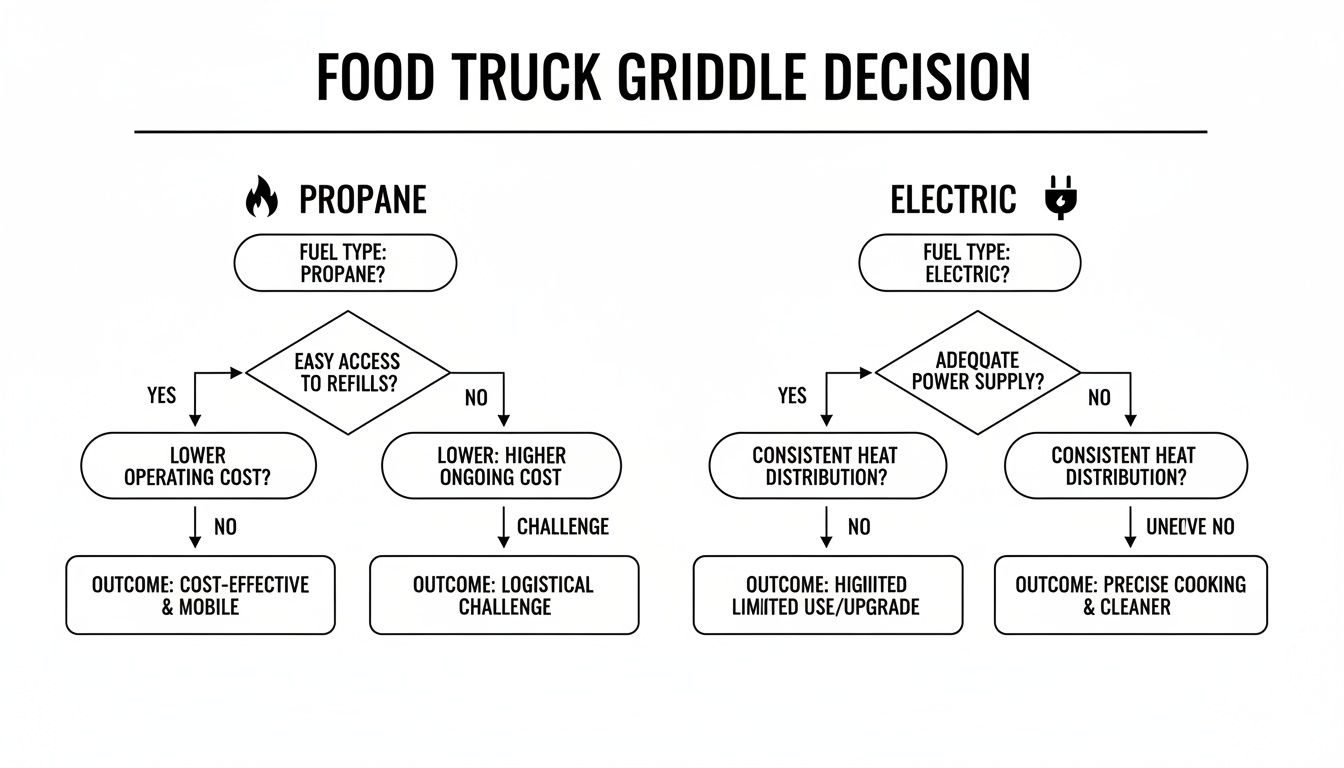
As you can see, propane griddles are the workhorses, offering raw power for banging out high volumes. Electric models, on the other hand, bring precision to the table, which might be a better fit for a smaller, more specialized menu.
Common Griddle Sizes and Their Capacity
Commercial griddles come in a few standard widths. Knowing what each size can realistically produce will help you make a much smarter investment for your food truck.
The biggest mistake I see new operators make is underestimating their griddle needs. It's always, always better to have a little extra space you aren't using than to be a few inches short when the tickets start piling up.
Here’s a practical look at the common sizes and what they can handle, using our 4-inch burger patty example:
| Griddle Width | Cooking Depth (Typical) | Total Area | Max Burger Capacity (at one time) | Best For |
|---|---|---|---|---|
| 24 inches | 19 inches | 456 sq. inches | ~15 patties | Trucks with tight space or where the griddle is a secondary tool. |
| 36 inches | 19 inches | 684 sq. inches | ~24 patties | The sweet spot. This is the most popular and versatile size for most high-volume trucks. |
| 48 inches | 19 inches | 912 sq. inches | ~32 patties | The beast. For operations built almost entirely around griddled items. |
Don't forget to factor in some elbow room on the flat top for flipping, plus a holding area for things like grilled onions, toasting buns, or melting cheese. And remember, the same careful logic you apply to your hot line is just as vital for your cold line. You can learn more in our guide to commercial refrigerator sizes and how to balance them in a mobile kitchen. Getting that hot-cold equipment balance right is everything.
Understanding Griddle Plate Thickness and Heat Control
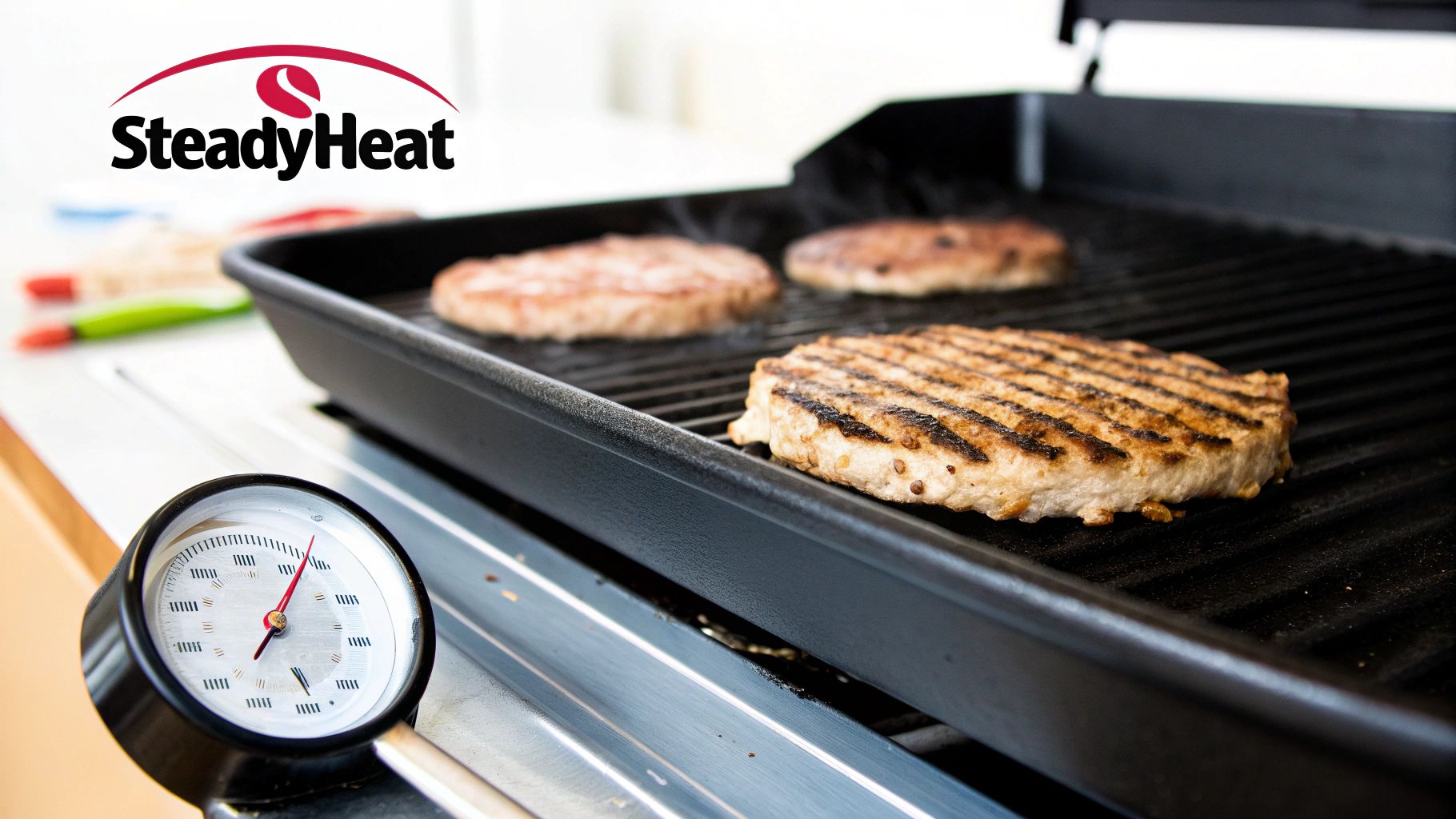
The secret to a killer smash burger or perfectly golden pancakes isn’t just about turning the knob to high. The real workhorse is the griddle plate itself. Its thickness is one of the biggest factors that will make or break your food truck grill's performance when the ticket machine won't stop spitting.
Think of your griddle plate like a thermal battery. A thin, cheap plate is like a tiny AA battery—it heats up in a flash but dies just as fast. The second you drop a half-dozen cold burger patties on it, the temperature nosedives, and you end up steaming your food instead of searing it. Not a good look.
But a thick, heavy-duty steel plate, especially one that’s ¾-inch to 1-inch thick, is a beast. It’s like a massive car battery. Sure, it takes longer to "charge" (preheat), but once it’s hot, it holds a tremendous amount of heat. That stored energy keeps the surface screaming hot, even when you're slamming it with food during a brutal lunch rush.
Decoding BTUs: The Horsepower of Your Griddle
If plate thickness is about heat retention, then British Thermal Units (BTUs) are all about raw power. Consider BTUs the horsepower rating for your griddle. This number tells you how fast it can get up to temp and, more importantly, how quickly it can recover after you've loaded it up.
A higher BTU rating means your burners are pumping more juice into that thick steel plate, recharging your "thermal battery" in a hurry between orders. For any food truck trying to make money, that rapid recovery is everything. It’s the engine that keeps your line moving.
As a rule of thumb, shoot for a griddle that delivers around 30,000 BTUs per 12 inches of cooking width. This gives you plenty of muscle to maintain those crucial searing temperatures and push out orders without getting bogged down.
More power translates directly to faster cook times and a more consistent product, which means more money in your pocket and happier customers coming back for more.
Thermostatic vs. Manual Controls: Finding Your Sweet Spot
Now, let's talk about how you control all that heat. The choice between thermostatic and manual controls really comes down to your menu and how you like to cook. One isn't better than the other; they're just different tools for different jobs.
-
Thermostatic Controls: Think of these as cruise control for your griddle. You set a precise temperature—say, 350°F—and a thermostat cycles the burners to hold it there. This is perfect for delicate items like eggs, pancakes, or fish that need consistent, even heat.
-
Manual Controls: This is your gas pedal. You get simple low, medium, and high settings, giving you direct, hands-on control over the flame. Old-school chefs often prefer manual controls for the raw power and flexibility to create different heat zones on the fly—like a super-hot zone for searing cheesesteaks right next to a cooler area for toasting the buns.
Here’s a quick cheat sheet to help you decide what’s right for your truck.
| Control Type | Best For | Cooking Style | Key Advantage |
|---|---|---|---|
| Thermostatic | Delicate foods, breakfast, consistent batch cooking | Precision-focused, set-it-and-forget-it | Unmatched temperature accuracy and consistency. |
| Manual | High-volume searing, burgers, cheesesteaks, zoned cooking | High-power, hands-on, and dynamic | Maximum power output and operational flexibility. |
At the end of the day, picking the right combination of plate thickness, BTUs, and controls is a strategic move. You're matching the engineering of your equipment to the specific demands of your menu to build a cooking machine that's both a powerhouse and a precision instrument.
Navigating Safety Codes and Proper Installation
Let's talk about the least glamorous, but most critical, part of your food truck build: safety and compliance. Picking out the perfect commercial griddle is the fun part. Bolting it in correctly and passing your inspections? That's what keeps you in business.
Don't think of safety codes as bureaucratic red tape. They’re the professional blueprint for building a mobile kitchen that’s secure, legal, and built to last. Nail this from the start, and you'll sail through inspections instead of getting shut down by costly fines or dangerous mistakes.
The Critical Role of Ventilation and Fire Suppression
When you're cranking out food on a high-heat griddle inside a big metal box, you’re creating a constant cloud of grease-laden vapor. This stuff isn't just smoke; it's basically aerosolized fuel. If you let it build up, it coats every surface and turns your truck into a fire hazard waiting to happen.
This is exactly why a professional ventilation and fire suppression system isn’t optional—it's mandatory.
The heart of this system is the Type 1 hood, often called a grease hood. This isn't your standard kitchen vent. It's an engineered system designed specifically to capture the hot, greasy air spewing off your food truck grill. This hood works hand-in-hand with an upblast exhaust fan, which is usually mounted on your roof to powerfully suck all that hazardous vapor up and out of your kitchen.
I can't stress this enough: local fire marshals do not bend the rules on ventilation. A properly installed, certified Type 1 hood and exhaust system is the very first thing they check. If it fails, your entire inspection fails. Period.
But what happens if something goes wrong and a fire does break out? That's where your automatic fire suppression system comes in. Think of it as your on-board firefighter. Nozzles inside the hood are aimed right at your griddle. If they detect the intense heat from a grease fire, the system instantly unleashes a wet chemical retardant to smother the flames on the spot.
Your Essential Installation Checklist
Getting your griddle installed is way more than just hooking up a propane tank. It's a precise process of meeting strict clearance and safety rules. Follow this checklist, and you’ll be ready when the inspector shows up with their clipboard.
Here are the absolute must-dos for your installation:
- Mind the Gap (Proper Clearance): Heat needs space. Your griddle has to be installed with a specific buffer zone between the unit and any flammable surface—walls, ceilings, even the fridge next to it. Your manufacturer's manual will list these minimums, which are usually around 6 to 12 inches.
- Leave Gas Lines to the Pros: If you’re running a propane griddle, this is not a DIY project. Hire a licensed professional to install the gas lines. They'll make sure everything is secured, leak-free, and has the right safety shut-off valves in all the right places.
- Bolt It Down for Good: Your truck is going to be bumping down roads and turning corners. A 300-pound griddle can’t be sliding around. It must be securely bolted or welded to a heavy-duty stainless-steel stand, which in turn needs to be anchored directly to the truck's floor. A loose griddle that severs a gas line is a catastrophe.
- Easy-Access Shut-Off Valves: When an emergency hits, you need to kill the fuel supply in seconds. Make sure your main propane tank valve and the individual shut-off for the griddle itself are both easy to see and even easier to reach. No fumbling around when every second counts.
Following these rules isn’t just about passing an inspection. It’s about creating a safe, professional kitchen where your food truck grill can run at peak performance without putting anyone at risk. That's the peace of mind you need to focus on what really matters: cooking incredible food.
Essential Maintenance to Protect Your Griddle Investment
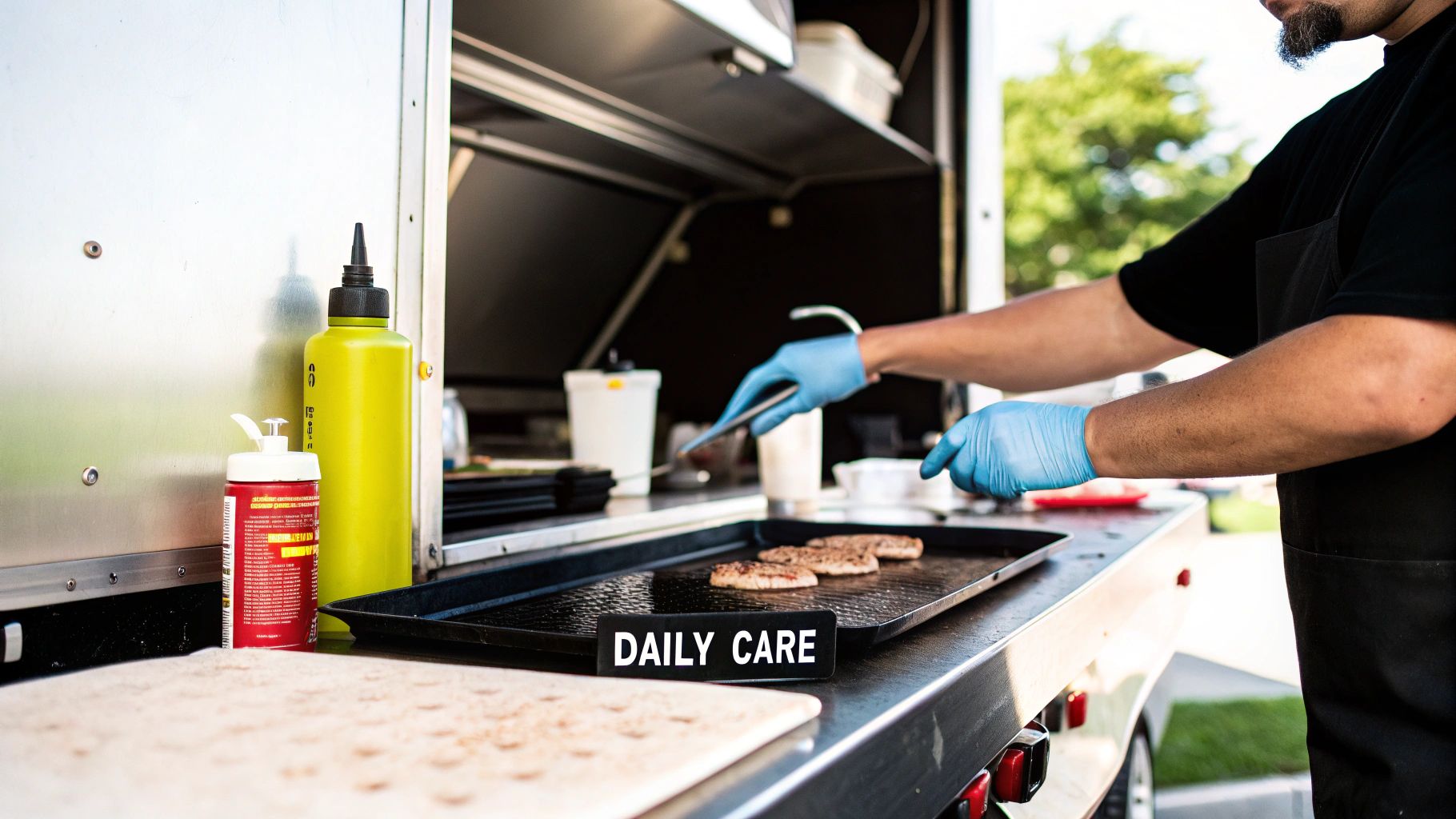
Your commercial griddle is a serious investment. Think of it as the engine of your food truck—it needs regular tune-ups to keep your business profitable and running smoothly. Consistent maintenance isn't a chore; it’s a core business practice that protects your most valuable cooking asset.
A little daily respect prevents the kind of long-term damage that leads to expensive repairs and, worse, unexpected downtime during a busy lunch rush. A well-cared-for food truck grill cooks better, prevents that weird flavor transfer between a morning's pancakes and an afternoon's burgers, and keeps you on the right side of food safety standards.
The Art of Seasoning Your Griddle
The very first thing you need to master is seasoning. This is how you create a natural, tough-as-nails non-stick shield for your cooktop. A properly seasoned griddle develops a beautiful, dark patina that stops food from gluing itself to the surface, makes cleanup a breeze, and protects the steel from rust.
It’s pretty simple: just apply a super-thin layer of a high-smoke-point oil (canola is great for this) to a clean, hot surface. Let it heat up until it stops smoking, wipe it down, and repeat a few times. This process builds up layers of polymerized oil, creating that slick, perfect cooking surface you're after.
This initial seasoning is your foundation for success. A well-maintained patina makes daily service smoother, faster, and much easier to clean up at the end of a long shift.
Beyond that first time, you'll want to re-season your griddle every so often to keep that protective layer in top shape, especially after a deep clean. It's the single best thing you can do for your equipment. For a deeper dive, check out our guide on commercial kitchen equipment maintenance.
Your Daily and Weekly Cleaning Routine
Cleaning your griddle every day is non-negotiable. Period. It guarantees your food always tastes fresh and has your griddle ready to rock for the next service. You only need a couple of basic tools to get it done right.
Your Daily and Weekly Griddle Maintenance Checklist
Use this simple checklist to stay on top of essential cleaning and maintenance tasks, ensuring your griddle performs flawlessly and lasts for years.
| Task | Frequency | Why It Is Important |
|---|---|---|
| Scrape Down Surface | Daily (End of Service) | Removes fresh grease and food bits before they carbonize and become a huge pain to clean. |
| Scrub with Grill Brick | Daily/As Needed | Lifts away stubborn, cooked-on spots without damaging the seasoned steel surface. |
| Wipe & Re-Oil | Daily (End of Service) | Cleans the surface and applies a protective oil barrier to prevent rust overnight. |
| Empty & Clean Grease Trap | Weekly (or Daily) | Prevents dangerous grease buildup, reduces fire risk, and eliminates nasty odors. |
| Wipe Down Exterior | Weekly | Keeps your entire unit looking professional and prevents grease from building up on controls. |
This simple routine is your ticket to a griddle that works as hard as you do, day in and day out.
And while you’re focused on the griddle, don't forget about the bigger picture. Your whole truck is a system, and safety is key. That includes basics like proper fire extinguisher maintenance to protect not just your equipment, but your entire business.
Your Top Food Truck Griddle Questions Answered
Even after you've done your homework, pulling the trigger on a major piece of gear like a griddle always brings up a few last-minute questions. Let's tackle the most common ones we hear from food truck owners so you can feel 100% confident in your choice.
What Is the Best Material for a Griddle Plate?
Hands down, for nearly every food truck out there, a thick steel plate (¾-inch to 1-inch) is the way to go. It's the undisputed champ for a reason. Steel holds heat incredibly well and is tough enough to handle the relentless pace of a mobile kitchen. Think of it as a thermal battery, keeping the surface screaming hot even when you're slammed with orders.
You might see chrome tops out there, and while they have a great non-stick surface and clean up easily, they're also more delicate. The day-in, day-out abuse of a food truck grill calls for rugged, reliable steel. It's the practical choice that will last.
How Many BTUs Does a 36-Inch Griddle Need?
For a standard 36-inch griddle, you want a unit that packs a punch—aim for a total of at least 90,000 BTUs. A solid rule of thumb is to look for 30,000 BTUs for every 12 inches of griddle width.
Why so much power? Two big reasons:
- Fast Preheating: It gets your griddle up to cooking temp in a flash when you're starting your day.
- Quick Recovery: This is the most critical part. When you drop cold patties or veggies onto the surface, high BTUs ensure the temperature bounces back almost instantly. No waiting, no slowing down the line.
A quick but important note: Can you just use a residential griddle in a food truck? Absolutely not. Don't even think about it. Those units aren't built for commercial abuse and will die a quick death. More importantly, they aren't NSF-certified, meaning you'll fail your health inspection, create a massive fire hazard, and likely void your business insurance.
Is a Bigger Griddle Always Better?
Nope, not always. It's tempting to go big, thinking more space is more capacity, but the best size is about efficiency, not just real estate. A griddle that's too big for your needs is a waste—it burns extra fuel and eats up precious counter space you could use for something else.
The smart move is to look at your menu and your sales projections. Figure out how many of your best-selling items you need to cook during your busiest hour. Choosing the right-sized food truck grill ensures you can keep up with the rush without wasting fuel or creating a bottleneck on your line. It's a business decision, not just a space one.
Ready to gear up with a commercial griddle that can take the heat? At Griddles.com, we live and breathe this stuff, providing top-tier, reliable griddles built for the toughest service rushes. Explore our full collection of commercial griddles today.