
Choosing the Best Commercial Griddle for Your Food Truck
When you're building out your food truck, the single most important piece of food truck kitchen equipment you'll buy is your commercial griddle. This isn't just another appliance; it’s the profit engine that defines your menu, dictates your speed, and drives your entire operation. A great griddle can handle up to 80% of a typical food truck menu, making it the most valuable real estate you own.
The Commercial Griddle: Your Food Truck's Profit Engine
Welcome to the heart and soul of your mobile kitchen. It's easy to get overwhelmed by a long list of gear, but let's be clear: the commercial griddle stands alone as the strategic center of any truly successful food truck.
Think of it less as a cooking surface and more like a ship's engine—it determines how fast you can go, how much you can carry, and whether you can handle the daily rush. The constant battle for every mobile chef is winning against the limits of space and power, and this is where the griddle becomes your secret weapon.
Its incredible versatility is its superpower. From flipping pancakes and searing breakfast sausages in the morning to grilling paninis for the lunch crowd and smashing burgers for the evening rush, a single griddle does the work of multiple pans and burners. This do-it-all capability is exactly what makes it such a vital piece of food truck kitchen equipment.
Making the Most of Limited Space and Power
In a tiny kitchen where every single inch counts, a good griddle gives you an unmatched return on the space it takes up. Choosing a high-performance model helps you simplify your cook line, freeing up precious counter space for prepping ingredients and plating orders. This efficiency isn't a small thing; it leads directly to a smoother, faster workflow when the tickets start flying.
A well-chosen commercial griddle isn't just an operational tool—it's a financial one. It allows a single cook to juggle multiple orders at once, which speeds up service, keeps customers happy, and cuts down on labor costs. That goes straight to your bottom line.
Key Benefits of a High-Quality Commercial Griddle
The right commercial griddle is more than just a slab of hot steel; it's the foundation of your entire service. Here’s what a premium griddle brings to your mobile kitchen:
- Menu Versatility: It gives you the power to build a diverse menu that can change with the time of day or type of event, from breakfast burritos to late-night cheesesteaks.
- High-Volume Capacity: A quality griddle heats evenly and recovers its temperature quickly, letting you pump out food for long lines without ever compromising on quality.
- Operational Simplicity: When most of your cooking happens on one surface, you simplify training for new hires, slash your cleaning time, and create a much more organized kitchen.
At the end of the day, picking the right commercial griddle is one of the first and most critical business decisions you'll make. This guide will walk you through everything you need to know—from size and power to must-have features—to make sure your investment pays off with every order you serve. Your griddle is where your menu truly comes to life, making it the undeniable MVP of your food truck.
Matching Commercial Griddle Size to Your Menu and Space
Picking the right commercial griddle size is hands-down the most important decision you'll make when building out your food truck kitchen. This isn't just about how much flat-top real estate you have; it's a strategic move that defines your menu's potential, how fast you can serve customers, and how smoothly your whole operation runs. Think of it like tailoring a suit—a perfect fit makes all the difference, while a bad one will constantly trip you up.
Get the size wrong, and you’ll create instant bottlenecks. Too small, and you’ll be drowning during a lunch rush, leaving hungry customers waiting and profits on the table. Go too big, and you’re just wasting precious prep space, burning through propane, and creating a clumsy, inefficient kitchen. The sweet spot is where your cooking capacity lines up perfectly with your menu and the tight constraints of your truck.
This is a make-or-break decision for any piece of food truck kitchen equipment. Smart operators are leaning into compact, powerful setups with the griddle as the undisputed star. And the numbers back this up: cooking appliances like griddles and fryers make up the biggest slice of the food service equipment market at 36.9%. This trend is fueled by the reality that most food trucks (50.95%) are mid-sized rigs between 16-25 feet, forcing owners to get creative with multi-function gear.
This decision tree breaks it down nicely: a simple, focused menu plays well with a smaller griddle, while a complex one demands more cooking surface to keep up.
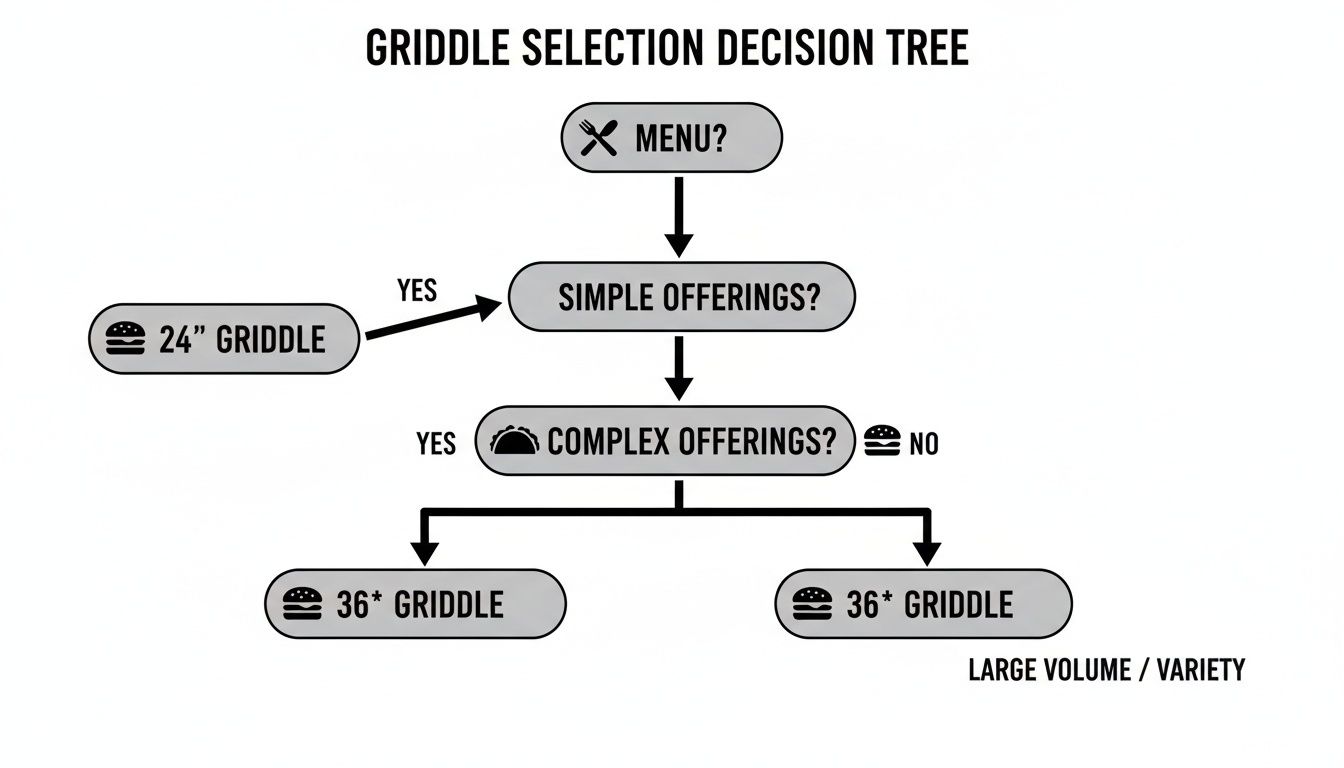
The takeaway here is simple but crucial: let your menu drive your equipment choices. It's the best way to avoid overspending on a beast of a griddle you don't need or crippling your service with one that’s too small.
Connecting Griddle Size to Menu Capacity
Commercial griddles come in a few standard widths, and each one is built for a different kind of fight. Let's look at the most common options and what they really mean for your output.
-
The 24-Inch Griddle: The Specialist This compact unit is the perfect partner for trucks with a laser-focused menu. If your entire concept revolves around gourmet grilled cheese, artisan paninis, or a simple but killer breakfast menu, the 24-inch model gives you all the space you need without hogging your counter. It’s ideal for handling about 12-16 standard burger patties at once.
-
The 36-Inch Griddle: The Workhorse This is the undisputed champion of the food truck world for a reason. The 36-inch griddle hits that perfect balance between high-volume capacity and a manageable footprint. It’s versatile enough to handle a diverse menu—smash burgers sizzling next to Philly cheesesteaks and sautéed veggies. You can comfortably cook 18-24 burger patties on this thing at the same time.
-
The 48-Inch Griddle: The Powerhouse For the high-volume heavy hitters, the 48-inch griddle is an absolute monster. If you plan on parking at massive festivals or the busiest downtown lunch spots, this is your weapon. With this much surface area, you can create multiple heat zones—searing proteins on one side while toasting buns on the other. It can crank out a whopping 24-32 burger patties in a single go.
To put it all in perspective, here's a quick guide to help you match the right griddle to your ambitions.
Commercial Griddle Size and Capacity Guide
| Griddle Size | Best For | Typical Output (Burgers/Hour) | Space Requirement |
|---|---|---|---|
| 24-Inch | Niche menus (e.g., grilled cheese, breakfast) | Up to 144 | Compact |
| 36-Inch | Diverse, high-volume menus (e.g., burgers, cheesesteaks) | Up to 240 | Moderate |
| 48-Inch | Very high-volume, complex menus (e.g., festivals) | Over 320 | Significant |
Ultimately, your griddle choice is a direct reflection of your business plan. A smaller, focused menu often leads to higher profit margins and less food waste, making a 24-inch griddle a smart financial move. A bigger, more diverse menu can draw a larger crowd, but you’ll need the space and power of a 36-inch or 48-inch model to pull it off.
The Essential Pre-Purchase Measurement Checklist
Before you even think about clicking "buy," grab a tape measure. Trust me, a few minutes of measuring now will save you a world of hurt later. I’ve seen too many excited operators buy a beast of a griddle, only to realize it won’t fit through the truck door or under the hood. For a deeper dive into everything you'll need, check out our complete food truck equipment list.
Run through this quick checklist to guarantee a perfect fit:
-
Measure Your Counter Space: Get the exact width, depth, and height of the spot where the griddle will live. Don't forget to factor in clearance—you'll need a few inches on the sides and back for safety and airflow.
-
Verify Ventilation Hood Clearance: Your griddle absolutely must sit cleanly under your exhaust hood. Measure from the countertop to the bottom of the hood filters. Make sure there’s enough vertical space for the griddle itself and for air to circulate properly.
-
Check Doorway and Path Dimensions: This sounds obvious, but can you physically get the unit into your truck? Measure the width of your service door and any tight corners or hallways you have to navigate.
-
Confirm Proximity to the Service Window: In a perfect world, your griddle is close enough to the service window for a fast hand-off, but not so close that you’re blasting customers with heat and grease. A smart layout shaves seconds off every order, and that adds up.
Choosing Your Power Source: Propane vs. Electric
Once you’ve settled on the right size, your next big call is how you're going to power that griddle. This isn't just a technical footnote; it’s a decision that dictates where you can park, how fast you can sling food, and what your energy bill looks like. In the world of food truck kitchen equipment, it all comes down to two main contenders: propane and electric.
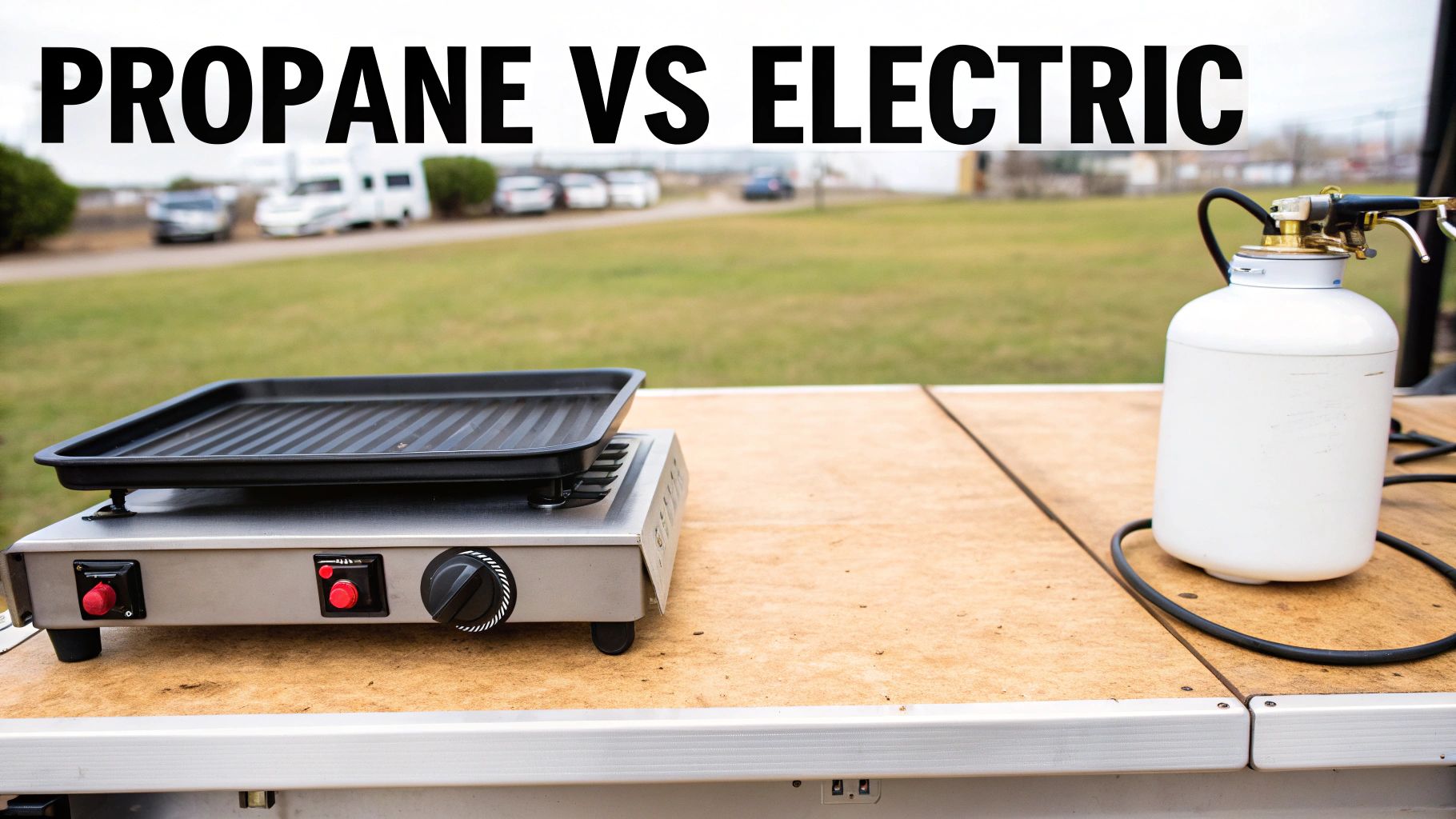
Think of it like choosing between a beast of an off-road truck and a sleek, high-tech EV. One gives you raw, go-anywhere muscle, while the other offers clean, pinpoint precision. What's right for you will come down to your menu, your truck's current setup, and where you dream of serving customers.
Propane Griddles: The High-Heat Workhorse
In a mobile kitchen, propane is king when it comes to raw, unadulterated power. A propane griddle hooks right up to the tanks on your truck, making it a totally self-sufficient cooking station that doesn't have to fight your generator for juice.
This brute strength is measured in BTUs (British Thermal Units). The more BTUs, the more heat your griddle can throw down, which means it preheats in a flash and recovers its temperature just as quickly. When you drop a dozen ice-cold burger patties on the flat-top, a high-BTU propane unit gets back to searing temps almost instantly.
This is exactly why propane is the weapon of choice for high-volume, fast-paced trucks. It’s the engine you need to pump out hundreds of orders at a packed festival, a bustling street corner, or any outdoor spot where speed is money.
-
Pros of Propane:
- Immense Power: High BTUs mean lightning-fast heating and temperature recovery.
- Off-Grid Capable: Runs independently, saving your generator's electricity for other appliances.
- Cost-Effective: Propane can be a cheaper fuel to burn per hour than running a generator at full tilt.
-
Cons of Propane:
- Less Precise Temperature Control: You might deal with hot spots and have less fine-tuned control over the heat.
- Open Flame Restrictions: A deal-breaker for many indoor events, convention centers, or fire-sensitive venues.
- Refill Logistics: You're responsible for hauling, swapping, and refilling heavy propane tanks on the regular.
Electric Griddles: The Precision Specialist
If propane brings the muscle, electric brings the brains. These griddles are the specialists of the kitchen, giving you incredibly precise and even temperature control from corner to corner. Their power is measured in wattage, and they need a serious amount of power from your food truck’s generator to run.
The real magic of an electric griddle is its consistency. You can set it to exactly 350°F with its thermostatic controls, and it will hold that temperature perfectly. This is a game-changer for delicate items like pancakes, crepes, or eggs that will burn in a heartbeat on a fluctuating surface.
Even more importantly, an electric griddle is your ticket into many indoor events. Countless venues—from corporate campuses to indoor markets—have a strict no-open-flame policy. Going electric can open up a whole new world of catering gigs that are completely off-limits to propane-only trucks. If this sounds like your business plan, you can check out a huge variety of top-tier electric griddle models built for commercial kitchens.
Making the Right Choice for Your Truck
So, which one gets a spot in your kitchen? The right answer comes down to three things: what you cook, where you cook, and what your truck can handle.
- Analyze Your Menu: Is your menu built on a hard, fast sear like smash burgers or cheesesteaks? Propane is your best friend. Or do you need gentle, consistent heat for things like omelets and pancakes? Electric is probably the smarter play.
- Evaluate Your Venues: Are you planning to be an outdoor warrior at festivals and street fairs? Propane is perfect. Eyeing those lucrative indoor corporate lunches and catered events? You'll absolutely need an electric option.
- Assess Your Power System: Do you have a beast of a generator that can easily handle the high wattage of an electric griddle? If not, a propane model that runs on its own power might be the only practical choice.
In the end, many of the busiest trucks I've seen actually run a hybrid setup. They'll have a big propane griddle as their main powerhouse for the daily rush and a smaller countertop electric unit for specialty items or for those indoor-only gigs. It’s the best of both worlds—raw power when you need it, and precision when it counts.
Essential Griddle Features for Mobile Kitchens
Once you've sorted out the right size and power source for your griddle, it's time to dig into the details that make or break a mobile kitchen workhorse. These aren't just fancy add-ons; they're the battle-tested features that directly affect your speed, how clean you can keep your truck, and whether your food truck kitchen equipment will survive life on the road. A standard restaurant griddle just isn't built for the constant vibration and abuse of a kitchen on wheels.
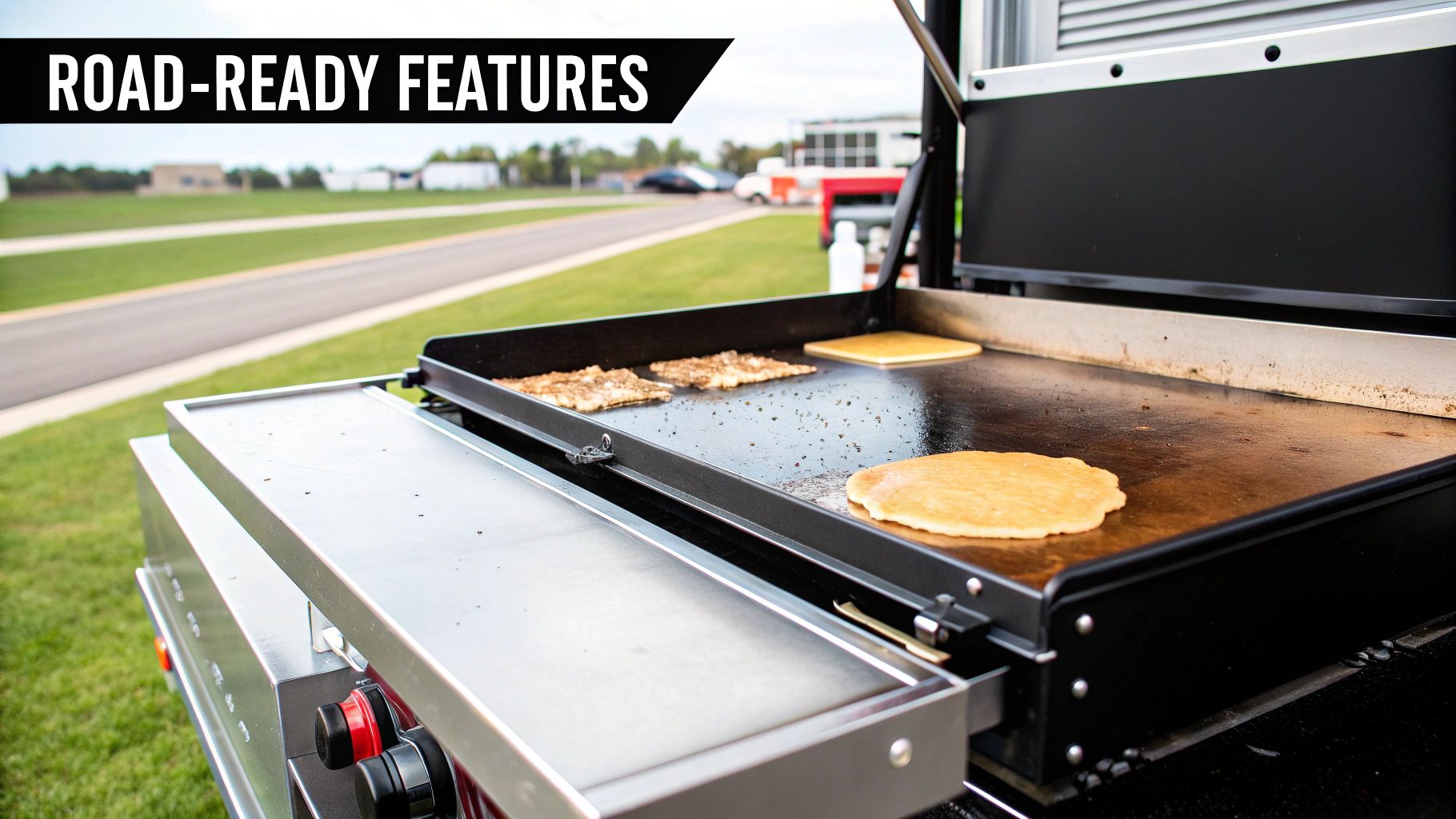
Getting these features right is a serious investment. The global food truck market is set to blow past USD 3.6 billion by 2030, and a huge slice of your startup budget—often 25–40%—is poured directly into the kitchen. That’s why smart operators build their entire service around a high-quality, multi-use griddle. To get a feel for where the industry is headed, you can check out more insights on the global food truck industry.
The Undeniable Importance of a Thick Griddle Plate
If there’s one feature you absolutely cannot compromise on, this is it. Your griddle plate needs to be at least 1-inch thick. Anything thinner will fail you right in the middle of a lunch rush.
Think of that heavy steel plate as a thermal battery. It soaks up an incredible amount of heat and holds onto it, giving you a rock-solid, stable cooking surface. The second you drop a dozen cold burger patties onto a flimsy, thin griddle, the temperature craters. Your food starts steaming instead of searing, and your cook times go through the roof.
A thick plate, on the other hand, has so much heat stored up that it barely notices the cold food. You get those perfect, consistent sears every single time, which means faster service and happier customers. This is the single most important feature for keeping quality high and the line moving.
Features That Simplify Your Workflow
Beyond the plate, you need a griddle designed for the tight quarters of a truck. These are the practical, real-world features that make your day less of a grind.
-
Robust Stainless-Steel Construction: Your truck hits potholes, makes sharp turns, and generally gets bounced around. A fully welded, heavy-duty stainless-steel frame is a must-have. It keeps everything tight and prevents your equipment from rattling itself to pieces.
-
Tall, Welded Splash Guards: In a cramped space, grease doesn't just make a mess—it creates a slip hazard. High splash guards are essential for containing spatter, keeping your walls clean, and making the floor safer for everyone.
-
Large-Capacity Drip Trays: Look for a deep, wide grease tray that you can pull out easily. The last thing you want during a slammed service is to deal with a tiny, overflowing grease trap. A bigger tray means less time spent on messy cleanup and more time cooking.
These little details add up to massive time savings. A griddle that contains its own mess and is easy to wipe down lets your crew focus on slinging food, not constantly fighting grease.
Control and Precision for Menu Mastery
Finally, the quality of your controls dictates how much you can really do with your griddle. Propane gives you all the power you could want, but you need to be able to tame it.
Look for griddles with multiple, independent heating zones. This is a total game-changer. You can have one side cranked up for a hard sear on steaks while the other side is on low, gently toasting buns or melting cheese. This level of control effectively turns one piece of equipment into multiple cooking stations, which is priceless when space is at a premium. It’s what allows you to execute a diverse menu from a single, compact footprint.
Installation and Maintenance on the Go
Your new commercial griddle isn't really part of your food truck kitchen equipment until it’s installed correctly and you have a solid maintenance plan. In a regular restaurant, equipment just sits there. In a food truck? It has to endure constant jolts, sudden stops, and bumpy roads. Proper installation is your first line of defense against breakdowns, and consistent upkeep is what keeps it pumping out orders, day after day.
First things first: you absolutely have to secure your griddle. Just imagine hitting a pothole and having a heavy, blazing-hot griddle slide across the kitchen. It’s a nightmare scenario. The unit must be securely bolted and braced to the countertop or equipment stand, making sure it doesn't budge an inch. This protects your crew, your truck, and your investment.
If you're running a propane griddle, this also means using flexible, heavy-duty gas lines made for mobile kitchens. These specialized hoses can handle the vibrations without cracking and causing a dangerous leak. This is one of those jobs where you don't cut corners—get a professional.
Securing Your Commercial Griddle for Safety and Longevity
Installing your griddle is about more than just hooking up the gas. It's about being smart, safe, and compliant with regulations designed for the unique challenges of a kitchen on wheels.
Here’s what that looks like in practice:
- Secure and Brace the Unit: Anchor the griddle directly to its stand or the countertop. Use heavy-duty bolts and brackets to lock it down tight. This prevents the unit from shifting, which can damage the gas lines or the griddle itself.
- Ensure Proper Clearance: Every griddle needs a little breathing room. Check the manufacturer's specs and leave enough space—usually a few inches—between the griddle and any walls or other equipment. This is essential for ventilation and fire prevention.
- Install Flexible Gas Lines: This is non-negotiable. Use certified, flexible gas hoses designed to absorb vibrations. Rigid pipes will eventually crack under the stress of daily driving, leading to a serious hazard. If you want to get a better handle on the fundamentals, you can learn more about installing gas cooktops, as many of the safety principles are the same.
Mastering Daily Sanitation and Upkeep
In a food truck, your cleaning game has to be on point. It’s not just about passing health inspections; it’s about earning your customers’ trust. A sparkling clean griddle tells them you care about quality. Your daily cleanup needs to be a fast, effective habit for the whole crew.
The best method is simple: scrape the surface down while it’s still warm, use a griddle brick to scrub off any tough, cooked-on bits, and then wipe it down with a light coat of oil. This seasons the steel, prevents rust, and stops yesterday's flavors from creeping into today's food.
Think of daily cleaning as a reset button for your griddle. It ensures that the first burger of the day tastes just as clean and delicious as the last one from the night before, protecting your food quality and reputation.
Regular maintenance is what saves you from those "out of service" signs. A proactive approach will save you from the headache of emergency repairs and lost sales. The good news is, your team can handle most of these checks in just a few minutes each week.
The key is to make it a routine. For a deeper dive into building a full-blown maintenance schedule, check out our guide on commercial kitchen equipment maintenance.
Here’s a simple checklist to get you rolling:
- Weekly Pilot Light Check: Make sure the pilot ignites easily and burns with a steady blue flame. A yellow, lazy, or flickering flame is a red flag that something's off with the gas flow.
- Monthly Hose and Connection Inspection: Give all your gas hoses a quick visual check for cracks, kinks, or any other signs of wear. You can test the connections by spraying them with soapy water—if you see bubbles, you’ve got a leak that needs immediate attention.
- Quarterly Calibration Check: Use an infrared thermometer to see if the griddle's surface temperature matches what the dial says. If it's way off, your thermostat might need to be recalibrated by a pro.
Why Your Commercial Griddle Is a Strategic Business Decision
We've spent this guide digging into the nuts and bolts of commercial griddles. Now, let’s tie it all back to the one thing that really matters: your bottom line. Choosing the right commercial griddle isn't just about picking out kitchen gear; it’s a critical financial decision that will shape the future of your food truck.
Think of your griddle as the profit engine of your entire operation. A high-performance, well-chosen model is the heart of an efficient kitchen. It lets you pump out more food, serve customers faster, and keep a tight grip on your costs. Honestly, it's the single most important piece of food truck kitchen equipment you'll ever buy.
Maximizing Profitability Through Efficiency
A great commercial griddle makes you money from several different angles. Its sheer versatility means you can crank out a huge variety of menu items without cluttering your truck with extra, single-purpose cookers. You can sling breakfast burritos for the morning rush and then pivot to smash burgers for the late-night crowd, all on the same surface. That flexibility opens up more sales opportunities, no matter the event or time of day.
Even better, a powerful griddle with solid heat retention makes your ticket times plummet. When you can cook food fast and consistently without the surface temperature dropping, you slash customer wait times. That means higher turnover and more sales during your busiest hours. It also cuts down on food waste from burnt or undercooked orders, which is a direct hit to your profits.
The right griddle lets a single cook juggle multiple orders at once, turning your cookline into a lean, mean, money-making machine. This often means you can run with a smaller crew, cutting down on labor costs—one of the biggest expenses you'll face.
Investing in Professional-Grade Equipment
The trend in the mobile food world is crystal clear: operators are ditching flimsy gear for the same professional-grade equipment you'd find in a brick-and-mortar restaurant, just with a smaller footprint. As menu prices climb, savvy owners know they need reliable, high-throughput equipment to stay profitable.
The numbers back this up. The global food service equipment market was valued at USD 35.8 billion and is on track to more than double by 2035. Kitchen-specific equipment like griddles makes up a staggering 36.9% of that revenue in North America alone. You can read the full research on food service equipment trends to see just how big this shift is.
This all points to one simple truth: buying quality isn't an expense, it's an investment in your future. A durable, efficient commercial griddle is the foundation you can build and scale your business on.
And once you've got your profit engine humming, you can think about building a loyal following. A great way to keep customers coming back is by exploring the best loyalty programs for restaurants. At the end of the day, your griddle is so much more than a flat-top—it's the financial engine powering your entire dream.
Food Truck Griddle FAQs
When you're building out a food truck, the commercial griddle isn't just another piece of food truck kitchen equipment—it's often the heart of the whole operation. Getting this choice right is crucial. To help you nail it, we've answered the most common questions we hear from food truck owners every day.
Think of this as the practical, real-world advice you need to back up the technical stuff. It’s all about making sure you buy a griddle that works for you, not against you.
How Do I Know What Size Griddle My Food Truck Needs?
Figuring out the right commercial griddle size is a classic balancing act between your menu, how many customers you expect to serve, and the actual, physical space you have to work with. There’s no magic number here; it all comes down to your specific business.
If you’re running a simple menu with a steady but manageable flow of customers, a 24" griddle can be a perfect fit. But if you're slinging a wide variety of items—think burgers, cheesesteaks, and a full breakfast lineup—you’ll need the real estate of a 36" or 48" model to avoid getting buried during a rush.
Before you even think about clicking "buy," measure everything. Twice. Check your counter space, measure the area under your vent hood, and map out the path for getting the unit inside. A few minutes with a tape measure can save you from a massive headache.
Is a Thicker Griddle Plate Really Better for a Food Truck?
Yes, one hundred percent. In the non-stop world of a food truck, a thick griddle plate is your best friend. Aim for 1-inch thick—it's not just a feature, it's a necessity.
Imagine the plate as a thermal battery. It soaks up and holds a huge amount of heat, which is exactly what you need when the orders start flying. When you throw cold food onto a thin plate, the temperature plummets, and your food ends up steaming instead of searing. A thick plate, on the other hand, recovers almost instantly, giving you consistent, perfect results every single time.
What Safety Checks Are Crucial for a Propane Griddle?
Safety is everything in a mobile kitchen, especially when you're working with propane in a tight space. Running regular, thorough checks isn't just good practice; it's essential for protecting your team, your customers, and your truck.
Here are the three non-negotiables for propane griddle safety:
- Check for Leaks, Always: A little soapy water on your gas lines and connections is your best tool. If you see bubbles, you've got a leak that needs immediate attention.
- Confirm Your Ventilation: Your exhaust hood must be running properly any time the griddle is on. This prevents carbon monoxide from building up, which is a serious danger in a confined kitchen.
- Make Sure It's Secure: Before you hit the road for every single service, physically check that your griddle is bolted down tight. The last thing you want is a multi-hundred-pound piece of hot metal shifting while you drive.
Ready to find the perfect profit engine for your mobile kitchen? At Griddles.com, we specialize in high-performance commercial griddles built to handle the demands of any food truck. Explore our full collection of road-ready griddles and get free, fast shipping on your order.