

A Pro's Guide to the Flat Top Grill Scraper
In any professional kitchen, your flat top grill scraper is more than just a cleaning tool—it's a critical piece of equipment for keeping your griddle in prime condition. This isn't your average spatula; it's a purpose-built, heavy-duty workhorse with a sharp, rigid blade designed to power through burnt-on food, grease, and stubborn carbon buildup.
Honestly, using the right scraper is critical for food safety and equipment longevity. It's a non-negotiable.
Why Your Grill Scraper Is a Kitchen MVP
Think about how fast things move on the line. In that rush, efficiency and hygiene are everything, and the humble grill scraper is central to both. It’s not just about wiping away messes; it’s about maintaining the heart of your cooking station. A clean griddle means today's pancakes won't taste like last night's seared salmon—a cardinal sin in any commercial kitchen.

More importantly, that carbonized gunk you're scraping off can be a breeding ground for bacteria. Getting rid of it is non-negotiable. This daily discipline has a direct impact on your bottom line by protecting your investment, which is a core principle of any solid commercial kitchen equipment maintenance plan.
The Unseen Benefits of a Quality Scraper
Any seasoned chef can tell you the difference a good scraper makes. It goes way beyond just looking clean. A well-maintained surface heats more evenly, which means no more frustrating hot spots that scorch one part of a burger while leaving another undercooked. It's that kind of consistency that separates the pros from the amateurs.
Here's what you're really getting:
- Better Tasting Food: No more flavor transfer. Your breakfast items taste like breakfast, and your dinner items taste like dinner. Simple.
- A Safer Kitchen: Grease buildup is a fire hazard, period. Regular scraping removes that flammable gunk and reduces your risk.
- Faster Turnaround: A quick scrape between orders and a deep clean at the end of the night saves a ton of labor time.
- Longer Griddle Life: Carbon buildup causes pitting and damage over time. Protecting that surface means you won't be replacing a multi-thousand-dollar piece of equipment prematurely.
It's no surprise that the global market for flat top grills and their accessories hit about $4.5 billion in 2024. That number alone shows just how essential these tools are in commercial kitchens. You can dig into more stats on the market at marketreportanalytics.com.
At the end of the day, investing a few bucks in a quality flat top grill scraper and training your team to use it properly is one of the smartest, simplest things you can do. It pays off in performance, safety, and the longevity of your equipment. It's an indispensable part of a professional toolkit.
Choosing the Right Scraper for Your Griddle
Picking a flat top grill scraper for your commercial kitchen isn’t just grabbing a tool; it's an investment in your line's speed and the lifespan of your griddle. The materials in the blade and handle are what separate a workhorse from a headache, directly impacting how well it performs under the pressure of a Saturday night rush.
Getting it right means faster cleanup between orders, better ergonomics for your cooks, and a tool that won’t quit when you need it most.
Blade Material: Stainless Steel vs. Carbon Steel
The whole game starts with the blade—that’s the part doing all the heavy lifting. In most professional kitchens, the choice boils down to two key players, and what you pick really depends on your priorities.
Stainless steel is the undisputed industry champ for a reason. It’s incredibly resistant to rust and corrosion, which is a huge deal in a steamy, fast-paced kitchen where a tool might sit damp for a few minutes. It's tough, reliable, and a breeze to sanitize, making it the go-to for kitchens that value low-maintenance gear.
Then you have the old-school favorite: carbon steel blades. Many seasoned chefs won't use anything else. Why? They’re typically harder and can hold a much sharper, more precise edge for longer. That razor-sharp edge makes quick work of stubborn, burnt-on gunk, often with less elbow grease. The trade-off is that carbon steel demands respect. It has to be cleaned and dried religiously after every use to keep rust at bay.
A sharp, well-maintained carbon steel blade feels less like a scraper and more like a surgical tool, lifting debris clean off the griddle. But leave it wet through one shift, and you’ll be scrubbing rust spots off it—compromising both its performance and hygiene.
Why the Handle Material Matters Just as Much
Don't overlook the handle. It’s just as critical as the blade, playing a direct role in safety, comfort, and sanitation. A cheap, poorly designed handle will lead to tired hands and can even cause repetitive stress injuries for your crew.
- Heat-Resistant Synthetics: Most modern commercial scrapers use handles made from high-temp plastics or composites. These are the smartest choice for a busy kitchen. They stay cool, offer a solid grip even with greasy hands, and are non-porous—meaning no place for bacteria to hide.
- Wood Handles: A classic wood handle feels great in your hand, no doubt. But in a commercial setting, they're a liability. Wood is porous, soaking up moisture, grease, and bacteria if it's not perfectly sealed. Over time, wood splinters and cracks, creating a sanitation nightmare that no health inspector wants to see.
For the vast majority of commercial kitchens, a scraper with a heat-resistant synthetic handle is the only way to go. It simply aligns with the strict health and safety standards we all have to follow.
Commercial Scraper Material Comparison
Still on the fence? This table breaks down the key differences between blade and handle materials to help you find the perfect flat top grill scraper for your kitchen's unique demands.
| Material Type | Key Feature | Best For | Sanitation Consideration |
|---|---|---|---|
| Stainless Steel Blade | Superior rust resistance | High-moisture kitchens needing low-maintenance tools | Easy to clean and sanitize |
| Carbon Steel Blade | Holds a sharper edge longer | Kitchens wanting maximum scraping efficiency | Requires immediate drying to prevent rust |
| Synthetic Handle | Heat-resistant and non-porous | High-volume kitchens prioritizing safety and hygiene | Excellent; easy to sanitize |
| Wood Handle | Traditional, comfortable feel | Low-volume settings with meticulous tool care | Poor; porous material can harbor bacteria |
Ultimately, choosing the right material comes down to balancing performance with your kitchen’s workflow. A high-performance carbon steel blade might be perfect for a disciplined crew, while a stainless steel scraper provides peace of mind and reliability for everyone.
Mastering Professional Scraping Techniques
Having the right flat top grill scraper is only half the battle. Knowing how to actually use it is what separates a seasoned line cook from a rookie. Professional scraping is a skill built on temperature, angle, and a methodical approach—all designed to get a perfectly clean surface without damaging your griddle. It's about working smarter, not harder, especially when the ticket machine won't stop screaming.
It all starts with temperature. Trying to scrape a cold griddle is a pointless workout, and a scorching hot one will just bake the gunk on even harder. You're looking for the sweet spot: warm. The griddle should be hot enough to keep grease liquid, but not so hot that it’s smoking like crazy. This allows your scraper to glide under the debris and lift it off with minimal force.
This chart breaks down the key choices you'll make when picking the right scraper for the job.

As you can see, every element—from the blade material to the handle design—is chosen with a specific purpose, ensuring you can work safely and efficiently.
Finding the Right Angle and Approach
Technique is everything here. You want to hold the scraper at a low, shallow angle to the griddle surface, somewhere around 30 degrees. This angle lets the blade get under the food and grease, lifting it cleanly instead of just pushing it around. If you come in too steep, you risk gouging the steel, creating tiny scratches where food will stick later.
Don't just attack random spots. Work in a deliberate pattern, like you're mowing a lawn. Start at the back and pull everything forward toward the grease trough in long, smooth strokes. Make sure to overlap each pass slightly so you don't miss a spot. This systematic method isn't just more effective—it's way faster.
The goal is to make each pass count. Think of it like mowing a lawn; you create clean, overlapping lines to cover the entire area efficiently. Random, frantic scraping just creates more work and leads to inconsistent results.
Adapting to Real-World Kitchen Scenarios
How you scrape depends entirely on the situation. A quick clean between orders during the lunch rush is a world away from the deep clean at the end of the night.
- Mid-Service Scrape-Down: In the middle of a chaotic service, speed is what matters. Just flipped a dozen burgers? Give that section a quick, firm scrape to clear the rendered fat and char. This keeps those flavors from transferring to the next order of pancakes. The whole thing should take you less than 30 seconds.
- End-of-Night Deep Clean: This is your chance to hit the reset button. After the last ticket is out, turn the griddle off but start scraping while it's still hot. Use your zone-by-zone method to push every last bit into the grease trough. This is the most important clean of the day and sets the next shift up for success.
Managing the Grease Trough and Final Wipe
All that gunk you scraped off has to go somewhere, and that's the grease trough. Don't let it become an afterthought. As you clean the main surface, use the edge of your flat top grill scraper to guide everything into the collection tray. Once the flat-top is clear, give the trough itself a good scrape to get any lingering residue out.
With the heavy lifting done, all that's left is a final wipe. While the griddle is still warm, squirt a little water or a 50/50 water-and-vinegar mix on the surface. It’ll steam up instantly, loosening any fine particles left behind. Grab a clean, folded towel with a pair of tongs and wipe the surface dry. You'll be left with a spotless griddle, ready for action.
Mastering this entire routine is a core part of learning how to clean a flat top griddle the right way. A pristine griddle isn't just for show; it's the mark of a truly professional kitchen.
Critical Safety Protocols for Griddle Cleaning
In the controlled chaos of a commercial kitchen, safety isn't just a suggestion—it's everything. When you're dealing with a screaming hot griddle, sizzling oil, and a razor-sharp scraper, the risk of a serious accident is very real. Knowing your safety protocols is just as vital as perfecting your scraping technique.
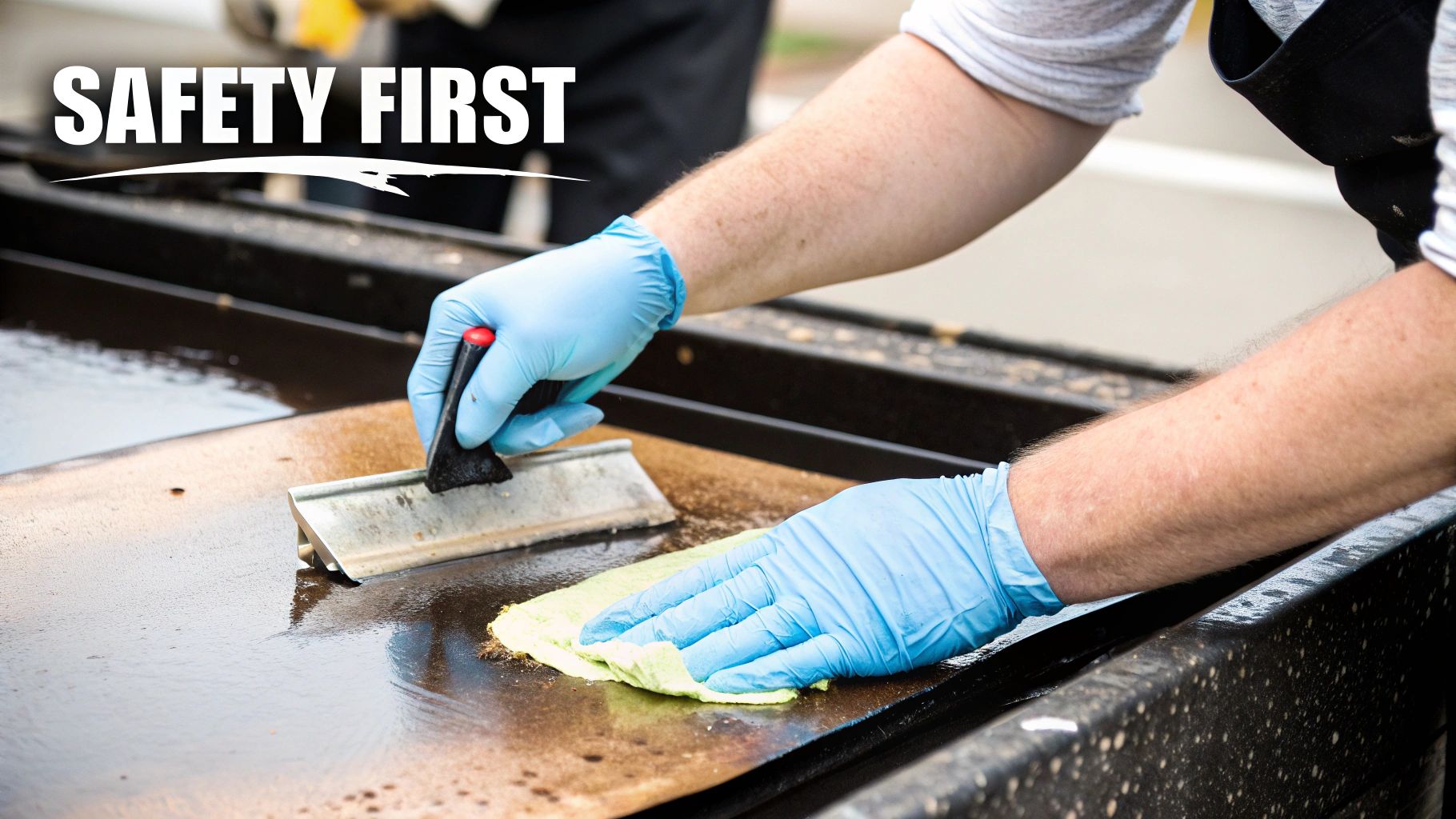
Your first line of defense is always going to be your personal protective equipment (PPE). Heat-resistant gloves are non-negotiable here. A folded kitchen towel just isn't going to cut it against a 350°F surface. The right gloves give your team the confidence to work safely and efficiently around a warm flat top.
Handling Your Scraper with Care
Treat your scraper like any other professional blade in the kitchen. It’s a tool designed for a specific job, and its sharp edge demands respect. Always keep a solid grip on the handle, and make sure your other hand stays clear of the blade's path.
When you’re not actively using it, never leave a scraper on the griddle surface or balanced on the edge where it can fall. Find a designated spot for it, like a tool holder or a magnetic strip. For really tough, caked-on messes, use a secure, two-handed grip—one hand on the handle and the other (wearing a cut-resistant glove, of course) applying steady pressure to the back of the blade. This gives you maximum control and prevents the tool from slipping.
The most preventable accidents in a kitchen often stem from a lack of environmental awareness. A moment of distraction is all it takes for a routine task to become a dangerous situation.
Creating a Safe Cleaning Environment
Safety doesn't stop at the griddle's edge. The entire area needs to be clean, dry, and clear of obstacles. We all know how quickly a kitchen floor can get greasy, and a slip-and-fall near a hot griddle is a nightmare scenario.
- Mind the Floor: Make sure your non-slip mats are in good shape and that the floor is mopped regularly to cut through any grease buildup.
- Keep Pathways Clear: Don't let boxes, cords, or stray equipment create a tripping hazard around the griddle station.
- Manage Steam and Splatter: Any time you introduce water or a cleaning solution to a hot griddle, you're going to get a burst of steam and potential splatter. Be ready for it.
The importance of quality tools is reflected across the industry. The global market for grilling tools and accessories hit US$ 7.1 billion in 2023, and North America accounted for about 29% of that. It just goes to show how much professional kitchens rely on the right equipment for cooking and cleaning. You can learn more about the growing grilling accessories market from industry research.
Inspecting Your Tools Before Every Use
Finally, take five seconds before you start cleaning to give your scraper a quick once-over. This simple habit can save you from an injury and prevent damage to your expensive griddle.
- Check the Handle: If it's loose or wobbly, you could lose control and get a nasty cut.
- Examine the Blade: A chipped or nicked blade won't clean properly and is a prime suspect for scratching your griddle surface.
- Look for Bent Corners: A bent blade applies uneven pressure, making your job harder and increasing the risk of gouging the steel.
If you find any of these problems, pull that scraper from service immediately. Using faulty equipment is a gamble no professional kitchen can afford to take.
Scraper Maintenance and Sanitation Standards
Your job isn't done just because the griddle is clean. Think about it: a dirty scraper will just drag old food particles, grease, and bacteria right back onto that pristine surface. All your hard work, gone.
Sticking to a strict cleaning routine for your tools is a non-negotiable part of kitchen hygiene. It directly impacts food safety and even how long your equipment lasts. Skipping this simple step is a rookie mistake that can ruin everything from flavor to a health inspection.
The Essential Wash, Rinse, and Sanitize Process
After every single use, your scraper needs a proper cleaning. Just wiping it down with a towel won't cut it in a commercial kitchen. There's a reason the three-compartment sink is the gold standard.
- Wash: In the first sink, get in there with hot, soapy water and a good scrub brush. Really focus on the spot where the blade meets the handle—that’s where gunk loves to hide.
- Rinse: Move to the second sink and rinse off all the soap residue with clean, warm water. No shortcuts here.
- Sanitize: Lastly, submerge the scraper in the third sink, which should have a properly mixed, food-safe sanitizing solution. Let it soak for the recommended time, usually at least 30-60 seconds.
Once it's sanitized, let the scraper air-dry completely on a clean rack. Using a towel can just reintroduce lint and germs you worked so hard to remove.
Blade Care: Sharpening and Rust Prevention
A sharp blade isn't just more effective, it's safer. When a scraper is dull, you have to push harder, which increases the odds of it slipping and gouging you or your griddle.
Take a few minutes to periodically sharpen the edge with a whetstone or a dedicated blade sharpener. Keep a consistent, low angle to get a clean, burr-free edge that glides smoothly.
If you're using carbon steel blades, rust is the enemy. After washing and drying, wipe a super-thin coat of food-grade mineral oil on the blade to create a barrier against moisture. It's the same principle as seasoning your griddle, which you can learn more about in our guide on how to season a new griddle. This tiny step makes a huge difference in keeping your tools in prime condition.
Proper tool maintenance isn't just good practice; it's a growing focus in the industry. The market for grill cleaning tools, including the humble flat top scraper, was valued at a massive USD 622.2 million in 2023 and is projected to hit USD 912.3 million by 2031. This shows just how seriously professionals are taking hygiene and equipment care.
When to Retire Your Scraper
Even the best scraper won't last forever. Daily inspections are key to knowing when it's time to say goodbye.
Look for these deal-breakers:
- A Loose or Cracked Handle: This is a serious safety hazard. A wobbly handle means you have zero control over a very sharp blade.
- Significant Nicks or Chips in the Blade: A damaged edge won't clean evenly and can leave deep, ugly scratches on your griddle plate.
- Excessive Wear: If you've sharpened the blade so much that it's thin or rounded, it's lost its edge and its effectiveness.
Trying to squeeze a few more weeks out of a worn-out tool just isn't worth the risk of poor results or an accident. Investing in a new scraper is a small price to pay for safety and consistency in the kitchen.
Common Questions About Commercial Griddle Scrapers
Even the most seasoned pros have questions about getting the most out of their tools. A flat top grill scraper seems simple enough, but using one correctly in a slammed kitchen has its own set of rules. Nailing these details is what keeps your gear from getting wrecked and ensures your customers get the quality they expect.
Getting this stuff right isn't just about technique—it's about protecting your investment and your reputation.
How Often Should I Scrape My Griddle During a Shift?
Honestly? Probably more than you are now. A quick scrape-down between different foods is non-negotiable. You can't go from searing fish to grilling asparagus without cleaning that surface—unless you want everything to taste like fish.
Anytime you hit a lull in service, that's your chance for a more thorough scrape to keep the gunk from building up. But the big one, the mandatory one, is the deep scrape at the end of the night. That daily discipline is what prevents that thick, black carbon from ever getting a foothold.
Can a Metal Scraper Damage a Chrome Griddle Top?
Absolutely, and it's an expensive mistake to make. Never use a standard sharp-edged metal scraper on a chrome-plated or specially coated commercial griddle. Those surfaces are slick and easy to clean, but they're also delicate. One bad scrape and you've ruined the finish and its non-stick magic for good.
For these griddles, you have to use the tools the manufacturer recommends. That usually means scrapers made from special high-temp plastics or metal ones with smooth, rounded edges built specifically for chrome. If you’re not sure, dig out that owner’s manual. It’s better than guessing.
Using the wrong flat top grill scraper on a chrome griddle can void its warranty and lead to an expensive resurfacing or replacement. It’s a classic example of where using the right tool for the job is not just a suggestion, it's a requirement.
What Is the Best Method for Heavy Carbon Buildup?
When you’re facing that stubborn, burnt-on carbon, brute force isn't the answer. It’s a multi-stage attack. First, get the griddle warm and scrape off all the loose stuff you can.
Next, bring in the big guns: a commercial-grade griddle cleaner. Follow the directions, let it sit and do its thing, breaking down that carbon. Once it's worked its magic, go at the tough spots with a griddle brick or a heavy-duty scouring pad. Follow that up with another pass of your scraper, and you'll see the rest of that crud lift right off. Finish with a good rinse and re-season the surface if your griddle requires it.
When Is It Time to Replace My Grill Scraper?
Your scraper is a workhorse, but it's not meant to last forever. Once it becomes ineffective or just plain unsafe, it's time to retire it.
Give the blade a good look every so often. It's time for a replacement if you see:
- Big nicks, dings, or chips along the scraping edge.
- The edge is so worn down it’s no longer straight.
- The corners are bent or damaged, which leads to uneven scraping.
A busted blade doesn't just do a lousy job; it can actually gouge your griddle. More importantly, if the handle is cracked, loose, or broken, toss the whole tool immediately. A compromised handle is a major safety and sanitation hazard you can't afford to have on the line.
Ready to equip your kitchen with reliable, high-performance tools? Griddles.com offers a curated selection of commercial griddles and accessories designed to withstand the demands of a busy professional kitchen. Find the perfect equipment for your needs at https://griddles.com.